What to Say Instead of “In Conclusion”: 40+ Natural Alternatives
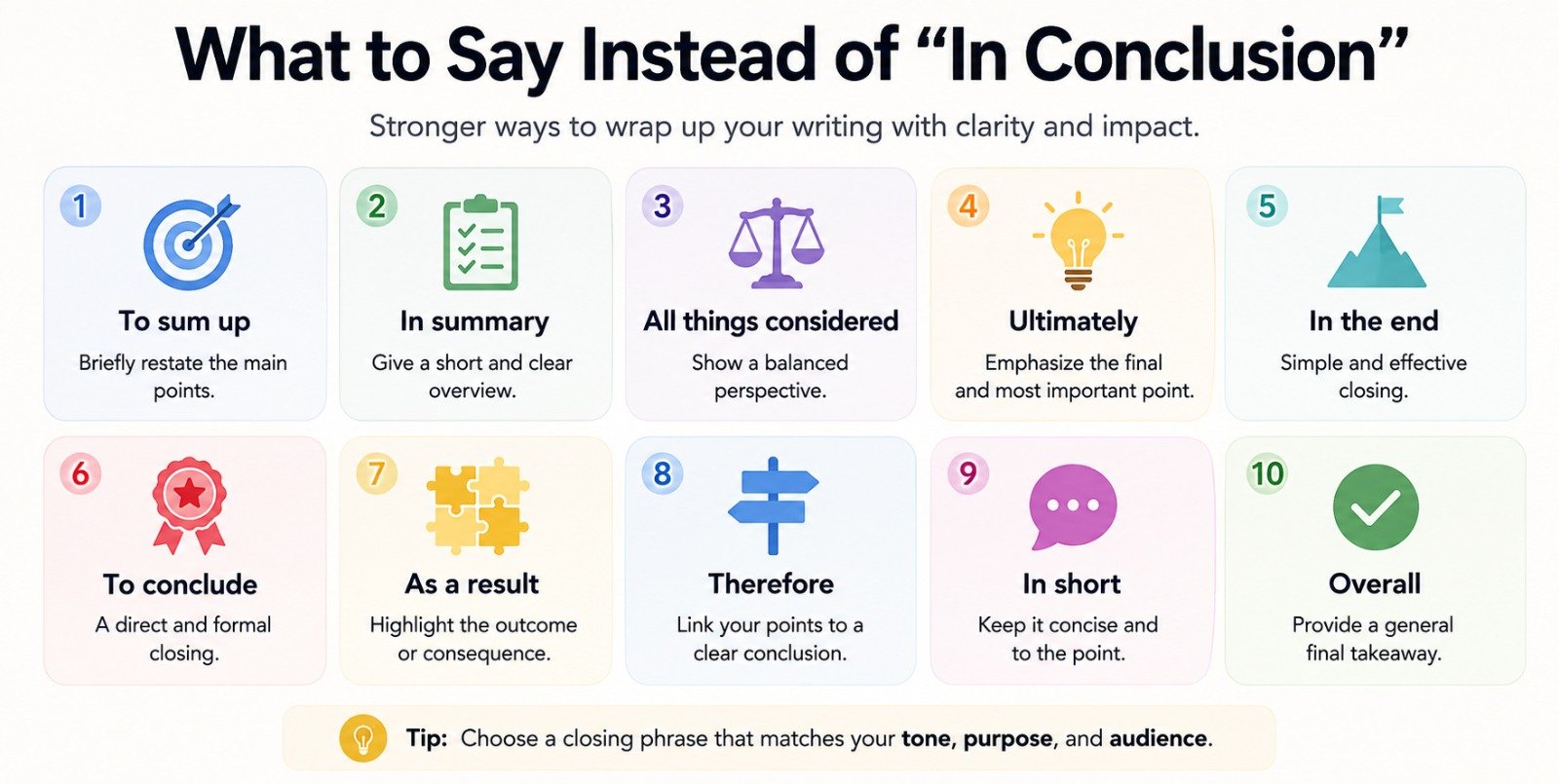
“In conclusion” is clear and grammatically correct, but it can feel predictable when it appears at the end of every essay, report, or presentation. If you’re wondering what to say instead of “in conclusion,” the best choice depends on what your final paragraph is actually doing.
You might be summarizing key points, giving a final judgment, weighing evidence, offering a recommendation, or simply bringing a discussion to a natural close. Phrases such as in summary, ultimately, overall, taken together, all things considered, and in closing can all work, but they are not interchangeable in every situation.
Best Alternatives to “In Conclusion” at a Glance
Different closing phrases perform different jobs. This table can help you choose one that fits your purpose rather than simply replacing the words mechanically.
| Alternative | Tone | Best Used For | What It Signals |
|---|---|---|---|
| In summary | Formal/neutral | Essays, reports | A summary of main points |
| To sum up | Neutral | Essays, presentations | A concise recap |
| Ultimately | Formal/neutral | Arguments, analysis | A final judgment |
| Overall | Neutral | Reports, reviews | A general assessment |
| Taken together | Formal | Research, academic writing | Combined evidence |
| All things considered | Neutral/formal | Arguments, evaluations | A balanced judgment |
| On balance | Formal | Compare-and-contrast writing | Weighing competing factors |
| In closing | Formal | Speeches, presentations | A clear ending |
| In brief | Formal/neutral | Reports, summaries | Condensing information |
| The key takeaway is | Professional | Presentations, workplace writing | The main message |
| To wrap things up | Casual/neutral | Blogs, talks | A conversational ending |
| All in all | Casual/neutral | Informal writing | An overall conclusion |
You May Also Read | 35 Other Ways to Say “However” in Essays, Emails and Everyday English
Other Ways to Say “In Conclusion” in an Essay
Academic writing usually benefits from alternatives that sound clear without becoming overly conversational. The following options are among the most natural choices.
Other Ways to Say “In Conclusion”: In Summary
In summary is one of the safest alternatives for essays because it clearly tells the reader that you are bringing the main points together.
Example:
“In summary, access to reliable public transportation can reduce congestion while improving mobility for residents.”
Use it when your final paragraph mainly summarizes what has already been established.
Other Ways to Say “In Conclusion”: Ultimately
Ultimately works especially well when your ending presents a final judgment rather than a simple recap.
Example:
“Ultimately, the success of the policy will depend on how consistently it is implemented.”
This alternative is useful in argumentative and analytical essays because it sounds decisive without being overly formal.
Other Ways to Say “In Conclusion”: Taken Together
Taken together is particularly effective when several pieces of evidence support one final interpretation.
Example:
“Taken together, these findings suggest that early intervention can significantly improve long-term outcomes.”
It is especially natural in research papers, analytical essays, and evidence-based writing.
Other Ways to Say “In Conclusion”: Overall
Overall introduces a broad assessment of everything discussed.
Example:
“Overall, the program achieved its primary goals despite several implementation challenges.”
It works well in evaluations, reviews, reports, and essays.
Other Ways to Say “In Conclusion”: All Things Considered
Use all things considered when you have examined several factors or different sides of an argument.
Example:
“All things considered, expanding the program appears to offer more benefits than disadvantages.”
This phrase signals that your conclusion comes after weighing multiple considerations.
Other Ways to Say “In Conclusion”: On Balance
On balance is particularly useful when an essay compares benefits and drawbacks.
Example:
“On balance, the economic advantages of the proposal outweigh its short-term costs.”
It sounds more analytical than a simple “in conclusion.”
Other Ways to Say “In Conclusion”: In the Final Analysis
In the final analysis introduces a considered final judgment.
Example:
“In the final analysis, long-term environmental stability should take priority over short-term financial gains.”
It is formal and best suited to academic, analytical, or professional writing.
Other Ways to Say “In Conclusion”: Considering the Evidence
This expression connects your final statement directly to the evidence discussed earlier.
Example:
“Considering the evidence, stricter safety regulations appear justified.”
It is particularly useful when your conclusion depends on research, data, or examples.
Formal Words and Phrases to Say Instead of “In Conclusion”
Some writing calls for a more formal ending, particularly research papers, business reports, academic assignments, and professional documents.
Useful formal alternatives include:
- In summary
- To conclude
- In brief
- Taken together
- In the final analysis
- On balance
- Considering the evidence
- Based on these findings
- In light of these findings
- Viewed as a whole
- Taking all factors into account
- All things considered
- Upon consideration
- Drawing these points together
Other Ways to Say “In Conclusion”: Based on These Findings
Based on these findings works well when your conclusion follows from data, research, or analysis.
Example:
“Based on these findings, increasing investment in preventive care would be a reasonable next step.”
This phrase does more than signal an ending; it explains where the conclusion comes from.
Other Ways to Say “In Conclusion”: In Light of These Findings
This alternative is similar but slightly more reflective.
Example:
“In light of these findings, the organization should reconsider its current training strategy.”
It is useful in research reports, recommendations, and formal analysis.
Other Ways to Say “In Conclusion”: Viewed as a Whole
Use viewed as a whole when individual details need to be considered together.
Example:
“Viewed as a whole, the novel presents ambition as both a source of achievement and personal conflict.”
This wording can work particularly well in literary analysis.
Professional Ways to Say “In Conclusion”
Workplace communication often benefits from endings that are direct and action-oriented rather than academic.
Other Ways to Say “In Conclusion”: The Key Takeaway Is
The key takeaway is focuses attention on the point the reader should remember.
Example:
“The key takeaway is that customer response times need to improve before the next product launch.”
It is natural in presentations, internal reports, meetings, and professional emails.
Other Ways to Say “In Conclusion”: The Bottom Line Is
The bottom line is introduces the most important practical point.
Example:
“The bottom line is that the current process cannot support our expected growth.”
It sounds confident and businesslike, although it may be too conversational for a formal academic paper.
Other Ways to Say “In Conclusion”: Looking Ahead
Looking ahead works best when the final section moves from what has happened to what should happen next.
Example:
“Looking ahead, the team will need to focus on improving customer retention.”
This is particularly useful in project updates, reports, and business presentations.
Other Ways to Say “In Conclusion”: In Closing
In closing clearly signals that a speech, presentation, letter, or formal discussion is ending.
Example:
“In closing, I would like to thank everyone who contributed to the project.”
It is more natural in spoken or professional communication than in many academic essays.
Casual Things to Say Instead of “In Conclusion”
Informal writing allows more relaxed wording. These expressions can work in blog posts, conversations, personal writing, and less formal presentations.
Other Ways to Say “In Conclusion”: All in All
All in all gives an overall judgment in an easy, conversational style.
Example:
“All in all, the trip was worth the extra planning.”
It is natural in informal writing but may sound too relaxed in a research paper.
Other Ways to Say “In Conclusion”: To Wrap Things Up
This phrase openly signals that the discussion is finishing.
Example:
“To wrap things up, remember that consistency matters more than perfection.”
It works well in presentations, blog posts, videos, and spoken explanations.
Other Ways to Say “In Conclusion”: In a Nutshell
In a nutshell means that you are reducing a longer discussion to its essential point.
Example:
“In a nutshell, good communication starts with listening.”
It is conversational and should usually be avoided in highly formal academic writing.
Other Ways to Say “In Conclusion”: At the End of the Day
This phrase introduces what the speaker sees as the most important consideration after everything else has been discussed.
Example:
“At the end of the day, the right decision depends on what matters most to the customer.”
It is common in conversation and informal professional speech but can sound cliché in formal essays.
Other Ways to Say “In Conclusion”: To Put It Simply
Use this when you want to end with a clear, uncomplicated statement.
Example:
“To put it simply, preparation makes difficult tasks easier.”
It emphasizes simplicity rather than merely announcing that the text is ending.
Creative Other Ways to Say “In Conclusion”
Sometimes the strongest ending does not sound like a traditional conclusion at all.
Try expressions such as:
- The key point is…
- What matters most is…
- One final thought…
- The larger lesson is…
- The central takeaway is…
- Bringing everything together…
- The bigger picture is…
- If there is one thing to remember, it is this…
- What should we take away from this?
- The evidence points to one clear conclusion…
- Looking at the issue as a whole…
- That brings us to the main point…
- The final takeaway is…
- Where does that leave us?
- Before we finish…
For example:
“If there is one thing to remember, it is this: clear writing is usually stronger than complicated writing.”
This type of conclusion works especially well in speeches, articles, blogs, and persuasive writing where a memorable final idea matters.
Words to Say Instead of “In Conclusion”
A complete phrase is not always necessary. Certain single words can introduce a final point naturally.
Ultimately
Best when expressing a final judgment:
“Ultimately, the responsibility lies with the organization.”
Overall
Best when giving a broad assessment:
“Overall, the campaign produced encouraging results.”
Therefore
Best when presenting a logical result:
“The existing system cannot handle the increased demand. Therefore, an upgrade is necessary.”
Thus
Similar to “therefore,” but somewhat more formal:
“The evidence does not support the original claim. Thus, another explanation must be considered.”
Finally
Useful for introducing the last point in a sequence:
“Finally, the committee should review the implementation costs.”
These words may appear in conclusions, but their meanings differ. That distinction matters.
Not Every Alternative Is Interchangeable
A useful alternative should fit the purpose of the sentence, not merely appear near the end of a piece of writing.
“Ultimately” Is Not Always the Same as “In Conclusion”
Ultimately normally introduces a final judgment, outcome, or underlying truth.
“In conclusion” simply tells the reader that a conclusion is beginning.
Compare:
“In conclusion, the project had several advantages.”
“Ultimately, the project succeeded because the team adapted quickly.”
The second sentence makes a judgment rather than simply announcing an ending.
“Finally” Is Not Always Another Way to Say “In Conclusion”
Finally often means “the last item in a sequence.”
For example:
“First, gather the data. Next, analyze the results. Finally, prepare the report.”
Here, “finally” means “last,” not “in conclusion.”
Using it at the beginning of your final paragraph can therefore suggest that you are introducing one more point rather than summarizing the entire argument.
“Therefore” Is Not a Direct Synonym for “In Conclusion”
Therefore expresses a logical consequence.
“The test produced inconsistent results. Therefore, further research is necessary.”
It should only be used when the second idea follows logically from the first.
“In Essence” Has a Different Emphasis
In essence means “when reduced to the most important idea.”
For example:
“In essence, the disagreement concerns how limited resources should be distributed.”
It can appear near the end of an explanation, but it does not specifically mean “I am concluding.”
“In Short” Signals Brevity
In short tells the reader you are condensing a larger idea.
“In short, the new process is faster, cheaper, and easier to manage.”
It works well for summaries but may be less appropriate when your conclusion introduces a nuanced final judgment.
Other Things to Say Instead of “In Conclusion” in a Speech
Spoken English allows more direct and personal transitions.
Useful options include:
Other Ways to Say “In Conclusion”: Before I Finish
“Before I finish, I want to leave you with one final idea.”
This sounds natural because the speaker is directly acknowledging the audience.
Other Ways to Say “In Conclusion”: Let Me Leave You With This
“Let me leave you with this: meaningful change usually starts with small actions.”
This works well when you want your final message to be memorable.
Other Ways to Say “In Conclusion”: One Final Thought
“One final thought: success often depends more on consistency than intensity.”
This phrase introduces a last reflection rather than a summary.
Other Ways to Say “In Conclusion”: To Bring It All Together
“To bring it all together, strong teams need clear goals, honest communication, and shared responsibility.”
It works particularly well when a presentation has covered several related ideas.
Can You End an Essay Without Saying “In Conclusion”?
Yes. Sometimes the strongest replacement for “in conclusion” is no transition phrase at all.
If your paragraph clearly functions as the conclusion, readers usually do not need to be told explicitly that they have reached it.
Compare:
Less direct:
“In conclusion, social media can have both positive and negative effects.”
Stronger:
“Social media is therefore most useful when people control how they use it rather than allowing it to control their attention.”
The second version immediately gives the final insight.
Another example:
Basic:
“In conclusion, artificial intelligence will change the workplace.”
Stronger:
“The real question is no longer whether artificial intelligence will change the workplace, but how workers and organizations will respond.”
A strong concluding thought often creates closure more effectively than an obvious transition.
How to Choose What to Say Instead of “In Conclusion”
Think about the job your final sentence or paragraph needs to perform.
If you are summarizing earlier points, good options include:
- In summary
- To summarize
- To sum up
- In brief
If you are making a final judgment, consider:
- Ultimately
- Overall
- In the final analysis
- All things considered
If you are combining evidence or findings, try:
- Taken together
- Considering the evidence
- Based on these findings
- In light of these findings
If you are weighing different arguments, use:
- On balance
- All things considered
- Taking everything into account
If you are finishing a speech or presentation, try:
- In closing
- Before I finish
- One final thought
- Let me leave you with this
If the writing is casual, options such as these may sound more natural:
- All in all
- To wrap things up
- In a nutshell
- At the end of the day
The most polished choice is not necessarily the most formal one. It is the expression that accurately matches what you are trying to communicate.
40+ Things to Say Instead of “In Conclusion”
Here is a quick reference list:
- In summary
- To summarize
- To sum up
- Overall
- Ultimately
- Taken together
- All things considered
- On balance
- In closing
- In brief
- In short
- To conclude
- In the final analysis
- Considering the evidence
- Based on these findings
- In light of these findings
- Viewed as a whole
- Taking everything into account
- Taking all factors into consideration
- Bringing these ideas together
- Bringing everything together
- Drawing these points together
- The key takeaway is
- The main takeaway is
- The bottom line is
- The main point is
- The central point is
- The larger lesson is
- The final takeaway is
- Looking ahead
- One final thought
- On a final note
- All in all
- To wrap things up
- In a nutshell
- At the end of the day
- To put it simply
- If there is one thing to remember
- What matters most is
- The bigger picture is
- To bring it all together
- Before I finish
- Let me leave you with this
- What should we take away from this?
- The evidence points to…
- When viewed collectively
Frequently Asked Questions
What is another way to say “in conclusion”?
Good alternatives include in summary, to sum up, overall, ultimately, taken together, all things considered, on balance, and in closing. The best option depends on whether you are summarizing, judging, or simply ending the discussion.
What can I say instead of “in conclusion” in an essay?
For essays, natural choices include in summary, ultimately, overall, taken together, considering the evidence, on balance, and in the final analysis. You can also begin directly with your final argument without using a transition.
What are some formal alternatives to “in conclusion”?
Formal alternatives include in summary, to conclude, taken together, in the final analysis, based on these findings, in light of these findings, and taking all factors into account.
Can I use “overall” instead of “in conclusion”?
Yes, when you are giving a broad assessment. For example, “Overall, the project was successful despite several delays.” It may not work when you specifically need to signal a logical result or summarize several individual arguments.
Is “ultimately” a synonym for “in conclusion”?
It can serve a similar purpose, but it is not an exact synonym. Ultimately usually introduces a final judgment, outcome, or most important consideration rather than simply signaling the final paragraph.
Is “finally” another way to say “in conclusion”?
Not always. Finally usually introduces the last item in a sequence. It can appear near the end of writing, but it does not necessarily summarize or conclude the whole discussion.
Is it okay to use “in conclusion” in an essay?
Yes. The phrase is grammatically correct and appropriate in academic writing. The main reason to use alternatives is to avoid predictable wording or to choose a transition that more precisely reflects the purpose of your conclusion.
Should a conclusion always begin with a transition phrase?
No. A clearly written conclusion often does not need one. Starting directly with your final interpretation, implication, recommendation, or takeaway can make the ending stronger.
Conclusion
The best thing to say instead of “in conclusion” depends on what you want your ending to accomplish. Use “in summary” when recapping ideas, “ultimately” for a final judgment, “taken together” when combining evidence, and “on balance” when weighing different sides. More conversational choices such as “all in all” or “to wrap things up” suit less formal settings.
Good conclusions are less about finding a fancier synonym and more about choosing words that accurately guide the reader into your final thought. That attention to context and tone is exactly what Clarifyra aims to make easier: finding better ways to say what you mean.
You May Also Read | 25 Better Other Ways to Say “In Conclusion” in Essays and Professional Writing