Instalment or Installment: Which Is Correct?
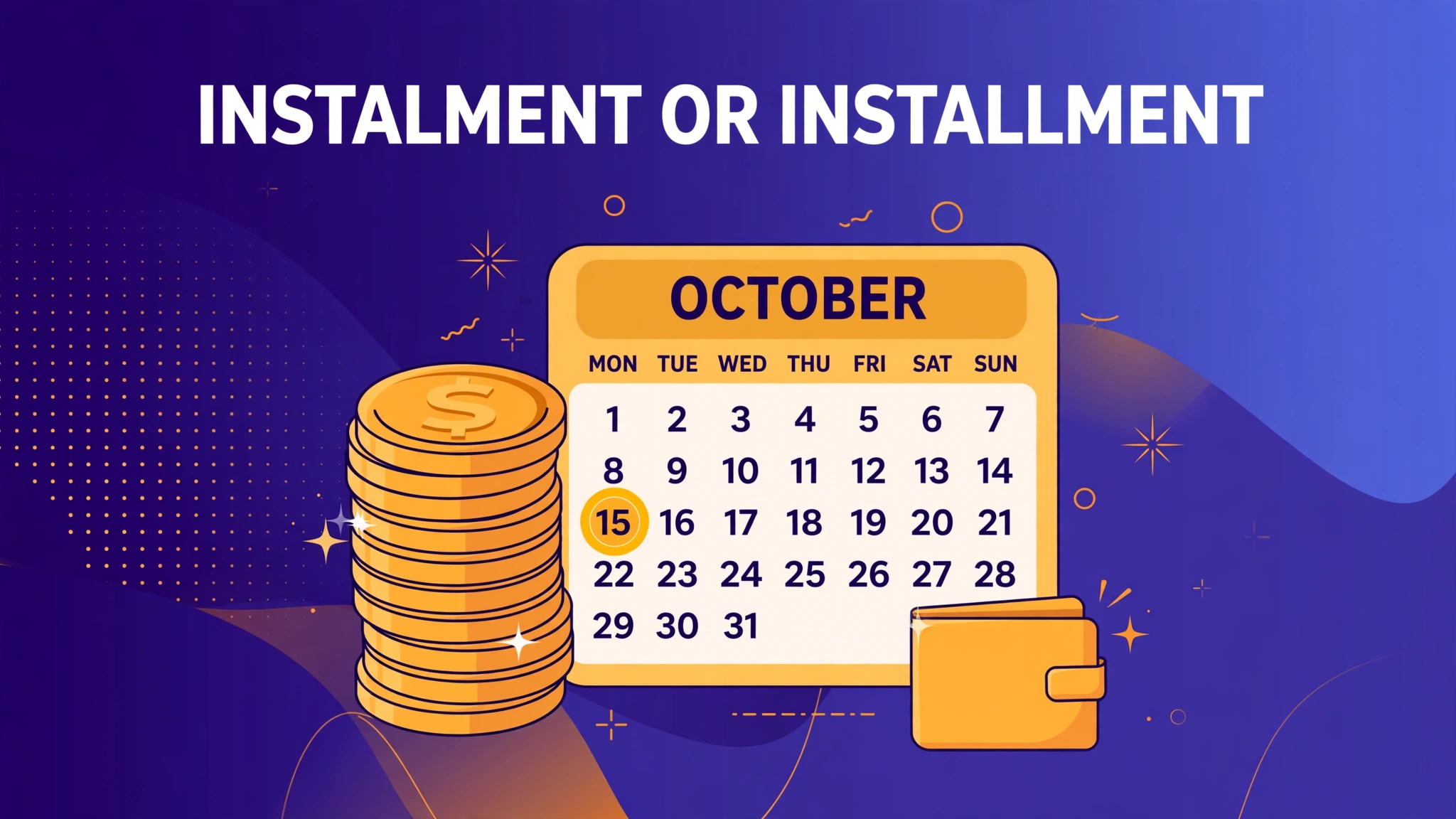
Both are correct — the difference is regional. Instalment (one l) is the British spelling; installment (two l‘s) is the American spelling. Collins’s British entry gives the headword as instalment with the regional note “in AM, use installment,” while its American English entry lists installment as the standard form. The meaning is identical in both: a noun for one of several parts of a payment or series, paid or released at intervals. Match the spelling to your audience and, above all, to the spelling convention of the document you are already writing in.
Quick Answer
Write instalment (one l) in British English: She paid the first instalment of her student loan last month. Write installment (double l) in American English: She paid the first installment of her student loan last month. Pronunciation is the same in both varieties — BrE /ɪnˈstɔːlmənt/, AmE /ɪnˈstɔlmənt/ — and the plurals follow their regions: instalments (UK), installments (US).
What “instalment/installment” means
The word is a countable noun with two closely related senses, both recorded by Collins’s COBUILD entry. The first — the one most people meet — is a payment sense: one of several small sums of money paid at regular intervals instead of all at once. “If you pay for something in instalments, you pay small sums of money at regular intervals over a period of time, rather than paying the whole amount at once.” The loan example is the classic: The first instalment of £1 per share is payable on application.
The second sense is about things released in parts: “An instalment of a story or plan is one of its parts that are published or carried out separately one after the other.” The disappointing third instalment of a film series, the next instalment of a novel serialized in a magazine, the final instalment of a training course — all belong here. The word’s reach is wider than money, and writers sometimes forget that. If a story is published in chapters over months, each chapter is an instalment; if a project rolls out in phases, each phase is an instalment.
Both senses share the same underlying idea: a whole divided into parts that arrive at intervals. That is the meaning to hold on to, whichever side of the Atlantic your spelling comes from.
Why the spelling differs: the single-l family
This pair belongs to a well-known family of British/American spelling differences where British English uses one l and American English uses two before certain suffixes. The same pattern appears in enrolment/enrollment, fulfilment/fulfillment, and — famously — in the verb instal/instal pairing. Grammarist puts the rule plainly: the noun “referring to something issued or paid at intervals is spelled installment in the U.S. Outside the U.S., it’s spelled with one l — instalment.”
Collins traces the word’s origin to the eighteenth century, from the obsolete estallment — which in turn comes from Old French estaler, “to fix,” hence “to agree a rate of payment,” from estal, “something fixed, a place,” rooted in Old High German stal, “stall.” That history matters for one reason: it explains why the British single-l form is not a lazy shortening of the verb install. The noun has carried its own spelling for three centuries, and the British form simply never doubled its l. Do not let the resemblance to install tempt you into “correcting” instalment to the double-l form in British writing — the single l is the dictionary’s own headword there.
A related point worth getting right: the verb install itself keeps its double l in both varieties — installed, installing, installation are spelled identically in British and American English. The regional difference lives only in the noun instalment/installment. So the British pattern is install (verb, double l) but instalment (noun, single l), and the American pattern is double l throughout.
British vs American at a glance
| Feature | British English | American English |
|---|---|---|
| Standard spelling | instalment | installment |
| Plural | instalments | installments |
| Verb (both varieties) | install | install |
| Pronunciation | /ɪnˈstɔːlmənt/ | /ɪnˈstɔlmənt/ |
| Common in | UK, Australia, India, Canada (often) | USA, Philippines (often) |
Examples: the same sentences, both spellings
The point of the pair below is to show that nothing changes except the letter l — the grammar, the meaning, and the rhythm of the sentence stay identical:
- ✓ BrE: She paid the first instalment of her student loan last month.
- ✓ AmE: She paid the first installment of her student loan last month.
- ✓ BrE: The novel was published in monthly instalments in the magazine.
- ✓ AmE: The novel was published in monthly installments in the magazine.
- ✓ BrE: The car dealership offers the option to pay in monthly instalments.
- ✓ AmE: The car dealership offers the option to pay in monthly installments.
- ✗ Mixed: She paid the first installment of her loan in monthly instalments. — never mix the two spellings in one piece of writing; pick your region and stay with it.
- ✗ Overcorrected: She paid the first installment of her student loan in a British document — in British English this double-l form is a regional mismatch; write instalment.
Common mistakes
Doubling the l “because the verb has two.” The most common British error: writing installment on the logic that the noun must mirror install. Collins’s British headword is instalment; the noun and verb simply follow different spelling traditions. Keep the verb’s double l and the noun’s single l side by side without trying to harmonize them.
Singularizing the double l in American writing. The reverse error — writing instalment in an American document — is less common but equally noticeable to American copyeditors, whose house style (and Collins’s American entry) says installment.
Mixing within one document. A report that contains installment plan in the introduction and monthly instalments in the conclusion looks careless, even though each spelling is correct somewhere. Consistency is the real rule: match the spelling to one variety for the whole text.
Confusing “instalment” with “install.” You do not pay an install on a loan, and you do not instalment new software. Install is a verb (to set something in position or set up software); instalment/installment is the noun for a part paid or released at intervals. They share a distant ancestor but do completely different jobs.
A compact memory rule: the single l in British instalment matches the single l in British enrolment and fulfilment — the whole British family keeps one l before -ment. See one of those spellings and you know where you are.
FAQs
Which is correct: “instalment” or “installment”?
Both are correct — it is a regional spelling difference, not a correctness difference. Instalment is the standard British spelling (Collins’s British headword, with the note “in AM, use installment“); installment is the standard American spelling. Choose according to your audience’s variety of English.
Is “instalment” pronounced differently from “installment”?
No. The doubled l makes no audible difference. Collins gives BrE /ɪnˈstɔːlmənt/ and AmE /ɪnˈstɔlmənt/ — the small transcription difference is just the usual British/American vowel notation, not a real change in how the word sounds. Nobody can hear which spelling you have in mind.
Why does British English use one “l”?
British English conventionally uses a single l before -ment in this family of words — the same habit behind enrolment and fulfilment. It is not a shortening of the verb install; Collins traces the noun to the eighteenth-century estallment, and the single-l form has been its British spelling ever since.
Should I use “instalment” or “installment” for an international audience?
Neither spelling is wrong for an international audience, but pick one and be consistent. If your publication or organization follows a named style guide (British or American), that decides it. If you are writing for a clearly British readership, instalment; for an American one, installment.
What is the plural: “instalments” or “installments”?
Both are correct in their regions: instalments in British English, installments in American English. There is no separate plural rule to learn — the plural simply takes an s in whichever spelling you are already using.
Takeaway
Instalment (UK) and installment (US) are the same word wearing different national spellings: one l in Britain, two in America, for a noun that means one of several parts paid or released at intervals. Collins makes instalment its British headword and installment its American one, the pronunciation is identical, and the verb install keeps its double l everywhere. Learn which side of the Atlantic your reader is on, pick the matching spelling, and keep it consistent to the end of the document.