Vapour or Vapor: What’s the Difference?
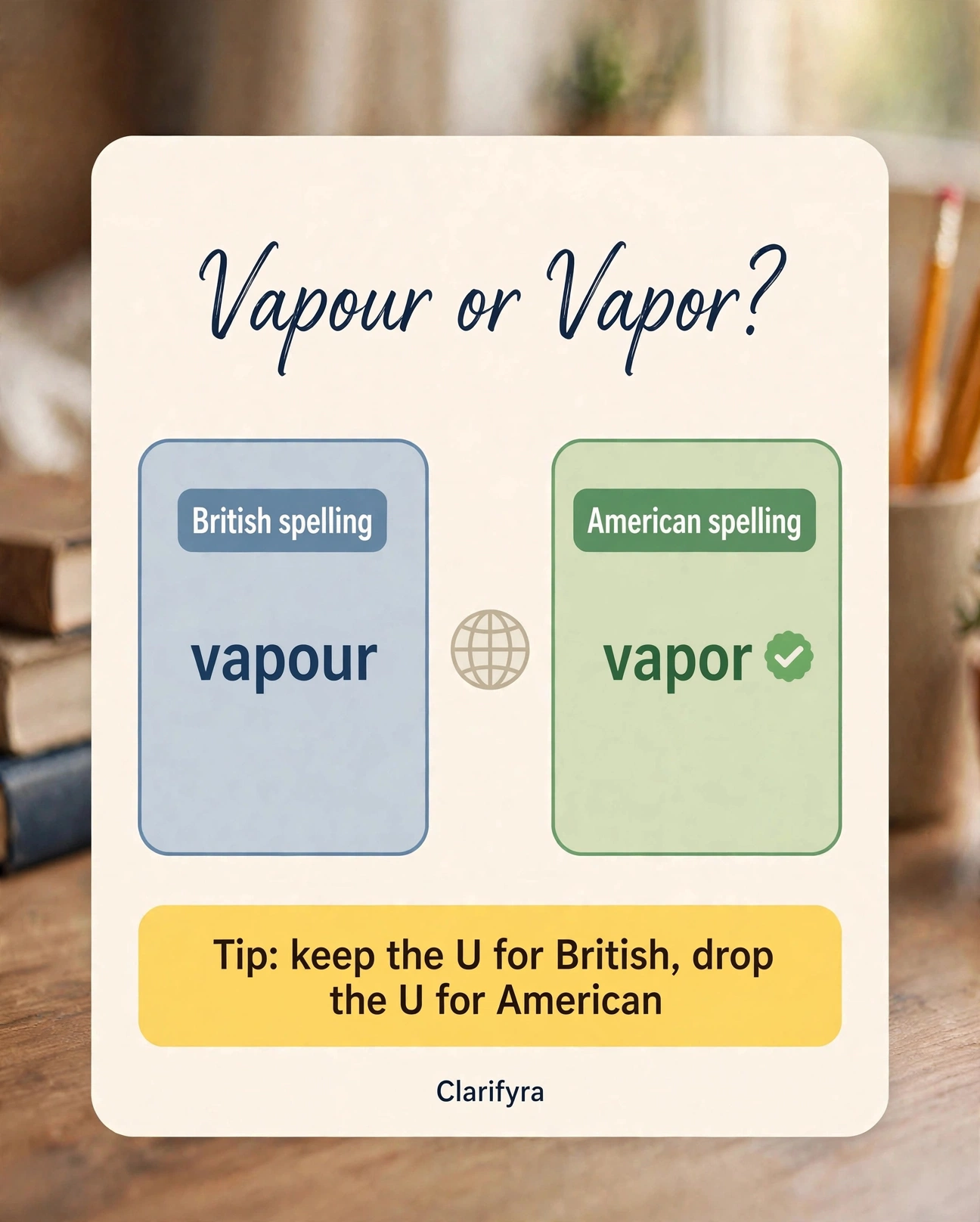
Both are correct — the difference is regional, not a matter of right and wrong. Vapour (with the u) is the standard spelling in British English; vapor (without the u) is the standard spelling in American English. Same word, same meaning, same pronunciation. Which one you use depends entirely on who you’re writing for.
Quick Answer
Vapour is the British English spelling and vapor is the American English spelling of the same noun. Cambridge heads its entry vapour and labels it “UK (US vapor)”; Merriam-Webster (an American dictionary) calls “vapour” the “chiefly British spelling of vapor“; Collins adds the regional note “in AM, use vapor.” Each dictionary lists the other form — neither is a misspelling. Pronunciation is effectively identical: Cambridge gives UK /ˈveɪ.pər/ and US /ˈveɪ.pɚ/.
What the Word Means (in Either Spelling)
The spelling difference says nothing about meaning. Oxford Learner’s Dictionaries defines vapour as “a mass of very small drops of liquid in the air, for example steam” — countable and uncountable — and its definition of vapor is word-for-word the same. Collins puts it more technically: “a substance that is in a gaseous state at a temperature below its boiling point.” Whatever you’re describing — water vapour over a kettle, mercury vapour in a lab, vapour rising off hot tarmac — the two spellings refer to exactly the same thing.
Here it is in real sentences, British and American side by side:
- British: “The kettle boiled and the kitchen filled with vapour.” / “Atmospheric water vapour is the main greenhouse gas.” / “As the jet climbed, it left a white vapour trail across the sky.”
- American: “The kettle boiled and the kitchen filled with vapor.” / “Atmospheric water vapor is the main greenhouse gas.” / “As the jet climbed, it left a white vapor trail across the sky.”
Every pair means the same thing; only the audience — and its house spelling — has changed.
Where the Two Spellings Come From
The split is a chapter of the familiar -our / -or story — the same split behind colour/color and honour/honor. But the history here is a little richer than most people assume.
Merriam-Webster’s etymology traces the word to Middle English vapour, borrowed from Anglo-French and Latin. Anglo-French itself used both vapor and vapour, but the Latin root — vapor, meaning “exhalation, steam, warmth” — had no u. The u arrived in English through French influence, and Collins records the word in English as far back as the 14th century (“C14: from Latin vapor”).
The American spelling is Noah Webster’s doing. His 1828 An American Dictionary of the English Language codified the -our → -or simplification as part of his spelling reform — a deliberate American change, not an organic drift. So vapor isn’t a corruption of vapour; it is, in a strict sense, closer to the original Latin. The British spelling kept the French-influenced u; the American spelling dropped it.
What the Four Dictionaries Say
The major dictionaries agree, each from its own side of the Atlantic:
- Cambridge heads its entry vapour and labels it “UK (US vapor)” — British first, American variant named outright. It also gives both pronunciations: UK /ˈveɪ.pər/, US /ˈveɪ.pɚ/.
- Oxford Learner’s Dictionaries heads vapour with the note “(US English vapor)”, and heads vapor with “(British English vapour)”. Both entries give the same definition and the same two pronunciations.
- Merriam-Webster (American) lists vapour as the “chiefly British spelling of vapor” — and it is a full entry, not a throwaway cross-reference.
- Collins gives the COBUILD regional note “in AM, use vapor”, its British entry reads “or US vapor,” and even the American Webster’s New World entry on Collins is cross-referenced — each side of the Atlantic’s dictionary lists the other form.
Note the pattern: no dictionary calls the rival spelling wrong. At most they label it regionally, the way “chiefly British” and “in AM” do here.
Pronunciation: UK and US
The u is silent, and it is silent in both varieties. Oxford Learner’s gives /ˈveɪpə(r)/ and /ˈveɪpər/ for both British and American speakers — the only audible difference is the rhotic r at the end, which is simply how British and American speakers handle final r generally. Cambridge agrees: UK /ˈveɪ.pər/, US /ˈveɪ.pɚ/ (“VAY-puh” either way). Nobody pronounces the u; it is pure spelling convention.
Correct vs Incorrect
| British English | American English | Verdict |
|---|---|---|
| vapour | vapor | ✓ Both correct — match your audience |
| vapor in a UK school textbook | vapour in a US science paper | ✗ Wrong variety for the context (understood, but flagged) |
| vapour + vapor in one document | ✗ Mixed — pick one and stay consistent | |
| vapoure | ✗ Not a word in either variety — drop the final e | |
| Pronouncing the u (“vap-OOR”) | ✗ The u is silent — “VAY-puh” | |
| “Vapour trail” in American English | ✗ Americans write vapor trail (the jet contrail sense) | |
Common Mistakes
1. Mixing the two in one document. ✗ “The report measured water vapour and mercury vapor.” → ✓ “The report measured water vapour and mercury vapour” (British) or “…water vapor and mercury vapor” (American). Spellcheckers only enforce one variety at a time — consistency is your job.
2. Assuming the American spelling is the “wrong” one. It isn’t. Merriam-Webster’s headword is vapor, and the etymology shows the Latin root was vapor — the American form is actually closer to the word’s 14th-century origins. Regional, not inferior.
3. Assuming the British spelling is a typo. If your spellchecker is set to US English, it will underline vapour — that is the checker enforcing American style, not proof of an error. Switch the dictionary language, and the red squiggle disappears.
4. Forgetting the split carries through to related words. The pattern extends: vapourize/vaporize, vapoury/vapory, vapourish/vaporish, vapourless/vaporless. Collins lists these as pairs — “vapourable or US vaporable,” “vapour-like or US vapor-like” — so the rule is consistent: once you pick a variety, spell the whole family to match. Don’t write “vapourize” in one paragraph and “vapor” in the next.
5. Writing “vapour trail” for an American audience. The condensation-trail term is a fixed collocation that follows the same regional rule: British sources write vapour trail, American sources write vapor trail. It’s not a separate term — just the rule applied consistently.
6. Using “the vapours” in modern scientific writing. In older English, the vapours (plural) was an old-fashioned term for a fit of faintness or nervous weakness — Cambridge still lists “the vapours” as an old-fashioned plural use. It’s a literary/historical term, not a scientific one. If you meet it in a novel, it’s intentional; if you’re tempted to use it in a lab report, don’t.
7. Treating it as a verb by default. Collins lists rare verb senses — “to evaporate or cause to evaporate” in physics, and (intransitive) “to make vain empty boasts” — but in practice vapour/vapor is overwhelmingly a noun. For the verb action, use vapourize/vaporize or evaporate; nobody says “the kettle vapoured.”
FAQs
Which is correct: vapour or vapor?
Both. “Vapour” is the standard spelling in British English and “vapor” is the standard spelling in American English. All four major dictionaries (Cambridge, Oxford Learner’s, Merriam-Webster, Collins) list both, labeled by region.
Is there any difference in meaning?
None whatsoever. They are the same noun — a mass of tiny liquid drops in the air, or a substance in the gaseous phase below its boiling point — differing only in spelling. The choice tells your reader which variety of English you’re using, not what you mean.
Is “vapour” pronounced differently from “vapor”?
No. The u is silent in both. Cambridge gives UK /ˈveɪ.pər/ and US /ˈveɪ.pɚ/ — effectively the same sound apart from the usual British/American difference in final r.
Which countries use “vapour”?
Britain, and most countries that follow British spelling conventions — Ireland, Australia, New Zealand, South Africa, India, and Canada in most contexts. American English — and the style guides built on it — uses “vapor.”
Does the spelling difference extend to related words?
Yes. The our/or pattern applies across the word family: vapourize/vaporize, vapoury/vapory, vapourish/vaporish, vapourless/vaporless. Collins lists these as paired variants, so once you choose a variety, keep the whole family consistent.
Is “vapor” the original spelling?
Almost. The Latin root was vapor (no u); the u came in through French and appeared in English as vapour by Middle English. Noah Webster’s 1828 dictionary codified vapor for American English as part of his -our → -or reform. So neither modern spelling is a corruption of the other.
What does “the vapours” mean?
In older English, “the vapours” described faintness or nervous weakness — Cambridge lists it as an old-fashioned plural use. You’ll meet it in period fiction, not in modern prose. Don’t use it in scientific or technical writing.
Which should I use in my essay, report, or email?
Match your audience and your style guide: vapour for British, Commonwealth, and international (non-US) contexts; vapor for American ones. Within a single document, use one spelling throughout — including in related words like “vaporize.”
The Takeaway
Vapour is British; vapor is American. The meaning is identical, the pronunciation is effectively the same, and both dictionaries on each side of the Atlantic list the other form. There is only one rule: pick the spelling that matches your reader — and use it everywhere in the document, from “water vapour” to “vapourize,” without mixing. One audience, one spelling, no exceptions.