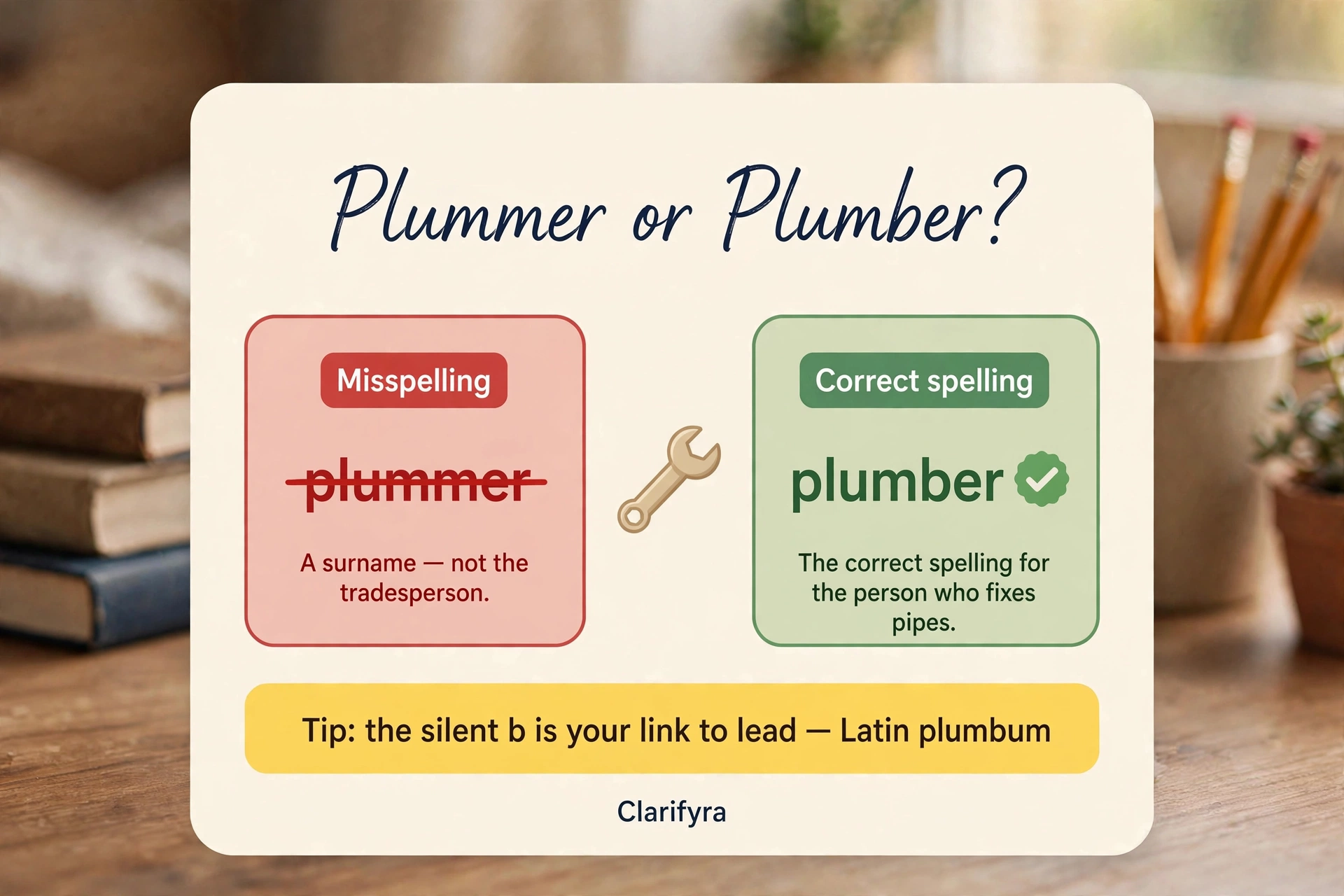
Plummer or Plumber: Which Is Correct?
Plumber is the correct spelling for the tradesperson who installs and repairs pipes. Plummer is not a mistake in every context — it is a real surname and a real engineering term — but if you mean the person who fixes your sink, writing “plummer” is wrong.
Quick Answer
Use plumber for the tradesperson. Use plummer only as a surname (Christopher Plummer) or in the engineering term “plummer block” (a bearing housing). The b in plumber is silent: UK /ˈplʌmə/, US /ˈplʌmər/ — say it like “plummer,” spell it like “plumber.”
Why “plummer” looks so right
The confusion is almost entirely about the silent b. Say plumber out loud and what you hear is “plummer” — two clear syllables, no trace of the b. When you sit down to write, your ear overrules your memory and you spell it exactly as it sounds: p-l-u-m-m-e-r.
It doesn’t help that English is full of double-m spellings that match this pattern (summer, swimmer, dinner), or that the b in this word family is genuinely odd. Plumb — the lead weight on a line used to check verticality — also hides a silent b. So the correct spelling looks like a mistake and the mistake looks like the correct spelling.
There is even a grain of history in the wrong version. Collins’s American dictionary entry (Webster’s New World) notes that modern plumber replaced the Middle English form plummer, borrowed from Anglo-French. In other words, your fingers are typing a word that was perfectly fine six hundred years ago. Today, though, neither Merriam-Webster nor Collins lists plummer as the tradesperson — and your readers will read it as a typo.
What the dictionaries say
Plumber — the tradesperson
Collins defines a plumber as a person whose job is to connect and repair things such as water and drainage pipes, baths, and toilets. Webster’s New World (in Collins) describes a skilled worker who installs and repairs pipes and fixtures — water, drainage, or gas systems in a building. It also records an obsolete sense: a worker in lead or similar metals.
Pronunciation is consistent across references: UK /ˈplʌmə/, US /ˈplʌmər/. The b is silent in both.
The etymology explains the silent letter. Collins traces plumber to the 14th century, from Old French plommier (“worker in lead”), from Late Latin plumbārius, from Latin plumbum — lead. Early pipes really were made of lead, so the original plumbers were literally lead-workers. The b has been silent for a long time; the spelling kept the Latin memory.
Plummer — what it actually is
Type plummer into a general dictionary and you won’t find an entry for a tradesperson, because that’s not what it means. What you will find depends on the dictionary:
- Merriam-Webster does list plummer — as part of the entry for “plummer block,” defined as “a pillow block or bearing block.” Its etymology note says the term is probably from the name Plummer.
- As a standalone, Plummer is a well-established English surname — most famously borne by the Canadian actor Christopher Plummer (1929–2021), Captain von Trapp in The Sound of Music.
So plummer is not a misspelling when it’s a person’s name or a bearing housing. It is simply never the spelling for the tradesperson.
Where “plummer” is actually correct
This matters because “correction” depends on meaning. Two legitimate uses to know:
1. The surname
Plummer is a genuine family name. Christopher Plummer’s seven-decade acting career — an Academy Award, two Tony Awards, two Emmys — means the name is widely known, which may be one reason the spelling looks “right” to so many writers: it really is a word they have seen, just not with this meaning.
2. The plummer block
In mechanical engineering, a plummer block is a bearing housing that supports a rotating shaft — another name for a pillow block. Merriam-Webster gives it a full entry: “a pillow block or bearing block.” If you work with conveyor systems, agricultural machinery, or industrial equipment, you’ll meet this term in catalogues and manuals, where it is spelled exactly that way. Do not “correct” it to plumber block; in engineering, plummer is the right word.
Plummer vs plumber: side by side
| Spelling | Correct for | Example |
|---|---|---|
| Plumber | The tradesperson who installs and repairs pipes and fixtures | “Our plumber fixed the leak under the sink.” |
| Plummer | A surname | “Christopher Plummer played Captain von Trapp.” |
| Plummer block | An engineering term: a bearing housing (also called a pillow block) | “The shaft runs through a plummer block bearing.” |
Common mistakes
1. Writing “plummer” for the tradesperson
✗ “We called a plummer to fix the boiler.”
✓ “We called a plumber to fix the boiler.”
This is the mistake in almost every case. Spellcheckers may miss it, because plummer is a real name — so this one slips through into emails, reviews, and job adverts.
2. Pronouncing the b
✗ Saying “plum-ber,” with a hard b in the middle.
✓ Saying “plummer,” with the b silent.
The silent b in this family goes back to Latin plumbum. The same thing happens in climb, comb, and doubt — the letter stays in the spelling but never reaches the mouth. If pronouncing the b is what makes you want to spell the word wrong, remember: the b is a souvenir, not a sound.
3. Writing “plumb-er” or guessing at the ending
✗ “He works as a plummer.”
✓ “He works as a plumber.”
Only one m, then b, then er. If you catch yourself doubling the m, you’re writing the surname — or the sound of the word — instead of its spelling.
4. “Fixing” plummer block to plumber block
✗ “The manual specifies a plumber block for this shaft.”
✓ “The manual specifies a plummer block for this shaft.”
In engineering contexts, plummer block is correct — Merriam-Webster lists it, and it’s the term used across the bearing industry. “Correcting” it introduces the error.
How to remember it
Three tricks, pick the one that sticks:
- The lead trick. A plumber originally worked with lead — Latin plumbum. The silent b in plumber is the same b that’s in plumb and plumbum. If you remember the metal, you’ll remember the b.
- The pair trick. Plumb (the lead weight) and plumber (the worker) share the spelling pattern: silent b after the m. Plummer, with its double m, belongs to the surname family — it has no b at all.
- The ear trick. You say “plummer” but you write “plumber” — the same way you say “climer” and write “climber.” The ear handles the sound; the pen handles the b.
It is the same kind of trap as collum vs column, where a perfectly sensible-sounding spelling drops a letter that belongs there. When the spoken form and the written form disagree, reach for the dictionary, not your ear.
Frequently Asked Questions
Is “plummer” a word?
Yes — but not for the tradesperson. Plummer is a real surname (Christopher Plummer, for example), and plummer block is a real engineering term meaning a bearing housing or pillow block (listed in Merriam-Webster). Neither Merriam-Webster nor Collins lists plummer as a spelling of the pipe-fitter; that is always plumber.
Why is there a b in “plumber”?
The word comes from Latin plumbum (lead), via Late Latin plumbārius and Old French plommier — Collins gives this etymology in its British English entry. The b was pronounced once and then fell silent, exactly as in plumb, comb, and climb. It stayed in the spelling as a fossil of the word’s history.
How do you pronounce “plumber”?
The b is silent: UK /ˈplʌmə/, US /ˈplʌmər/ — it sounds exactly like “plummer.” That mismatch between sound and spelling is precisely why the word gets misspelled so often.
What is a plummer block?
A plummer block is a housing that holds a bearing and supports a rotating shaft — another name for a pillow block, per Merriam-Webster’s definition (“a pillow block or bearing block”). It is used in industrial machinery such as conveyors and motors. Merriam-Webster notes the term probably comes from the name Plummer. In this context, plummer is the correct spelling.
Was “plummer” ever spelled that way for the tradesperson?
Interestingly, yes — centuries ago. Collins’s American entry (Webster’s New World) notes that modern plumber replaced the Middle English form plummer, from Anglo-French. So the “misspelling” has genuine historical roots, but it has not been the standard spelling in modern English.
Should a company name use “plummer” or “plumber”?
If it’s a plumbing business, the trade spelling is plumber (“Acme Plumbers”). A company called “Plummer” is either using the family name or — deliberately or not — misspelling. Searchers looking for a tradesperson will type “plumber,” so the b matters for being found.
Final Takeaway
Plumber — with the silent b — is the only correct spelling for the tradesperson, in both UK and US English. Plummer is a surname and half of an engineering term, never the pipe-fitter. Say “plummer,” write “plumber,” and let the silent b remind you of the lead (plumbum) that gave the trade its name.