Inaccessible or Unaccessible: Which Is Correct?
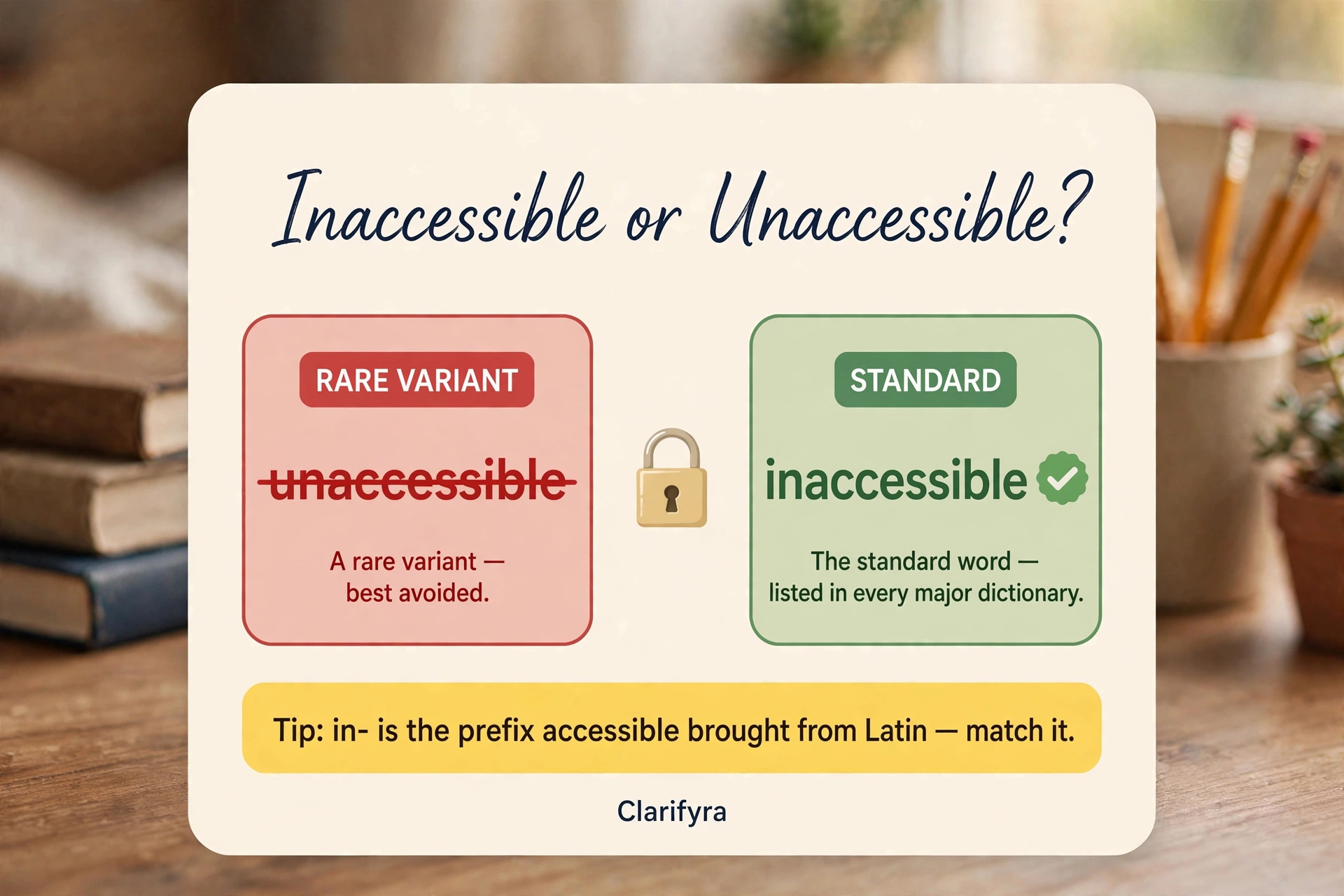
Inaccessible is the correct, standard word — use it in every context. Unaccessible does exist: Merriam-Webster lists it as an adjective defined simply as “inaccessible,” and Dictionary.com includes it too. But Cambridge, Oxford Learner’s Dictionaries, and Collins have no standalone entry for it, and it is so rare that most spell-checkers and editors will flag it. The safe choice is inaccessible.
Quick Answer
Inaccessible is the correct word: it means not able to be reached, obtained, or understood. Unaccessible is a rare variant — Merriam-Webster defines it as “inaccessible,” but most major dictionaries don’t list it at all, so use inaccessible and you’ll never go wrong.
Why “Unaccessible” Feels Plausible
The mistake is completely understandable. Both in- and un- mean “not” in English, and un- is the prefix we reach for most often: unhappy, unlucky, unopened, unusual. So when someone wants to say “not accessible,” the brain does quick mental arithmetic: un- + accessible = unaccessible. It looks logical, it follows a pattern that works in thousands of words, and — as we will see — it is not entirely without precedent.
But English prefixes are not freely interchangeable. Which negative prefix a word takes is usually decided by the word’s history, not by logic. And accessible has a history that already made the choice.
What the Dictionaries Actually Say
Start with the standard word. Inaccessible is firmly established in every major dictionary:
- Cambridge Dictionary defines it as an adjective: “not able to be (easily) approached, reached or obtained,” and gives the collocation inaccessible to someone/something — “very difficult or impossible for something or someone to travel to or reach” (e.g. some of the houses on the hillside are inaccessible to cars) and “difficult for someone to obtain, have, or use.”
- Oxford Advanced Learner’s Dictionary lists it as an adjective with two senses: (1) “difficult or impossible to reach, get or use” and (2) “of language or art, difficult to understand or appreciate.” Its word-origin note says it came into late Middle English from French or late Latin inaccessibilis, from in- “not” + accessibilis.
- Merriam-Webster defines it as an adjective meaning “not accessible,” gives the pronunciation ˌi-nik-ˈse-sə-bəl, and notes a first known use in the 15th century. It also records the noun inaccessibility and the adverb inaccessibly.
- Collins gives three senses: a place that is very difficult or impossible to reach; something you are unable to see, use, or buy; and someone or something difficult or impossible to understand or appreciate.
Now for the honest part about unaccessible. Here is exactly what I found, dictionary by dictionary:
- Merriam-Webster: yes — it has an entry. It lists unaccessible as an adjective and defines it with a single word: inaccessible. In other words, it is recorded only as a cross-reference to the standard form.
- Dictionary.com: yes — it includes unaccessible as a word derived from accessible.
- Cambridge Dictionary: no standalone English entry found — a search turned up only example sentences from other sources (such as Wikipedia) quoting it, not a definition of its own.
- Oxford Learner’s Dictionaries: no entry found.
- Collins: no entry found.
- Wiktionary (not one of the big four, but worth knowing about) lists it as an adjective meaning “not accessible,” describing it as a “piecewise doublet of inaccessible” — a later rebuild of the word from English parts.
That is the key distinction: unaccessible is recorded in a few places, but it is not recommended anywhere. Its dictionary coverage is a cross-reference, not an endorsement — and three of the four major learner’s and general dictionaries don’t list it at all.
The Prefix Logic: in- vs un-
There is a genuine pattern behind which prefix goes where, and it goes back to the origin of the word itself. Accessible comes from the Latin root — Oxford’s word-origin note traces it through late Latin accessibilis, from access- “approached,” from the verb accedere (“to approach”). Because inaccessible entered English already carrying its in- prefix from French/Latin in the 15th century (per Merriam-Webster’s etymology), nobody ever needed to build the word from English parts.
That same inheritance shows up across whole families of Latin-derived adjectives, where in- (or its variants im-, il-, ir-) does the negating:
- Inedible — Collins explicitly breaks it down as in- + edible, and Merriam-Webster defines it as “not fit to be eaten.” Nobody writes “unedible.”
- Inadvisable — listed in Cambridge Learner’s Dictionary as an adjective (/ˌɪnədˈvaɪzəbl/ in UK English). Nobody writes “unadvisable.”
- Inaccessible — late Latin inaccessibilis, in- + accessibilis (Oxford). Nobody should write “unaccessible.”
Un-, meanwhile, is the native Germanic prefix: it attaches most naturally to words of Germanic origin — unhappy, unkind, unopened — and to past participles (unbroken, unspoken). When un- meets a Latin-derived -ible/-able adjective like accessible, the result may be understandable, but it fights the word’s own etymology. Accessible arrived in English with its in- already attached; rebuilding it with un- produces a double cousin of the real word, which is exactly what Wiktionary’s “piecewise doublet” label describes.
The Verdict at a Glance
| Word | Status | Recommendation |
|---|---|---|
| Inaccessible | Listed as a full entry with definitions in Cambridge, Oxford Learner’s, Merriam-Webster, and Collins | Use always — in writing and speech, formal and informal |
| Unaccessible | Listed in Merriam-Webster only as a cross-reference defined as “inaccessible”; included in Dictionary.com; no entry in Cambridge, Oxford Learner’s, or Collins | Avoid — use inaccessible instead |
Note the practical side of this verdict: because unaccessible is so rare and three major dictionaries have no entry for it, most spell-checkers and grammar tools will flag it. Using inaccessible means your writing passes every tool and every dictionary without a second thought.
Common Mistakes
- Rebuilding the word from English parts.
✗ The hilltop village was unaccessible by car.
✓ The hilltop village was inaccessible by car. - Mixing the two forms in one document.
✗ Some files were inaccessible, while others remained unaccessible.
✓ Some files were inaccessible, while others remained inaccessible.
Pick one spelling and stick to it — and let it be the standard one. - Assuming an entry means approval.
✗ Merriam-Webster lists “unaccessible,” so it must be fine to use.
✓ Merriam-Webster lists it only as a cross-reference to “inaccessible” — recording a form is not the same as recommending it. - Using “unaccessible” in formal writing.
✗ The archives were unaccessible to the general public. (job application, academic paper, published article)
✓ The archives were inaccessible to the general public.
In formal contexts the standard form is not optional. - Forgetting that “inaccessible” has two senses.
✗ The lecture was unaccessible to first-year students. (and also unclear about meaning)
✓ The lecture was inaccessible to first-year students. — this can mean either too hard to get to or too hard to understand, since Oxford Learner’s lists both “difficult or impossible to reach” and “(of language or art) difficult to understand or appreciate.”
Memory Tricks
- The -ible test: if the adjective ends in -ible or -able and looks Latin (accessible, edible, advisable), reach for in-, not un-. That gives you inaccessible, inedible, inadvisable — every one of them confirmed in the dictionaries above.
- Match the word’s history: inaccessible entered English already wearing its in- prefix, borrowed whole from French/Latin. You don’t need to add a new prefix to a word that brought its own.
- The family test: the word family runs accessible → inaccessible → inaccessibility. There is no unaccessibility in the Oxford or Merriam-Webster families — if the related noun and adverb all use in-, the adjective should too.
Frequently Asked Questions
Is “unaccessible” ever correct?
Merriam-Webster lists unaccessible as an adjective defined simply as “inaccessible,” and Dictionary.com includes it as well — so it has been recorded, and you may meet it in older texts or casual writing. But Cambridge, Oxford Learner’s Dictionaries, and Collins have no entry for it, and it is far rarer than inaccessible. Treat it as a variant to avoid, not a synonym to choose from.
Why is it “inaccessible” and not “unaccessible”?
Because the word was borrowed into English whole from French/late Latin inaccessibilis (in- “not” + accessibilis), with the in- prefix already attached — Oxford’s and Merriam-Webster’s etymologies both record this. Un- is the native Germanic prefix, and while it works on Germanic words (unhappy, unopened), it sits oddly on a Latin-derived -ible adjective like accessible.
How do you pronounce “inaccessible”?
UK: /ˌɪnækˈsesəbl/ (in-ak-SES-uh-bul), US: /ˌɪnəkˈsɛsəbl/ (in-uhk-SES-uh-bul), per Oxford Learner’s Dictionaries. The stress falls on the third syllable: in-ac-CESS-i-ble. Merriam-Webster gives a similar US form, ˌi-nik-ˈse-sə-bəl.
What is the noun form of “inaccessible”?
Inaccessibility — “the fact of being impossible to reach or to get” (Oxford Learner’s, uncountable). Merriam-Webster also lists the adverb inaccessibly. There is no established unaccessibility in these dictionaries’ word families.
What’s the opposite of “inaccessible”?
Accessible — all four dictionaries list it as the direct opposite. Oxford Learner’s marks accessible as the opposite of both senses of inaccessible (hard to reach, and hard to understand).
Final Takeaway
Inaccessible is the correct word — it has full entries, clear definitions, and centuries of standard use behind it. Unaccessible is understandable, and a couple of dictionaries record it, but it is a rare rebuilt variant that most major dictionaries don’t list. When the word’s own history already chose in-, follow it: write inaccessible, every time.