Chili or Chile: What’s the Difference?
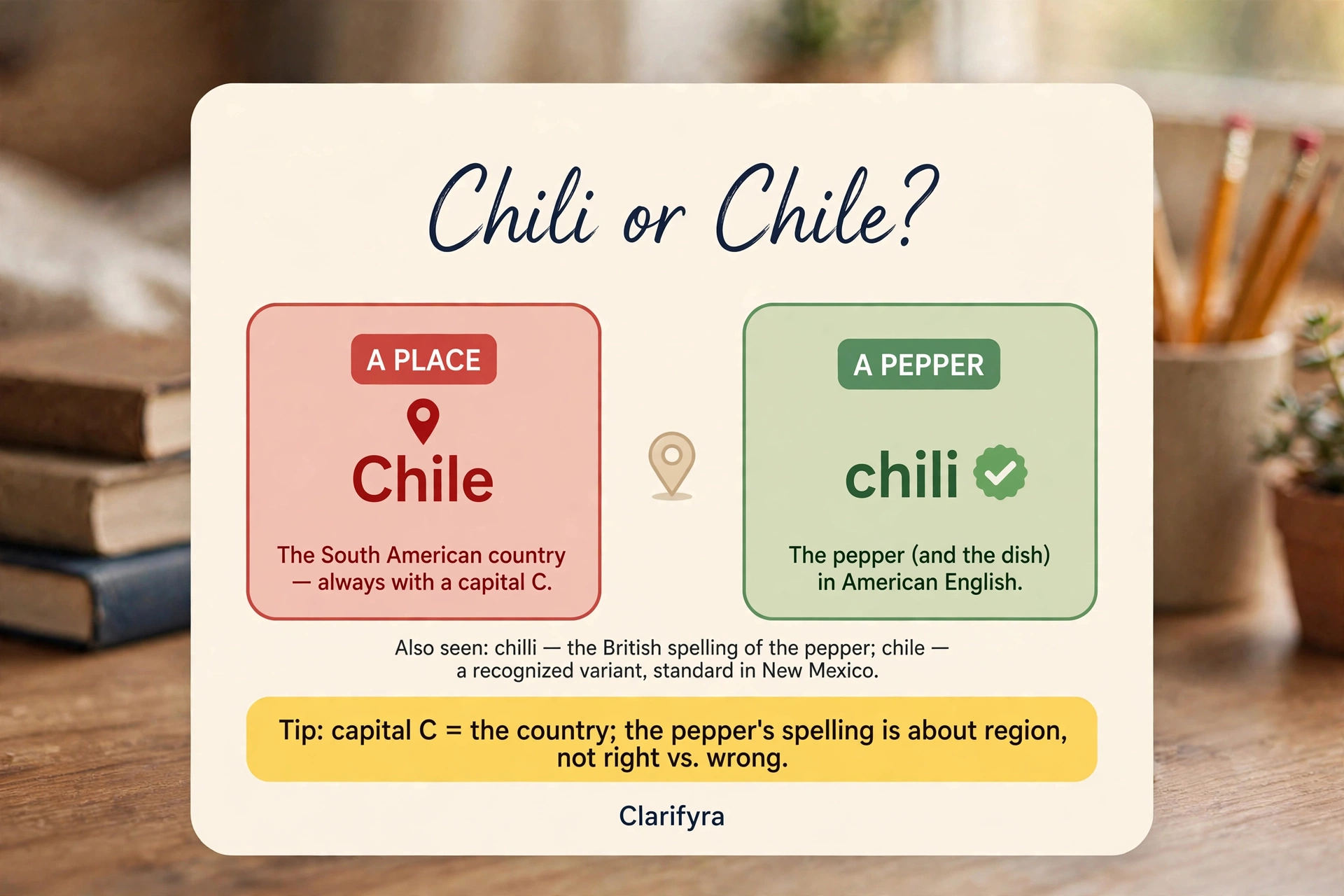
One capital letter separates these two words: Chile (capital C) is the South American country, and chili (lowercase c) is the pepper — or the spicy stew made from it. The wrinkle is the third spelling, chile, which dictionaries genuinely list as a variant spelling of the pepper, so it can’t be dismissed as simply “wrong.” The real rule is simpler than the folklore: use the capital letter for the country, and pick the pepper spelling that matches your region — chili in American English, chilli in British English, and chile where that regional variant is the local norm.
Quick Answer
Chile = the country (always capitalized; pronounced CHIL-ee — UK /ˈtʃɪlɪ/, US /ˈtʃɪli/, per Collins). Chili = the pepper and the dish in American English; chilli = the same word in British English. Chile (lowercase) is a legitimate dictionary-recognized variant of the pepper, standard in the US Southwest — it is not automatically a typo. Keep the capital C for the country and you’ll rarely go wrong.
Why This Trio Is So Easy to Mix Up
Few word groups are as unfair as this one. You have three forms — chili, chile, chilli — that differ by a single letter or a shift key, and all three can legitimately refer to a hot pepper. Add the country Chile, and the same five letters can mean a South American republic or a spice. No wonder writers hesitate.
It helps to know the shared root. All the pepper spellings trace back to the same word: Spanish chile, from the Nahuatl chīlli (meaning “hot pepper”), as recorded by both Merriam-Webster and Collins. Random House dates the borrowing into English to 1655–65; Merriam-Webster records chile in English use from 1604 and the chili spelling from 1839. So chili, chilli, and chile aren’t three different words fighting over one meaning — they’re three regional spellings of one borrowed word. The country, by contrast, just happens to look almost identical. Only the capital letter (and context) tells them apart.
Chile: The Country (Always Capitalized)
Chile with a capital C is the long, narrow republic on the southwest coast of South America, wedged between the Andes Mountains and the Pacific Ocean. Its capital is Santiago. Collins gives the pronunciation as UK /ˈtʃɪlɪ/ and US /ˈtʃɪli/ — CHIL-ee on both sides of the Atlantic.
Because country names are proper nouns, Chile is always capitalized — there’s no situation where a lowercase chile refers to the nation. That’s the single most reliable disambiguation tool you have: if you’re writing about the country, the capital C does the work for you. No reader will mistake “She travelled across Chile” for a pepper.
Note the derived forms keep the capital too: a person from Chile is Chilean, and things associated with the country (Chilean wine, Chilean salmon) are capitalized as well.
The Pepper: Chili, Chilli, or Chile?
Here’s where the nuance lives. The pepper (and, by extension, the dish) has three accepted spellings, and which one you use depends on where you write and which style you follow.
Chili — the American standard
In the United States, chili is the standard spelling for both the pepper and the dish. Merriam-Webster lists chili as the headword and gives the first-known English use of the word as 1839, with a separate, older entry for the dish (chili con carne) dating to the mid-1800s.
Chilli — the British standard
In British English, the doubled l is the norm: chilli. Collins marks chilli as “[mainly British]” and its British English entry explicitly reads “or especially US chili.” So “chilli flakes” in a British recipe and “chili flakes” in an American one are the same ingredient, spelled two ways — just as the British double the consonant in fuelled where Americans write fueled.
Chile — the regional variant, not a mistake
This is the one most usage articles get wrong. Chile (lowercase) for the pepper is not a typo that dictionaries reject: Random House gives the headword as “chili or chile,” Collins’s American entry lists “Also: chile, chilli” under chili, and Collins’s British English entry defines lowercase chile as “a variant spelling of chilli.” Collins’s American English entry (from Webster’s New World) lists chile as a US noun with the plural chiles.
Where does this spelling dominate? In the US Southwest, especially New Mexico, chile is the standard spelling for the pepper — it’s the word you’ll see on menus and in cookbooks from Santa Fe to Albuquerque, partly because the local usage traces directly back to the Spanish spelling, and partly to keep the pepper visually distinct from the stew (chili). New Mexican food writers spell it chile consistently (“the pepper is always spelled ‘chile,’ not ‘chili'”), and Merriam-Webster’s own example sentences show the spelling in live use, from a “Hatch chile menu” in Texas to “Calabrian chile flakes” in recent food writing.
Bottom line: correcting someone’s “green chile” to “green chili” in a New Mexican context would mark you as the outsider. Outside the Southwest, chili (US) or chilli (UK) remains the safer default for a general audience.
The Dish: Chili Con Carne
Chili con carne — literally “chili with meat” — is the spicy stew of minced peppers, meat, and often beans. Merriam-Webster dates the shortened form chili for the dish to the mid-1800s and defines it as the stew plus any meatless versions of it (vegetarian chili, seafood chili, and the like).
For the dish, the spelling follows the same regional pattern as the pepper: chili in American English, chilli in British English. The Southwest pepper spelling chile is rarely used for the stew — in fact, one reason New Mexico favors chile for the pepper is precisely to avoid confusion with the dish.
The Verdict at a Glance
| Word | Meaning | Where it’s standard |
|---|---|---|
| Chile (capital C) | The South American country | Everywhere — always capitalized |
| chili | The pepper; the dish (chili con carne) | United States |
| chilli | The pepper; the dish | United Kingdom (Collins: “mainly British”) |
| chile (lowercase) | The pepper (variant spelling) | US Southwest, especially New Mexico; recognized by MW and Collins elsewhere |
Common Mistakes
1. Using a lowercase chile for the country
✗ “We flew to chile in December.”
✓ “We flew to Chile in December.”
Country names always take a capital letter. This is the one genuine error in the whole family — and the easiest to catch, since the fix is a single keystroke.
2. Writing chili when you mean the country
✗ “The capital of Chili is Santiago.”
✓ “The capital of Chile is Santiago.”
Read your sentence back: if you could substitute “the country” for the word, it needs the capital C and the e.
3. Mixing UK and US spellings in one document
✗ “Add chili flakes, then simmer the chilli for an hour.”
✓ “Add chilli flakes, then simmer the chilli for an hour.” (British) or “Add chili flakes, then simmer the chili for an hour.” (American)
Neither spelling is wrong, but consistency matters. Pick chili or chilli for your audience and stick with it — the same consistency rule that governs other UK–US spelling splits.
4. Confusing chilly with the whole family
✗ “The evening was chili and we lit a fire.”
✓ “The evening was chilly and we lit a fire.”
Entirely different word: chilly (with a y) means cold or producing shivers. It’s unrelated to the pepper — it comes from chill, not from Nahuatl.
Memory Tricks
- The capital saves the country. A proper noun is always capitalized, and Chile is a proper noun. If there’s no capital C, it can’t be the nation — full stop.
- Double the l for London. British English doubles the consonant (chilli, like fuelled and travelled), while American English keeps it simple (chili, like fueled).
- Chile with an e says “Southwest.” If you see chile spelled with an e on a menu, think of Santa Fe and the Spanish spelling it preserves — and think of the capital-C country only when the letter is capitalized.
Frequently Asked Questions
Is “chile” ever correct for the pepper?
Yes. Random House gives the headword as “chili or chile,” Collins lists “Also: chile, chilli” under chili, and it’s the standard spelling in the US Southwest (particularly New Mexico). For a general American or British audience, chili or chilli is the more widely recognized choice — but chile is not a misspelling.
How do you pronounce Chile (the country)?
Collins gives the country as UK /ˈtʃɪlɪ/ and US /ˈtʃɪli/ — CHIL-ee in both varieties. The pepper is the same (CHIL-ee, ˈtʃɪli). One pronunciation for all of them — which is exactly why capitalization matters for telling them apart in writing.
Is “chili” short for “chili con carne”?
Yes, for the dish. Merriam-Webster’s entry for chili explicitly includes “chili con carne” as one sense, alongside the pepper and meatless versions of the stew. The two senses coexist — “a bowl of chili” means the dish, “a handful of chilies” means the peppers — which is why the plural often helps: chilies or chiles almost always means the peppers, not the stew.
What’s the plural of the pepper?
The dictionaries list several: chilies (most common in general American use), chilis, chillies/chillis (British), and chiles (the Southwest spelling’s plural). Follow the singular spelling you chose: chili → chilies, chilli → chillies, chile → chiles.
What about “chilly”?
A different word entirely. Chilly means unpleasantly cold — as in “a chilly morning” — and has nothing to do with peppers. The y ending is the giveaway.
Final Takeaway
The chili/chile question looks like a right-and-wrong spelling test, but it’s really a geography test. The country Chile always takes a capital C; the pepper takes the spelling of your region — chili in the US, chilli in the UK, and chile in the Southwest, where dictionaries recognize it as a genuine variant rather than an error. Keep the country capitalized and the spellings consistent within a document, and this trio stops being a trap.