Peaked or Piqued: What’s the Difference?
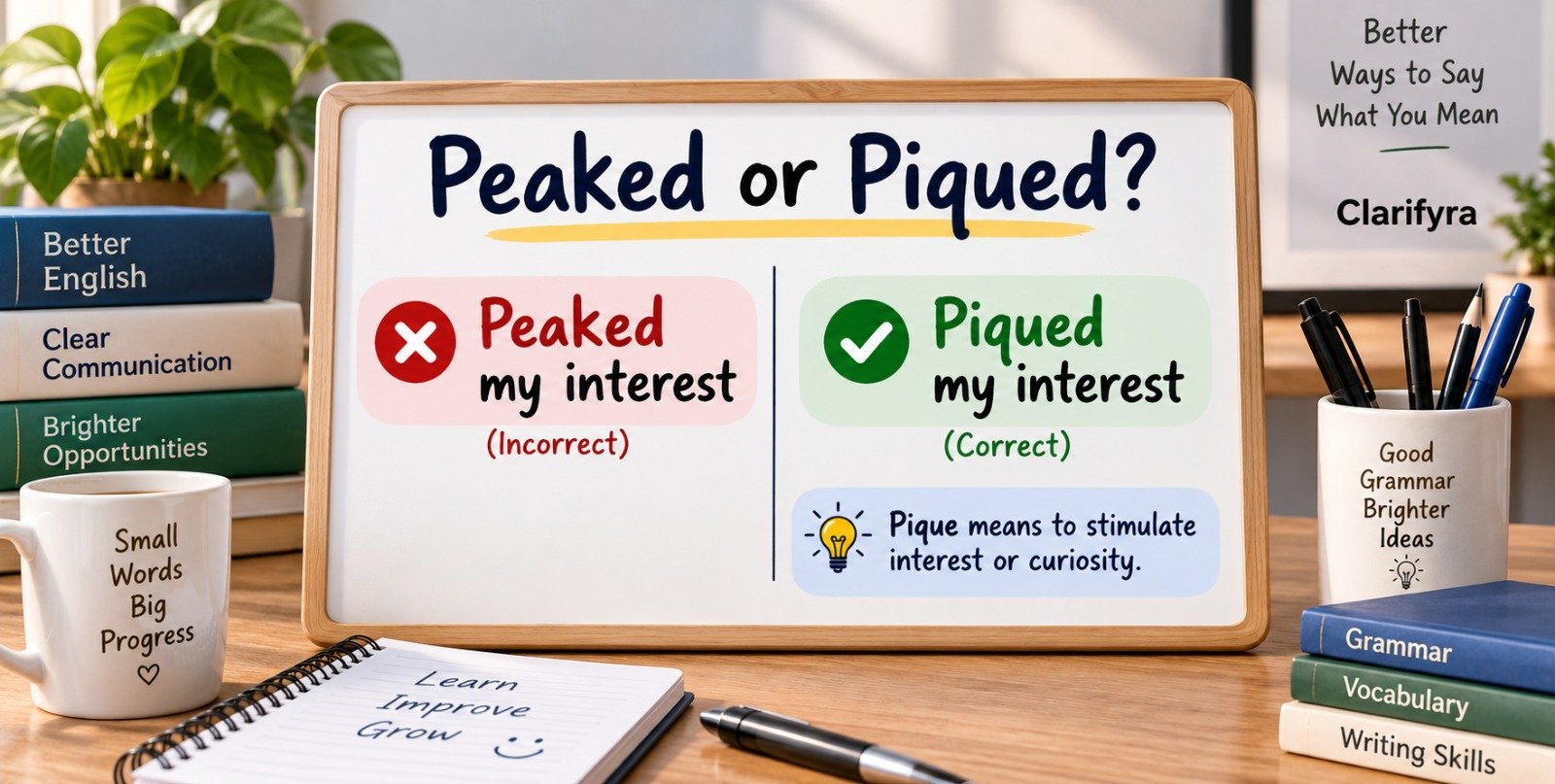
Peaked and piqued sound the same, which makes them easy to confuse in writing. However, they have different meanings and are not interchangeable. Peaked usually means that something reached its highest point, while piqued means that something stimulated interest or curiosity. That distinction matters in phrases such as “piqued my interest,” “piqued my curiosity,” and “peaked in high school.” Once you connect each word with its core meaning, choosing the correct one becomes much easier.
Piqued is correct when something sparks your interest or curiosity, as in “The idea piqued my interest.” Peaked means reached a highest point, as in “Sales peaked in June” or “He peaked in high school.”
Peaked vs Piqued: The Key Difference
Both words are correct English words, but they describe very different ideas.
| Feature | Peaked | Piqued |
|---|---|---|
| Basic meaning | Reached a highest point | Stimulated interest, curiosity, or attention |
| Base word | Peak | Pique |
| Typical use | Performance, sales, temperature, popularity | Interest, curiosity, attention |
| Example | Attendance peaked on Saturday. | The headline piqued my curiosity. |
| Correct with “my interest” | Usually no | Yes |
The simplest rule is:
Peak = reach the top.
Pique = spark interest.
Many English learners mix up similar-looking words such as Either or Ither: Which Is Correct and Why?
What Is “Peaked”?
Peaked is the past tense and past participle of the verb peak.
When something peaks, it reaches its highest point, greatest level, strongest intensity, or most successful stage.
For example:
- Temperatures peaked in the late afternoon.
- Sales peaked during the holiday season.
- Her popularity peaked after the television show became a hit.
- Traffic peaked just before the concert started.
The word can describe measurable things such as temperature, demand, traffic, or sales, but it can also describe performance, fame, ability, or success.
“I’ve Peaked” Meaning
If someone says:
“I’ve peaked.”
they usually mean they believe they have already reached their best or highest point.
For example:
I think I peaked as a runner when I was 25.
That sentence suggests the speaker believes their best athletic performance happened at that time.
What Is “Piqued”?
Piqued is the past tense of pique.
When something piques your interest or curiosity, it causes you to become interested, curious, or more attentive.
Examples:
- The unusual headline piqued my interest.
- Her mysterious answer piqued my curiosity.
- The documentary piqued his interest in astronomy.
- That small detail piqued our curiosity about the case.
The verb pique can also have another meaning related to irritation or wounded pride, but in everyday phrases involving curiosity and interest, it means to stimulate or arouse.
Is It “Peaked My Interest” or “Piqued My Interest”?
The correct expression is:
Piqued my interest
For example:
Correct: The job description piqued my interest.
Incorrect: The job description peaked my interest.
The reason is simple: the job description is causing or stimulating interest. It is not making your interest reach a numerical or measurable highest point.
However, peak can still be used with the noun interest in a different grammatical structure.
For example:
Public interest peaked after the announcement.
Here, the level of public interest reached its highest point, so peaked is correct.
Compare:
The announcement piqued public interest.
The announcement created or stimulated interest.
Public interest peaked after the announcement.
The amount of interest reached its highest level.
That distinction is the key to understanding whether interest is peaked or piqued.
Is Curiosity Peaked or Piqued?
If something makes you curious, the natural expression is:
My curiosity was piqued.
For example:
- The strange noise piqued my curiosity.
- Her vague response piqued my curiosity.
- The first paragraph piqued his curiosity enough to keep reading.
So if you are wondering whether my curiosity is peaked or piqued, piqued is normally the word you want when something creates curiosity.
There is one situation in which peaked can be correct.
Consider:
My curiosity peaked when she opened the box.
In this sentence, the speaker already felt curious, and that curiosity reached its greatest level at a particular moment.
The difference is:
Something piques your curiosity.
Something causes or stimulates curiosity.
Your curiosity peaks.
Your level of curiosity reaches its highest point.
Peaked or Piqued My Curiosity?
The same rule applies to the phrase “peaked or piqued my curiosity.”
Use piqued when another thing causes you to become curious.
Correct: The locked door piqued my curiosity.
Correct: His unexpected answer piqued her curiosity.
Using peaked my curiosity would normally sound incorrect because peak is not usually used transitively in this expression to mean “make curious.”
If you want to use peaked, restructure the sentence:
My curiosity peaked when I noticed the hidden door.
Now the subject is my curiosity, and it is reaching its highest level.
Is It “I’ve Peaked” or “I’ve Piqued”?
Both forms can be grammatically correct, but they are used differently.
“I’ve Peaked”
I’ve peaked can stand alone.
It means:
I have reached my highest point.
For example:
I’m only joking, but I think I’ve peaked after winning that award.
“I’ve Piqued”
I’ve piqued usually needs an object because you normally pique something.
For example:
I’ve piqued their interest.
I’ve piqued her curiosity.
Simply saying “I’ve piqued” sounds incomplete in most contexts because the listener expects to know what was piqued.
So when asking “is it I’ve peaked or piqued?”, the answer depends on meaning:
- I’ve peaked = I reached my highest point.
- I’ve piqued their interest = I made them interested.
Peaked or Piqued in High School?
The correct expression is:
Peaked in high school
For example:
He jokes that he peaked in high school.
The phrase generally means that someone experienced their greatest popularity, athletic success, social status, confidence, or achievement during their high-school years.
It can be used seriously, but it is often humorous or critical.
Examples:
- He still talks about his old football trophies as if he peaked in high school.
- She definitely did not peak in high school; her career took off years later.
- I thought I had peaked in high school, but my best years were still ahead.
Piqued in high school would not express this meaning because pique refers to stimulating interest or curiosity.
Why Are Peaked and Piqued So Easy to Confuse?
The main reason is pronunciation.
Peak and pique are pronounced the same way in standard English. Their past-tense forms, peaked and piqued, also sound alike.
This makes the error especially easy to miss when a phrase is learned through conversation before it is seen in writing.
There is also a third commonly confused word:
peek
A peek is a quick look.
Compare:
- Peak = highest point
- Pique = stimulate interest
- Peek = quick look
Examples:
The climber reached the mountain peak.
The mystery piqued my interest.
I took a quick peek inside the room.
Correct Usage Examples
Here are a few examples showing how the two words work naturally.
Use “Peaked”
- Attendance peaked at around 8 p.m.
- His performance peaked near the end of the season.
- The temperature peaked at 96°F.
- Interest in the story peaked after the interview aired.
- She believes her athletic career peaked several years ago.
Use “Piqued”
- The title piqued my interest.
- The strange message piqued her curiosity.
- His explanation piqued my interest in the subject.
- The preview piqued our curiosity about the ending.
- Her unusual career path piqued his interest.
Common Mistakes to Avoid
One of the most frequent errors is writing:
Peaked my interest
when the intended meaning is:
Piqued my interest
Another mistake is assuming peaked is always wrong when used near words such as interest or curiosity.
It can be correct if the noun itself is reaching its highest level:
Public interest peaked on Friday.
Likewise:
My curiosity peaked during the final scene.
A useful way to check your sentence is to ask:
Do I mean “sparked” or “reached the highest point”?
If you mean sparked, use piqued.
If you mean reached the highest point, use peaked.
An Easy Way to Remember the Difference
Think of a mountain peak.
A peak is the top or highest point, so peaked means something reached its top level.
Then connect pique with interest:
Pique = provoke interest.
So:
The mystery piqued my interest.
but:
My interest peaked during the final reveal.
This simple contrast works in most situations.
Final Verdict: Which Word Should You Use?
Use piqued when something creates, stimulates, or increases your interest or curiosity. Use peaked when something reaches its highest point, whether that is popularity, performance, temperature, sales, or even the level of someone’s curiosity.
That means “piqued my interest,” “piqued my curiosity,” and “peaked in high school” are the standard expressions to remember. At Clarifyra, the easiest way to keep them straight is to remember that pique sparks interest, while peak reaches the top.
Frequently Asked Questions
Is it peaked or piqued my interest?
The correct phrase is “piqued my interest.” It means that something attracted your attention or made you more interested. Peaked my interest is generally incorrect when used with that meaning.
Is it “my curiosity was peaked” or “my curiosity was piqued”?
Use “my curiosity was piqued” when something made you curious. You can say “my curiosity peaked” when you mean that your curiosity reached its highest level.
Can “peaked” and “piqued” ever mean the same thing?
No. They can sound the same, but their meanings are different. Peaked refers to reaching a high point, while piqued refers to stimulating interest, curiosity, or attention.
Is “peaked in high school” correct?
Yes. Peaked in high school means that someone is considered to have reached their highest level of success, popularity, performance, or social status during high school.
Is “I’ve piqued” correct English?
It can be, but it usually needs an object. For example, “I’ve piqued their curiosity” is complete. Saying only “I’ve piqued” normally sounds unfinished.
What is the easiest way to remember peaked vs piqued?
Associate peak with the top of a mountain, so peaked means “reached the highest point.” Associate pique with curiosity or interest, so piqued means “sparked or stimulated.”
You May Also Read | Savor or Savour: Which Spelling Is Correct?