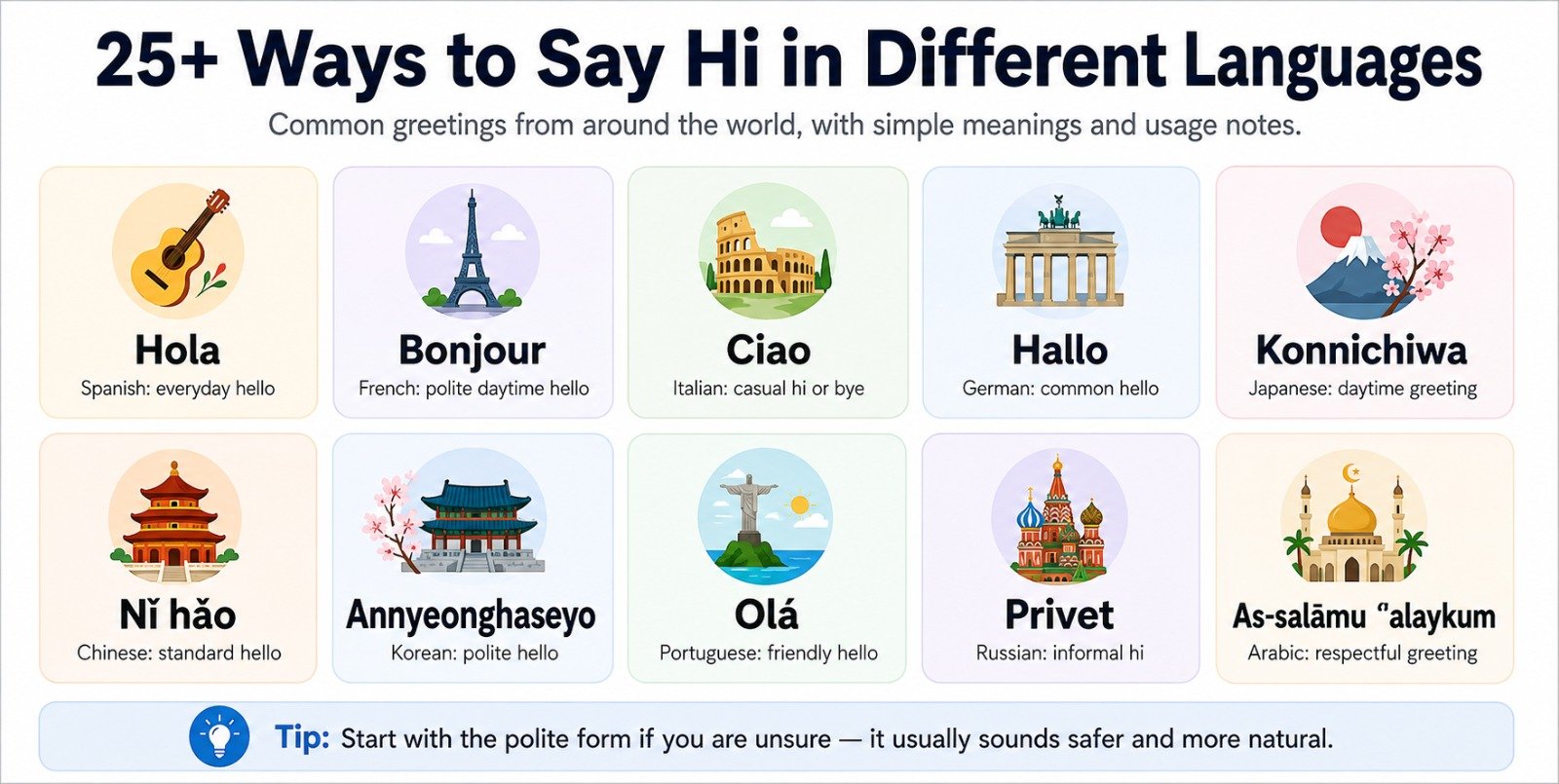
25+ Ways to Say Hi in Different Languages Around the World
Saying “hi” is often the first step toward connecting with someone in another language. But greetings don’t always translate word for word. Some are casual, some are polite, and others change depending on the time of day or who you’re speaking to.
If you want to learn ways to say hi in different languages, it helps to know more than the translation alone. The right greeting can make you sound friendlier, more natural, and more respectful.
How to Say Hi in Different Languages
Here is a quick reference for common greetings from around the world. Where a language has both formal and informal options, the table gives a widely understood or useful everyday choice.
| Language | Greeting | Natural English Meaning | Typical Use |
|---|---|---|---|
| Spanish | Hola | Hi / Hello | Almost any everyday situation |
| French | Bonjour | Hello / Good day | Polite, neutral |
| Italian | Ciao | Hi / Bye | Informal |
| German | Hallo | Hello | Neutral, everyday |
| Portuguese | Olá | Hello | General greeting |
| Japanese | こんにちは (Konnichiwa) | Hello | Mainly daytime |
| Mandarin Chinese | 你好 (Nǐ hǎo) | Hello | General, especially with unfamiliar people |
| Korean | 안녕하세요 (Annyeonghaseyo) | Hello | Polite everyday greeting |
| Russian | Привет (Privet) | Hi | Informal |
| Arabic | السلام عليكم (As-salāmu ʿalaykum) | Peace be upon you | Respectful traditional greeting |
| Dutch | Hoi | Hi | Informal |
| Danish | Hej | Hi / Hello | Everyday |
| Swedish | Hej | Hi / Hello | Everyday |
| Norwegian | Hei | Hi / Hello | Everyday |
| Turkish | Merhaba | Hello | General |
| Greek | Γεια σου (Yia sou) | Hi / Hello | Informal, one person |
| Polish | Cześć | Hi / Hello | Informal |
| Romanian | Bună | Hi / Hello | Informal/neutral |
| Czech | Ahoj | Hi | Informal |
| Hindi | नमस्ते (Namaste) | Hello / Greetings | Polite, widely recognized |
| Hawaiian | Aloha | Hello / Goodbye | General greeting |
| Swahili | Habari | Hello / How are things? | Common conversational greeting |
| Indonesian | Halo | Hello | General |
| Filipino/Tagalog | Kumusta | Hello / How are you? | Everyday |
| Vietnamese | Xin chào | Hello | Polite/general |
These greetings are useful starting points, but they are not all exact equivalents of the English word “hi.” Some literally mean “good day,” “peace be upon you,” or even function more like “how are things?” Their role in conversation is what makes them useful greetings.
Also Check | Different Ways to Say Hi: 100+ Friendly, Cute and Flirty Greetings
Ways to Say Hi in Spanish
Spanish gives you plenty of options beyond hola. Which one sounds most natural depends on the time of day, region, level of formality, and how well you know the person.
10 Ways to Say Hi in Spanish
- Hola — Hi / Hello
- Buenos días — Good morning
- Buenas tardes — Good afternoon
- Buenas noches — Good evening
- Buenas — Hi / Hello, casually
- ¿Qué tal? — How’s it going?
- ¿Cómo estás? — How are you?
- ¿Cómo te va? — How’s it going for you?
- ¿Qué pasa? — What’s up?
- Ey — Hey
Hola
Hola is the safest all-purpose choice. It works with friends, coworkers, shop staff, neighbors, and people you’re meeting for the first time.
Example:
“Hola, ¿cómo estás?”
“Hi, how are you?”
Buenos días, buenas tardes, and buenas noches
Spanish commonly uses time-specific greetings.
Buenos días is used in the morning, while buenas tardes is used later in the day. Buenas noches can be used as an evening greeting as well as when saying good night.
They tend to sound slightly more polite or conventional than a simple hola.
Buenas
In many Spanish-speaking settings, buenas works as a shortened casual greeting. It comes from longer greetings such as buenos días or buenas tardes.
You might hear someone enter a small shop or room and simply say:
“¡Buenas!”
It is friendly and convenient, but its frequency varies by region.
¿Qué tal?
¿Qué tal? isn’t literally another word for “hi.” It is closer to “How’s it going?” However, it often functions as part of a casual greeting.
You can also combine it with hola:
“Hola, ¿qué tal?”
That sounds very natural in everyday conversation.
¿Qué pasa?
¿Qué pasa? can work like “What’s up?” between friends. Because it is informal, it is not usually your best opening when addressing someone in a formal setting.
So, although there are many ways to say hi in Spanish, don’t treat all ten as interchangeable versions of hola. Some greet directly, while others begin a conversation by asking how someone is doing.
Ways to Say Hi in French
French greetings are especially sensitive to formality. English speakers may casually say “hi” to almost anyone, but in French, choosing between bonjour, salut, and coucou can signal how familiar you are with the other person.
Bonjour
Bonjour is the safest French greeting in most daytime situations. Although it literally relates to “good day,” it functions as the normal polite way to say hello.
Use it when greeting:
- A shop employee
- A customer
- A teacher
- A colleague you don’t know closely
- Someone you’re meeting for the first time
If you’re unsure what to say, bonjour is usually a safer choice than an overly casual greeting.
Salut
Salut is closer to English “hi” or “hey.” It is informal and works naturally among friends, classmates, relatives, and people who already know each other reasonably well.
Example:
“Salut, ça va?”
“Hi, how’s it going?”
Salut can also mean “bye” in casual French.
Coucou
Coucou is warmer and more familiar. English equivalents might include “hey,” “hiya,” or a cheerful “hi!”
It is common among close friends, family members, partners, and in informal messages. It can sound too familiar in professional or formal situations.
Bonsoir
In the evening, French speakers commonly switch to bonsoir, meaning “good evening.”
That makes it useful to remember that the best answer to “How do you say hi in French?” changes according to the situation. Bonjour is the broad polite choice, salut is casual, coucou is very familiar, and bonsoir is suited to the evening.
Ways to Say Hi in Japanese
Japanese greetings depend heavily on context, including time of day, familiarity, and politeness. As a result, there isn’t one expression that replaces English “hi” in every situation.
こんにちは — Konnichiwa
Konnichiwa is probably the Japanese greeting most English speakers recognize. It is generally used as a daytime “hello.”
It is useful and polite, but Japanese speakers don’t normally use it as an all-day equivalent of English “hi.”
おはよう — Ohayō
Ohayō means “good morning” and is informal. You might use it with friends, family members, or people you’re close to.
A more polite version is:
おはようございます — Ohayō gozaimasu
This is appropriate when greater respect or formality is needed.
こんばんは — Konbanwa
Konbanwa means “good evening” and is the natural greeting once evening arrives.
Together, these three expressions illustrate an important distinction:
- Ohayō / Ohayō gozaimasu — morning
- Konnichiwa — daytime
- Konbanwa — evening
やあ — Yā
Yā is an informal greeting similar to “hi” or “hey.” It is suitable only in casual relationships and is far less universally appropriate than konnichiwa.
もしもし — Moshi moshi
Moshi moshi is associated with answering or beginning a telephone conversation.
It does not function as a normal face-to-face substitute for “hello.”
For example:
Phone: “Moshi moshi?”
In person: Usually choose another greeting.
はじめまして — Hajimemashite
Hajimemashite is useful when meeting someone for the first time. Its natural English sense is closer to “Nice to meet you” than simply “hi.”
So if you’re learning ways to say hi in Japanese, focus on the situation as much as the words themselves.
More Ways to Say Hi in Other Languages
Beyond Spanish, French, and Japanese, there are many interesting greetings worth knowing.
Italian: Ciao
Ciao is one of the world’s most recognizable greetings. It can mean both “hi” and “bye.”
It is informal, however. In situations requiring more politeness, Italian speakers may use greetings such as buongiorno (“good day/good morning”) instead.
German: Hallo
Hallo is the straightforward German equivalent of “hello” and works in many everyday situations.
Among friends, you may also hear greetings such as Hi or regional alternatives.
Portuguese: Olá and Oi
Olá is a general Portuguese “hello.”
Oi is a very common casual greeting, particularly in Brazilian Portuguese, and is closer to English “hi.”
This is a good example of why regional context matters even within the same language.
Mandarin Chinese: Nǐ hǎo
你好 (Nǐ hǎo) is the standard beginner-friendly expression taught for “hello.”
A more respectful form is 您好 (Nín hǎo), which may be used when showing greater politeness.
In everyday life, native speakers may also greet each other in ways that depend on the relationship and situation rather than using nǐ hǎo every time.
Korean: Annyeonghaseyo
안녕하세요 (Annyeonghaseyo) is a polite and widely useful Korean greeting.
Among close friends or people of similar age in an informal relationship, you may hear:
안녕 (Annyeong) — “Hi”
The shorter version is much more casual, so it shouldn’t automatically replace annyeonghaseyo when speaking to someone older or in a formal relationship.
Russian: Privet
Привет (Privet) means “hi” and is used informally.
When addressing strangers or in more formal settings, Russian has more formal greeting options, so privet is best reserved for people you would naturally address casually.
Arabic: As-salāmu ʿalaykum
As-salāmu ʿalaykum is a traditional Arabic greeting meaning “Peace be upon you.”
A customary reply is:
Wa ʿalaykum as-salām — “And peace be upon you.”
Arabic is spoken across a large geographical area, so everyday casual greetings and pronunciation can vary considerably by dialect and country.
Why “Hi” Doesn’t Translate Exactly in Every Language
Translation lists are useful, but greeting someone naturally requires context.
Consider these examples:
- French bonjour is closer literally to “good day,” but often fills the role of “hello.”
- Spanish ¿qué tal? is more literally “how’s it going?” but can function as a greeting.
- Japanese moshi moshi means “hello” in a telephone context but sounds wrong as an ordinary face-to-face greeting.
- Italian ciao works for both “hi” and “bye,” but mainly in informal situations.
- Korean annyeong may sound natural with a close friend but too casual with someone who deserves more respectful speech.
This is why learning a language means learning when a phrase is appropriate, not simply memorizing its English translation.
Formal vs. Informal Greetings
One of the easiest mistakes language learners make is choosing an informal greeting simply because its English translation says “hi.”
| Language | More Neutral/Polite | More Casual |
| Spanish | Buenos días / Hola | ¿Qué pasa? |
| French | Bonjour | Salut / Coucou |
| Italian | Buongiorno | Ciao |
| Japanese | Konnichiwa | Yā |
| Mandarin Chinese | Nín hǎo | Nǐ hǎo |
| Korean | Annyeonghaseyo | Annyeong |
| Russian | Zdravstvuyte | Privet |
A casual greeting is usually safest with friends, relatives, classmates, or people who have already established an informal relationship with you.
When talking to an older person, customer, teacher, stranger, or professional contact, using the neutral or polite form is often the better starting point.
How to Choose the Right International Greeting
Before using a new greeting, consider four things.
Who are you speaking to?
A phrase that’s perfect for a close friend may sound overly familiar with a stranger.
What time is it?
Some languages rely heavily on morning, daytime, or evening greetings. Japanese and Spanish provide clear examples.
Where are you?
Languages can vary substantially between countries and regions. Portuguese in Brazil doesn’t always follow exactly the same everyday habits as Portuguese in Portugal, while Spanish expressions can vary across Spain and Latin America.
Are you speaking or writing?
Text messages tend to allow more casual greetings than business conversations. A familiar expression may therefore sound perfectly natural in a group chat but inappropriate at the beginning of a professional meeting.
When you’re uncertain, choose a widely accepted polite greeting first. You can become more casual after you understand how the other person communicates.
Frequently Asked Questions
What is the most common way to say hi in Spanish?
Hola is the most versatile Spanish greeting. It means “hello” or “hi” and can be used in both casual and many neutral situations. Other greetings, such as buenos días and buenas tardes, depend on the time of day.
How do you say hi casually in French?
Salut is a common informal French equivalent of “hi.” Coucou is even more familiar and playful, so it is generally better suited to close friends, family, or informal messages.
How do you say hi in Japanese?
Konnichiwa (こんにちは) is a widely known Japanese daytime greeting. Japanese also uses ohayō or ohayō gozaimasu in the morning and konbanwa in the evening.
Is ciao a formal way to say hello in Italian?
No. Ciao is primarily informal and is normally used with friends, relatives, peers, and people with whom you have a casual relationship. Buongiorno is a safer greeting when more politeness is appropriate.
What is the difference between hello and hi in other languages?
Not every language makes exactly the same distinction as English. Some languages distinguish greetings more strongly according to politeness, age, social relationship, time of day, or situation. For that reason, a phrase translated as “hello” may actually be more appropriate than the phrase listed as “hi.”
What are some easy ways to say hi in other languages?
Easy greetings to remember include Hola in Spanish, Bonjour in French, Ciao in Italian, Hallo in German, Hej in Swedish or Danish, Olá in Portuguese, and Aloha in Hawaiian. Even with simple greetings, checking whether a phrase is formal or informal is helpful.
Final Thoughts
Learning a few greetings can make conversations in another language feel much less intimidating. Start with a safe, widely understood expression, then learn the more casual or situation-specific versions as you become familiar with the language. A simple translation tells you what a greeting means; understanding tone, timing, and relationship tells you when it actually sounds natural.
That distinction is especially useful when exploring expressions from around the world, and Clarifyra aims to make those small but meaningful language choices easier to understand so you can greet people in a way that fits the moment.
Also Read | Ways to Say Hello in Different Languages: 50+ Greetings Around the World