Refer or Reffer: Correct Usage and Common Mistakes
If you are unsure whether to write refer or reffer, the confusion usually comes from related forms such as referred and referring, which contain a doubled r. The base verb, however, is much simpler. Refer is the standard English spelling, while reffer is incorrect when you mean to mention something, direct someone somewhere, or point to a source. Understanding the spelling pattern also makes related forms such as referral, referred, and referring easier to use correctly.
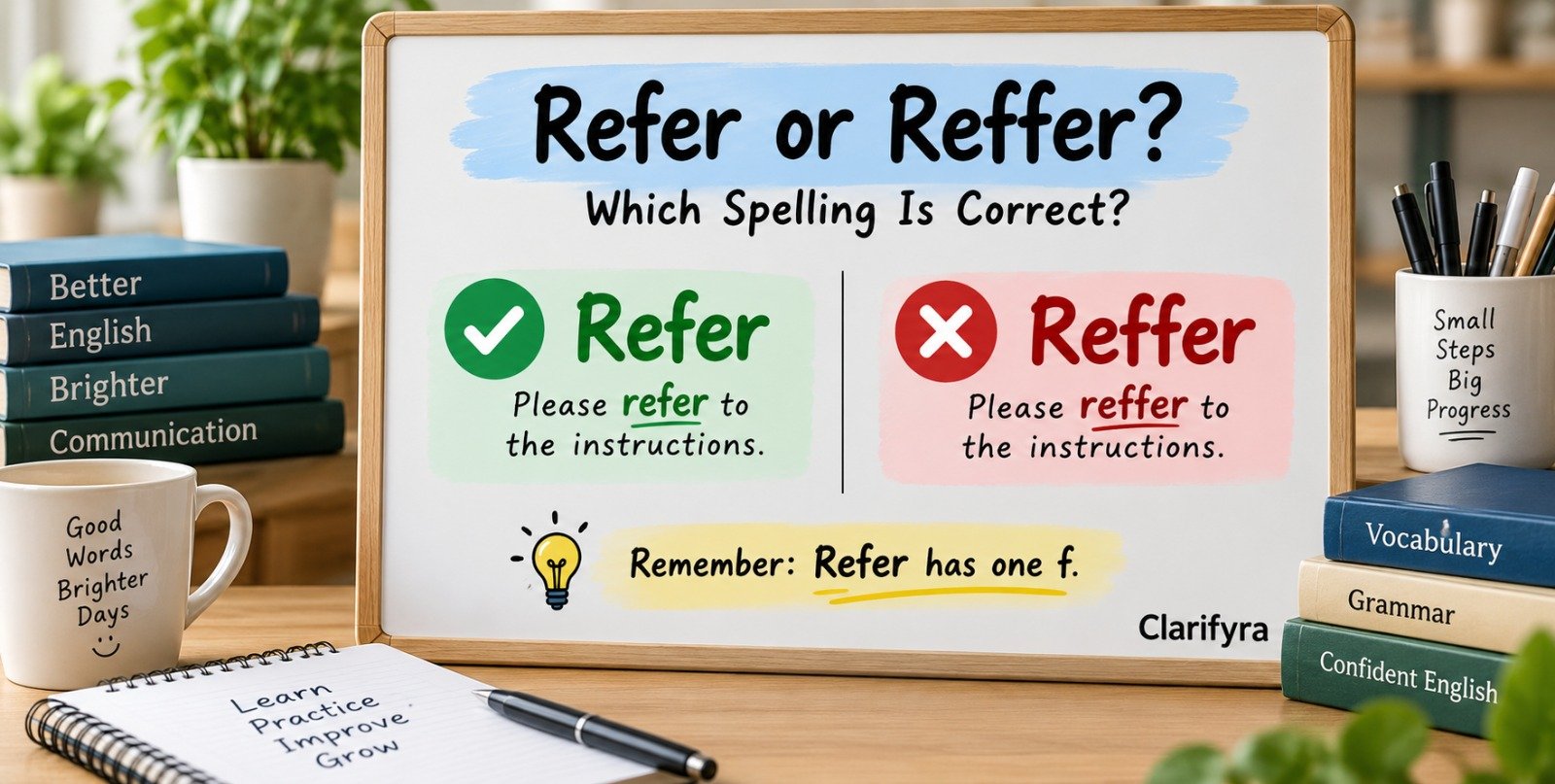
Refer is the correct spelling. Reffer is a misspelling and should not be used in standard English. Use refer when you mean to mention, direct, recommend, or point someone toward information or another person.
Refer or Reffer: Which Is Correct?
The correct form is refer.
Reffer is not the standard spelling of this verb. If you are writing an email, essay, report, message, or any other standard English text, use refer.
| Feature | Refer | Reffer |
|---|---|---|
| Correct spelling? | Yes | No |
| Part of speech | Verb | Misspelling |
| Common meaning | To mention, direct, recommend, or point to | No standard meaning as a form of refer |
| Example | Please refer to the guide. | Please reffer to the guide. ❌ |
A simple example shows the difference:
Correct: Please refer to the instructions.
Incorrect: Please reffer to the instructions.
You May Also Read | Compair vs Compare: Which Is Correct?
What Does “Refer” Mean?
If you are asking “What does mean refer?”, the natural question in standard English would be, “What does refer mean?”
Refer is a verb with several related uses.
It can mean to mention something:
- She referred to the earlier conversation.
- The article refers to several important studies.
It can also mean to direct someone to another person or service:
- My doctor referred me to a specialist.
- The receptionist referred us to the billing department.
Another common meaning is to look at or consult information:
- Refer to page 12 for more details.
- Please refer to the chart below.
In each case, the basic idea is that attention is being directed toward a person, thing, source, or subject.
Is “Reffer” a Real Word?
For the meaning discussed in this article, reffer is not the correct standard spelling.
You should not write:
I will reffer you to my manager.
Instead, write:
I will refer you to my manager.
The mistake often happens because English speakers see forms such as referred and referring and assume the basic word must contain a doubled consonant as well. It does not.
The correct base form is:
refer
Related forms include:
- refers
- referred
- referring
- referral
So if you are wondering about the refer or reffer meaning, remember that only refer is the standard verb in this comparison.
Why Is “Reffer” Such an Easy Spelling Mistake?
The confusion mainly comes from the way refer changes when certain endings are added.
Consider these forms:
| Form | Correct Spelling |
|---|---|
| Base form | refer |
| Third-person singular | refers |
| Past tense | referred |
| -ing form | referring |
| Related noun | referral |
The final r is doubled in referred, referring, and referral.
However, the f is never doubled.
That means:
refer → referred
not:
reffer → reffered
This spelling pattern explains why someone may incorrectly type reffer after becoming familiar with referred or referring.
Refer or Reffer in a Sentence
Here are natural examples showing the correct spelling in different situations.
Correct: I will refer your question to the support team.
Incorrect: I will reffer your question to the support team.
Correct: Please refer to the attached document.
Incorrect: Please reffer to the attached document.
Correct: The teacher referred to the previous chapter.
Correct: She is referring to the person standing near the door.
Correct: This number refers to your order ID.
Notice that the base form always remains refer, even though some related forms double the final r.
Refer or Refer To: What Is the Difference?
Both refer and refer to can be correct, but they are used in different sentence structures.
Use “refer to” when mentioning or consulting something
Examples:
- Please refer to the manual.
- He referred to his notes during the presentation.
- The phrase refers to a specific type of behavior.
Here, refer to means to mention, consult, point to, or relate to something.
Use “refer someone to” when directing a person
Examples:
- The doctor referred me to a specialist.
- I can refer you to our technical department.
- She was referred to a local adviser.
So the pattern often depends on what follows the verb:
refer to + thing or subject
refer + person + to + person/service/place
What Does “I Will Refer” Mean?
The phrase “I will refer” describes something the speaker plans to do in the future.
Its meaning depends on the rest of the sentence.
For example:
I will refer you to our manager.
This means:
I will direct or send you to our manager.
But:
I will refer to your email during the meeting.
means:
I will mention or consult your email during the meeting.
Therefore, the “I will refer” meaning changes slightly according to the object or phrase that follows it.
Common Meanings of “Refer”
The verb can be used in several practical situations.
To mention
She referred to her previous experience.
Here, refer means mention.
To consult information
Refer to the timetable for departure times.
Here, it means look at or consult.
To direct someone elsewhere
The clinic referred him to another doctor.
Here, it means send or direct someone to a specialist or service.
To indicate what something means
The word “they” refers to the students.
Here, refer explains what a word or expression represents.
To recommend someone
My colleague referred me for the position.
In professional contexts, refer can mean recommending or connecting someone with an opportunity, person, or organization.
Does “Refer” Have a Slang Meaning?
Refer is mainly a standard English verb rather than a slang word.
In informal speech, people may use it casually in phrases such as:
“Tell them I referred you.”
This usually means:
Tell them I recommended you or sent you there.
In workplaces, referral programs, services, recruiting, and everyday recommendations, refer may sound conversational, but the meaning is still based on its standard sense of directing or recommending someone.
So when someone looks for a refer slang meaning, there is usually no separate universal slang definition to learn.
Common Mistakes With Refer
Several errors can occur because the different forms look similar.
1. Writing “reffer”
Incorrect:
Can you reffer me to someone?
Correct:
Can you refer me to someone?
2. Writing “refered”
The past tense needs a doubled r:
Incorrect:
She refered me to another office.
Correct:
She referred me to another office.
3. Writing “refering”
The -ing form also doubles the final r:
Incorrect:
What are you refering to?
Correct:
What are you referring to?
4. Forgetting “to”
When the meaning is “mention” or “consult,” refer to is normally required.
Incorrect:
Please refer the instructions.
Correct:
Please refer to the instructions.
However, a construction such as refer someone to a specialist is different because a person appears directly after the verb.
Easy Way to Remember the Spelling
Remember this simple pattern:
Refer has one F.
Then remember that some related forms double the final R:
refer → referred → referring
A useful visual reminder is:
RE + FER = REFER
There is no need to add another f.
If you can remember that referred doubles the r, not the f, you can avoid both reffer and refered.
Correct and Incorrect Examples at a Glance
| Correct | Incorrect |
|---|---|
| Please refer to the document. | Please reffer to the document. |
| I can refer you to a specialist. | I can reffer you to a specialist. |
| She referred me to her manager. | She refered me to her manager. |
| What are you referring to? | What are you refering to? |
| This phrase refers to the previous sentence. | This phrase reffers to the previous sentence. |
These examples show the main rule clearly: refer has one f, while some inflected forms double the final r.
Final Verdict: Refer or Reffer?
Use refer in standard English. Reffer is an incorrect spelling when you mean to mention, direct, recommend, consult, or point to something. The easiest way to avoid mistakes is to remember that the base word has one f, while forms such as referred and referring double the final r. For clear explanations of confusing spellings and everyday English usage, Clarifyra helps you choose the right form without unnecessary complexity.
Frequently Asked Questions
Is it refer or reffer?
Refer is correct. Reffer is a misspelling in standard English.
How do you spell refer correctly?
The correct spelling is R-E-F-E-R. It contains one f and ends in r.
Is it “refer to” or just “refer”?
Both constructions can be correct. Use refer to when mentioning or consulting something, as in “Refer to the manual.” You can use refer someone to when directing a person elsewhere, as in “The doctor referred me to a specialist.”
Why is “referred” spelled with two Rs?
When refer takes endings such as -ed or -ing, the final r is doubled: referred and referring. This does not mean that the base word is reffer.
Is “reffer” acceptable in British English?
No. When referring to this standard English verb, refer is the correct spelling in both American and British English.
What part of speech is “refer”?
Refer is a verb. Depending on context, it can mean to mention, direct, recommend, consult, or indicate what something relates to.
You May Also Read | Math or Maths: What’s the Difference and Which Is Correct?