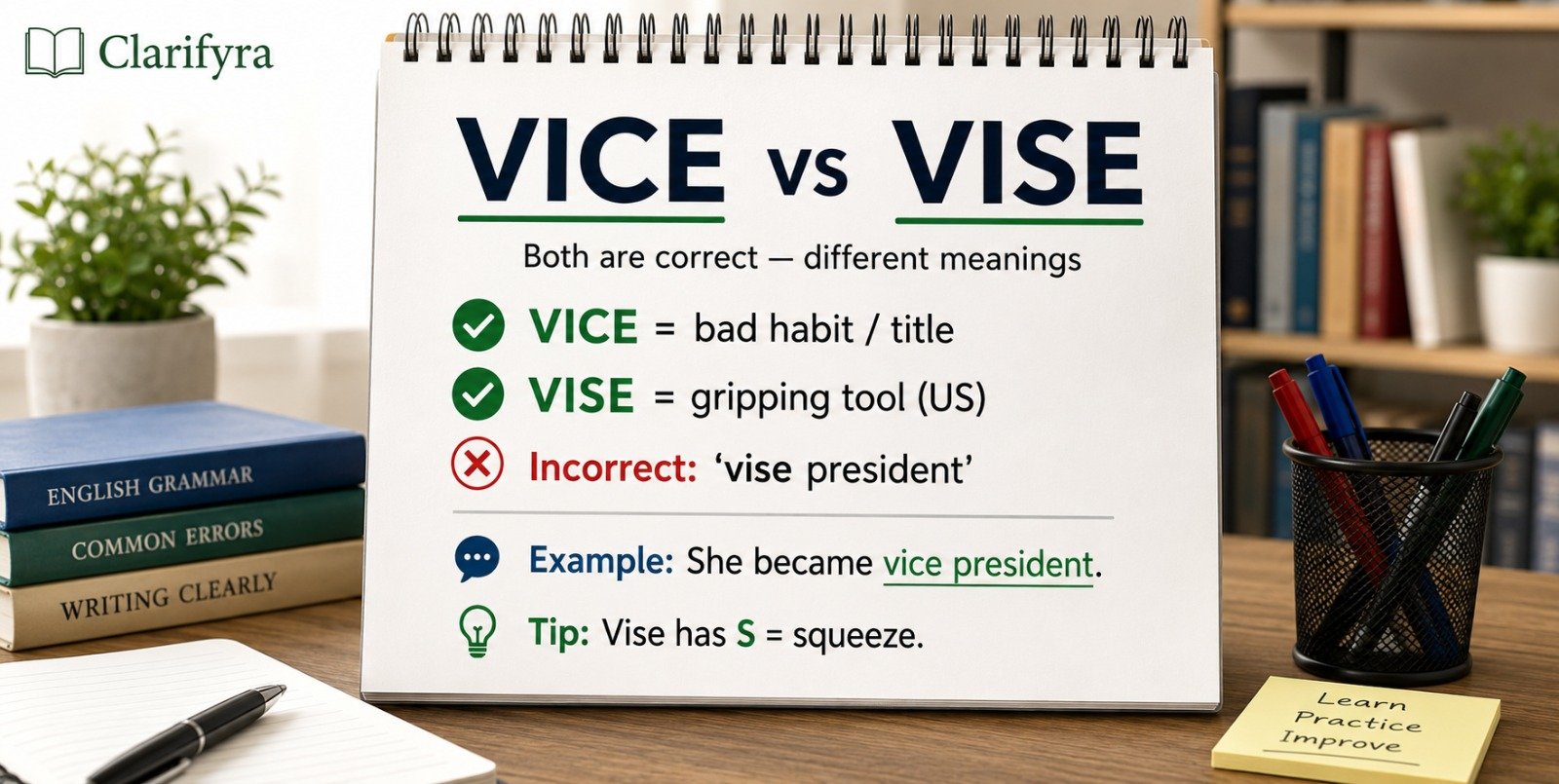
Vice vs Vise? Which Spelling Should You Use?
The words vice and vise sound the same and differ by only one letter, but their meanings and usage are not always the same. In American English, vice usually refers to a bad habit, moral fault, or deputy position, while vise is a tool used to hold something firmly. British English adds another layer because vice is also the standard British spelling for that gripping tool. Understanding the difference becomes much easier once you know which meaning and regional spelling you need.
Both vice and vise are correct words. In American English, vice means a bad habit, moral fault, or deputy position, while vise means a tool used to grip something tightly. In British English, vice is also used for the gripping tool.
Vice and Vise at a Glance
| Feature | Vice | Vise |
|---|---|---|
| Correct word? | Yes | Yes |
| Main meaning | Bad habit, moral fault, or deputy position | Tool used to hold or grip something |
| American English tool spelling | No | Yes |
| British English tool spelling | Yes | Rare |
| Example | Coffee is my only vice. | Tighten the pipe in the vise. |
The main distinction is therefore based on meaning and, when talking about the tool, regional spelling.
What Is Vice?
Vice is a noun with several established meanings.
One common meaning is a bad habit, personal weakness, or immoral behavior.
Examples:
- Gambling became his biggest vice.
- She jokes that chocolate is her only vice.
- Greed is often described as a human vice.
- He decided to give up several unhealthy vices.
The word does not always describe something seriously immoral. In everyday conversation, people may use it lightly for an indulgence they enjoy but consider unhealthy or excessive.
For example:
“Coffee is my only vice.”
Here, vice simply means a guilty pleasure or habit.
Vice in Titles
The word also appears before job titles to describe someone who is below or assists the main officeholder.
Common examples include:
- vice president
- vice chairman
- vice principal
- vice captain
- vice admiral
For example:
She was promoted to vice president last year.
The spelling vise president is incorrect.
What Is Vise?
A vise is a mechanical tool designed to hold an object firmly while someone works on it.
A typical vise has two jaws that tighten around an object. It is commonly used in:
- woodworking
- metalworking
- mechanical repairs
- engineering
- workshops
- DIY projects
Examples:
- The carpenter secured the board in a vise.
- Place the metal piece in the vise before drilling.
- He tightened the pipe firmly in the vise.
- The workshop has a large bench vise.
In American English, vise is the usual spelling when referring to this tool.
It can also be used figuratively to describe severe pressure or a tight grip.
For example:
Fear held him in a vise-like grip.
The image comes from the physical tool squeezing or holding something tightly.
The Key Difference Between Vice and Vise
The easiest way to understand the vice vs vise difference is to look at what the sentence is describing.
Use vice for:
- a bad habit
- moral wrongdoing
- personal weakness
- an official deputy position
Use vise in American English for:
- a mechanical gripping tool
- something compared with a very tight grip
Compare these sentences:
His biggest vice is gambling.
Here, vice means an unhealthy or undesirable habit.
The mechanic placed the bolt in a vise.
Here, vise means a tool.
The two words are pronounced alike, but their meanings are separate in standard American usage.
Vice vs Vise in UK English
The distinction becomes slightly different in British English.
In the UK, vice is normally used for the mechanical tool as well as for a bad habit or moral fault.
A British writer may therefore write:
Secure the piece of wood in the vice.
An American writer would normally write:
Secure the piece of wood in the vise.
Both sentences can be correct.
The difference is regional:
- American English: vise for the tool
- British English: vice for the tool
British English still uses vice in its other meanings too.
For example:
Smoking was his worst vice.
She became vice-chair of the committee.
Context tells the reader which meaning is intended.
Vice vs Vise Spelling Difference
The spelling difference is only one letter:
- vice
- vise
Because they are pronounced the same, you cannot normally determine the intended spelling from speech alone.
In American English, the spelling can help separate the meanings:
Vice → bad habit, moral fault, or deputy position
Vise → gripping tool
This distinction does not work as neatly in British English because vice can refer to both the moral concept and the mechanical tool.
Vice vs Vise vs Wise
Another word that can cause confusion is wise.
Although vice, vise, and wise can sound similar, wise has a completely different meaning.
What Does Wise Mean?
As an adjective, wise means having good judgment, knowledge, or experience.
Examples:
- That was a wise decision.
- It would be wise to leave early.
- She gave me some wise advice.
- He was wise enough to check the details first.
So the basic distinction is:
- vice = bad habit, moral fault, or deputy position
- vise = American spelling for a gripping tool
- wise = showing good judgment or intelligence
Consider this sentence:
It was wise to place the metal securely in the vise.
Both words are correct, but they serve completely different purposes.
Is It Number Wise or Vise?
The correct expression is generally number-wise, not number vise or number vice.
The suffix -wise can be used informally to mean “in terms of,” “regarding,” or “with respect to.”
Examples:
- Number-wise, this year was stronger.
- Price-wise, both options are similar.
- Time-wise, we are doing well.
- Performance-wise, the newer model is better.
Therefore:
Correct: Number-wise, the results look good.
Incorrect: Number vise, the results look good.
Incorrect: Number vice, the results look good.
In formal writing, however, a phrase such as “in terms of numbers” may sound more polished.
For example:
Informal: Number-wise, the campaign performed better.
More formal: In terms of numbers, the campaign performed better.
Vice and Vise Synonyms
Since the two words have different meanings, they also have different alternatives.
Other Ways to Say Vice
When vice means a bad habit or personal weakness, possible alternatives include:
- bad habit
- weakness
- fault
- failing
- flaw
- wrongdoing
- indulgence
- immorality
The best synonym depends on the context.
For example:
Original: Gambling was his greatest vice.
Alternative: Gambling was his greatest weakness.
However, weakness often sounds less serious than vice, so the words are not interchangeable in every situation.
Other Ways to Say Vise
Depending on the context, related terms may include:
- clamp
- gripping tool
- holding device
- bench vise
- work holder
A clamp is similar in purpose, although a clamp and a vise are not necessarily the exact same type of tool.
Vice and Vise Examples in Sentences
Seeing both words in context is one of the easiest ways to learn the distinction.
Examples With Vice
- His love of expensive watches became a costly vice.
- She considers sugary desserts her only vice.
- The novel explores the struggle between virtue and vice.
- He was elected vice president of the association.
- Pride can become a serious vice when left unchecked.
Examples With Vise
- The technician secured the metal in a vise.
- A bench vise can keep the board from moving.
- He tightened the vise before beginning the repair.
- The mechanic used a vise to hold the small component.
- Anxiety seemed to hold him in a vise-like grip.
In British English, the tool-related examples would normally use vice instead.
Why Are Vice and Vise Confused?
The biggest reason is pronunciation.
Vice and vise are homophones, meaning they are pronounced the same even though their spelling and meanings can differ.
Other common homophones include:
- right and write
- brake and break
- flour and flower
- pair and pear
- there and their
Because vice and vise sound identical, writers have to rely on meaning rather than pronunciation.
Regional differences also create confusion. Someone familiar with British English may naturally write bench vice, while an American reader may expect bench vise.
Neither is necessarily wrong; the correct choice depends on the variety of English being used.
Easy Way to Remember the Difference
For American English, try connecting the S in vise with squeeze.
A viSe is a tool that Squeezes or grips something.
Think:
Vise → Squeeze → Tool
For vice, think of familiar expressions such as:
- bad vice
- personal vice
- vice president
This simple association can help prevent spelling mistakes.
Common Mistakes to Avoid
Writing “Vise President”
Incorrect:
She became vise president of the company.
Correct:
She became vice president of the company.
The title always uses vice.
Using Vise for a Bad Habit
Incorrect:
Smoking is his worst vise.
Correct:
Smoking is his worst vice.
A harmful habit or moral weakness is a vice.
Assuming “Vice” Cannot Mean the Tool
That assumption is only true if you are following standard American spelling.
In British English:
bench vice
is completely normal.
Writing “Number Vise”
If you mean “in terms of numbers,” use:
number-wise
For more formal writing, consider:
in terms of numbers
Final Verdict: Vice or Vise?
Both spellings are correct, but they are not always interchangeable. Use vice for a bad habit, moral fault, or deputy position such as vice president. In American English, use vise for the tool that holds an object firmly; in British English, that same tool is normally called a vice. If you are comparing these words while improving your English vocabulary, remembering the distinction can make guides from resources such as Clarifyra easier to understand as well.
Frequently Asked Questions
Is vise the American spelling of vice?
Yes, but only when referring to the mechanical gripping tool. American English normally uses vise for the tool, while British English commonly uses vice. Other meanings of vice, such as a bad habit or vice president, remain spelled vice in American English.
Are vice and vise pronounced differently?
No. They are generally pronounced the same way, making them homophones. Their different spellings in American English help distinguish their meanings in writing.
Is “bench vice” correct?
Yes. Bench vice is standard British English. In American English, the usual spelling is bench vise. Choose the spelling that matches the regional English used throughout your writing.
Can vice mean a bad habit?
Yes. A vice can be a bad habit, weakness, indulgence, or form of immoral behavior. For example, someone might say, “Chocolate is my only vice,” using the word in a light and informal way.
Is it number wise or number vise?
Use number-wise when you mean “in terms of numbers.” The forms number vise and number vice are incorrect for this meaning. In formal writing, in terms of numbers may be a smoother alternative.
What is the easiest way to remember vice and vise?
In American English, remember that vise contains an S, and a vise squeezes things. Use vice for a bad habit, moral fault, or position such as vice president.
You May Also Read | Is It Hidding or Hiding? Correct Spelling Explained