35 Other Ways to Say “However” in Essays, Emails and Everyday English
“However” is a useful word for introducing contrast, disagreement, exceptions, or an unexpected second point. It works perfectly well in essays, reports, emails, and everyday writing, but using it again and again can make your sentences sound repetitive.
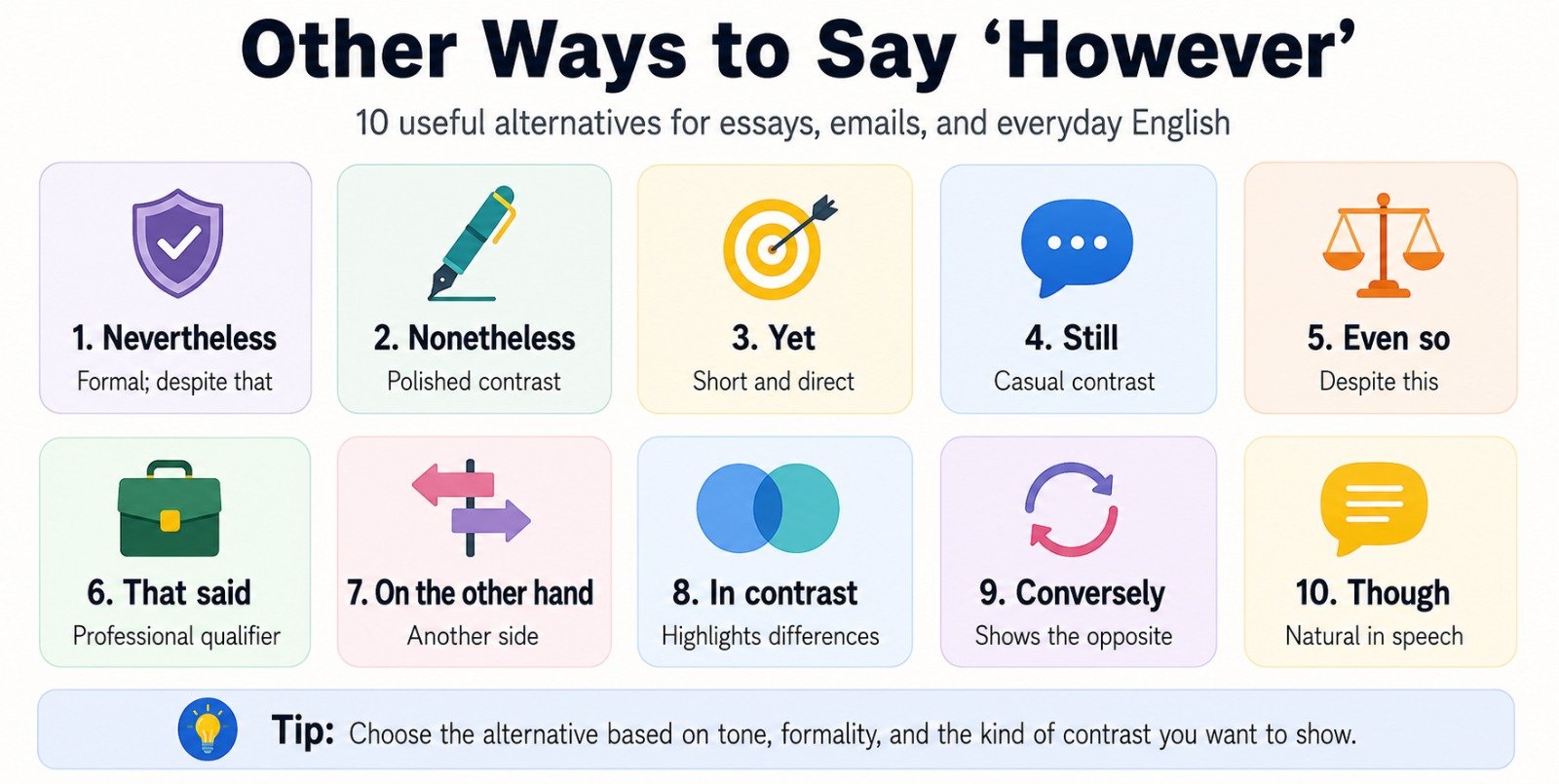
The best other ways to say however include nevertheless, nonetheless, yet, still, even so, that said, on the other hand, in contrast, conversely, although, though, despite this, and at the same time. The right choice depends on the relationship between your ideas, because not every alternative carries exactly the same meaning.
What Does “However” Mean?
“However” is commonly used to introduce information that contrasts with what has just been said.
For example:
The apartment is small. However, it is in an excellent location.
The second statement doesn’t completely contradict the first. Instead, it introduces another consideration that changes how we view the situation.
“However” can also have a different meaning, as in:
However difficult the exam is, I will do my best.
Here, “however” means something closer to “no matter how.” This article focuses mainly on its more common contrast function because that is where alternatives such as “nevertheless,” “yet,” and “on the other hand” are useful. Dictionaries distinguish these meanings rather than treating every synonym as interchangeable.
Quick Comparison of Alternatives to “However”
| Alternative | Tone | What It Usually Expresses | Best For |
|---|---|---|---|
| Nevertheless | Formal | Despite what was stated | Essays, reports |
| Nonetheless | Formal/neutral | Despite that | Academic and professional writing |
| Yet | Neutral | Direct contrast | Essays and general writing |
| Still | Neutral/conversational | Despite a difficulty | Everyday writing |
| Even so | Neutral | Unexpected continuation | General writing |
| That said | Professional/conversational | A qualification or counterpoint | Emails, discussions |
| On the other hand | Neutral | Another side of an issue | Essays, comparisons |
| In contrast | Formal/neutral | Clear difference | Academic writing |
| Conversely | Formal | Opposite relationship | Analytical writing |
| Although | Neutral/formal | Contrast within a sentence | Essays and reports |
| Though | Conversational | Softer contrast | Speech and informal writing |
| Despite this | Formal/neutral | Something remains true despite a problem | Reports and essays |
| At the same time | Neutral | Two contrasting facts can coexist | Professional writing |
| But | Neutral | Simple direct contrast | Everyday English |
You May Also Read | 45+ Other Ways to Say “Sorry” for Every Situation
Other Ways to Say “However” in an Essay
Academic writing is one of the main situations where writers need alternatives to “however.” Repeating one transition throughout an essay can make the structure feel mechanical.
The following choices are useful, but each serves a slightly different purpose.
Other Ways to Say “However” — Nevertheless
Nevertheless is one of the closest formal alternatives when you mean “despite what was just mentioned.”
Example:
“The sample size was relatively small. Nevertheless, the results revealed a consistent pattern.”
It is particularly useful when the second statement remains true despite a limitation or difficulty.
Other Ways to Say “However” — Nonetheless
Nonetheless works in a similar way to “nevertheless” and fits academic, analytical, and professional writing.
Example:
“The approach has several limitations. Nonetheless, it provides a useful starting point for further research.”
Use it when you want a polished transition without substantially changing the meaning.
Other Ways to Say “However” — In Contrast
In contrast works best when you are comparing noticeable differences.
Example:
“Urban populations increased during the period. In contrast, several rural areas experienced population decline.”
This is more specific than “however.” It tells the reader that a comparison is being made.
Other Ways to Say “However” — Conversely
Conversely introduces an opposite relationship or situation.
Example:
“High demand can cause prices to rise. Conversely, falling demand can place downward pressure on prices.”
It is especially useful in analytical essays because it signals logical opposition. It should not be inserted merely because you want a more sophisticated synonym.
Other Ways to Say “However” — On the Other Hand
On the other hand introduces another perspective, consideration, advantage, or disadvantage.
Example:
“Remote learning gives students greater flexibility. On the other hand, face-to-face classes may offer more immediate interaction.”
It is ideal for essays that weigh two sides of an argument.
Other Ways to Say “However” — Despite This
Use despite this when the second outcome happens even though the first point could have prevented it.
Example:
“The company faced significant supply problems. Despite this, production increased by the end of the year.”
The phrase emphasizes overcoming or continuing despite a preceding circumstance.
Other Ways to Say “However” — Yet
Yet gives you a shorter way to express contrast.
Example:
“The proposal appears simple, yet implementing it would require considerable investment.”
It is useful when you want two contrasting clauses to remain within one sentence.
Formal Ways to Say “However”
When writing reports, proposals, policies, or other formal material, precise transitions matter more than simply using an impressive-sounding synonym.
Other Ways to Say “However” — Notwithstanding
Notwithstanding is considerably more formal than “however.”
Example:
“Notwithstanding these concerns, the committee approved the recommendation.”
It can sound natural in legal, official, or highly formal writing, but unnecessarily stiff in everyday communication.
Other Ways to Say “However” — Be That as It May
Be that as it may acknowledges a point before moving to a different conclusion.
Example:
“The concerns deserve consideration. Be that as it may, a decision must be reached this week.”
It has a distinctly formal and somewhat traditional tone.
Other Ways to Say “However” — In Spite of This
This phrase highlights that an outcome occurs despite the situation previously described.
Example:
“The initial response was disappointing. In spite of this, the organization continued with the campaign.”
Other Ways to Say “However” — All the Same
All the same can mean “nevertheless” or “even so.”
Example:
“The evidence is incomplete. All the same, it raises an important question.”
It is less academic than “nevertheless” but still useful in thoughtful general writing.
Professional Ways to Say “However”
In workplace communication, an overly sharp transition can make disagreement sound harsher than intended. Softer phrases can help introduce concerns without undermining the other person’s point.
Other Ways to Say “However” — That Said
That said is natural in professional emails, meetings, presentations, and commentary.
Example:
“The campaign performed well overall. That said, we should review the cost of acquiring each new customer.”
It acknowledges the first point before adding a qualification.
Other Ways to Say “However” — Having Said That
This is slightly longer but performs a similar function.
Example:
“We are pleased with the progress so far. Having said that, several deadlines still need closer attention.”
It often sounds diplomatic because the speaker recognizes one side before introducing another.
Other Ways to Say “However” — At the Same Time
Use this when two apparently opposing ideas can both be valid.
Example:
“We need to reduce unnecessary spending. At the same time, we should continue investing in customer support.”
This is not a direct synonym for every use of “however.” Its strength is showing that two considerations coexist.
Other Ways to Say “However” — Even So
Even so acknowledges a difficulty without allowing it to change the main conclusion.
Example:
“The schedule is demanding. Even so, the team believes it can meet the deadline.”
Other Ways to Say “However” — Still
“Still” is less formal but sounds natural in many modern professional messages.
Example:
“The revised design isn’t perfect. Still, it’s a significant improvement.”
Casual and Everyday Alternatives to “However”
You don’t need formal transition words in every conversation. In spoken English, messages, personal writing, and casual posts, shorter choices often sound more natural.
Other Ways to Say “However” — But
But is the simplest alternative for straightforward contrast.
Instead of:
“The café was busy. However, we found a table.”
You could say:
“The café was busy, but we found a table.”
The meaning is similar, although the grammar and sentence structure change.
Other Ways to Say “However” — Though
“Though” is extremely natural in conversation.
Example:
“The movie was pretty good. A little too long, though.”
Putting “though” at the end gives the contrast a relaxed, conversational feel.
Other Ways to Say “However” — Then Again
Then again is useful when reconsidering your own point.
Example:
“We could drive tonight. Then again, leaving tomorrow morning might be easier.”
It suggests that the speaker is looking at the situation again from another angle.
Other Ways to Say “However” — On the Flip Side
This is an informal way of introducing another side of an issue.
Example:
“Working from home can feel isolating. On the flip side, you don’t have to commute.”
It works in conversation, blogs, and informal writing but is generally too casual for academic work.
Other Words for “However” Based on Meaning
Instead of asking which word is the closest synonym, first ask what you actually want your sentence to communicate.
When You Mean “Despite That”
Choose:
- Nevertheless
- Nonetheless
- Even so
- Still
- Despite this
- In spite of this
- All the same
Example:
“The forecast predicted storms. Even so, the event went ahead.”
When You Mean “There Is Another Side”
Choose:
- On the other hand
- That said
- Having said that
- At the same time
- On the flip side
Example:
“The job pays well. On the other hand, the commute is extremely long.”
When You Mean “The Opposite Is True”
Choose:
- Conversely
- In contrast
- By contrast
Example:
“Some employees prefer fixed schedules. Conversely, others work better with greater flexibility.”
When You Need a Simple Contrast
Choose:
- But
- Yet
- Though
- Although
- While
- Whereas
Example:
“Although the room was small, it felt comfortable.”
Not Every Synonym for “However” Is Interchangeable
This distinction matters.
A thesaurus may place several expressions near “however,” but similar words can perform different grammatical or logical functions. “However” itself can signal opposition or introduce another consideration, while synonym resources also group words such as “still,” “nevertheless,” and “yet” around that contrast meaning.
Consider these examples.
“However” vs. “Although”
These can communicate similar contrasts, but the grammar is different.
However:
“The hotel was expensive. However, the service was excellent.”
Although:
“Although the hotel was expensive, the service was excellent.”
You can’t simply swap the two words without restructuring the sentence.
“However” vs. “On the Other Hand”
“On the other hand” usually introduces another side of a comparison.
Example:
“Living downtown is convenient. On the other hand, housing can be expensive.”
It isn’t automatically appropriate every time “however” appears.
“However” vs. “Conversely”
“Conversely” implies a clearer opposite relationship.
Example:
“Increasing supply can lower prices. Conversely, restricting supply may cause prices to rise.”
Use it for logical opposites rather than general disagreement.
“However” vs. “Alternatively”
“Alternatively” introduces another option, not simply a contrasting fact.
Example:
“You can submit the application online. Alternatively, you can send it by post.”
That differs from:
“The online application is convenient. However, some applicants prefer paper forms.”
“However” vs. “On the Contrary”
On the contrary is strongest when correcting or directly contradicting an idea.
Example:
“She isn’t uninterested. On the contrary, she has asked several questions about the project.”
It would be inaccurate to use “on the contrary” as a universal replacement for “however.”
How Sentence Structure Changes With Alternatives
Choosing another way to say “however” may require changing more than one word.
Compare:
The idea is risky. However, it could succeed.
The idea is risky; nevertheless, it could succeed.
The idea is risky, yet it could succeed.
Although the idea is risky, it could succeed.
The idea is risky. That said, it could succeed.
The idea is risky but could succeed.
All of these communicate contrast, but they create different rhythms and use different grammatical structures.
That is why replacing transition words mechanically can produce awkward sentences.
Where Can “However” Appear in a Sentence?
“However” is flexible and can appear in several positions.
At the beginning:
“However, the results were encouraging.”
In the middle:
“The results, however, were encouraging.”
After a semicolon:
“The first test failed; however, the second produced better results.”
This flexibility is another reason some alternatives require sentence restructuring rather than direct substitution.
Which Alternative Sounds Most Natural?
The most natural option depends on the setting.
For an academic argument:
Nevertheless
“The evidence is limited. Nevertheless, the findings deserve further investigation.”
For a direct comparison:
In contrast
“The northern region experienced growth. In contrast, employment declined in the south.”
For a professional qualification:
That said
“The proposal is promising. That said, the projected cost needs further review.”
For casual conversation:
Though
“I liked the restaurant. It was expensive, though.”
For simple contrast:
But
“I wanted to stay, but I had to leave.”
For two valid perspectives:
At the same time
“The change could improve efficiency. At the same time, employees will need additional training.”
Common Mistakes When Looking for Another Way to Say “However”
Choosing a Formal Word Just to Sound Smarter
“Notwithstanding” may be correct, but it doesn’t automatically make your writing better.
Natural:
“The deadline is tight, but we can manage.”
Unnecessarily formal:
“The deadline is tight. Notwithstanding, we can manage.”
Choose vocabulary that matches your audience.
Using “Conversely” Without an Opposite Relationship
Avoid:
“The restaurant was busy. Conversely, we found a table.”
Finding a table is surprising given the crowd, but it isn’t the logical opposite of the restaurant being busy.
Better:
“The restaurant was busy. Nevertheless, we found a table.”
Using “On the Contrary” for Ordinary Contrast
Avoid treating “on the contrary” as a fancy version of “however.”
Incorrect relationship:
“The phone is affordable. On the contrary, its camera isn’t very good.”
Better:
“The phone is affordable. However, its camera isn’t very good.”
“On the contrary” works when the second idea actually contradicts or corrects the first.
Overusing Alternatives
Variation helps, but constantly switching transition words can make an essay feel unnatural too.
Sometimes “however” is already the clearest choice. Good writing doesn’t require eliminating common words; it requires using them deliberately.
Frequently Asked Questions
What is another way to say “however”?
A close alternative is “nevertheless” when you mean “despite that.” Other useful options include nonetheless, yet, still, even so, and that said. For comparisons, on the other hand or in contrast may be more precise.
What are the best other ways to say “however” in an essay?
Useful essay alternatives include nevertheless, nonetheless, in contrast, conversely, on the other hand, despite this, yet, although, and whereas. Choose according to the logical relationship between your sentences rather than simply rotating synonyms.
What is a formal synonym for “however”?
Nevertheless and nonetheless are strong formal choices. Notwithstanding is considerably more formal and is best suited to official or legal-style writing.
Can I say “but” instead of “however”?
Often, yes, but the sentence structure usually changes.
“The task was difficult; however, we finished it.”
becomes:
“The task was difficult, but we finished it.”
“But” is usually more direct and conversational.
Is “nevertheless” the same as “however”?
They overlap, but they aren’t identical in every situation. “Nevertheless” strongly conveys “despite what was just mentioned,” while “however” can introduce a broader contrast or qualification.
Can I start a sentence with “however”?
Yes. Starting a sentence with “however” is standard when it introduces a contrast with the previous statement.
Example:
“The original proposal was rejected. However, a revised version was later approved.”
What can I use instead of “however” at the beginning of a sentence?
Depending on the meaning, try nevertheless, nonetheless, still, even so, that said, in contrast, conversely, despite this, or on the other hand.
What is a casual way to say “however”?
But, still, though, then again, and on the flip side work well in less formal communication. “Though” is especially common at the end of a conversational sentence.
Is “on the other hand” the same as “however”?
Not exactly. “On the other hand” specifically introduces another perspective or side of an issue, whereas “however” can signal several kinds of contrast.
Should I avoid “however” in academic writing?
No. “However” is appropriate for academic writing. The goal isn’t to remove it but to avoid unnecessary repetition and choose more precise transitions when the relationship between ideas calls for them.
Conclusion
There isn’t one perfect synonym for every use of “however.” Nevertheless and nonetheless are useful when something remains true despite a previous point, in contrast and conversely suit comparisons, that said works well for professional qualifications, and but, still, or though often sound better in relaxed communication.
The best expression depends on your context, audience, tone, sentence structure, relationship with the reader, and level of formality. Clarifyra helps make those distinctions clearer so you can choose wording that doesn’t just sound different, but actually says what you mean.
You May Also Read | 25 Other Ways to Say “Hope You Had a Great Weekend” Naturally