Selfs or Selves: Which Is Correct?
It is easy to hesitate over selfs or selves, especially because many English nouns form their plurals simply by adding -s. The word self, however, follows a different plural pattern. The standard plural is selves, not selfs. This can be confusing because selves changes the spelling of the final f to v before adding -es. There is also a specialized use of selfs as a verb form, so the word is not completely nonexistent—but it is not the plural you want in ordinary English.
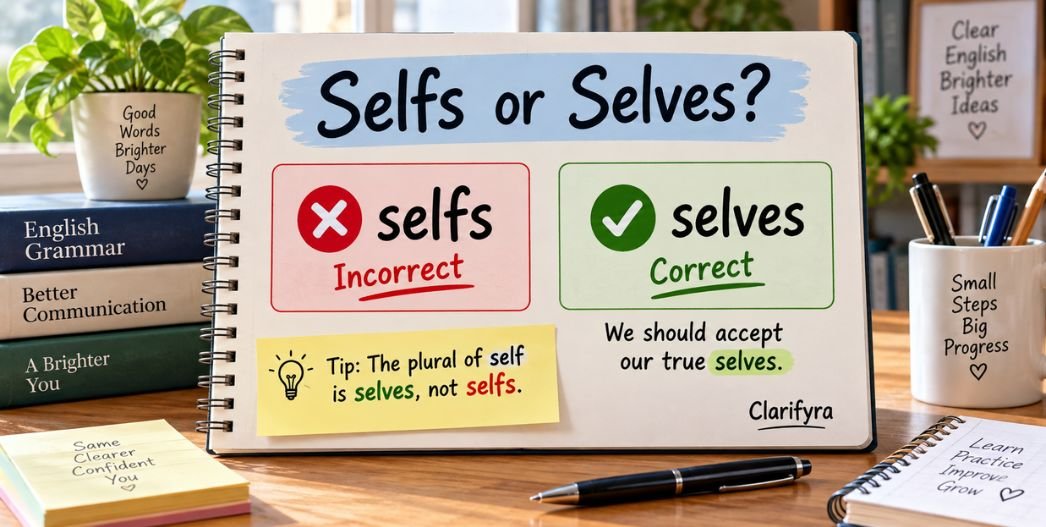
Selves is the correct standard plural of self. Use selves when referring to more than one self, such as in “our true selves” or “their younger selves.” Selfs is not the standard plural, although it can appear as a specialized third-person singular verb form of self in the sense of “to inbreed.”
Selfs vs. Selves: The Key Difference
The easiest way to understand the distinction is to look at the grammatical role of each form.
| Feature | Selves | Selfs |
|---|---|---|
| Standard plural of self? | Yes | No |
| Meaning | More than one self | Specialized verb form |
| Word type | Plural noun | Verb form |
| Ordinary modern usage | Common | Rare and specialized |
| Example | “We must accept our true selves.” | “The plant selfs.” |
For virtually all ordinary writing about people, personalities, identities, or different versions of a person, selves is the form you need.
The basic pattern
Singular: self
Plural: selves
For example:
- My self has changed over the years.
- Our different selves can emerge in different situations.
This is an irregular plural rather than the regular self + s pattern.
What Does “Selves” Mean?
Selves is the plural form of self. The noun self can refer to a person’s identity, character, personality, or individual nature. Therefore, selves refers to two or more such identities or individual aspects.
For example:
- We should learn to accept our true selves.
- Their younger selves would probably be surprised by their lives today.
- The two characters reveal very different selves throughout the story.
- The experience encouraged them to understand their inner selves.
The meaning can vary slightly according to the adjective or surrounding context.
Common expressions with “selves”
You will often encounter selves in expressions such as:
- true selves
- real selves
- inner selves
- younger selves
- former selves
- future selves
- private selves
- public selves
In these expressions, selves indicates different versions, identities, or aspects of one or more people.
Why Is the Plural of “Self” “Selves”?
The plural selves is an irregular plural form. English has a number of nouns ending in -f or -fe whose plurals change the ending to -ves.
Some familiar examples include:
- self → selves
- wife → wives
- life → lives
- wolf → wolves
- leaf → leaves
- knife → knives
However, this is not a rule that applies to every word ending in f. For example:
- roof → roofs
- chief → chiefs
- belief → beliefs
So it is better to remember selves as the established plural of self rather than assuming that every noun ending in f must follow the same pattern.
Is “Selfs” a Real Word?
This question needs a little nuance.
If you mean “Is selfs the plural of self?”, the answer is no in standard English. The plural is selves.
However, selfs can occur as a specialized verb form. Dictionary resources record self as a verb in the specialized context of breeding a plant or organism with itself. In that usage, selfs can function as the third-person singular present-tense form.
For ordinary readers, this distinction is unlikely to affect everyday writing.
Consider the difference:
Plural noun:
The different selves of the character are explored in the novel.
Specialized verb:
In specialized botanical terminology, a plant may be described using the verb self.
Thus, it would be inaccurate to say that selfs can never appear anywhere in English. The important point is that it is not the normal plural spelling of self.
Correct Usage Examples
Here are some natural examples showing how selves works in sentences.
Example 1
We should be comfortable with our true selves.
Here, selves means the genuine identities or personalities of the people involved.
Example 2
Our younger selves could never have imagined this future.
The phrase refers to earlier versions of the same people.
Example 3
They wanted to rediscover their creative selves.
Here, creative selves refers to their creative identities or aspects of their personalities.
Example 4
The experience helped them understand their inner selves.
Inner selves refers to their internal thoughts, feelings, identities, or personalities.
Example 5
We sometimes behave differently at work than we do as our private selves.
The plural noun refers to different aspects or presentations of the people involved.
Incorrect vs. Correct Spelling
A simple spelling comparison makes the difference clear.
Correct:
We should accept our true selves.
Incorrect as a plural:
We should accept our true selfs.
Another example:
Correct:
Their former selves seemed like completely different people.
Incorrect:
Their former selfs seemed like completely different people.
The reason selfs looks tempting is that many English plurals simply add -s:
- book → books
- car → cars
- house → houses
But self does not follow that regular pattern.
“Selves” in Reflexive Pronouns
The spelling selves also appears in several familiar plural reflexive pronouns.
These include:
- ourselves
- yourselves
- themselves
Examples:
We prepared ourselves for the examination.
You should be proud of yourselves.
The students introduced themselves.
This is another useful clue that selves is the established form associated with the plural of self.
Notice that these are not simply the noun selves by itself. They are reflexive pronouns formed with possessive or personal elements:
our + selves = ourselves
your + selves = yourselves
them + selves = themselves
Why Do People Confuse the Two Spellings?
The confusion mainly comes from the fact that selfs looks like a logical regular plural.
Someone who knows that many nouns form plurals by adding -s might naturally reason:
self + s = selfs
But English contains many irregular plural forms, and selves is the established plural.
The pronunciation can also make the spelling less obvious. The written change from f to v is not necessarily what a learner would predict from hearing the word.
The safest approach is simply to remember:
One self, two or more selves.
Selfs or Selves Spelling: The Easy Rule
If you are writing about people, identities, personalities, or different versions of a person, choose:
selves
Think of the pattern:
self → selves
For example:
- my self → our selves
- your self → your selves
- their self → their selves
In actual English, some of these combinations may instead appear as reflexive pronouns such as myself, ourselves, yourself, or themselves, depending on the sentence.
A useful memory trick
Remember the related pair:
life → lives
self → selves
Both change the final f sound/spelling pattern to v in their plural forms.
This is not a universal rule for every -f noun, but it is a useful reminder for these particular words.
What Is a Synonym for “Selves”?
There is no single synonym that works in every context because selves can have several related meanings.
Depending on the sentence, possible alternatives include:
- identities
- personalities
- characters
- natures
- personas
- individualities
- versions of oneself
- inner identities
For example:
We should accept our true selves.
Could become:
We should accept our true identities.
But the meaning is not always identical. Selves can refer to a broader combination of identity, personality, character, and individual experience.
Similarly:
Our younger selves would be amazed.
Could be expressed as:
The people we were when we were younger would be amazed.
In many situations, selves is the most natural and concise choice.
Common Mistakes to Avoid
1. Using “selfs” as the plural
Incorrect:
We need to understand our different selfs.
Correct:
We need to understand our different selves.
2. Assuming every noun ending in “f” uses “-ves”
It is useful to know that self → selves, but don’t apply the pattern automatically to every f-ending noun.
For instance:
roofs, chiefs, beliefs
are standard plurals, not rooves, chieves, or believes.
3. Confusing “selves” with “ourselves”
Selves is a plural noun.
Ourselves is a plural reflexive pronoun.
Compare:
Our different selves appeared in the discussion.
with:
We introduced ourselves.
The words are related, but they serve different grammatical purposes.
4. Treating “selfs” as the ordinary plural because it appears somewhere
Because selfs can occur in specialized terminology as a verb form, seeing it in a dictionary or technical text does not make it the standard plural of self.
For normal writing, use selves.
How to Choose the Right Form
When deciding between the two, ask a simple question:
Am I talking about more than one self?
If yes, use selves.
Our selves have changed.
More naturally, depending on context:
Our younger selves have changed.
If you are dealing with a specialized technical use of self as a verb, selfs may have a different grammatical function. That is a separate matter from forming the plural noun.
For students, general writers, bloggers, and most professional communication, the practical rule is very simple:
self → selves
FAQ
Is “selves” the plural of “self”?
Yes. Selves is the standard plural form of self. It can refer to multiple identities, personalities, characters, or individual versions of people. Examples include “our true selves,” “their younger selves,” and “our former selves.”
Is “selfs” grammatically correct?
Not as the ordinary plural of self. Standard English uses selves for the plural noun. Selfs can occur in a specialized grammatical use as a third-person singular verb form of self, but this is unrelated to the normal plural.
Why does self become selves?
Self has an irregular plural: selves. Like some other English nouns ending in -f, its plural changes the ending to -ves. However, not all nouns ending in -f follow this pattern, so the plural should be learned individually.
What does “selves” mean?
Selves is the plural of self. It can refer to multiple identities, personalities, individual natures, or different versions of a person. Phrases such as “true selves” and “younger selves” are common examples.
What is a synonym for “selves”?
Depending on context, possible alternatives include identities, personalities, characters, natures, personas, or versions of oneself. None is a perfect replacement in every sentence, so the best synonym depends on the intended meaning.
Final Verdict: Selfs or Selves?
For standard English, selves is the correct plural of self. Use it when referring to multiple identities, personalities, or versions of a person: “our true selves,” “their younger selves,” or “our former selves.” Although selfs can appear in a specialized verb usage, it should not be used as the ordinary plural. For clear and accurate word choices, Clarifyra keeps the distinction simple: one self, multiple selves.