Millennia or Millennium: What’s the Difference?
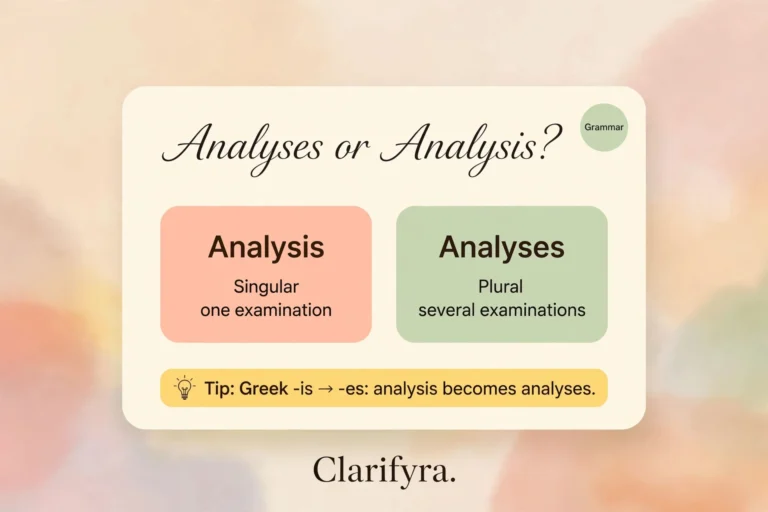
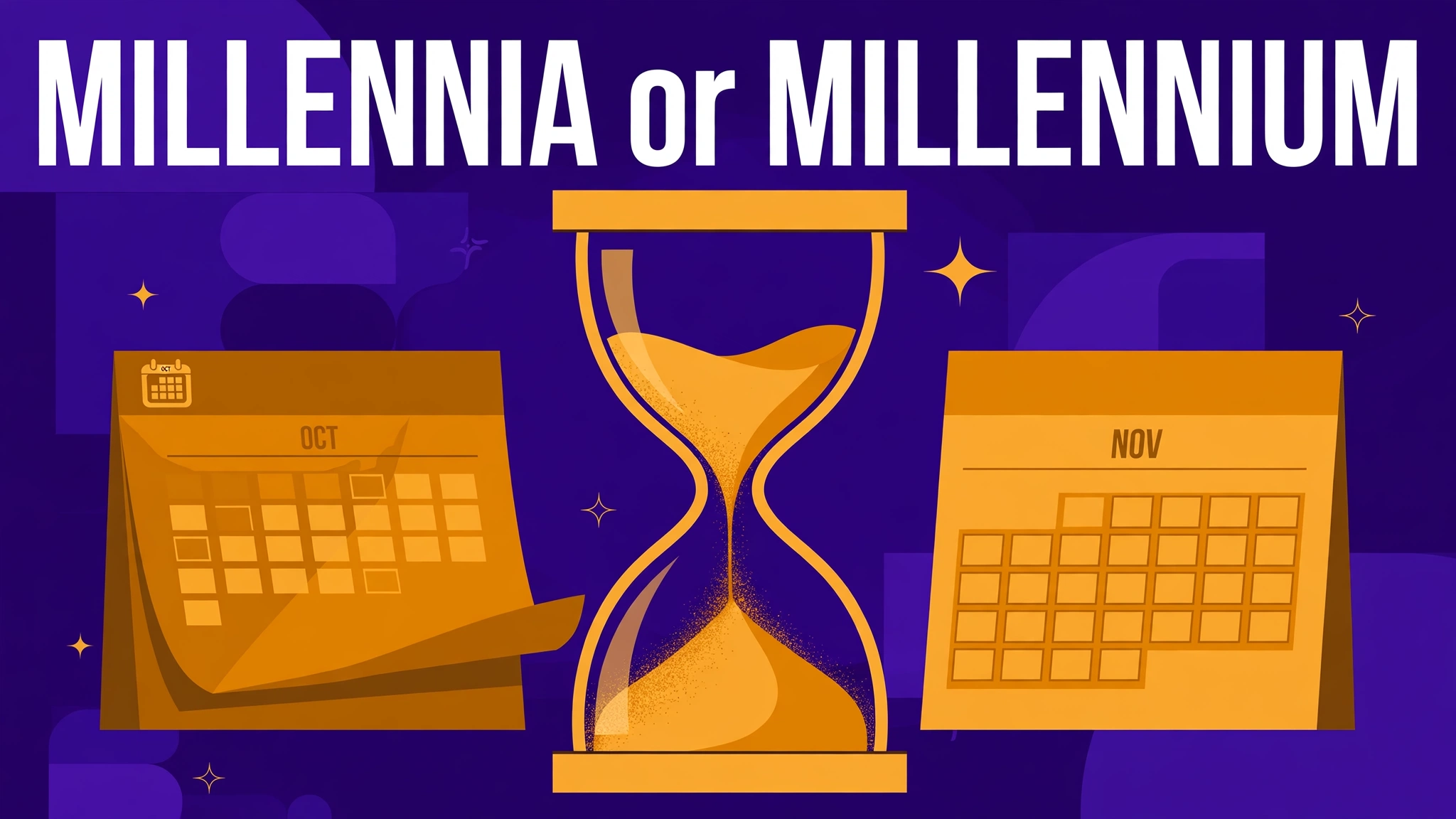
If you have ever paused over millennia and millennium while writing about history, climate, or archaeology, here is the short version: they are the same word in different numbers. Millennium is the singular — one period of a thousand years. Millennia is the plural — two or more. “We are living at the start of the third millennium.” “Glaciers shaped this valley over millennia.” Get the number wrong and the sentence quietly stops making sense.
The confusion is almost always about the ending. Millennium ends in -ium, and plenty of Latin-derived nouns ending that way form their plurals in -ia: millennium → millennia, just like criterion → criteria and phenomenon → phenomena. Writers who sense this pattern get it right instinctively; writers who don’t sometimes invent milleniums or mangle the spelling of the singular itself.
The Singular and the Plural, Plainly Stated
Start with the definitions the dictionaries agree on. Merriam-Webster gives millennium two core senses: “a period of 1000 years”, and “the thousand years mentioned in the book of Revelation” — the religious sense, often capitalised as “the Millennium”. Collins states it just as directly: “A millennium is a period of one thousand years, especially one which begins and ends with a year ending in ‘000’, for example the period from the year 1000 to the year 2000.” Both note a further sense: a thousandth anniversary or its celebration — the sense behind all those “millennium celebrations” in the year 2000.
Millennia is simply the plural. In almost all writing, millennia appears in the construction “for millennia” or “over millennia“, meaning “for/over thousands of years”. Merriam-Webster’s own example sentence runs: “The book describes the changes that have occurred in the landscape over many millennia.” The word almost never appears with a numeral — you would not write “three millennia” wrong, but you would usually write “for millennia” when the exact count is unknown or unimportant.
There is one fine point worth knowing: millenniums is also a correct plural. Collins lists the word forms as “plural millenniums or millennia“. In practice, millennia is overwhelmingly preferred in edited writing — the Latinate plural sounds more natural in formal contexts — but millenniums is not an error. If you write it, no dictionary can object; if you write millennia, every dictionary agrees.
Why the Double N Trips Everyone Up
The singular itself is a spelling trap: millennium has a double n that writers constantly reduce to one. Milennium or milenium are among the most common misspellings of the word, and spellcheckers catch them for a reason. The double n is not decorative — it comes from the Latin root mille, “thousand”, which has the double l, combined with the ending -ennium, which has the double n. Merriam-Webster’s etymology reads: “New Latin, from Latin mille thousand + New Latin -ennium (as in biennium)”. Collins traces it the same way: “C17: from New Latin, from Latin mille thousand + annus year”.
Knowing that Latin anatomy gives you a memory hook that actually works: the same -ennium ending appears in biennium (two years), triennium (three years), and centennium (a hundred years). If you can spell biennium — double n — you can spell millennium. The double n travels with the ending, not with the root.
There is also a stress trap in pronunciation. The stress falls on the second syllable: mi-LEN-ee-uhm, in both British and American English (Cambridge gives UK /mɪˈlen.i.əm/ and US /mɪˈlen.i.əm/). Writers who stress the first syllable — “MILL-en-ium” — are often the same writers who drop a letter from the spelling. Say it correctly and the double n suddenly sounds natural.
How to Pronounce Each Form
The two forms differ in their final vowel, which is the whole audible difference between them:
- millennium (singular): UK /mɪˈlen.i.əm/, US /mɪˈlen.i.əm/ — “mi-LEN-ee-uhm”, four syllables, stress on LEN.
- millennia (plural): /mɪˈlen.i.ə/ — “mi-LEN-ee-uh”, four syllables, stress on LEN, ending on a plain schwa.
- millenniums (alternate plural): /mɪˈlen.i.əmz/ — “mi-LEN-ee-uhmz”, adding the regular -s sound.
The common error is to pronounce the singular as “mill-NEE-um”, skipping the middle syllable, which tends to drag the spelling along with it. Four syllables: mi — len — ee — uhm. Both the British and American pronunciations are effectively identical here, so this is one of the rare Latin words where the Atlantic makes no difference.
Millennia in Real Sentences
- For millennia, the river flooded the plain every spring.
- We are living at the beginning of the third millennium.
- These fossils have been buried for two millennia.
- The new millennium brought a wave of technological change.
- Civilisation in this region spans several millennia.
- The millennium celebrations lit up cities around the world.
- Over the past three millennia, the coastline has shifted dramatically.
Notice the pattern: millennium pairs with singular determiners — “the third millennium”, “the new millennium” — while millennia pairs with plural or indefinite ones — “for millennia”, “several millennia”, “three millennia”. If the word before it is “the” plus an ordinal, it is almost certainly the singular. If the word before it is “for” or “over” or “many”, it is the plural.
Correct vs. Incorrect
| Correct | Incorrect |
|---|---|
| We are in the third millennium. | We are in the third millennia. |
| The pyramids have stood for millennia. | The pyramids have stood for millennium. |
| The millennium bug was fixed in 1999. | The milennium bug was fixed in 1999. |
| Climate has varied over two millennia. | Climate has varied over two milleniums. |
| Each millennium brings its own turning points. | Each millennia brings its own turning points. |
Common Mistakes
Mistake 1: Using the singular where the plural belongs. “For millennium” is wrong — “for” with a timespan demands the plural: “for millennia“. This is the single most frequent error in the wild, usually in phrases like “over millennium” or “throughout millennium”.
Mistake 2: Dropping the double n. Milennium, milenium, milennia — all misspelled. The -ennium ending always carries the double n, in the singular and in every plural. Remember the Latin anatomy: mille (thousand) + -ennium.
Mistake 3: Adding the plural ending twice. Milleniums — with one n and an -s — stacks two errors: the wrong plural form on the wrongly spelled base. Either millennia or millenniums; never milleniums.
Mistake 4: Confusing millennium with millennial. Millennial is an adjective or noun meaning “relating to a millennium” — and, famously, a person who reached adulthood around the year 2000. “The millennial generation” has nothing to do with “the third millennium” except through the shared root.
Frequently Asked Questions
Is “millennia” singular or plural?
Millennia is plural — the plural of millennium, which is singular. “One millennium, two millennia.” Collins lists the word forms as “plural millenniums or millennia“, with millennia the form you will see in nearly all published writing.
Is “milleniums” a word?
Only in the misspelled sense. The correct alternate plural is millenniums — with the double n intact. Milleniums with a single n is a misspelling of both the singular and the plural.
How do you spell the plural of millennium?
Millennia — m-i-l-l-e-n-n-i-a. The common error is to write milennia with a single n. Keep the -ennium ending’s double n, then change -ium to -ia, the same pattern as criterion → criteria.
Do Americans and Britons spell it differently?
No — millennium and millennia are spelled identically in British and American English, and pronounced the same way (UK /mɪˈlen.i.əm/, US /mɪˈlen.i.əm/). This is a purely singular/plural question, not a regional one.
Is the year 2000 “the millennium”?
Many people refer to the year 2000 as the Millennium — Collins notes “Many people refer to the year 2000 as the Millennium” — but strictly the third millennium began on 1 January 2001, since there was no year zero. For everyday writing, either convention is understood; for historical writing, precision matters.
The Takeaway
Millennium is one thousand years; millennia is more than one. The plural ends in -ia, the alternate plural millenniums is acceptable but rare, and every form keeps the double n from the Latin mille + -ennium. Write “for millennia“, “the third millennium“, and you will never need to think about it again.
Sources: Collins — millennium; Merriam-Webster — millennium.