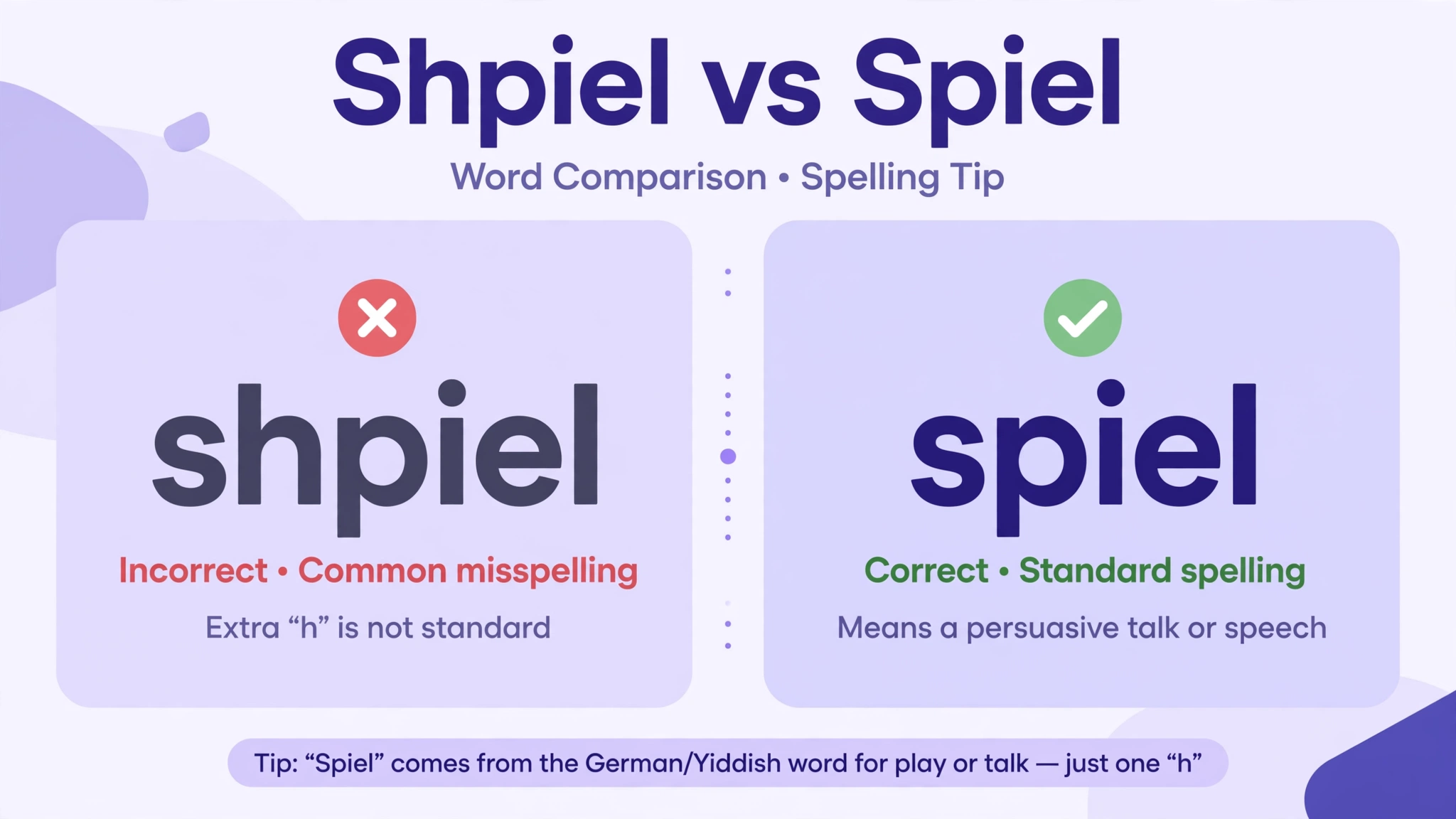
Shpiel or Spiel: Which Is Correct?
If you’re choosing between shpiel and spiel, write spiel. It’s the spelling every major dictionary gives — for the noun (a rehearsed, persuasive pitch) and for the verb (to talk volubly or extravagantly). Shpiel is a phonetic respelling: it reflects the way the word is often pronounced, with a “sh” sound that came into English via Yiddish — but no standard dictionary lists it as the headword spelling. The pronunciation may go either way; the spelling doesn’t.
Quick Answer
Spiel is the dictionary spelling. As a noun it means “a fast speech that someone has often said before and that is usually intended to persuade people to buy something or to agree to something” (Merriam-Webster); as a verb it means “to talk volubly or extravagantly.” Shpiel mirrors the common /ʃpiːl/ (“shpeel”) pronunciation — Collins records both /spil/ and /ʃpil/ as pronunciations of spiel — but the standard written form keeps the German spelling: s-p-i-e-l.
What “Spiel” Means
The dictionaries agree on the core meaning, and it’s more specific than just “a speech.” Merriam-Webster’s Word of the Day entry defines the noun spiel as “a fast speech that someone has often said before and that is usually intended to persuade people to buy something or to agree to something” — “The founder gave us a long spiel about the benefits of joining the running club.” Collins COBUILD puts it similarly: “Someone’s spiel is a well-prepared speech that they make, and that they have usually made many times before, often in order to persuade you to buy something” — and marks it [informal].
Two nuances matter. First, a spiel is typically rehearsed — it’s the pitch the salesperson has delivered a hundred times, the candidate’s stump speech, the timeshare presentation. Second, it’s typically persuasive in intent — it wants something from you. That’s what separates a spiel from a mere long speech.
The verb works the same way. Merriam-Webster defines spiel as a verb meaning “to talk volubly or extravagantly” — “Paco whipped out his smartphone, logged on to Instagram Live, and began to spiel” (Los Angeles Times, cited by Merriam-Webster). And the person doing it is a spieler — Merriam-Webster’s noun entry: “one that spiels: the giver of a spiel,” including the carnival barker who attracts customers “by a voluble line of extravagant claims and skillful persuasion.”
“We let the salesman give us his opening spiel, but we cut him short at the high-pressure tactics.” (noun)
“Don’t give me your spiel about how you can fix my car.” (noun)
“She spieled for twenty minutes about the new policy.” (verb)
Where the “Sh” Comes From
Here’s the interesting part: the “sh” pronunciation is completely legitimate — it’s the spelling “shpiel” that isn’t standard. The word came into American English in the late 19th century from two directions at once. Merriam-Webster traces the noun to German Spiel (“play, game”) or Yiddish shpil (“play, game”), and the verb to German spielen (“to play”) — with the verb recorded from 1870 and the noun from 1896.
That double origin is the whole story. The German root is pronounced with a plain “sp-“; the Yiddish form is pronounced “shp-.” American English absorbed both, so both pronunciations survive — Collins lists them side by side for the single spelling spiel: (spil, ʃpil). When a writer hears the “sh” version and writes what they hear, “shpiel” is the natural result. It’s an honest phonetic spelling of a real pronunciation — it just isn’t the dictionary spelling.
A fun corroboration: spiel shares its German root with glockenspiel, the percussion instrument — literally “bell-play.” Nobody writes “glockenshpiel,” and the same German spelling logic holds for “spiel” itself.
Why “Shpiel” Isn’t the Standard Spelling
To be precise about the claim: the major references — Merriam-Webster, Collins (both the COBUILD learner’s dictionary and the full English dictionary) — list the headword as spiel, with no “shpiel” variant. The spellings “shpiel” and “schpiel” appear only in crowd-sourced alternative-form lists, which document what people type, not what dictionaries recommend. That’s a meaningful gap: a respelling that reflects pronunciation doesn’t become standard English just by being phonetically reasonable.
There’s a broader principle here. English is full of words whose spelling preserves their origin rather than their sound — the “k” in “knight,” the “gh” in “though,” the “ps” in “psychology.” “Spiel” is one of them: the spelling preserves the German root even where the Yiddish-influenced pronunciation says “sh.” Standard spelling follows the dictionaries, not the ear.
One practical note: because the word is marked [informal] in Collins, you’ll mostly meet it in journalism, dialogue, and casual prose rather than formal academic writing. But informal doesn’t mean misspelled — in every register where the word appears, it’s “spiel.”
The Verb Forms
Since spiel works as both noun and verb, it’s worth getting the inflections right:
| Form | Spelling | Example |
|---|---|---|
| Base (noun/verb) | spiel | “Give us your spiel.” / “He loves to spiel.” |
| Plural noun | spiels | “We’d heard their spiels before.” |
| Present participle | spieling | “…spieling judges, and taking pictures with fans” (Merriam-Webster) |
| Past tense | spieled | “She spieled for an hour.” |
| Agent noun | spieler | “a veteran spieler working the crowd” |
Note the plural: spiels, not “spieles.” And the verb inflects regularly — no apostrophes, no hyphens, no respelling.
Correct vs Incorrect
- ✗ “He launched into his usual shpiel about the product.” → ✓ “He launched into his usual spiel about the product.”
- ✗ “Save your schpiel for someone who cares.” → ✓ “Save your spiel for someone who cares.”
- ✗ “The candidates delivered their spieles.” → ✓ “The candidates delivered their spiels.”
- ✗ “She shpieled for an hour.” → ✓ “She spieled for an hour.”
Common Mistakes
1. Writing “shpiel” or “schpiel.” ✗ “his sales shpiel” → ✓ “his sales spiel.” The most common error — a phonetic spelling of a real pronunciation, but not the dictionary form.
2. Writing “speil” (transposed vowels). ✗ “speil” → ✓ “spiel.” The ie-after-sp order is fixed; “speil” is simply a typo.
3. Pluralizing as “spieles.” ✗ “their spieles” → ✓ “their spiels.” Collins lists the plural explicitly: spiels.
4. Using “spiel” for any long speech. A rambling monologue isn’t automatically a spiel — the word implies something rehearsed and persuasive. “His spiel about the weather” misfires unless he’s selling you an umbrella.
5. Calling the person a “spiel.” ✗ “He’s a real spiel.” → ✓ “He’s a real spieler.” The pitch is the spiel; the pitcher is the spieler.
6. Overcorrecting the pronunciation. Insisting on “speel” and correcting people who say “shpeel” — both pronunciations are recorded in Collins. The spelling is fixed; the pronunciation isn’t.
How to Remember It
Spiel keeps its German passport. However you say it — “speel” or “shpeel” — the spelling stays German: s-p-i-e-l, the way it came from Spiel (“play, game”). Think of glockenspiel: same German root, same sp- spelling, and nobody is tempted to write “glockenshpiel.” If the bell instrument keeps its sp-, so does the sales pitch.
Frequently Asked Questions
Is “shpiel” ever correct?
Not in standard English. It’s a phonetic respelling that reflects the Yiddish-influenced /ʃpiːl/ pronunciation, and it appears in crowd-sourced variant lists — but no major dictionary (Merriam-Webster, Collins, Cambridge, Oxford) lists it as a headword or variant. In edited writing, use “spiel.”
How do you pronounce “spiel”?
Either /spil/ (“speel”) or /ʃpil/ (“shpeel”) — Collins records both pronunciations under the single spelling “spiel.” The “sh” version comes via Yiddish shpil; the “s” version via German Spiel.
Is “spiel” a noun or a verb?
Both. The noun is the persuasive, often-rehearsed pitch (“his sales spiel”); the verb means to talk volubly or extravagantly (“she spieled for an hour”). Merriam-Webster records the verb from 1870 and the noun from 1896.
What’s a “spieler”?
One who spiels — the giver of a spiel. Merriam-Webster’s entry includes the carnival barker who draws customers with extravagant talk, and the term extends to any fluent, high-pressure persuader.
Is “spiel” slang?
It’s informal rather than slang — Collins marks it [informal], but it’s recorded in every major dictionary with a settled spelling and full verb forms. It’s at home in journalism, dialogue, and everyday prose.
What’s the plural of “spiel”?
Spiels — “we’d heard their spiels a dozen times.” Not “spieles.”
Where does the word come from?
From German Spiel (“play, game”) via Yiddish shpil, entering American English in the late 1800s. The verb’s oldest recorded sense is actually “to play music” — the persuasive-talk sense came later.
Is it related to “glockenspiel”?
Yes — same German root (Spiel, “play”). A glockenspiel is literally “bell-play.” The shared root is also a handy spelling anchor: if “glockenspiel” keeps its sp-, so does “spiel.”
Final Takeaway
Spiel is the spelling — the dictionary headword for the rehearsed, persuasive pitch and for the verb “to talk volubly,” with both the “speel” and “shpeel” pronunciations recorded under that one spelling. Shpiel is what the word sounds like in its Yiddish-influenced pronunciation, written out phonetically — understandable, but not standard. Keep the German spelling, pluralize it as spiels, and let the “sh” live in your pronunciation, not on the page.