Palet or Pallet: Which Is Correct?
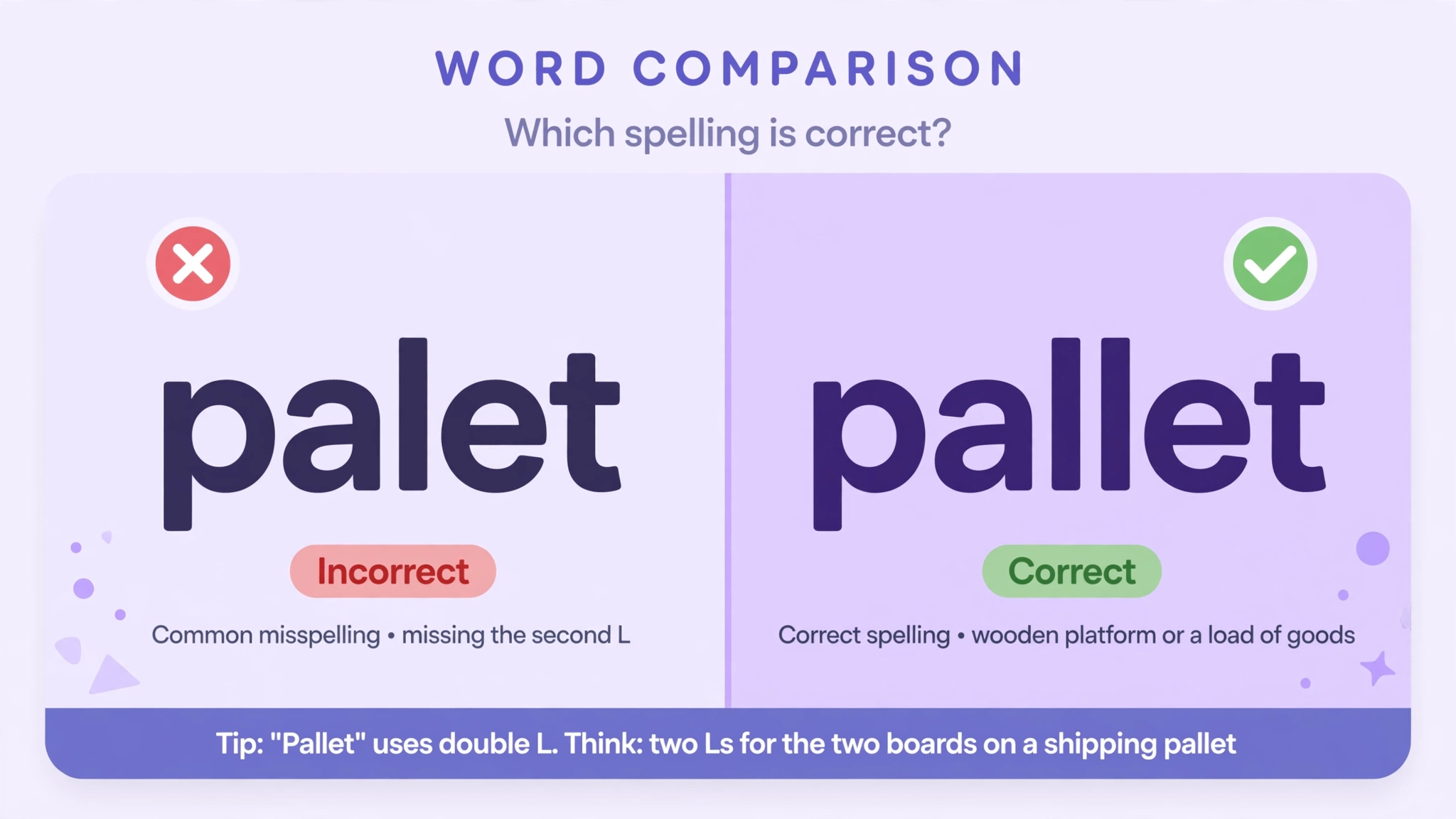
If you’re choosing between palet and pallet, the answer depends on what you mean — but for almost everything you’ll ever write, the answer is pallet, with two l’s. It’s the standard spelling for the wooden platform that goods are stacked on, the straw-filled mattress or makeshift bed, and the craftsman’s shaping tool. Palet, with one l, is not a variant spelling of any of those. It’s a separate, rare technical word you’ll only meet in heraldry — a narrow vertical band on a shield — and in botany, where it’s another name for a flower’s palea. Same pronunciation, completely different word. In everyday writing, “palet” is simply a misspelling.
Quick Answer
Pallet (double l) is correct for the shipping platform (“a pallet of bricks”), the straw mattress or makeshift bed (“sleeping on a pallet on the floor”), and the potter’s or gilder’s tool. Palet (single l) is a different, rare word: in heraldry, a diminutive of the pale (a vertical band on a shield); in botany, another name for a palea, part of a flower. Both are pronounced /ˈpælɪt/ (“PAL-it”) — which is exactly why the wrong one keeps appearing where it doesn’t belong.
What “Pallet” Means: Three Everyday Senses
Collins COBUILD lists three current senses of pallet, and they’re the three you’ll actually encounter:
- The platform. “A pallet is a flat wooden or metal platform on which goods are stored so that they can be lifted and moved using a forklift truck.” This is the warehouse sense — “the warehouse will hold more than 90,000 pallets” — and by far the most common in modern business writing.
- The straw bed. “A pallet is a narrow mattress filled with straw which is put on the floor for someone to sleep on.” Merriam-Webster gives it as “a straw-filled tick or mattress; a small, hard, or temporary bed.” You’ll meet this one in literature and historical writing — the humble pallet in the corner of a room.
- The craftsman’s tool. A flat-bladed instrument with a handle, used by potters for shaping clay, by gilders for lifting gold leaf, and by bookbinders — “a shaping tool used by potters and consisting of a flat blade or plate with a handle at one end” (Collins).
Here’s a detail worth knowing: pallet is actually two different historical words that converged on the same spelling. The American Heritage Dictionary traces them separately — the straw-bed word comes through Middle English paillet, from Old French paille (“straw,” from Latin palea), while the platform/tool word comes through Middle English palet, from Old French palete (“small potter’s shovel”). Yes — the single-l palet is literally the medieval ancestor of the tool/platform word. But ancestors aren’t spellings: in modern English, every one of these senses is spelled with two l’s.
“Stack the boxes on a pallet before the forklift arrives.” (platform)
“He slept on a pallet on the floor of the cabin.” (straw bed)
“She smoothed the clay with a wooden pallet.” (tool)
What “Palet” Actually Is
So the single-l form isn’t just an error floating in the void — it’s a real word with real dictionary entries, just not in the senses anyone is asking about. Here’s what the references record:
- Heraldry. Noah Webster’s 1828 dictionary defines palet as “a perpendicular band upon an escutcheon, one half the breadth of the pale” — a narrow vertical stripe on a coat of arms, the diminutive of the pale. This is also the origin Collins gives for one branch of the “pallet” family tree.
- Botany. The same 1828 entry gives a second sense: “Same as palea” — the small bract or scale in a flower head, particularly in grasses. Merriam-Webster’s word lists still carry palet with exactly this definition (“a palea”), which is why it’s even legal in Scrabble.
That’s the complete modern territory of palet: shields and flowers. Unless you’re describing a coat of arms or a grass floret, you don’t need this word — and using it for a shipping platform is wrong in every dictionary. The honest summary: palet is a word, but it’s never the word you want when you mean the platform, the bed, or the tool.
Why the Confusion Happens
Three forces keep the single-l spelling alive in the wrong places:
- Identical pronunciation. Both are /ˈpælɪt/ — “PAL-it.” There is nothing in the sound to tell you how many l’s to write, so the spelling has to be memorized. The same silent-letter trap sits behind plenty of spelling questions: if you can’t hear the difference, you have to know it.
- Single-l looks “simpler.” English is full of single-l words, and a writer guessing under pressure will often reach for the shorter form. The guess feels economical; it’s just wrong here.
- Interference from “palette.” The artist’s board — spelled palette — is the word most people meet first in this family, and its single-l start nudges writers toward “palet.” But “palette” is a different word entirely (see below), and its spelling is no guide to “pallet.”
The Four-Way Trap: Palet, Pallet, Palate, Palette
Collins attaches an explicit usage warning to its “pallet” entry: “Avoid confusion with palette, palate.” It’s worth taking that warning seriously, because this is a genuine four-way confusable — four words, one pronunciation family, four meanings:
| Word | Meaning | Example |
|---|---|---|
| pallet | shipping platform; straw bed; craftsman’s tool | “a pallet of bricks” |
| palet | heraldic band; flower’s palea (rare, technical) | “a palet on the shield” |
| palate | roof of the mouth; the sense of taste | “a discerning palate“ |
| palette | artist’s mixing board; a range of colors | “the painter’s palette“ |
A spellchecker won’t save you here — all four are valid spellings, so none gets flagged. Only meaning tells you which one you need. When in doubt, ask what the sentence is about: platforms and beds → pallet; mouths and taste → palate; paint and color → palette; shields and flowers → palet (and you’ll almost never need that last one).
Correct vs Incorrect
- ✗ “The shipment arrived on wooden palets.” → ✓ “The shipment arrived on wooden pallets.”
- ✗ “They slept on palets laid on the floor.” → ✓ “They slept on pallets laid on the floor.”
- ✗ “He shaped the vase with a potter’s palet.” → ✓ “He shaped the vase with a potter’s pallet.”
- ✓ “The shield bore a narrow palet down its center.” (heraldry — correct, and almost the only place you’ll write it)
Common Mistakes
1. Writing “palet” for the shipping platform. ✗ “a palet of goods” → ✓ “a pallet of goods.” The single most common error — and the one this article exists to fix.
2. Writing “palet” for the straw bed. ✗ “a straw palet” → ✓ “a straw pallet.” Same word, same double l.
3. Writing “palette” for the platform. ✗ “stacked on a wooden palette” → ✓ “stacked on a wooden pallet.” The -ette ending belongs to the artist’s board and to color ranges, not to warehouses.
4. Writing “pallet” for the roof of the mouth. ✗ “the pallet of the mouth” → ✓ “the palate of the mouth.” Different word, different spelling.
5. Writing “palate” for the artist’s board. ✗ “mixing colors on his palate” → ✓ “mixing colors on his palette.” Painters use palettes; tasters have palates.
6. Pluralizing as “palets.” ✗ “twenty palets” → ✓ “twenty pallets.” Collins lists the plural explicitly: pallets.
7. Assuming “palet” must be a variant because it’s old. It’s true that Middle English used “palet” — it’s the recorded ancestor of the tool/platform word. But etymology isn’t spelling: the modern standard form is “pallet,” full stop.
How to Remember It
Think of what a pallet does: it carries a double load — goods stacked high, a whole mattress, a craftsman’s full toolkit of meanings. So it gets a double l. Or picture the platform itself: it’s built from parallel slats, and the two l’s in “pallet” are two slats side by side. The lonely single-l “palet” is left for the lonely specialists — heraldists and botanists — who are the only people who need it.
Frequently Asked Questions
Is “palet” a word at all?
Yes — but a rare technical one. It’s recorded as a heraldry term (a narrow vertical band on a shield, half the breadth of the pale) and a botany term (another name for a palea, part of a flower). It is not a variant spelling of “pallet” in any modern sense.
What’s the plural of “pallet”?
Pallets — “a warehouse full of pallets.” Never “palets” for the platform or bed.
What’s the difference between “pallet,” “palette,” and “palate”?
Pallet = shipping platform, straw bed, craftsman’s tool. Palette = artist’s mixing board; a range of colors. Palate = roof of the mouth; the sense of taste. Collins explicitly warns against confusing them.
Is there a verb “pallet”?
Yes — “to pallet” means to place goods on a pallet (“pallet the cartons before loading”), with forms palleted, palletting. Same double-l spelling throughout.
Do British and American English spell it differently?
No. Pallet is the standard spelling on both sides of the Atlantic, and the pronunciation (/ˈpælɪt/) is the same too.
How do you pronounce “pallet”?
/ˈpælɪt/ — “PAL-it,” stress on the first syllable. “Palet,” “palette,” and “palate” are all pronounced the same way, which is precisely why the spelling has to be learned, not sounded out.
Why does “palet” appear in old books?
Because Middle English spelled the ancestor of the tool/platform word as “palet” (from Old French palete, “small shovel”). Spelling standardized with the double l centuries ago — an old spelling in an old book is history, not permission.
Final Takeaway
Pallet — double l — is the word for the platform, the straw bed, and the tool: the spelling every dictionary gives for every everyday sense. Palet — single l — is a real but rare word confined to heraldry and botany, and it is never correct for platforms, beds, or tools. Keep the lookalikes straight (palate for taste, palette for paint), remember the double load gets the double l, and you’ll never misspell it again.