45 Other Ways to Say “You’re Welcome” for Any Situation
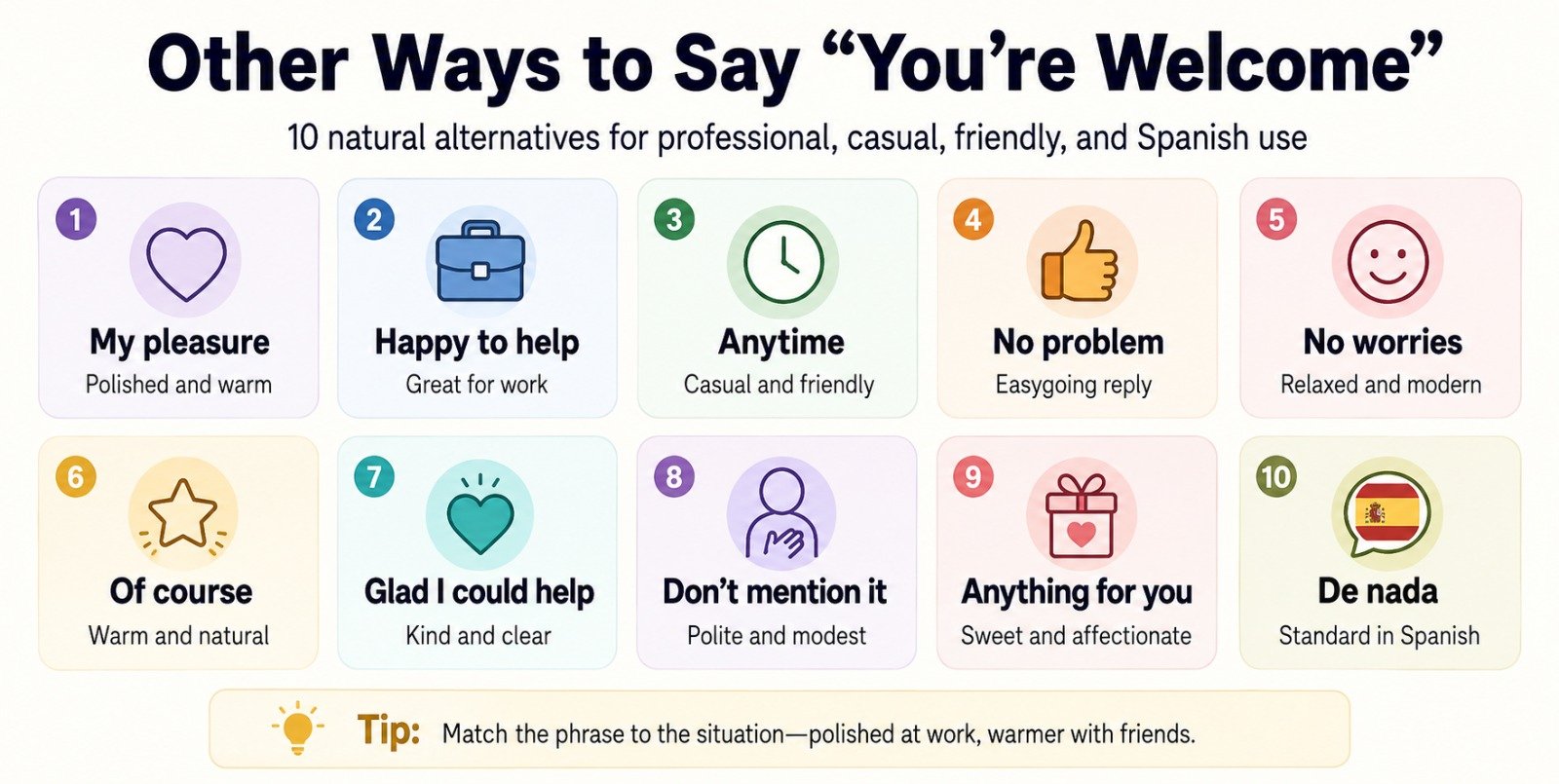
“You’re welcome” is one of the safest and most familiar responses to “thank you,” but it isn’t always the best fit. A client email may call for something polished like “My pleasure,” while a friend might appreciate “Anytime,” and a romantic text could sound warmer with “Anything for you.”
These other ways to say you’re welcome give you more control over your tone. Some sound professional, some casual, some affectionate, and a few are playful or flirty. The key is choosing an expression that matches the relationship and situation rather than treating every alternative as interchangeable.
A Quick Guide to Different Ways to Say You’re Welcome
| Phrase | Tone | Best Used For |
|---|---|---|
| My pleasure | Polished, warm | Clients, customers, formal conversations |
| Happy to help | Friendly, professional | Coworkers, emails, support |
| Glad I could help | Warm, neutral | Everyday and workplace situations |
| Anytime | Casual, friendly | Friends, coworkers, texts |
| No problem | Relaxed | Informal conversations |
| No worries | Very casual | Friends and familiar coworkers |
| Of course | Warm, reassuring | Friends, family, supportive situations |
| Don’t mention it | Polite, modest | Everyday conversation |
| The pleasure was mine | Formal, gracious | Meetings, introductions, professional settings |
| Anything for you | Affectionate | Partners, close friends |
| I’ve got you | Supportive, casual | Friends and family |
| You can thank me over dinner | Flirty, playful | Romantic conversations |
| De nada | Neutral Spanish | General response to “gracias” |
| Con gusto | Warm Spanish | Friendly or service situations |
You May Also Read | 25 Other Ways to Say “Hope You Had a Great Weekend” Naturally
Professional Ways to Say You’re Welcome
Professional responses should acknowledge someone’s gratitude without sounding overly familiar. “You’re welcome” itself is perfectly acceptable in business communication, but alternatives can help you sound warmer or more specific.
Other Ways to Say “You’re Welcome” Professionally
1. My pleasure
A polished response that suggests you were genuinely happy to help.
Example:
“Thank you for preparing the documents so quickly.”
“My pleasure.”
2. Happy to help
Friendly, modern, and appropriate in many workplace settings.
Example:
“Thanks for explaining the new process.”
“Happy to help.”
3. Glad I could assist
More formal than “glad I could help,” making it suitable for clients or customers.
Example:
“Thank you for resolving the issue.”
“Glad I could assist.”
4. It was my pleasure
A slightly more formal version of “my pleasure.”
Example:
“Thank you for taking the time to meet with us.”
“It was my pleasure.”
5. Always happy to help
Useful when you want to signal that the person can rely on you again.
Example:
“Thanks for reviewing the proposal.”
“Always happy to help.”
6. I’m glad I could be of assistance
A traditional and formal option that works well in customer service or business correspondence.
Example:
“Thank you for helping us solve the billing problem.”
“I’m glad I could be of assistance.”
7. I’m pleased I could help
Professional without sounding stiff.
Example:
“Thank you for clarifying the requirements.”
“I’m pleased I could help.”
8. The pleasure was mine
Gracious and slightly formal. It is especially natural after a meeting, introduction, or conversation.
Example:
“Thank you for meeting with me today.”
“The pleasure was mine.”
Different Ways to Say You’re Welcome Professionally in an Email
In email, you often have room to do more than simply acknowledge the thank-you. A good response can also keep the conversation open or confirm that you were happy to assist.
Other Ways to Say “You’re Welcome” in an Email
9. Happy to help. Please let me know if you need anything else.
This is useful when the recipient may need further assistance.
10. My pleasure. Feel free to reach out with any other questions.
Warm but still professional.
11. I’m glad I could help with this.
A simple response when you solved a specific problem.
12. It was my pleasure to assist.
More formal and suitable for clients, customers, or senior contacts.
13. You’re very welcome. I’m glad we could get this resolved.
Works well after completing a task or fixing an issue.
14. Always happy to support the team.
Best for internal workplace communication.
15. I’m pleased everything worked out.
Useful when your help contributed to a positive result.
Professional writing guidance commonly recommends adapting your response to the relationship and level of formality rather than forcing a highly formal expression into every email.
Casual Ways to Say You’re Welcome
Casual expressions are ideal for friends, family members, classmates, and coworkers you know well.
Other Ways to Say “You’re Welcome” Casually
16. Anytime
Short and friendly. It also suggests you would willingly help again.
Example:
“Thanks for giving me a ride.”
“Anytime.”
17. No problem
Relaxed and common in everyday conversation.
Example:
“Thanks for sending me the notes.”
“No problem.”
18. No worries
Very informal and easygoing.
Example:
“Thanks for waiting for me.”
“No worries.”
19. Of course
This can communicate that helping the person felt natural.
Example:
“Thanks for checking on me.”
“Of course.”
20. You got it
Upbeat and conversational.
Example:
“Thanks for grabbing me a coffee.”
“You got it.”
21. Don’t mention it
A polite way to minimize the effort involved.
Example:
“Thank you for helping me carry these boxes.”
“Don’t mention it.”
22. It was nothing
Useful for a small favor, though it can sound dismissive if someone is expressing deep gratitude.
Example:
“Thanks for fixing the shelf.”
“It was nothing.”
23. Sure thing
Casual and cheerful.
Example:
“Thanks for covering my shift.”
“Sure thing.”
24. Absolutely
Friendly and confident, especially when the favor was something you were happy to do.
Example:
“Thanks for coming with me.”
“Absolutely.”
Friendly Ways to Say You’re Welcome
Friendly responses can show warmth without becoming romantic.
Other Ways to Say “You’re Welcome” to a Friend
25. Glad I could help
One of the most natural all-purpose responses.
Example:
“Thanks for helping me move.”
“Glad I could help.”
26. I’ve got you
Supportive and informal.
Example:
“Thank you for being there yesterday.”
“I’ve got you.”
27. That’s what friends are for
Warm and reassuring when the favor relates to friendship or emotional support.
Example:
“Thanks for listening to me all night.”
“That’s what friends are for.”
28. You can count on me
This carries more emotional weight than a simple “you’re welcome” because it emphasizes dependability.
Example:
“Thank you for showing up when I needed someone.”
“You can count on me.”
29. I’m always here if you need me
Best after meaningful help rather than a tiny everyday favor.
Example:
“Thanks for talking me through everything.”
“I’m always here if you need me.”
30. No need to thank me
A warm way to suggest that helping was natural.
Example:
“Thank you for staying with me.”
“No need to thank me.”
Cute Ways to Say You’re Welcome
Cute responses work best when you already share a close, affectionate relationship with the other person.
Other Ways to Say “You’re Welcome” in a Cute Way
31. Anything for you
Sweet and affectionate without necessarily being romantic.
Example:
“Thanks for bringing my favorite snack.”
“Anything for you.”
32. Always
One word can be enough when the relationship is close.
Example:
“Thanks for being there for me.”
“Always.”
33. You deserve it
A good response when someone thanks you for a gift or kind gesture.
Example:
“Thank you for the surprise!”
“You deserve it.”
34. You never have to thank me
Warm and personal, especially when someone close to you is expressing heartfelt gratitude.
Example:
“Thank you for always listening.”
“You never have to thank me.”
35. Anytime, sunshine
Playful and cute, but too familiar for professional situations.
Example:
“Thanks for cheering me up.”
“Anytime, sunshine.”
36. Seeing you happy is enough
Best for affectionate relationships.
Example:
“Thank you for making today special.”
“Seeing you happy is enough.”
Flirty Ways to Say You’re Welcome
Flirty responses do more than acknowledge gratitude; they turn the exchange into playful conversation. They should generally be used only when there is already mutual comfort or romantic interest.
Other Ways to Say “You’re Welcome” Flirtatiously
37. For you? Anytime.
The pause gives an ordinary expression a more personal tone.
Example:
“Thanks for bringing me coffee.”
“For you? Anytime.”
38. You can thank me over dinner
A playful way to turn the moment into an invitation.
Example:
“Thanks for saving me with those notes.”
“You can thank me over dinner.”
39. I might let you return the favor
Light teasing that keeps the conversation open.
Example:
“Thanks for helping me out.”
“I might let you return the favor.”
40. Seeing you smile is thanks enough
Romantic and complimentary.
Example:
“Thank you for the surprise.”
“Seeing you smile is thanks enough.”
41. Careful, I might start spoiling you
Best when playful flirting is already part of the relationship.
Example:
“Another coffee? Thank you!”
“Careful, I might start spoiling you.”
42. I’ll accept coffee as repayment
A softer, humorous version of asking to return the favor.
Example:
“Thanks for covering for me.”
“I’ll accept coffee as repayment.”
Short Ways to Say You’re Welcome in a Text
Text messages usually favor shorter expressions. The relationship matters more than formality.
Other Ways to Say “You’re Welcome” Over Text
Try:
- Anytime!
- Of course!
- No worries!
- Got you.
- Always.
- No problem 🙂
- Happy to help!
- You know I’ve got you.
- Don’t mention it.
- Anything for you.
- Sure thing!
- Absolutely!
A message such as “Always” can feel affectionate, while “Happy to help!” remains friendly and neutral. “Anything for you” can sound romantic depending on the relationship.
Ways to Say You’re Welcome in Spanish
The standard Spanish response to thanks is “de nada.” Dictionaries also recognize “no hay de qué” as a natural response to gratitude.
There are other possibilities, but some vary by region and context.
Other Ways to Say “You’re Welcome” in Spanish
43. De nada
The safest and most widely understood choice.
Meaning: “You’re welcome.”
Example:
“Gracias por tu ayuda.”
“De nada.”
44. No hay de qué
A polite expression similar to “don’t mention it” or “there’s nothing to thank me for.”
Example:
“Muchas gracias.”
“No hay de qué.”
45. Con gusto
Literally connected with doing something “with pleasure.” It is a warm response and is particularly common in many Latin American contexts.
Example:
“Gracias por ayudarme.”
“Con gusto.”
More Natural Spanish Options
Con mucho gusto adds extra warmth and can mean something close to “with great pleasure.”
Es un placer means “it’s a pleasure” and can sound more polished.
A la orden is used in service and commercial interactions in some Latin American countries, especially places such as Colombia. It is closer to “at your service” than a universal direct equivalent of “you’re welcome.”
One important distinction: bienvenido/bienvenida is not normally the response to “gracias.” It means “welcome” in the sense of welcoming someone to a place or situation. For responding to thanks, de nada is the standard choice.
Not Every Alternative Means Exactly the Same Thing
The expressions above overlap, but they don’t all communicate the same message.
“My pleasure” emphasizes that you were happy to help.
“No problem” emphasizes that the favor caused no inconvenience.
“Anytime” suggests willingness to help again.
“Of course” can imply that helping was natural or expected.
“Anything for you” adds affection and may sound romantic.
“You can thank me over dinner” is not a neutral synonym at all; it deliberately turns the exchange into flirting.
This distinction matters. A phrase that feels charming in a romantic text could be inappropriate in a client email, while a highly formal response might sound unnatural between close friends.
Choosing the Best Response to “Thank You”
A useful approach is to think about what you want your response to communicate.
For a client or customer, choose something polished such as “My pleasure” or “Glad I could assist.”
For a coworker, “Happy to help” usually feels professional without being stiff.
For a friend, “Anytime,” “No worries,” or “I’ve got you” may sound more natural.
For a partner or romantic interest, affectionate phrases such as “Anything for you” can work if they suit the relationship.
For heartfelt gratitude, avoid responses that may unintentionally minimize what happened. If someone sincerely thanks you for significant emotional support, “I’m glad I could be there for you” may feel more considerate than “It was nothing.”
Common Mistakes to Avoid
Don’t Make a Formal Situation Too Casual
“No worries” may be perfectly natural with coworkers, but “My pleasure” or “Happy to help” is usually safer when communicating with a new client or senior professional.
Don’t Make a Meaningful Thank-You Sound Unimportant
Phrases such as “it was nothing” deliberately minimize the favor. That can be reassuring after a small task, but less suitable after something emotionally significant.
Don’t Use Flirty Responses Without the Right Relationship
“You can thank me over dinner” clearly changes the tone of the conversation. It isn’t simply a creative synonym for “you’re welcome.”
Don’t Confuse the Two Meanings of “Welcome” in Spanish
When responding to gracias, use expressions such as de nada. When welcoming someone to a place, bienvenido/bienvenida is appropriate.
Frequently Asked Questions
What Are Some Other Ways to Say You’re Welcome?
Natural alternatives include my pleasure, happy to help, glad I could help, anytime, no problem, no worries, of course, don’t mention it, and the pleasure was mine. The best option depends on how formal or personal the situation is.
What Is a Professional Way to Say You’re Welcome?
“My pleasure,” “Happy to help,” “Glad I could assist,” and “It was my pleasure” are strong professional choices. In an email, you can also add a useful follow-up such as, “Please let me know if you need anything else.”
Is “No Problem” Rude Instead of “You’re Welcome”?
Usually not. “No problem” is widely used in casual conversation and emphasizes that helping caused no inconvenience. However, “my pleasure” or “happy to help” can sound more polished in formal business communication.
What Is a Cute Way to Respond to Thank You?
Depending on your relationship, try “Anything for you,” “Always,” “You deserve it,” or “You never have to thank me.” These responses communicate more affection than a neutral “you’re welcome.”
What Is a Flirty Response to Thank You?
Playful options include “For you? Anytime,” “You can thank me over dinner,” and “I might let you return the favor.” These change the interaction from simple politeness to flirting, so they should fit the existing relationship.
What Can I Say Instead of You’re Welcome in a Work Email?
Try “Happy to help,” “My pleasure,” “Glad I could assist,” or “I’m glad I could help with this.” You can make the reply more useful by adding, “Feel free to reach out if you have any other questions.”
How Do You Say You’re Welcome in Spanish?
The standard response is “de nada.” “No hay de qué” is another natural option, while “con gusto” is a warm expression common in many Latin American settings.
Is “Anytime” a Good Response to Thank You?
Yes, particularly in casual and friendly situations. It has the added implication that you would be willing to help the person again, which makes it warmer than a simple acknowledgment.
Conclusion
The best response to “thank you” depends less on finding a perfect synonym and more on matching the moment. “My pleasure” suits polished communication, “Happy to help” works naturally at work, “Anytime” feels relaxed, and affectionate or flirty responses belong in relationships where that tone is already comfortable.
Small wording choices can signal professionalism, warmth, closeness, or humor. Clarifyra helps make those differences easier to recognize, so you can choose a way to say “you’re welcome” that sounds natural for the person, relationship, and situation.