Other Ways to Say “Have a Good Night”: 75+ Natural Alternatives for Any Situation
“Have a good night” is one of the easiest ways to end an evening conversation warmly. It works with friends, family, coworkers, customers, and even people you have just met. Still, there are times when Have a Good Night feels too routine, too formal, or simply not personal enough.
Depending on your relationship and the situation, you might say “Sleep well,” “Sweet dreams,” “Enjoy your evening,” or something more playful. The important part is choosing a phrase that matches what you actually mean: wishing someone an enjoyable evening is slightly different from wishing them restful sleep.
What Does “Have a Good Night” Mean?
“Have a good night” is a friendly farewell used in the evening or at night. It expresses the hope that the other person enjoys the rest of their evening, gets some rest, or simply has a pleasant night.
For example:
“Thanks for coming over. Have a good night!”
It is usually a farewell rather than a greeting.
If you arrive at a restaurant at 7 p.m., “Good evening” sounds natural as a greeting. When you leave the restaurant later, “Have a good night” is more appropriate.
The expression is neutral enough for most situations, but the alternatives below can make your message warmer, more affectionate, more professional, or more playful.
Quick Comparison: Which Good-Night Phrase Should You Use?
| Expression | Tone | Best Used For |
|---|---|---|
| Have a good night | Neutral, friendly | Almost any evening farewell |
| Sleep well | Warm, caring | Someone going to bed |
| Sweet dreams | Affectionate | Partners, family, close friends |
| Rest well | Caring, calm | Someone who is tired |
| Enjoy your evening | Polite, neutral | Work, customers, early evening |
| Have a peaceful night | Warm, thoughtful | Friends, family, supportive messages |
| See you tomorrow | Casual | Coworkers, friends, classmates |
| Sleep tight | Playful, affectionate | Children, partners, close family |
| Take care tonight | Warm | Friends or someone traveling home |
| Catch some Z’s | Humorous, casual | Close friends |
These aren’t all interchangeable. “Enjoy your evening,” for example, makes sense when someone still has several hours of their evening ahead. “Sleep well” only fits when sleep is actually relevant.
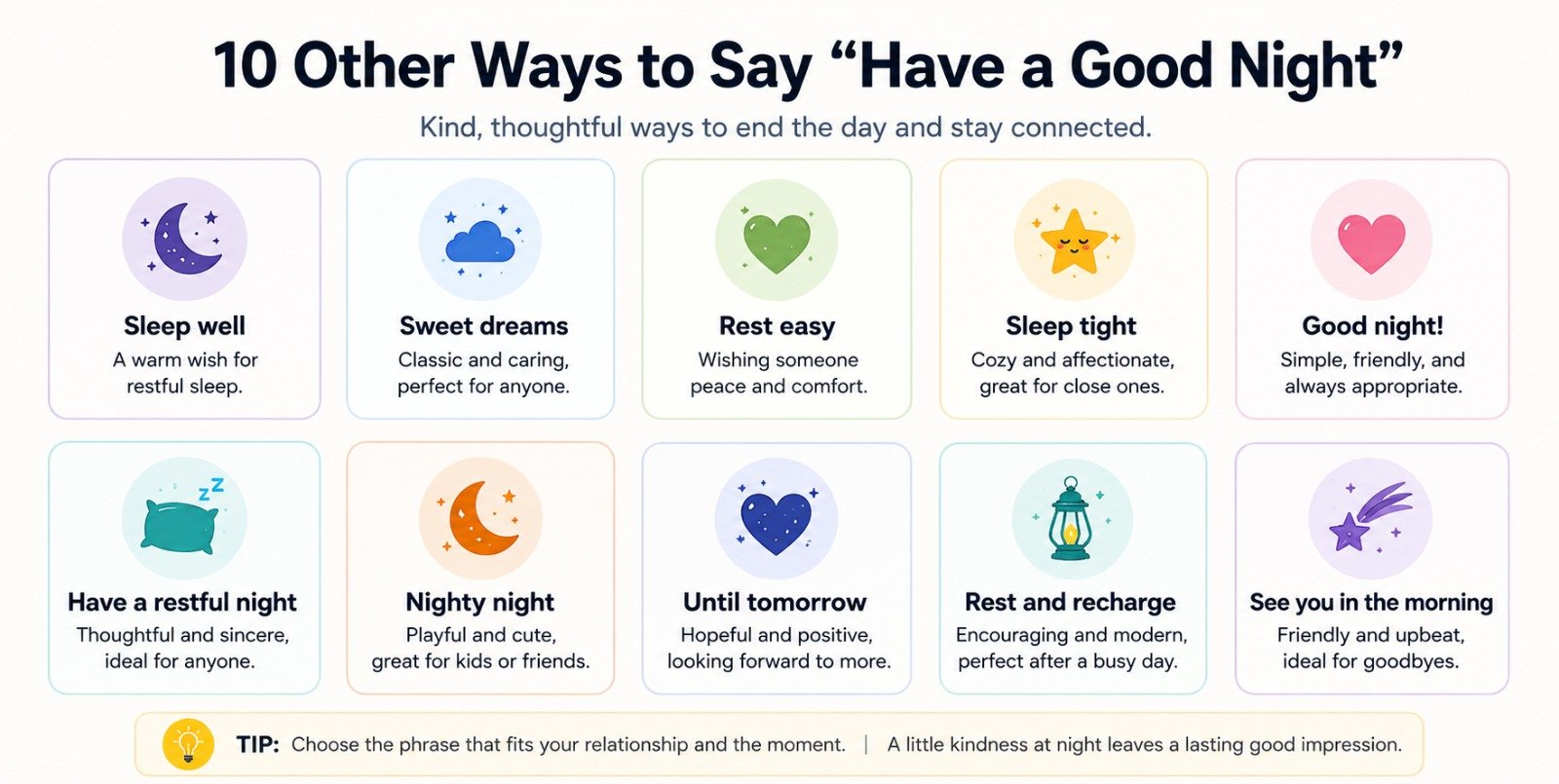
Other Ways to Say “Have a Good Night”
For everyday conversations, these alternatives sound natural without being overly affectionate or formal.
- Sleep well
- Rest well
- Have a restful night
- Have a peaceful night
- Enjoy your evening
- Enjoy the rest of your evening
- Have a relaxing evening
- Have a pleasant evening
- Take care tonight
- See you tomorrow
- Get some good rest
- Hope you sleep well
- Hope you have a relaxing night
- Have a lovely evening
- Rest easy
Sleep well
“Sleep well” is one of the closest alternatives when the person is actually heading to bed.
Example:
“It’s been a long day. Sleep well!”
It is warm without sounding romantic, so you can use it with friends, relatives, and partners.
Rest well
“Rest well” puts more emphasis on recovery than sleep itself. It works especially well when someone has had a tiring or stressful day.
Example:
“You’ve done enough for today. Rest well tonight.”
Enjoy the rest of your evening
This is a good alternative when someone isn’t necessarily going to bed yet.
Example:
“Thanks for joining us. Enjoy the rest of your evening.”
Because it doesn’t refer to sleep, it works well with coworkers, customers, acquaintances, and professional contacts.
Have a peaceful night
This sounds softer and slightly more thoughtful than the standard phrase.
Example:
“I hope things feel easier tomorrow. Have a peaceful night.”
It can be comforting, although it may sound more personal than a routine workplace farewell.
Friendly and Casual Ways to Say Good Night
With friends, you don’t always need a complete or polished sentence. Casual English often becomes shorter.
- Night!
- Goodnight!
- Night, then!
- See you tomorrow.
- Catch you tomorrow.
- Talk tomorrow.
- Later!
- Get some rest.
- Have a chill night.
- Enjoy your night.
- Don’t stay up too late.
- Hope you get some sleep.
- Time to call it a night.
- Have a relaxing one.
- Take it easy tonight.
“Night!”
Simply saying “Night!” is common with people you know well. It sounds much more casual than “Have a good night.”
“I’m heading upstairs. Night!”
You probably wouldn’t use it as your first choice with a client or in a formal business email.
“Talk tomorrow”
“Talk tomorrow” doesn’t literally wish someone a good night. Instead, it closes the conversation while showing that you expect to reconnect soon.
“I’m exhausted, so I’m logging off. Talk tomorrow!”
That makes it particularly natural in text messages and online chats.
Sweet and Affectionate Ways to Say “Have a Good Night”
When you’re speaking to someone you care about, you may want a warmer expression.
- Sweet dreams.
- Sleep tight.
- Sleep peacefully.
- Dream sweetly.
- Hope you have beautiful dreams.
- Have the sweetest dreams.
- Rest easy tonight.
- Sleep well, sweetheart.
- Goodnight, sleepyhead.
- Hope you wake up refreshed.
- Sending you peaceful thoughts tonight.
- Have a cozy night.
- Dream happy thoughts.
- See you in the morning.
- Nighty night.
Sweet dreams
“Sweet dreams” is affectionate but flexible. Parents say it to children, partners use it with each other, and close friends may use it too.
Example:
“I’m heading to bed now. Sweet dreams!”
Sleep tight
“Sleep tight” sounds warm and slightly playful.
Example:
“Sleep tight. I’ll call you in the morning.”
It is more natural with children, partners, close relatives, or close friends than with professional contacts.
Nighty night
“Nighty night” is intentionally cute and informal. Adults sometimes use it playfully with partners, but it is also commonly associated with speaking to children.
It would sound strange in most professional situations.
Romantic Ways to Say “Have a Good Night” Over Text
Romantic good-night messages often do more than wish someone sleep. They can express affection, closeness, or anticipation about seeing the person again.
Here are some natural options:
- Sweet dreams, my love.
- Sleep well, beautiful.
- Sleep well, handsome.
- Goodnight, love.
- Wish I were there with you.
- Dream of me.
- I hope you sleep peacefully tonight.
- Can’t wait to see you tomorrow.
- Sending you a goodnight kiss.
- Sleep well. I’m thinking of you.
- Hope you wake up smiling.
- I wish I could say goodnight in person.
- Rest well, sweetheart.
- I’ll be thinking about you.
- Goodnight to my favorite person.
- Hope your dreams are as lovely as you are.
- Sleep peacefully, babe.
- Can’t wait to talk to you tomorrow.
- Have the sweetest dreams.
- Goodnight. I love you.
A romantic message should match the stage of the relationship. “Sleep well, I’m thinking of you” can feel affectionate without being intense, while “Goodnight, my love” implies a closer relationship.
Funny Ways to Say “Have a Good Night”
Humor works best with people who already understand your personality.
Try:
- Catch some Z’s.
- Go recharge your human battery.
- Time to power down.
- Report to dreamland.
- Go make friends with your pillow.
- May your alarm forget you exist.
- Enjoy your scheduled unconsciousness.
- Try not to fight the blankets tonight.
- Off to dreamland with you.
- Go negotiate with your pillow.
- May your dreams have better plots than TV.
- Don’t let tomorrow find you awake.
- Time to enter sleep mode.
- Shut down and reboot tomorrow.
- See you after your eight-hour disappearance.
Some familiar playful expressions, such as “Don’t let the bedbugs bite,” are deliberately silly rather than literal.
Example:
“Okay, I’m done texting for tonight. Go recharge your human battery.”
Funny alternatives shouldn’t normally be used when someone is upset, ill, grieving, or genuinely struggling to sleep.
Polite and Professional Alternatives
“Have a good night” is perfectly acceptable in many workplace situations. You don’t have to replace it simply because the conversation is professional.
However, these options may fit better depending on the time and relationship:
- Have a pleasant evening.
- Enjoy your evening.
- Enjoy the rest of your evening.
- Have a relaxing evening.
- Take care.
- Have a good evening.
- Have a restful evening.
- Wishing you a pleasant evening.
- Thank you, and enjoy your evening.
- I hope you have a restful evening.
- Have a lovely evening.
- Take care and have a good night.
For a coworker
“Thanks for helping me finish that report. Have a good night.”
or:
“I’m signing off for the day. Enjoy your evening.”
For a client
“Thank you for your time today. Have a pleasant evening.”
For customer service
“Thank you for calling. Have a good night.”
There is nothing unprofessional about the original expression when it matches the time of day.
“Good Night” vs. “Good Evening”
These two expressions are related but perform different jobs.
Good evening
“Good evening” is primarily a greeting.
“Good evening, everyone. Thanks for joining us.”
Good night
“Good night” is primarily a farewell, particularly late in the evening or when someone is going to bed.
“I’m heading home. Good night!”
Have a good evening
This is also a farewell, but it suggests that the person’s evening is still continuing.
“Thanks for stopping by. Have a good evening!”
Have a good night
This can be used later in the evening and often has a stronger sense of ending the day.
“It’s getting late. Have a good night!”
The exact boundary isn’t fixed by the clock. Context matters more than a particular hour.
“Have a Good Night” vs. “Sleep Well”
These phrases overlap, but they’re not identical.
Have a good night can refer to the entire night, including dinner, social plans, relaxation, traveling home, or sleeping.
Sleep well specifically refers to sleep.
Imagine a friend leaves your house at 8 p.m. to attend another event:
“Have a good night!”
sounds natural.
“Sleep well!”
would sound premature unless they’re heading home to bed.
Have a Good Night’s Sleep: Is This the Correct Phrase?
The natural expression is:
Have a good night’s sleep.
Here, night’s is possessive.
For example:
“You look exhausted. I hope you have a good night’s sleep.”
Other natural versions include:
- Get a good night’s sleep.
- Hope you get a good night’s sleep.
- Sleep well tonight.
- Get some good rest.
- Rest well tonight.
People may type “have a good night sleep” informally, but when night describes the sleep as a possessive construction, “a good night’s sleep” is the standard form.
Compare:
Natural:
“I really need a good night’s sleep.”
Natural:
“I hope you sleep well tonight.”
Less standard:
“I really need a good night sleep.”
How to Say “Have a Good Night” in Spanish
There are several ways to express the idea in Spanish, and the right choice depends on what you mean.
Buenas noches
Buenas noches is the standard expression for “good night.” It can also function as an evening greeting in Spanish in situations where English speakers might say “good evening.”
Que tengas una buena noche
Que tengas una buena noche means approximately:
“Have a good night.”
This form is informal singular, so it suits someone you address as tú.
For example:
Gracias por venir. Que tengas una buena noche.
“Thanks for coming. Have a good night.”
Que tenga una buena noche
With someone you address formally as usted, you can say:
Que tenga una buena noche.
That makes the expression useful in polite service or professional situations.
How Do You Say “I Hope You Have a Good Night” in Spanish?
A natural version is:
Espero que tengas una buena noche.
This is appropriate when speaking informally to one person.
A slightly different natural construction is:
Espero que pases una buena noche.
Both express the idea that you hope the person has an enjoyable or pleasant night.
For formal singular address:
Espero que tenga una buena noche.
Spanish verb forms change according to the person you’re addressing, so the same English sentence may have more than one appropriate translation.
How to Say “Thank You, Have a Good Night” in Spanish
For an informal conversation with one person:
Gracias, que tengas una buena noche.
For a formal interaction with one person:
Gracias, que tenga una buena noche.
For multiple people:
Gracias, que tengan una buena noche.
This distinction is useful in restaurants, hotels, shops, and other situations where polite forms of address may matter.
How to Say “Have a Good Night” in French
French also distinguishes between wishing someone a pleasant evening and wishing them good night.
Bonne nuit
Bonne nuit means “good night.”
It is most natural when someone is going to bed or when the night is effectively over.
Bonne nuit !
“Good night!”
Bonne soirée
Bonne soirée is closer to:
“Have a good evening.”
Use it when the person still has an evening ahead of them.
For example, if you’re leaving a restaurant at 7:30 p.m., bonne soirée may fit better than bonne nuit.
This is an important distinction because translating “have a good night” word for word without considering the situation can produce wording that feels slightly off.
Have a Good Night GIF Ideas
Sometimes words aren’t the whole message. A Have a Good Night GIF can make a text feel warmer, funnier, or more expressive.
Common themes include:
- A sleepy cat curling up
- A moon appearing behind clouds
- Twinkling stars
- Someone dramatically falling into bed
- A waving character saying goodbye
- A cozy bedroom scene
- A sleeping puppy
- A cartoon character yawning
- A funny “powering down” animation
- A romantic moon-and-stars scene
Choose the style according to the recipient. A cute sleeping animal can work with friends and family, while an overly romantic animation might be awkward for a coworker.
You can also pair a GIF with a short message:
“Sleep well 😴”
or:
“That’s me done for the day. Night!”
Have a Good Night Meme Ideas
A Have a Good Night meme works when you want the farewell to feel humorous rather than sentimental.
Some relatable themes include:
- Saying you’re going to bed and still scrolling an hour later
- Setting five alarms and ignoring all of them
- Promising to sleep early before watching “one more episode”
- A pet refusing to leave the bed
- Someone collapsing into bed after work
- Checking the time and realizing it’s suddenly 2 a.m.
- Trying to sleep while remembering an embarrassing moment from years ago
For example, a meme could contrast:
9:30 p.m.: “I’m going to bed early tonight.”
with an image suggesting the person is still awake much later.
Memes work best with friends, partners, and casual group chats. For professional goodbyes, simple wording is safer.
Text Messages You Can Actually Send
Sometimes you don’t need dozens of alternatives. You just need a message that sounds natural.
To a friend
“I’m heading to bed. Hope you have a chill night!”
“Good talking to you. Sleep well!”
“Catch you tomorrow. Night!”
To your partner
“Sleep well, love. Can’t wait to see you tomorrow.”
“Goodnight ❤️ Hope you wake up feeling amazing.”
“Wish I could say goodnight in person. Sweet dreams.”
To a family member
“Get some rest. I’ll talk to you in the morning.”
“Have a peaceful night. Love you.”
To a coworker
“I’m signing off now. Enjoy your evening!”
“Thanks again for the help today. Have a good night.”
To someone who has had a difficult day
“I hope tonight gives you a chance to rest.”
“Take care of yourself tonight. Rest well.”
In the last situation, a calm and sincere phrase is usually better than a joke.
How to Choose the Right Good-Night Expression
The best alternative depends less on vocabulary and more on context.
Think about what the person is doing next
If they’re going straight to bed, use:
- Sleep well.
- Sweet dreams.
- Rest well.
If they’re continuing their evening, use:
- Enjoy your evening.
- Have a great night.
- Have fun tonight.
Consider your relationship
For a coworker:
“Enjoy your evening.”
For a close friend:
“Night! Talk tomorrow.”
For a partner:
“Sweet dreams, love.”
The warmer the relationship, the more affectionate the wording can naturally become.
Match the emotional situation
Someone celebrating a birthday might appreciate:
“Have an amazing night!”
Someone who has had a difficult day may prefer:
“I hope you get some peaceful rest tonight.”
The two messages are both positive, but their emotional tone is completely different.
Don’t force creativity
Sometimes the simplest phrase is the best one.
“Sleep well” often sounds more natural than an elaborate line created only to avoid saying “good night.”
A good alternative should improve the message, not merely make it different.
Frequently Asked Questions
What is another way to say “Have a good night”?
Natural alternatives include “Sleep well,” “Rest well,” “Sweet dreams,” “Enjoy your evening,” “Have a peaceful night,” and “See you tomorrow.” Choose according to whether the person is going to sleep or simply ending the conversation.
Is “Have a good night” polite?
Yes. “Have a good night” is a polite, friendly farewell that works in most casual and many professional situations. It is commonly used when leaving a restaurant, finishing a conversation, ending a work shift, or saying goodbye later in the evening.
Is it better to say “Have a good evening” or “Have a good night”?
Use “Have a good evening” when the person’s evening is still continuing. “Have a good night” feels more natural later in the day or when the interaction is ending for the night. There is no strict clock time that determines the choice.
Is “Sleep well” the same as “Have a good night”?
Not exactly. “Sleep well” specifically wishes someone good sleep, while “Have a good night” can refer to the person’s entire evening or night. If someone is going out after you say goodbye, “Have a good night” makes more sense.
What does “Buenas noches” mean?
Buenas noches is the standard Spanish expression for “good night.” Depending on the context, Spanish speakers can use it when greeting someone in the evening as well as when saying goodbye at night.
How do you say “Have a good night” naturally in Spanish?
For one person in an informal setting, “Que tengas una buena noche” is a natural option. In a formal singular situation, “Que tenga una buena noche” is appropriate.
What is the French phrase for “Have a good night”?
Bonne nuit means “good night” and is normally associated with bedtime or ending the night. If you mean “Have a good evening,” bonne soirée is usually the better choice.
Is “Have a good night sleep” grammatically correct?
The standard expression is “Have a good night’s sleep.” You can also say “Get a good night’s sleep,” “Sleep well tonight,” or “Get some good rest.”
Can I say “Sweet dreams” to a friend?
Yes. “Sweet dreams” can be affectionate without necessarily being romantic. It sounds natural with close friends and family members, although the tone may feel warmer than simply saying “good night.”
What is a professional way to say good night in an email?
Options such as “Enjoy your evening,” “Have a pleasant evening,” and “Have a good night” all work. In professional correspondence, “Enjoy your evening” often sounds polished without being overly formal.
Choosing a Good Night Message That Sounds Like You
There isn’t one perfect replacement for “Have a good night.” “Enjoy your evening” fits an early professional goodbye, “sleep well” suits someone heading to bed, and “sweet dreams” adds affection when the relationship allows it. Funny or creative versions can make a message more memorable, but only when they match the person and the moment.
The most natural wording is usually the phrase that reflects what you genuinely want to say rather than the most unusual alternative you can find. Clarifyra focuses on those small differences in tone and context so you can choose words that sound right for the relationship, situation, and message you want to leave behind.
You May Also Read | 75 Different Ways to Say Goodnight for Any Situation