Rein or Reign: What’s the Difference?
If you have ever wondered whether you should write rein or reign, you are dealing with two words that sound exactly alike but have very different meanings. Rein is connected to controlling or guiding a horse and is also used in expressions about control and freedom. Reign relates to ruling, especially the period or authority of a monarch. The confusion becomes particularly noticeable in phrases such as free rein, rein it in, and full rein, where reign can look tempting because it is associated with power and authority.
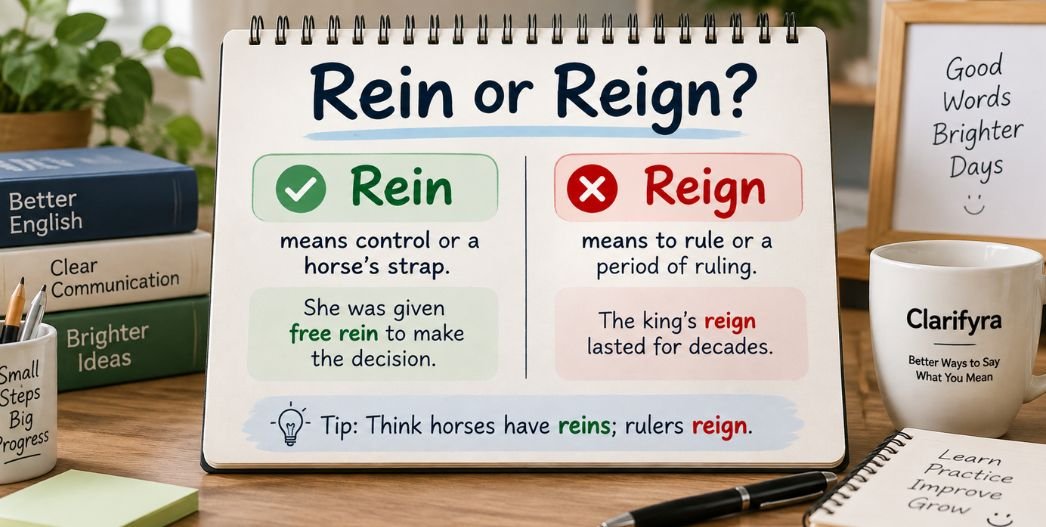
Rein and reign are both correct words, but they have different meanings. Use rein for a horse’s strap and in expressions such as “free rein” and “rein it in.” Use reign for ruling or a period of rule, such as “the king’s reign.”
Rein vs. Reign: The Key Difference
The easiest way to distinguish these words is to connect each one with its central idea:
| Word | Meaning | Typical use | Example |
|---|---|---|---|
| rein | A strap used to guide a horse; figuratively, control or restraint | Horses, freedom, control | She was given free rein over the project. |
| reign | Rule, authority, or a period of ruling | Monarchs and dominance | The queen’s reign lasted for decades. |
Both words are pronounced /reɪn/, which makes them homophones. Their pronunciation is identical, but their spelling and meaning are not.
A useful distinction is:
Rein = control or freedom
Reign = rule or authority
What Does “Rein” Mean?
A rein is traditionally a long strap attached to a horse’s bridle. A rider holds the reins to guide, slow, or stop the horse.
For example:
- The rider gently pulled the reins.
- She shortened the reins as the horse approached the gate.
The word also has several figurative uses. In these expressions, it often refers to control, restraint, or freedom from restraint.
For example:
- The manager needs to rein in unnecessary spending.
- The artist was given free rein to design the room.
- The writer had full rein over the creative direction.
These figurative expressions developed from the idea of controlling a horse with its reins.
What Does “Reign” Mean?
Reign refers to ruling or exercising authority. As a noun, it can describe the period during which a monarch rules.
For example:
- The king’s reign lasted forty years.
- Her reign began after the previous monarch died.
As a verb, reign means to rule or to be the dominant force in a particular situation.
For example:
- The emperor reigned over a vast territory.
- Silence reigned throughout the room.
The word can therefore be used both literally for rulers and figuratively for something that dominates a situation.
Free Rein or Free Reign?
The established expression is:
Free rein
Free rein means complete freedom to act, decide, or proceed without restriction.
Examples:
- The director gave the actors free rein to improvise.
- The designer had free rein to choose the colors.
- The committee gave her free rein over the project.
The expression comes from horseback riding. If a rider gives a horse free rein, the reins are loosened, allowing the horse greater freedom of movement.
What about “free reign”?
Free reign is widely encountered as a mistaken or alternative spelling of the established expression free rein. For standard English, particularly in careful or formal writing, free rein is the preferred form.
So if you mean complete freedom, write:
She was given free rein to make the decision.
Not:
She was given free reign to make the decision.
The distinction is worth remembering because reign is associated with power and authority, making it seem logical in this expression. However, the idiom comes from horse reins, not royal rule.
Rein It In or Reign It In?
The correct idiom is:
Rein it in
To rein something in means to control, limit, restrain, or reduce it.
Examples:
- The company needs to rein in its expenses.
- She tried to rein in her enthusiasm.
- The coach told the players to rein in their aggression.
The expression again comes from controlling a horse. A rider can pull on the reins to slow or control the animal.
Therefore:
Correct: The government needs to rein in spending.
Incorrect in this idiom: The government needs to reign in spending.
Although reign is associated with ruling and power, it is not the word used in this expression.
A useful way to remember it
If you can imagine pulling a horse’s reins to control something, choose rein in.
Full Rein or Full Reign?
When the intended meaning is unrestricted freedom or control of a horse, the traditional expression is:
Full rein
For example:
The horse raced across the field at full rein.
The phrase can also be used figuratively to describe giving someone broad or unrestricted freedom:
The author was given full rein to develop the story.
Full reign is not the standard expression for this meaning.
The word reign should instead be used when referring to ruling:
The monarch’s reign lasted for thirty years.
The two phrases may look similar, but they belong to completely different ideas.
Have Free Rein or Have Free Reign?
The conventional form is:
Have free rein
It means to have complete freedom to act or make decisions.
Examples:
- The architect had free rein to redesign the building.
- The children were given free rein to choose their activities.
- She had free rein over the project’s visual style.
If you are writing carefully edited English, have free rein is the form to choose.
The spelling have free reign occurs in real-world writing, but it results from the same confusion between the two homophones. It should not replace the established idiom in formal standard usage.
Rein or Reign Spelling: How Can You Remember?
A simple memory trick is:
REIN = HORSE
Think of the straps a rider uses to control a horse.
rein → horse → control
REIGN = RULER
Think of a king, queen, or monarch.
reign → ruler → rule
You can remember the distinction with this short sentence:
Horses have reins; rulers reign.
This also helps with related expressions:
- free rein → freedom
- rein in → control
- full rein → unrestricted movement or freedom
- reign → rule
- a monarch’s reign → period of rule
Compare the Words in Context
Seeing both words in complete sentences makes the distinction clearer.
Rein
The rider loosened the reins.
Here, rein refers to the straps used to control the horse.
The manager gave the team free rein.
Here, rein is figurative and means freedom.
The company is trying to rein in costs.
Here, rein in means control or reduce.
Reign
The king’s reign lasted several decades.
Here, reign means the period during which the king ruled.
The queen reigned over the country.
Here, reigned is the verb meaning ruled.
Fear seemed to reign in the city.
Here, reign is being used figuratively to describe something dominant.
Why Are These Words So Easy to Confuse?
The main reason is pronunciation. Rein and reign are homophones, meaning they have the same pronunciation but different spellings and meanings.
There is also a semantic overlap that can make the confusion stronger. Both words can be connected with control or authority, but they arrive there from different concepts.
Rein develops its figurative meaning from controlling a horse.
Reign is directly connected with ruling or being dominant.
So, when you see a sentence involving power or control, do not automatically choose reign. Check what the expression actually means.
If the idea is restraining or giving freedom, rein is usually the right choice.
If the idea is ruling or being dominant, reign is the appropriate word.
Common Mistakes to Avoid
1. Writing “free reign”
Use free rein when you mean complete freedom.
Correct: She was given free rein to choose the design.
2. Writing “reign it in”
Use rein it in when you mean control or restrain.
Correct: The company must rein in its costs.
3. Using “reign” for a horse
A horse has reins, not reigns.
Correct: He held the horse’s reins tightly.
4. Using “rein” when talking about a monarch’s rule
A monarch has a reign.
Correct: The king’s reign lasted twenty years.
A Quick Rule for Choosing the Right Word
Ask yourself what idea you are expressing:
Is it about a horse, control, restraint, or freedom?
→ Use rein.
Is it about ruling, a monarch, or dominance?
→ Use reign.
This rule covers most everyday situations.
| If you mean… | Use |
|---|---|
| A horse’s strap | rein |
| Control or restraint | rein |
| Complete freedom | free rein |
| Control or limit something | rein in |
| A period of ruling | reign |
| To rule | reign |
| Something dominant | reign |
FAQ
Is it free rein or free reign?
The established expression is free rein when you mean complete freedom to act or make decisions. It comes from the idea of loosening a horse’s reins and allowing it greater freedom of movement.
Is it rein it in or reign it in?
The standard expression is rein it in. It means to control, restrain, limit, or reduce something. The expression comes from pulling on a horse’s reins to control its movement.
What is the difference between rein and reign?
Rein refers literally to a horse’s strap and figuratively to control, restraint, or freedom. Reign refers to ruling, a ruler’s period of authority, or something that dominates.
Is “free reign” ever used?
Yes, free reign appears in actual English usage, but free rein is the established and preferred spelling for the idiom meaning complete freedom. In formal or carefully edited writing, use free rein.
Is it full rein or full reign?
When referring to unrestricted movement or freedom, the traditional expression is full rein. Reign should be reserved for meanings related to ruling or dominance.
How can I remember rein and reign?
Think rein = horse and reign = ruler. A rider holds reins, while a king or queen reigns. This simple association also helps you remember phrases such as free rein and rein in.
The Bottom Line
Rein and reign sound alike, but their meanings are different. Use rein for a horse’s reins and figurative expressions involving control or freedom, including free rein, full rein, and rein it in. Use reign when referring to ruling, a monarch’s period of rule, or something dominant. Once you connect rein with a horse and reign with a ruler, the distinction becomes much easier to remember. For more clear explanations of confusing English words and expressions, Clarifyra helps you find better ways to say what you mean.