Moral vs Morale Meaning: What’s the Difference?
Moral and morale are both correct English words, but they describe very different things. Moral usually relates to right and wrong, ethical principles, or the lesson of a story. Morale, meanwhile, refers to confidence, enthusiasm, or the emotional spirit of a person or group. The distinction becomes especially important in insurance, where moral hazard and morale hazard describe two different types of human-related risk.
Both moral and morale are correct. Moral relates to right and wrong or a lesson, while morale means confidence, enthusiasm, or group spirit. In insurance, moral hazard generally concerns character, incentives, or intentional behavior, whereas morale hazard involves carelessness or indifference toward a possible loss.
Moral vs Morale at a Glance
| Feature | Moral | Morale |
|---|---|---|
| Correct English word? | Yes | Yes |
| Part of speech | Adjective or noun | Noun |
| Main meaning | Right and wrong, ethical principles, or a lesson | Confidence, enthusiasm, or emotional spirit |
| Typical phrases | moral duty, moral values, moral lesson | team morale, employee morale, boost morale |
| Example | She felt a moral duty to help. | The victory improved team morale. |
| Insurance use | moral hazard | morale hazard |
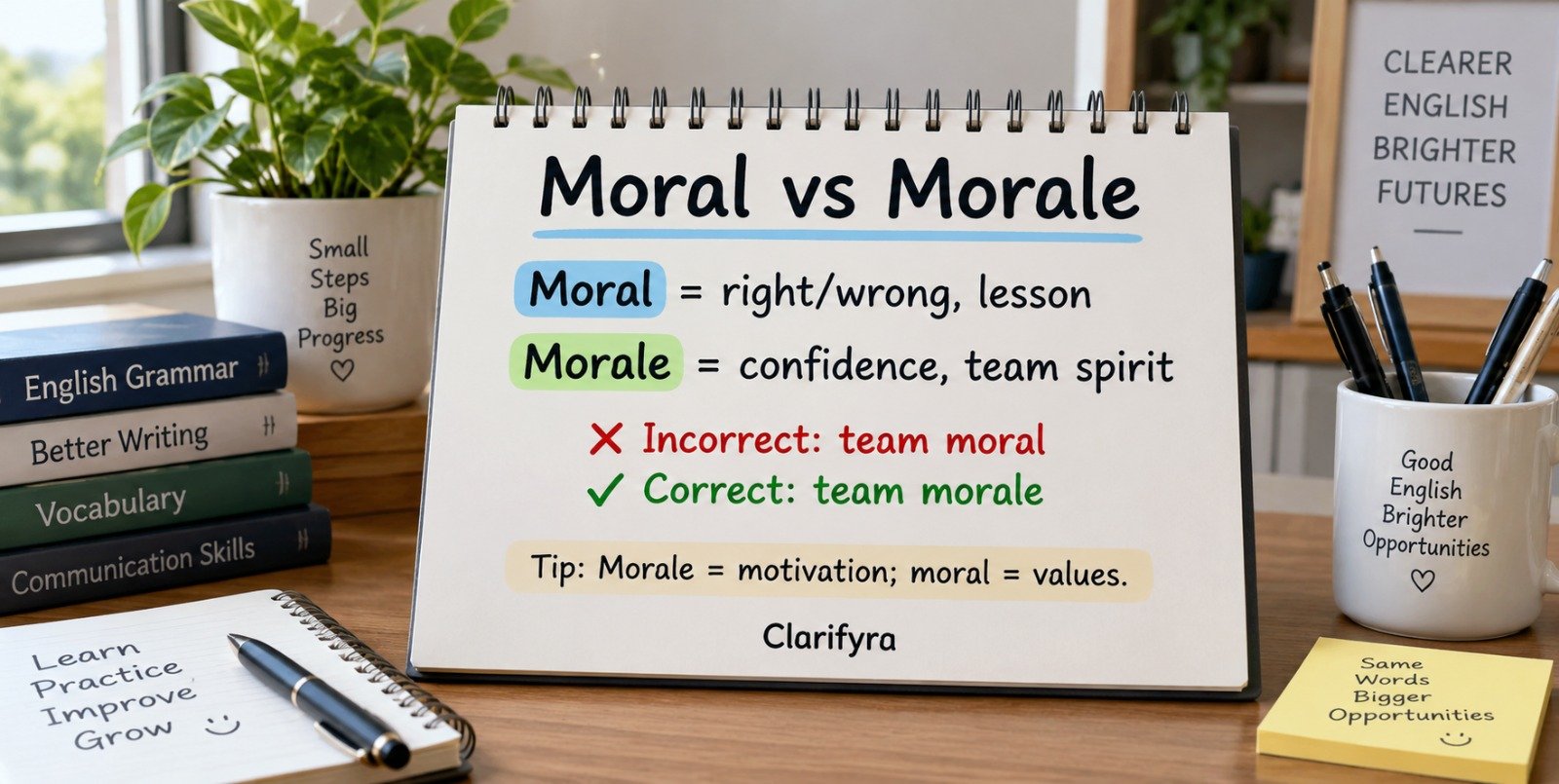
The simplest distinction is:
Moral = ethics or a lesson.
Morale = confidence and spirit.
Many English learners mix up similar-looking words such as Visiter or Visitor: Which Spelling Is Correct?
What Does “Moral” Mean?
Moral can be either an adjective or a noun.
As an adjective, it describes something related to standards of right and wrong behavior.
For example:
- She had a moral obligation to tell the truth.
- The book raises an important moral question.
- He made the decision based on his moral principles.
- Helping someone in danger may be seen as a moral duty.
As a noun, moral can mean a lesson about behavior, especially one learned from a story or experience.
For example:
- The moral of the story is to be honest.
- One moral we can take from the experience is to plan ahead.
The plural form morals normally refers to a person’s beliefs or standards about right and wrong.
Example: She is known for having strong morals.
What Does “Morale” Mean?
Morale is a noun referring to the confidence, enthusiasm, motivation, or emotional condition of a person or group.
It is especially common when talking about employees, teams, soldiers, students, or other groups working toward a shared goal.
Examples include:
- The successful project greatly improved employee morale.
- The coach tried to boost the team’s morale before the final.
- Staff morale was low after several difficult weeks.
- Her encouraging speech lifted everyone’s morale.
Unlike moral, morale is not about whether an action is ethically right or wrong.
If you say that a team has high morale, you mean its members feel positive, confident, and motivated.
The Key Difference Between Moral and Morale
The moral vs morale difference becomes clear when you consider what each word describes.
Use moral when discussing:
- ethics
- right and wrong
- principles
- duties or obligations
- lessons from stories or experiences
Use morale when discussing:
- confidence
- motivation
- enthusiasm
- team spirit
- emotional readiness
Compare these sentences:
Moral: It was a difficult moral decision.
Morale: The good news improved office morale.
In the first example, the issue concerns right and wrong. In the second, the subject is how employees feel.
Moral vs Morale Pronunciation
The words are also pronounced differently.
Moral is pronounced roughly:
MOR-uhl
In phonetic notation, Cambridge gives approximately:
- UK: /ˈmɒr.əl/
- US: /ˈmɔːr.əl/
The stress is on the first syllable.
Morale is pronounced roughly:
muh-RAL
Cambridge gives approximately:
- UK: /məˈrɑːl/
- US: /məˈræl/
The stress falls on the second syllable.
So you can hear the contrast:
MOR-uhl → moral
muh-RAL → morale
That difference in stress can help you separate the words when speaking.
Moral Hazard vs Morale Hazard in Insurance
The terms become more specialized when discussing moral vs morale hazard in insurance.
A hazard is something that can increase the probability or severity of a loss.
Moral Hazard
In traditional insurance terminology, moral hazard concerns increased risk associated with the character, circumstances, incentives, or possible intentional conduct of the insured.
A person may have a financial incentive to behave in a way that increases the possibility of an insured loss.
For example, suppose a struggling business owner knows that a property is heavily insured and intentionally causes a covered loss in an attempt to receive an insurance payment. That situation would involve moral hazard.
Intent and incentives are central to many traditional examples.
Morale Hazard
Morale hazard is different. It involves carelessness, indifference, or reduced motivation to prevent a loss because insurance protection exists.
The person does not necessarily want a loss to occur.
Instead, they may simply become less cautious because they know that insurance will help cover the financial consequences.
For example:
A driver who would normally lock a car carefully may become careless about security because the vehicle is insured against theft.
That is closer to morale hazard than moral hazard because the issue is attitude and carelessness rather than deliberate dishonesty.
Moral vs Morale Hazard Examples
A few side-by-side examples make the insurance distinction easier to understand.
| Situation | Type | Why? |
|---|---|---|
| An insured person deliberately exaggerates a covered loss for financial gain | Moral hazard | Intentional or dishonest behavior is involved |
| A property owner becomes less careful about security because the building is insured | Morale hazard | Carelessness or indifference increases the risk |
| Someone intentionally causes an insured loss hoping to collect money | Moral hazard | The possibility of financial gain affects behavior |
| A driver takes fewer precautions because insurance will pay for covered damage | Morale hazard | Reduced caution increases the chance of loss |
A useful simplified rule is:
Moral hazard: “A person’s incentives, circumstances, or intentional behavior increase the risk.”
Morale hazard: “A person’s carelessness or indifference increases the risk.”
Moral vs Morale Risk
The terms moral risk and morale risk may also appear in discussions of insurance and risk assessment.
A moral risk generally relates to concerns about a person’s honesty, motives, incentives, or willingness to cause or exaggerate a loss.
A morale risk, by contrast, relates more closely to attitude. The insured person may not intend to cause damage, but knowing that insurance exists can make them less motivated to prevent it.
The important distinction is therefore not simply whether insurance exists. It is why the person’s behavior creates additional risk.
Moral Support or Morale Support?
Another point of confusion involves the expressions moral support and morale support.
In ordinary English, moral support is the established phrase when you mean emotional encouragement or reassurance.
For example:
- I went with her to the appointment for moral support.
- His friends offered moral support during a difficult time.
Here, moral support does not mean teaching someone about right and wrong. It refers to encouragement given to help someone feel stronger or more confident.
Morale, however, is commonly used in phrases such as:
- boost morale
- improve morale
- raise morale
- maintain morale
- low morale
- high morale
For example:
The manager introduced flexible working hours to improve staff morale.
So the difference is:
Moral support = encouragement you give.
Morale = the level of confidence or enthusiasm someone has.
Common Mistakes to Avoid
Using “Morale” for Ethics
Incorrect:
She had a strong morale belief that lying was wrong.
Correct:
She had a strong moral belief that lying was wrong.
Ethics and beliefs about right and wrong require moral.
Using “Moral” for Team Spirit
Incorrect:
Winning the first match increased the team’s moral.
Correct:
Winning the first match increased the team’s morale.
Confidence or group spirit requires morale.
Treating Moral Hazard and Morale Hazard as Identical
They are related concepts, but traditional insurance terminology distinguishes them.
Moral hazard can involve character, incentives, or intentional behavior.
Morale hazard concerns indifference or reduced caution without necessarily involving dishonest intent.
Writing “Morale of the Story”
Incorrect:
The morale of the story is to never give up.
Correct:
The moral of the story is to never give up.
A lesson learned from a story is its moral.
Easy Way to Remember the Difference
A simple memory trick is to connect the extra E in morale with enthusiasm.
Morale → Enthusiasm
Both ideas relate to how positive and motivated someone feels.
Then remember:
Moral → right or wrong
This gives you an easy pair:
- Moral = ethics
- Morale = enthusiasm
You can also remember the common phrases:
moral values
moral lesson
moral support
but:
high morale
low morale
team morale
Correct Usage Examples
Here are some natural examples showing how each word works.
Moral
- She faced a serious moral dilemma.
- Honesty is one of his strongest moral values.
- The moral of the story is to appreciate what you have.
- I accompanied my friend for moral support.
- The decision raised both legal and moral concerns.
Morale
- The team’s morale improved after the victory.
- Management is looking for ways to boost employee morale.
- Frequent criticism can damage workplace morale.
- The captain gave a speech to raise morale.
- Staff morale remains high despite the demanding schedule.
Final Verdict: Moral or Morale?
Both words are correct, but they are not interchangeable. Use moral when referring to ethics, right and wrong, principles, a lesson, or the phrase moral support. Use morale for confidence, enthusiasm, motivation, or group spirit. In insurance, remember the finer distinction: moral hazard generally concerns character, incentives, or intentional conduct, while morale hazard concerns carelessness or indifference.
For clear comparisons like this, Clarifyra helps make similar-looking English words easier to understand and use correctly.
Frequently Asked Questions
Is moral or morale correct?
Both are correct. Moral relates to right and wrong, ethical principles, or a lesson. Morale refers to confidence, enthusiasm, or emotional spirit.
What is the difference between moral and morale in insurance?
In traditional insurance terminology, moral hazard relates to character, circumstances, incentives, or possible intentional conduct that increases risk. Morale hazard involves carelessness or indifference because insurance reduces concern about the financial effects of a loss.
Is it moral support or morale support?
Moral support is the standard phrase for emotional encouragement. For example, “I went with him for moral support.” You would normally use morale when describing someone’s level of confidence, as in “The speech boosted his morale.”
What is an example of morale hazard?
A person may become careless about locking an insured vehicle because they know insurance would help cover a theft. The person does not want the vehicle stolen, but reduced caution increases the risk.
What is an example of moral hazard?
A traditional insurance example would involve someone having an incentive to intentionally cause or exaggerate an insured loss for financial benefit. The important factor is the relationship between incentives or intentional conduct and the increased risk.
How can I remember moral vs morale?
Remember that the extra E in morale can stand for enthusiasm. Use morale for confidence and motivation. Use moral for ethics, principles, right and wrong, or the lesson of a story.
You May Also Read | Supposedly or Supposably Meaning: Which Is Correct?