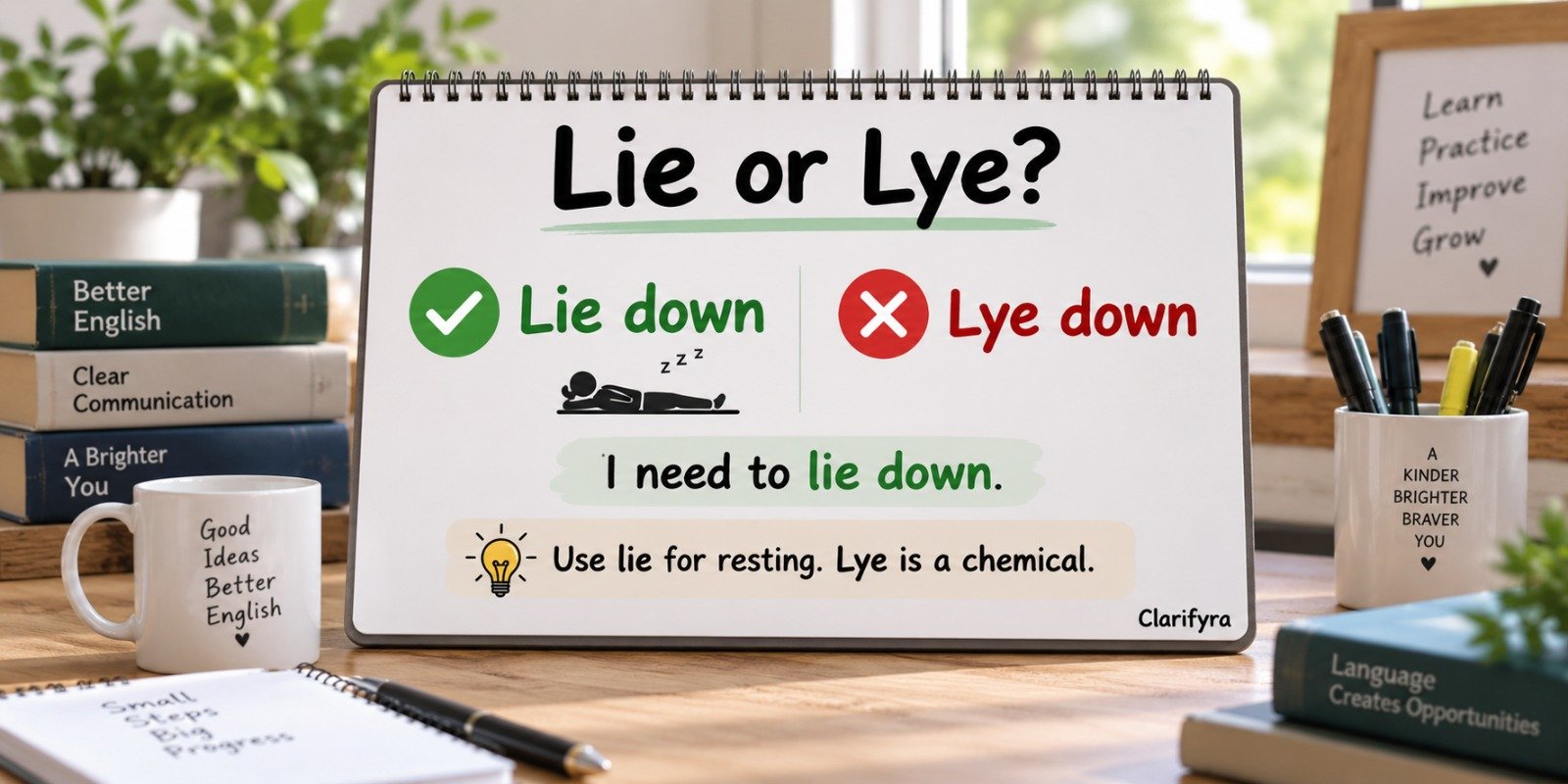
Lie or Lye: What’s the Difference and Which Is Correct?
“Lie” and “lye” sound exactly the same, but their meanings are completely different. That identical pronunciation makes them easy to confuse in writing, especially in phrases such as “lie down,” “lie in bed,” or “lie ahead.” In most everyday situations involving resting, location, false statements, or something existing in a particular place, lie is the word you need. Lye, by contrast, is a noun referring to a strong alkaline substance commonly associated with soap making and cleaning.
Lie is used when someone reclines, tells an untruth, or when something is located or exists somewhere. Lye is a strong alkaline chemical. Therefore, expressions such as “lie down,” “lie in bed,” “strengths lie,” and “lie ahead” always use lie, not “lye.”
Lie vs. Lye: What’s the Difference?
Both words are correct English words, but they are not interchangeable.
| Feature | Lie | Lye |
|---|---|---|
| Correct word? | Yes | Yes |
| Word type | Verb and noun | Noun |
| Main meanings | Recline, tell an untruth, be situated | Strong alkaline substance |
| Pronunciation | /laɪ/ | /laɪ/ |
| Example | I need to lie down. | The soap was made using lye. |
The simplest way to separate them is to remember that lie is the everyday word, while lye belongs mainly to chemical and manufacturing contexts.
You May Also Read | Columbia vs Colombia: Which Spelling Is Correct?
What Is “Lie”?
The word lie has several meanings, so its correct use depends on context.
Lie Meaning “to Recline”
As a verb, lie means to rest or place your body in a horizontal position.
Examples:
- I want to lie down for a few minutes.
- She likes to lie in bed and read.
- The dog will lie on the floor beside the sofa.
- He was lying on the grass.
This form does not take a direct object. You simply lie; you do not “lie something.”
The main verb forms are:
| Tense/Form | Word |
|---|---|
| Present | lie |
| Past | lay |
| Past participle | lain |
| Present participle | lying |
Examples:
- I lie down after lunch.
- Yesterday, I lay down early.
- I have lain here for an hour.
- She is lying on the couch.
The unusual past tense lay is one reason this verb often causes confusion.
Lie Meaning “to Say Something Untrue”
“Lie” can also mean to deliberately say something that is not true.
Examples:
- Please don’t lie to me.
- He lied about where he had been.
- She was lying when she denied it.
As a noun, a lie means a false statement.
For example:
- His excuse was a lie.
This meaning has different past forms from the reclining verb:
- lie
- lied
- lied
- lying
Context usually makes it clear which meaning is intended.
Lie Meaning “to Be Situated or Exist”
The verb can also mean that something is located, found, or exists in a particular place or area.
Examples:
- The village lies beyond the hills.
- The main problem lies elsewhere.
- Her greatest strengths lie in planning and communication.
- The responsibility lies with management.
This is the meaning used in phrases such as priorities lie, strengths lie, and opportunities lie ahead.
What Is “Lye”?
Lye is a noun referring to a strongly alkaline substance or solution. The term is commonly associated with chemicals such as sodium hydroxide and potassium hydroxide.
It is often mentioned in contexts involving:
- soap making
- cleaning
- chemical processing
- traditional preparation methods
Examples:
- The soap recipe calls for carefully measured lye.
- Always handle lye according to appropriate safety instructions.
- Some traditional soap-making methods use lye.
The important point is that lye is not a spelling variation of lie. It does not mean to rest, recline, tell an untruth, or be located somewhere.
Is It Lie or Lye in Bed?
The correct phrase is:
Lie in bed
Examples:
Correct: I want to lie in bed for another hour.
Correct: She likes to lie in bed and listen to music.
Incorrect: I want to lye in bed.
When referring to someone resting horizontally, use lie.
For past tense, however, the sentence changes:
- Yesterday, I lay in bed until noon.
That does not mean “lay” is always interchangeable with “lie.” It is simply the past tense of the reclining verb.
Lie or Lye Down?
Use lie down when talking about resting or reclining.
Correct: You should lie down and rest.
Correct: I need to lie down after the journey.
Incorrect: You should lye down.
The same rule applies to lie on the floor:
Correct: The child wanted to lie on the floor.
Incorrect: The child wanted to lye on the floor.
A person can lie down, but a chemical called lye cannot replace the verb.
My Strengths Lie or Lye?
The correct expression is:
My strengths lie in…
Here, “lie” means that something exists, is found, or is centered in a particular area.
Examples:
- My strengths lie in writing and research.
- Her strengths lie in leadership and organization.
- His greatest talent lies in explaining complicated ideas clearly.
“Lye” would be incorrect because the sentence has nothing to do with an alkaline substance.
The same pattern applies to similar expressions:
- The answer lies in better preparation.
- The difficulty lies in finding enough time.
- The responsibility lies with the owner.
Priorities Lie or Lye?
Use priorities lie.
For example:
- Our priorities lie in improving customer service.
- Their priorities lie elsewhere.
- The team’s main priorities lie in safety and reliability.
This use of “lie” is figurative. The priorities are not physically reclining; they are considered to exist or be focused in a certain area.
“Priorities lye” is incorrect.
Lie or Lye Ahead?
The standard phrase is:
Lie ahead
It refers to something that will happen or be encountered in the future.
Examples:
- Difficult decisions lie ahead.
- New opportunities lie ahead for the company.
- No one knows exactly what lies ahead.
Use lie, not “lye,” because the expression describes something existing in the future.
Golf Ball Lie or Lye?
In golf, the correct word is lie.
A golf ball’s lie refers to the position or conditions in which the ball comes to rest.
Examples:
- The ball has a good lie in the fairway.
- He had a difficult lie in the deep rough.
- The wet grass made the ball’s lie more challenging.
So the correct expression is:
golf ball lie
Not:
golf ball lye
This is another noun meaning of “lie,” separate from both reclining and telling an untruth.
Why Are Lie and Lye Confused?
The main reason is pronunciation.
Both lie and lye are pronounced like “lie” /laɪ/ and rhyme with:
- eye
- fly
- my
- sky
- why
Words that sound the same but have different spellings and meanings are called homophones.
Because you cannot hear the spelling difference in conversation, you have to use context when writing.
Compare:
- Please lie down on the bed.
- The soap contains lye.
They sound identical when spoken, but the meanings make the correct spelling obvious.
When to Use Lay, Lie, or Lye
The comparison becomes more confusing when lay is added.
Here is the easiest distinction:
| Word | Main Use | Example |
|---|---|---|
| Lie | Recline without placing an object | I want to lie down. |
| Lay | Put or place something somewhere | Please lay the book on the table. |
| Lye | An alkaline substance | The recipe uses lye. |
Lie Does Not Normally Take an Object
You lie yourself down naturally; you do not place another object.
- I need to lie down.
- The cat is lying on the chair.
Lay Usually Takes an Object
When you lay something down, there is usually an object being placed.
- Lay the keys on the desk.
- She laid the blanket on the bed.
However, remember that lay is also the past tense of reclining “lie”:
- Today I lie down.
- Yesterday I lay down.
That irregular pattern is responsible for much of the confusion between lie and lay.
Examples of Lie and Lye in Sentences
Looking at the words in context can make the difference easier to remember.
Sentences With “Lie”
- I usually lie on the sofa after work.
- Don’t lie about something so important.
- The old farmhouse lies near the river.
- Her greatest strengths lie in problem-solving.
- Several challenges lie ahead.
- The golfer checked the ball’s lie before choosing a club.
Sentences With “Lye”
- The soap maker carefully measured the lye.
- The container of lye was stored safely.
- Some soap-making processes involve combining oils with lye.
Notice that “lye” stays within its chemical meaning, while “lie” has several everyday uses.
Lie or Lye Synonyms
The best synonym depends on which meaning you intend.
For lie meaning to recline, possible alternatives include:
- recline
- rest
- lounge
- repose
For lie meaning an untruth, related words include:
- falsehood
- fib
- deception
- untruth
For lie meaning to be situated, alternatives may include:
- be located
- exist
- remain
- be situated
For lye, related chemical terms may include alkali, caustic soda, or sodium hydroxide, depending on the exact substance and context. These terms should not always be treated as perfect substitutes because “lye” can refer to more than one alkaline formulation.
Easy Way to Remember the Difference
A simple memory trick is:
Lye has a “y,” and you usually see it when talking about chemistry.
For ordinary actions and expressions, you will usually need lie:
- lie down
- lie in bed
- lie on the floor
- strengths lie in
- priorities lie in
- lie ahead
- golf ball lie
If the sentence is about a chemical used in soap making or a similar process, choose lye.
Common Mistakes to Avoid
One frequent mistake is writing “lye down.” The correct phrase is always lie down.
Another is using “lye” figuratively:
Incorrect: My strengths lye in communication.
Correct: My strengths lie in communication.
Writers also sometimes confuse lie with lay:
Correct: I want to lie down now.
Correct: Please lay the papers on my desk.
The first sentence has no object. In the second, “the papers” are the object being placed.
Finally, remember that lying is the correct -ing form:
Correct: She is lying on the bed.
Incorrect: She is lieing on the bed.
Final Verdict: Which Word Should You Use?
Use lie when referring to reclining, false statements, location, figurative position, future events, or a golf ball’s position. Use lye only when you mean the alkaline chemical or solution. So phrases such as lie in bed, lie down, strengths lie, priorities lie, lie ahead, and lie on the floor all take lie. Keeping that basic distinction in mind makes this pair much easier to handle in everyday writing.
Frequently Asked Questions
Is it lie or lye when resting?
Use lie. You lie down, lie in bed, or lie on the sofa when resting. “Lye” is a noun referring to an alkaline substance and is not a verb meaning to recline.
Is “lye” a real English word?
Yes. Lye is a real word, but it has a chemical meaning. It refers to a strongly alkaline substance or solution, commonly associated with sodium hydroxide or potassium hydroxide.
Is it “I need to lay down” or “I need to lie down”?
In standard grammar, “I need to lie down” is correct because no object is being placed. Use lay when something receives the action, as in “Lay the book on the table.”
What is the past tense of “lie down”?
The past tense is lay. For example: “Yesterday, I lay down for an hour.” The past participle is lain, as in “I have lain here long enough.”
Is “lie ahead” grammatically correct?
Yes. Lie ahead means to exist or occur in the future. For example, “Several challenges lie ahead.” Writing “lye ahead” would be incorrect.
What is correct in golf: lie or lye?
Use lie. A golf ball’s lie describes its position or the conditions around where it has come to rest. “Lye” has no standard golf meaning.
Once you remember that lye is the chemical and lie handles the everyday meanings, the distinction becomes much simpler. Clarifyra focuses on exactly these kinds of practical word differences, helping you choose clearer and more accurate English.
You May Also Read | This vs These: Meaning, Grammar, and Examples