Noteable or Notable: Which Is Correct?
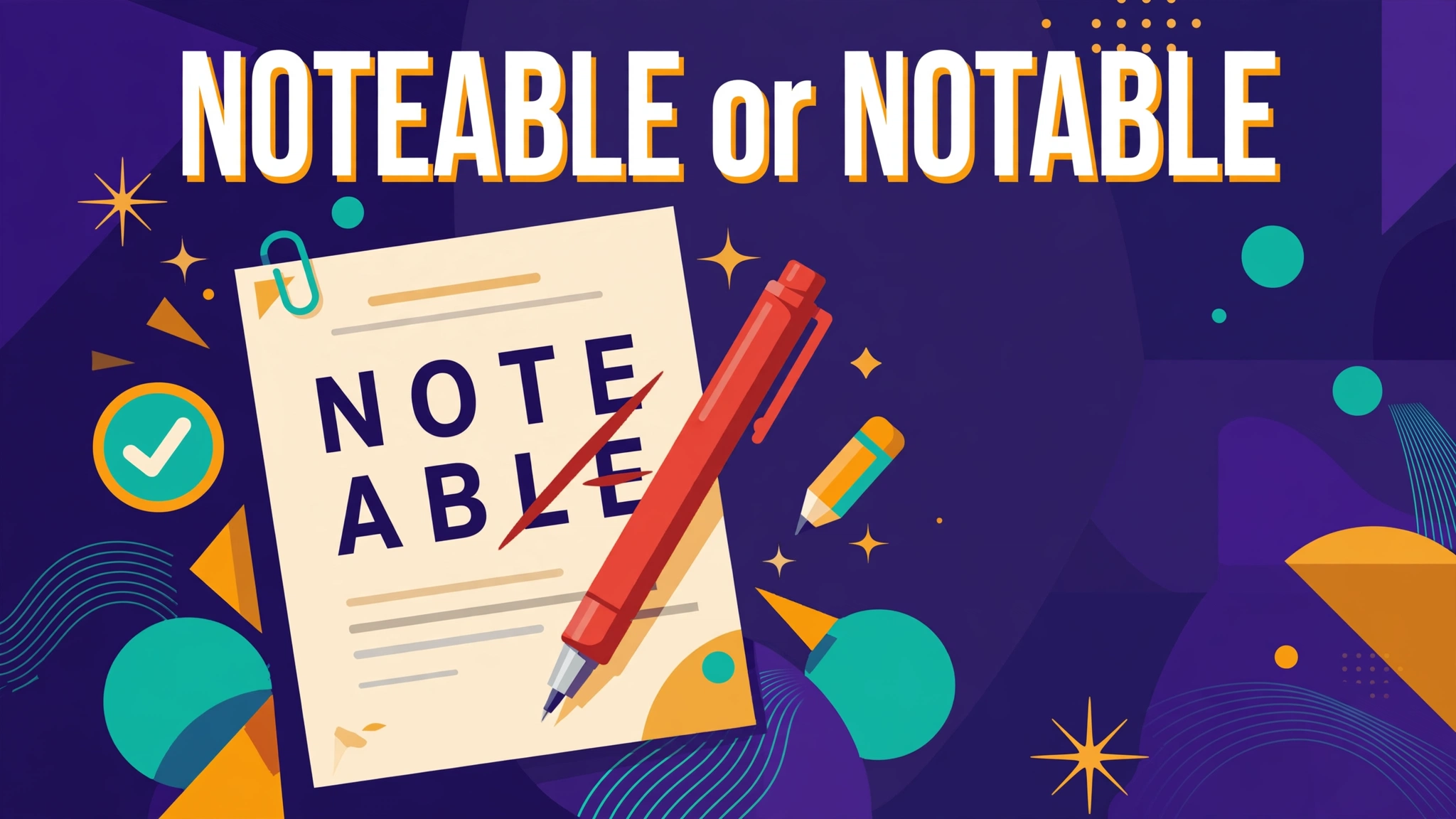
Is it noteable or notable? The correct spelling is notable — no e between the t and the a. “A notable achievement,” “a notable exception,” “several notables attended.”
This one is refreshingly clear-cut. Unlike pairs where both spellings survive (like racquet/racket) or where the “wrong” form turns out to be a rare real word (like propper), noteable is simply not listed in the dictionaries I checked: Merriam-Webster returns no entry for it, and neither does Collins. The word you want — the adjective meaning “worthy of note” — has been spelled notable since the 14th century.
Why “Noteable” Looks So Tempting
The misspelling is completely logical, which is why it’s so common. You start with the verb note (“to note something down,” “please note”), you add the familiar suffix -able (“readable,” “washable,” “enjoyable”), and you get note + able = noteable. Every step feels reasonable.
What the instinct misses is one of English spelling’s most consistent rules: a silent final e is dropped before a suffix that begins with a vowel. The e in note is doing a job — it tells you the o is long (“noht,” not “not”) — but once the suffix -able arrives with its own vowel, the e becomes redundant and English deletes it. That’s the whole story: note − e + able = notable.
The Rule, With Proof
This isn’t a quirk of one word — it’s a pattern you can verify across the dictionary:
| Base word | + -able | Result |
|---|---|---|
| note | drop the e | notable |
| use | drop the e | usable |
| value | drop the e | valuable |
| advise | drop the e | advisable |
| excuse | drop the e | excusable |
The exceptions prove the rule’s shape: the e is kept when dropping it would create confusion or an unpronounceable cluster. Notice becomes noticeable (keeping the e preserves the soft c — “noticable” would suggest a hard c, like critical). Courage becomes courageous for the same reason. Note has no such problem — notable reads exactly as intended — so the e goes.
What “Notable” Means
Merriam-Webster defines notable as an adjective meaning “worthy of note: remarkable” — “a notable improvement,” “a notable exception.” It’s a word of measured praise: stronger than interesting, calmer than extraordinary. A notable achievement is one worth writing down — which is exactly what the etymology says, since the word comes from Latin notabilis, “worthy of notice.”
Notable is also a noun: “a notable” is a person of distinction — “the guest list included several notables.” Same spelling, same root, different job.
- The study’s most notable finding was the drop in errors.
- There are a few notable exceptions to the rule.
- She interviewed several notables from the industry.
- It is notable that no one objected at the time.
Correct vs. Incorrect
| Correct | Incorrect |
|---|---|
| A notable achievement. | A noteable achievement. |
| It is notable that sales rose. | It is noteable that sales rose. |
| Several notables attended. | Several noteables attended. |
| The noticeable change. (keeps its e — correctly!) | The noticable change. (wrong — the e protects the soft c) |
Common Mistakes
1. Keeping the “e”: “noteable”
The headline error. It appears in drafts, emails, and even published articles — and spellcheckers sometimes wave it through because note + able looks morphologically plausible. It isn’t standard. Delete the e.
2. Over-correcting “noticeable” to “noticable”
Learning the drop-the-e rule sometimes backfires: writers apply it to notice and produce noticable. Don’t. The e stays in noticeable to keep the c soft. The rule drops the e only when nothing is lost — with note, nothing is.
3. Confusing “notable” with “noticeable”
They overlap but aren’t identical. Noticeable means easy to perceive with the senses (“a noticeable limp,” “a noticeable smell”). Notable means worthy of attention or remark (“a notable victory”). A smell can be noticeable without being notable.
4. Using “notable” where “noted” fits better
“A notable scholar” (a remarkable one) vs. “a noted scholar” (a famous, recognized one). They’re close, but noted leans toward reputation while notable leans toward merit. In most contexts either passes — just know the shading.
More Words That Drop the “E”
Once you see the pattern, you start spotting it everywhere — and each sighting reinforces the rule. All of these drop the silent e before -able, exactly like note → notable:
- move → movable (“a movable feast”)
- close → closable (“a closable lid”)
- excuse → excusable (“an excusable error”)
- value → valuable (“a valuable lesson”)
- advise → advisable (“it is advisable to book ahead”)
And the counter-examples sharpen the boundary: notice → noticeable and courage → courageous keep the e because dropping it would corrupt the soft c/g sound. The rule isn’t “always drop the e” — it’s “drop the e unless the e is doing pronunciation work.” In notable, it isn’t, so out it goes.
Quick Check: Test Yourself
Choose the correct spelling in each sentence. Answers follow.
- It was a (noteable / notable) victory for the underdogs.
- The instructions were (noteable / notable) for their clarity. (trick: same answer — the e never survives)
- Several (noteables / notables) signed the open letter.
- The stain was barely (noticable / noticeable). (trick: different word — the e stays to protect the soft c)
- The error was (excuseable / excusable).
Answers: 1. notable, 2. notable, 3. notables, 4. noticeable, 5. excusable. Nail the notable/noticeable distinction and you’ve mastered the whole rule family.
Pronunciation: UK vs. US
Notable is pronounced /ˈnəʊ.tə.bəl/ in British English (NOH-tuh-buhl) and /ˈnoʊ.t̬ə.bəl/ in American English (NOH-duh-buhl, with the characteristic American flap turning the middle t toward a d sound). Stress falls firmly on the first syllable in both varieties — never “no-TAY-ble.”
FAQs
Is “noteable” ever acceptable?
Not in standard English. Neither Merriam-Webster nor Collins lists it, and every dictionary entry for the adjective gives notable. You may see noteable in informal writing, but it’s a misspelling, not a variant.
Why does “noticeable” keep its “e” but “notable” doesn’t?
Because the e in noticeable is load-bearing: it keeps the c soft (like nice). Drop it and you’d get “noticable,” inviting a hard-c reading like critical. In notable, dropping the e costs nothing — the pronunciation is unambiguous — so the standard rule applies.
What’s the noun form — “notability”?
Yes: notability (“a person of notability,” “the notability of the achievement”). And the adverb is notably (“notably absent,” “the results were notably better”). Both keep the no-e spelling, naturally.
“Notable” vs. “noteworthy” — any difference?
Barely. Noteworthy is the Germanic-flavored synonym (“worth noting”) and runs slightly more informal; notable is the Latinate one and slightly more formal. In practice they’re interchangeable — pick the one that fits your sentence’s rhythm.
Where You’ll Meet “Notable” Most
Notable is a favorite of news writing, academic prose, and formal reports — genres that need measured, defensible praise. Journalists write “a notable shift in policy” rather than “a huge shift” because notable claims only that something is worth noticing, not that it’s the biggest ever. Scientists favor “the most notable result” for the same reason: it’s precise without being hyperbolic. If your writing keeps reaching for significant, important, or major, try rotating in notable — it often says exactly what you mean with less inflation.
The Takeaway
Notable — no e. The silent e of note drops before the vowel suffix -able, exactly as it does in usable and valuable. Noteable appears in no major dictionary I checked, so treat it as what it is: a logical, common, and completely avoidable misspelling.