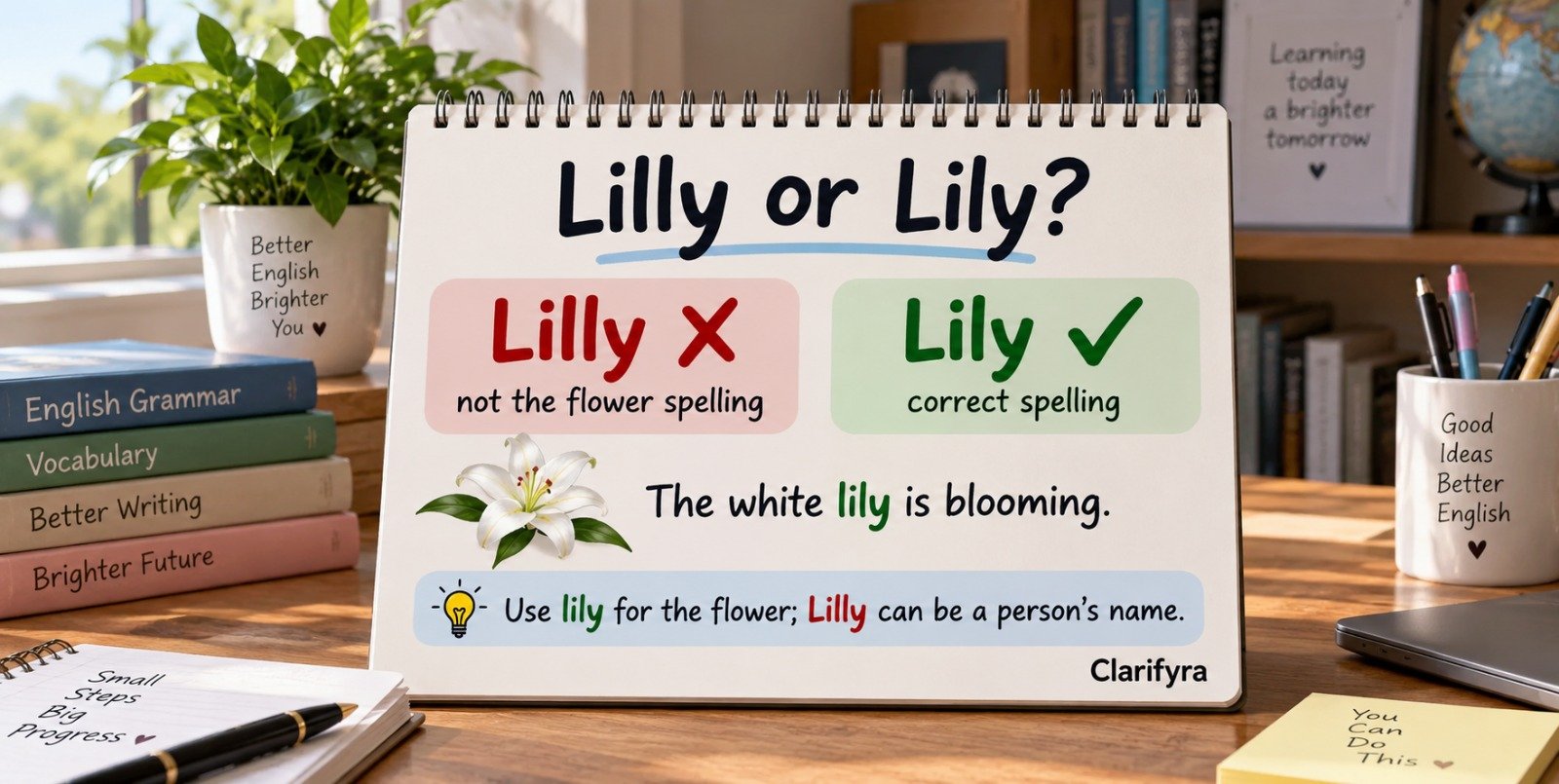
Lilly or Lily: Which Spelling Is Correct?
The difference between Lilly and Lily depends on what you are talking about. If you mean the flower, lily is the standard English spelling. If you mean a person’s name, however, both Lily and Lilly can be correct. The confusion is understandable because the two forms are pronounced the same and both appear as female given names. The key is to separate the ordinary English word for the flower from personal-name spellings.
Lily is the correct standard spelling for the flower and is also a common female name. Lilly is a valid alternative spelling when used as a person’s name, but it is not the standard spelling of the flower. Both are usually pronounced “LIL-ee.”
Lilly or Lily: Which Is Correct?
Both spellings can be correct, but they are not interchangeable in every context.
Use lily when referring to the flower:
- A white lily grew beside the fence.
- She carried a bouquet of lilies.
- The garden is filled with lily flowers.
Use Lily or Lilly when referring to someone whose name is spelled that way:
- Lily joined us for lunch.
- Lilly sent me the photos yesterday.
Because personal names can have different accepted spellings, you should always use the spelling preferred by the person.
Here is the basic difference:
| Feature | Lily | Lilly |
|---|---|---|
| Correct flower spelling | Yes | No |
| Used as a female name | Yes | Yes |
| Pronunciation | LIL-ee | LIL-ee |
| Standard common noun | Yes | No |
| Possible nickname for Lillian | Yes | Yes |
| Common in UK English | Yes | Mainly as a name |
You May Also Read | Levelling or Leveling: Which Spelling Is Correct?
What Is Lily?
Lily is primarily a noun referring to a flowering plant. Lilies are known for their large, noticeable flowers and come in many varieties and colors.
The word is also widely used as a female given name.
Examples:
- A pink lily opened in the garden this morning.
- She placed several lilies in a glass vase.
- Lily is meeting us after work.
- Their daughter is named Lily.
When written as the name of a person, it begins with a capital letter. When referring to the flower, it normally remains lowercase unless it begins a sentence.
Lily Flower Spelling
If you are wondering whether to write lilly or lily flower, the correct standard form is:
lily flower
Not:
lilly flower
The plural is also worth remembering:
Singular: lily
Plural: lilies
For example:
Correct: The pond was surrounded by beautiful lilies.
Incorrect: The pond was surrounded by beautiful lillys.
What Is Lilly?
Lilly is most commonly used as a female given name or a variant spelling of Lily.
It should not generally be treated as an alternative dictionary spelling for the flower.
Examples:
- My cousin Lilly lives in Manchester.
- Lilly won the school competition.
- We invited Lilly to dinner.
In these sentences, the spelling is correct because it is a proper name.
This means the answer to “What is Lilly?” depends on context. As a personal name, it is a legitimate alternative to Lily. As the ordinary word for the flowering plant, however, lily is the standard spelling.
Lilly or Lily Meaning
When the two forms are used as names, their meaning is closely connected.
Lily comes directly from the flower name. Because lilies have long been associated symbolically with ideas such as purity, beauty, and innocence, those associations are often connected with the personal name as well.
Lilly is an established spelling variant of the name Lily. It generally carries the same name associations rather than having a completely separate meaning.
The main distinction is therefore not meaning but spelling and context:
- lily = the standard word for the flower
- Lily = a female name
- Lilly = an alternative female-name spelling
Lilly or Lily Pronunciation
There is normally no pronunciation difference between Lily and Lilly.
Both are pronounced approximately:
LIL-ee
The first syllable rhymes with fill, and the second sounds like ee.
Because the two spellings sound identical when spoken, it is impossible to know how someone’s name is spelled just by hearing it.
For example, someone introducing herself as “Lily” could spell her name:
- Lily
- Lilly
That is why checking the person’s preferred spelling is important.
Lily or Lilly in UK English
The difference between these spellings is not an American-versus-British English distinction.
In UK English, the flower is spelled:
lily
The same spelling is standard in American English.
So this is unlike pairs such as colour/color or centre/center, where accepted regional spelling differences exist.
For the flower:
UK: lily
US: lily
The spelling Lilly may still appear in the UK as a person’s name, but it does not become the British spelling of the flower.
Is Lily or Lilly More Common?
Lily is generally the more conventional spelling because it serves two purposes: it is the standard spelling of the flower and a widely used female name.
Lilly is more specialized. It is mainly encountered as a personal name, surname, or other proper noun.
For ordinary English writing, you are therefore much more likely to need lily.
Compare:
- The lily needs more sunlight.
- Her favorite flower is the lily.
- Lily plays the piano.
- Lilly plays the piano.
All four sentences can be correct, but the final spelling depends on the person’s actual name.
When asking “Is Lily or Lilly more common?”, it is best to distinguish general English from personal naming preferences. In everyday vocabulary, lily is clearly the standard form.
Lily or Lilly for Lillian?
Both Lily and Lilly can be used as nicknames for Lillian.
There is no rule requiring the nickname to preserve the doubled l in Lillian.
For example:
Lillian → Lily
is perfectly natural.
So is:
Lillian → Lilly
The choice is mostly personal.
If you want the nickname to match the standard flower spelling, Lily is the simpler option. If you prefer the appearance of the doubled consonant or have a family spelling tradition, Lilly can work just as well.
The important thing is consistency.
Why Are Lilly and Lily Confused?
The confusion mainly comes from three factors.
First, the words are pronounced exactly the same in normal English. Nothing in their pronunciation tells you whether there should be one middle l or two.
Second, Lilly is genuinely used as a personal name. Seeing it frequently in names can make it look like an alternative spelling for the flower.
Third, names often allow spelling variations that ordinary vocabulary does not. A flower has a dictionary spelling, while parents can choose among established name variants.
For example:
Flower: lily
Person: Lily or Lilly
That simple distinction solves most of the confusion.
Correct and Incorrect Examples
Here are some examples showing when each spelling works.
Referring to the Flower
Correct: She planted a lily beside the gate.
Incorrect: She planted a lilly beside the gate.
Correct: These lilies bloom every spring.
Incorrect: These lillies bloom every spring.
Referring to a Person
Correct: Lily called me yesterday.
Correct: Lilly called me yesterday.
Both can be correct because they may represent different people’s names.
Referring to a Nickname
Correct: Lillian prefers to be called Lily.
Correct: Lillian prefers to be called Lilly.
Again, either spelling is possible when it is someone’s chosen name.
An Easy Way to Remember the Difference
Use this simple rule:
The flower has one middle L: lily.
If you are writing about a person, check how that person spells the name.
You can think of it this way:
One flower = Lily.
A person’s name = Lily or Lilly.
This prevents you from accidentally writing lilly flower in standard English.
Common Mistakes to Avoid
One common mistake is assuming that Lilly is the British spelling of Lily. It is not. Both British and American English use lily for the flower.
Another mistake is correcting someone’s personal name from Lilly to Lily. Personal names do not have to follow the ordinary flower spelling.
Writers also sometimes form the plural incorrectly. The plural of lily is:
lilies
not lilys or lillies when referring to the flower.
Finally, do not assume that Lily must be short for Lillian. Lily can be a complete given name on its own.
Final Verdict: Lilly or Lily?
Use lily when you mean the flower. Use Lily or Lilly when referring to a person, depending on how that individual spells the name. The two name forms are pronounced the same, and Lilly is not a special UK spelling of the flower.
For clear English writing, remember the simplest rule: the plant is always a lily, while a person’s name may be either Lily or Lilly. That kind of practical distinction is exactly what Clarifyra aims to make easier to understand.
Frequently Asked Questions
Is Lilly a correct spelling?
Yes, Lilly is a valid spelling when used as a person’s name or another proper noun. It is not the standard spelling of the flower, which is lily.
Is it lily or lilly flower?
Write lily flower. The standard English spelling of the plant is lily, with one l between the first and final syllables.
Are Lily and Lilly pronounced differently?
No. Both are normally pronounced “LIL-ee.” The difference is in spelling, not pronunciation.
Is Lilly the British spelling of Lily?
No. British English and American English both use lily for the flower. Lilly may be someone’s name in either region, but it is not a British spelling variant of the plant.
Can Lily be short for Lillian?
Yes. Lily is commonly used as a nickname or related form of Lillian, although it is also a complete given name in its own right. Lilly can also be used as a nickname if that spelling is preferred.
Which is more common, Lily or Lilly?
Lily is generally the more conventional form because it is both the standard word for the flower and a widely used personal name. Lilly is mainly an alternative personal-name spelling.
You May Also Read | Aisle vs Isle: What’s the Difference and Which Word Is Correct?