Pidgeon or Pigeon: Which Is Correct?
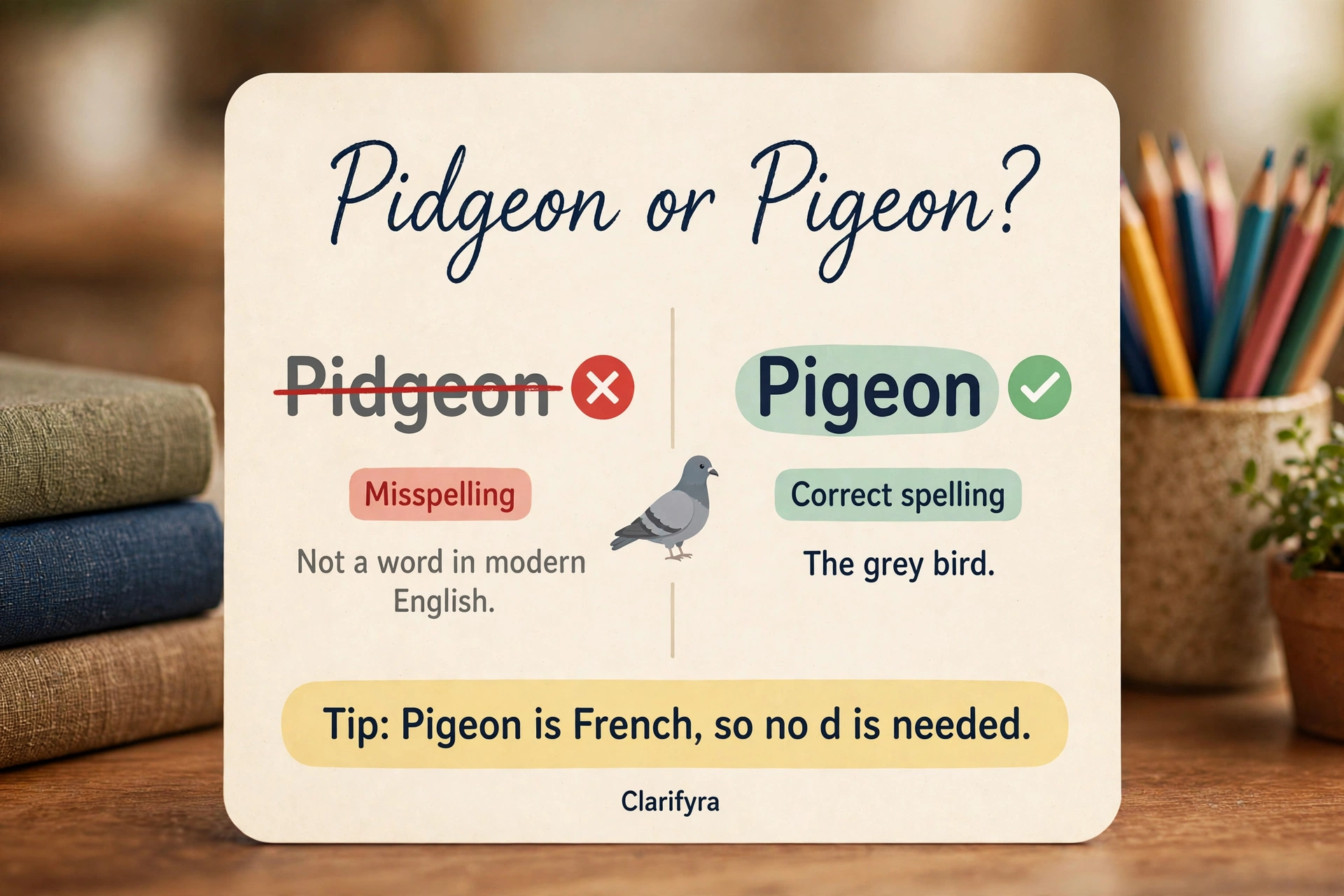
If you’re choosing between pidgeon and pigeon, the answer is one word long: pigeon. It is the only standard spelling of the bird’s name in modern English. Pidgeon is a misspelling — it has no entry in Cambridge, Oxford Learner’s, Merriam-Webster, or Collins, the four major references checked for this article. The extra d feels natural (think badge, bridge, edge), but pigeon came to English from French, and that French ancestry is exactly why the d was never there.
Quick Answer
Pigeon is the correct spelling — always. Pidgeon is a common misspelling with no entry in any of the four major dictionaries checked; its only dictionary presence is as an archaic 17th-century spelling (Wiktionary) and as a surname (Walter Pidgeon). Pronunciation: UK /ˈpɪdʒɪn/, US /ˈpɪdʒən/ — the /dʒ/ sound is what tempts writers to add a “d”. And don’t confuse it with pidgin (with an i): a completely different, real word meaning a simplified contact language.
What the Dictionaries Actually Say
The case for pigeon is unusually clean. Every major reference agrees on the spelling, the word class, and the meaning — and none of them lists pidgeon as a living word:
- Cambridge Dictionary: pigeon, noun — UK /ˈpɪdʒ.ən/, US /ˈpɪdʒ.ən/. Its example images are racing pigeons and homing pigeons: the bird, nothing else.
- Oxford Advanced Learner’s Dictionary: pigeon, noun — /ˈpɪdʒɪn/ in British English, /ˈpɪdʒən/ in American English: “a fat grey and white bird with short legs. Pigeons are common in cities and also live in woods and fields.” Oxford’s own collocations box lists flock … of pigeons as the standard pairing, and it groups related compounds — carrier pigeon, homing pigeon, stool pigeon, wood pigeon, clay pigeon — under the same entry.
- Collins English Dictionary: pigeon (ˈpɪdʒɪn), countable noun — “A pigeon is a bird, usually grey in colour, which has a fat body. Pigeons often live in towns.” Collins also records the slang sense: “a person who is easily fooled or cheated.” Its word-origin note is worth reading carefully: C14: from Old French pijon, young dove, from Late Latin pīpiō, young bird, from pīpīre, to chirp. That French pijon — with no d — is the spelling English inherited.
- Merriam-Webster: its thesaurus entry records the same slang noun sense — “one who is easily deceived or cheated” — with synonyms including sucker, dupe, and mark. No “pidgeon” anywhere.
And what about pidgeon itself? Searching the four references turns up nothing as a common word. Its only dictionary footholds are elsewhere: Wiktionary marks it as an archaic spelling of pigeon, quoting a 1674 text (“a dozen Pidgeons ready pulled”), and Dictionary.com lists Pidgeon solely as a proper noun — the surname of, among others, the Canadian actor Walter Pidgeon. The honest verdict, phrased the way the inclosed/enclosed research taught us to phrase things: pidgeon has no entry in the four major references checked, so in modern writing it functions as a misspelling. It’s the same pattern as inclosed vs enclosed — a spelling that once existed and now reads as an error.
The /dʒ/ Trap: Why “Pidgeon” Feels Right
If pidgeon is wrong, why do so many people — including careful writers — reach for it? Because English spelling has trained them to. In native English words, the /dʒ/ sound after a short vowel is normally written dge: badge, bridge, edge, judge, fridge, dodge. The hand hears “pij-in” and, following the pattern it knows, wants to write “pidgeon.”
Pigeon breaks the pattern because it isn’t a native English word at all. It arrived via Old French pijon in the 1300s and kept its French-looking ge. French-derived words play by French rules: the ge already does the /dʒ/ job, so no d is needed. The misspelling is, in other words, what happens when a perfectly good English instinct gets applied to a word that was never English to begin with. (Two spellings enter, one spelling leaves — the same standardization story as anual vs annual.)
Pronunciation: Say It Like the Dictionaries Do
The dictionaries split on the second syllable, so learn both:
- British English: /ˈpɪdʒɪn/ — “PIJ-in,” with a short i in the second syllable (Oxford Learner’s, Collins).
- American English: /ˈpɪdʒən/ — “PIJ-uhn,” with a schwa (Oxford Learner’s NAmE, Cambridge US).
Cambridge’s /ˈpɪdʒ.ən/ for both varieties is notation for the same reality: two syllables, stress firmly on the first, and the geo pronounced as a quick “jin/juhn” — never “gee-on.” Listen for the /dʒ/ sound: it’s the same consonant as in judge. That sound is precisely the trap. Knowing it consciously — “ah, there’s the /dʒ/ that’s tempting me to write dge” — is half the battle. The other half is remembering the French origin: pigeon is French, so no d is needed.
What “Pigeon” Means (It’s Not Just the Bird)
1. The bird
The core sense is the one everyone knows — the plump grey bird of city squares and park benches:
“A pigeon strutted along the roof, cooing rhythmically.”
“The square was full of tourists feeding the pigeons.”
“A flock of pigeons rose from the rooftops all at once.”
The word also anchors a small family of compounds, several recorded under Oxford’s entry: the carrier pigeon, trained to carry messages; the homing pigeon, trained to find its way home from long distances and raced for sport; and the wood pigeon, the larger cousin that lives in woods and fields rather than cities.
2. The slang sense: a person easily fooled
Both Collins (“a person who is easily fooled or cheated”) and Merriam-Webster (“one who is easily deceived or cheated”) record this older slang use, the vocabulary of con artists and card sharps — Merriam-Webster’s own example being “a confidence man in search of another pigeon.” It’s dated and informal; you won’t hear it in a boardroom, but you’ll meet it in detective novels and old films.
3. The idioms
Oxford records two British idioms worth knowing:
“Don’t tell her about the merger yet — you’ll put the cat among the pigeons.” (cause trouble by saying or doing something disruptive)
“Fixing the boiler is your pigeon, not mine.” (old-fashioned: your responsibility or business)
Note the second is marked old-fashioned in Oxford — “that’s not my pigeon” will get you a smile from older British readers and a blank look from younger ones.
“Pigeonhole”: The Useful Word Pigeon Built
Spell pigeon correctly and you get its best-known relative for free. Pigeonhole — one word, with the pigeon spelling intact — works as both noun and verb:
- Noun: a small open compartment for papers or letters, as in a desk or a hotel lobby wall — the physical slots that resemble nesting holes. Collins’s example: “There was a message waiting for me in the hotel pigeonhole.”
- Verb (forms: pigeonholed, pigeonholing): “to classify or categorize, esp. in a rigid manner” (Collins). “I don’t want to be pigeonholed as a kids’ presenter” is Collins’s own example sentence — the sense of being filed away into a category that doesn’t fit.
- Verb, second sense (especially American): “to put aside indefinitely, as if intending to ignore or forget” — shelved, filed and forgotten. “They pigeonholed the proposal after the budget cuts.”
The practical point: if you spell the bird “pidgeon,” you’ll misspell the whole family — “pidgeonhole,” “pidgeonholed.” Learn one spelling and the rest follows.
A Group of Pigeons: Flock, Flight, or Kit?
All three exist, but they aren’t interchangeable:
- A flock of pigeons — the standard, everyday term. Oxford’s collocations box lists it outright, and it’s the one to use in ordinary writing.
- A flight of pigeons — pigeons in the air. Use it when the birds are flying, not roosting.
- A kit of pigeons — the specialist’s term, used in pigeon breeding and racing for a group of homing or racing pigeons kept and trained together. Outside that world, it will confuse readers.
When in doubt, flock is never wrong.
Don’t Confuse It with “Pidgin”
Here’s the three-way tangle that makes this keyword genuinely tricky. Pidgin — spelled p-i-d-g-i-n — is a real, completely different word, and in both British (/ˈpɪdʒɪn/) and American (/ˈpɪdʒən/) pronunciation it sounds identical to pigeon:
| Word | Spelling | Meaning | Status |
|---|---|---|---|
| pigeon | p-i-g-e-o-n | the grey bird (and its slang/idiom senses) | correct |
| pidgeon | p-i-d-g-e-o-n | — | misspelling in modern English |
| pidgin | p-i-d-g-i-n | a simplified contact language | correct, different word |
A pidgin is “a simplified speech used for communication between people with different languages” (Merriam-Webster); Collins adds the key detail that “pidgin is not anyone’s first language.” The classic examples are trade languages — Nigerian Pidgin English, Chinese Pidgin English, Hawaiian Pidgin. The word itself is thought to come from 19th-century Chinese merchants in Guangzhou adapting the English word business (Merriam-Webster’s “Did you know?”; Collins: “perhaps from Chinese pronunciation of English business“). So “doing business” became “pidgin” — a neat story, and a useful memory hook: pidgin has an i like lingo, and it’s about language. The bird has an e — and everything else about it is spelled the French way.
✗ “He grew up speaking pigeon English.” → ✓ “He grew up speaking pidgin English.”
✗ “A pidgin landed on the windowsill.” → ✓ “A pigeon landed on the windowsill.”
Common Mistakes
1. Writing “pidgeon” for the bird. ✗ “A pidgeon sat on the fence.” → ✓ “A pigeon sat on the fence.” The /dʒ/ sound is doing the misleading; the French spelling doesn’t need the d.
2. Writing “pidgin” for the bird. ✗ “The pidgin cooed softly.” → ✓ “The pigeon cooed softly.” Same pronunciation, different word, different spelling.
3. Writing “pigeon” for the language. ✗ “They communicated in pigeon French.” → ✓ “They communicated in pidgin French.” If it’s about simplified speech between language groups, it’s pidgin with an i.
4. Carrying the error into “pigeonhole.” ✗ “Don’t pidgeonhole me.” → ✓ “Don’t pigeonhole me.” The verb keeps the bird’s spelling exactly — pigeonholed, pigeonholing.
5. Using “kit” outside pigeon fancying. ✗ “A kit of pigeons scattered across the plaza.” → ✓ “A flock of pigeons scattered across the plaza.” Kit is for breeders and racers; everyone else writes flock.
6. Capitalizing the bird. ✗ “The Pigeon flew away.” → ✓ “The pigeon flew away.” Capitalize only at the start of a sentence — or for the surname Pidgeon, which is a different matter entirely.
7. Pronouncing it “pi-JEE-on.” The geo is a quick “jin/juhn,” not two syllables: UK /ˈpɪdʒɪn/, US /ˈpɪdʒən/.
How to Remember the Spelling
Pigeon is French, so no d is needed. That’s the whole trick, and it’s historically true: the word came through Old French pijon, which never had a d. When your hand wants to write “pidgeon,” remind it that the /dʒ/ sound in badge and bridge belongs to native English words — this one flew in from France. As a backup anchor, remember pigeonhole: two common words, one spelling to learn, and it covers the family.
Frequently Asked Questions
Is “pidgeon” a word?
Not in modern English. It has no entry in Cambridge, Oxford Learner’s, Merriam-Webster, or Collins. Wiktionary marks it as an archaic 17th-century spelling, and it survives as a surname (Walter Pidgeon). In anything written today, spell it pigeon.
How do you spell pigeon?
P-I-G-E-O-N. No d. The word came from Old French pijon, which is why the /dʒ/ sound is written ge rather than dge.
How do you pronounce pigeon?
UK /ˈpɪdʒɪn/ (“PIJ-in”), US /ˈpɪdʒən/ (“PIJ-uhn”). Two syllables, stress on the first, and the “geo” is a quick “jin/juhn.”
What’s the difference between pigeon and pidgin?
Pigeon (p-i-g-e-o-n) is the bird. Pidgin (p-i-d-g-i-n) is a simplified contact language used between people who don’t share a language. They’re pronounced the same, which is exactly why the confusion persists.
Is it “a flock of pigeons”?
Yes — flock is the standard collective noun, listed in Oxford’s collocations. Flight works for pigeons in the air, and kit is the specialist term among pigeon breeders and racers.
What does “pigeonhole” mean as a verb?
Mainly “to classify or categorize, especially in a rigid manner” (“I don’t want to be pigeonholed as a kids’ presenter”). In American usage it can also mean to shelve something indefinitely. Forms: pigeonholed, pigeonholing.
Why do so many people spell it “pidgeon”?
Because English spelling trains us to write the /dʒ/ sound as dge after a short vowel (badge, bridge, edge, judge). Pigeon is a French borrowing that kept its French ge, so the usually reliable instinct misfires — plus pidgin, pronounced identically, keeps the sound-spelling muddle alive.
Can I play “pidgeon” in Scrabble?
According to Scrabble word-listing sites, it’s valid in the UK/international (SOWPODS/CSW) list but not in the North American (TWL) list — a quirk of how the lists treat archaic spellings. For writing, though, it’s a misspelling either way.
Final Takeaway
Pigeon is the spelling — the bird, the idioms, and pigeonhole all ride on it. Pidgeon is the spelling your English instincts suggest and the dictionaries reject: no entry in the four major references, an archaic ghost, a surname, and a red underline in every spellchecker. Remember the French connection — pigeon came through Old French pijon, no d required — and keep pidgin (with an i, for language) in its own separate box. One spelling, no d, never wrong.