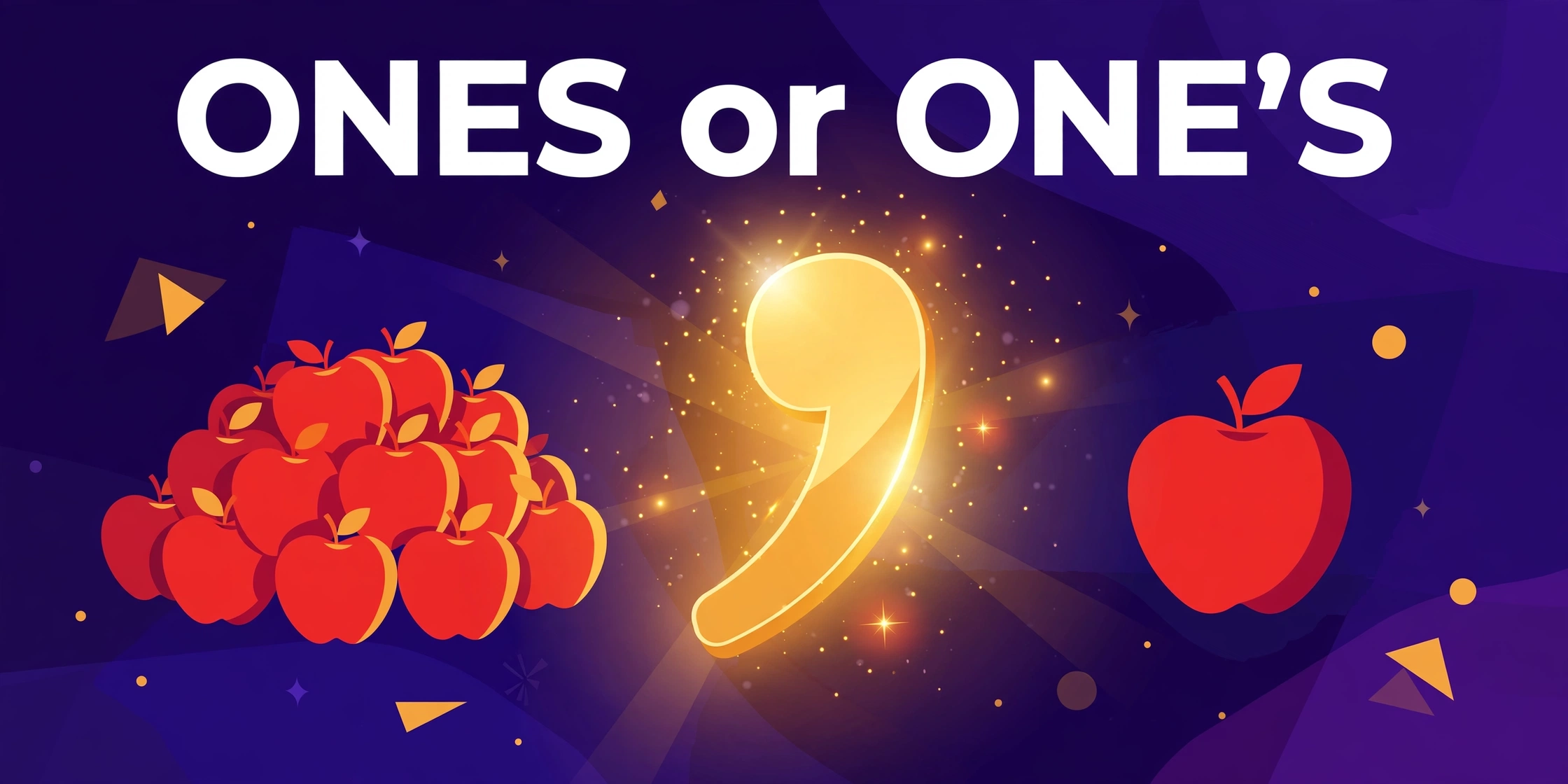
Ones or One’s: Which Is Correct?
Ones and one’s look like a typing accident waiting to happen: the same three letters, separated by a single apostrophe. That apostrophe does real work, though. It marks the difference between a plural and a possessive, between “more than one thing” and “belonging to one person in general”. Get it wrong and a sentence can quietly say the opposite of what you meant.
This guide explains what each form means, when to use it, why there is no such everyday word as ones’, and how to avoid the traps that catch even confident writers.
Quick Answer
Ones is the plural of one — more than one thing or person already mentioned (“I like the red ones”). One’s is the possessive of the pronoun one — belonging to people in general (“One must do one’s best”) — and it can also be a contraction of one is (“One’s going to be late”). If you mean “more than one”, use ones. If you mean “belonging to one”, use one’s.
What Does “Ones” Mean?
Ones is the plural form of one when one stands in for a noun that has already been mentioned. Cambridge Grammar explains that we commonly use one and its plural ones as a substitute for a countable noun, so that we do not have to repeat the noun itself.
That is its whole job: it replaces a plural noun to avoid repetition. “I bought two shirts — a blue one and a white one” becomes, in the plural, “I bought two shirts — the blue ones are for work.” The word ones stands in for shirts, and the reader knows exactly which shirts are meant because they were named a moment earlier.
Cambridge also notes the limits of this use. We do not use one to refer back to uncountable nouns — you cannot say “the rices” or “the ones” for a mass noun — and we do not normally use ones immediately after some, any, both, or numbers unless it is premodified. So “I want some ones” sounds wrong; “I want the small ones” sounds right, because small modifies it.
Ones is also the plural of the number itself: “The teacher gave him ones on all his art projects” — ones here means the numeral 1, more than one of them. In money, “ones” can mean one-dollar or one-pound notes: “She paid in ones.” In every case the meaning is plural, and there is no apostrophe.
Ones in Real Sentences
- I prefer the red ones.
- The small ones are cheaper than the large ones.
- These shoes are too big. I prefer the other ones.
- Which ones did you choose?
- She kept the best ones for herself.
What Does “One’s” Mean?
One’s has two jobs, and both need the apostrophe. The first and most important is the possessive of the pronoun one. Cambridge Grammar states it directly: “One’s is a possessive determiner”, giving the example “One’s health is much more important than having lots of money.” The pronoun one here means people in general, and one’s means belonging to people in general.
That is why the classic formal sentence is “One should do one’s duty”, not “One should do his duty” and not “One should do ones duty”. Once a sentence uses the indefinite pronoun one, it must stay consistent and use one’s for the possessive, and oneself for the reflexive. Mixing pronouns — “One should do his duty” — is a traditional error, because his belongs to a different pronoun.
Unlike the possessive forms of personal pronouns (its, hers, theirs), one’s is written with an apostrophe. That is a genuine exception worth learning on its own: its has no apostrophe, but one’s always does when it is possessive.
The second job of one’s is as a contraction of one is. “One’s going to have to decide” means “One is going to have to decide.” This use is much rarer than the possessive, and it appears mainly in informal speech and dialogue. It is correct, but it is not the use most readers will meet first.
One’s in Real Sentences
- One must examine one’s actions before criticising others.
- One’s health is much more important than having lots of money.
- One has to trust one’s family.
- One should always honour one’s parents.
- One’s experiences shape one’s expectations.
Ones or One’s: The Difference at a Glance
| Ones | One’s | |
|---|---|---|
| What it is | Plural of one | Possessive of one (or contraction of one is) |
| Apostrophe? | No | Yes |
| Meaning | More than one thing already mentioned | Belonging to people in general |
| Replaces | A plural noun | A possessive determiner such as your |
| Example | I like the red ones. | One must do one’s best. |
| Test | Can you replace it with the plural noun? | Can you replace it with “your” or “a person’s”? |
How to Pronounce One, Ones, and One’s
All three forms are pronounced the same: /wʌn/, rhyming with done and sun — not with bone or own. The spelling of one is famously irregular: it begins with the letter “o” but is pronounced with a “w” sound. The plural ones is /wʌnz/ and the possessive one’s is also /wʌnz/; the ear cannot tell them apart at all. Only the apostrophe, and the grammar of the sentence, can do that.
That is exactly why this pair is so often confused in writing, even by people who use both forms correctly in speech. In speech there is nothing to confuse. In writing, the apostrophe is the only signal, and it has to be placed by meaning, not by sound.
The “Ones'” Trap: There Is (Almost) No Plural Possessive
The most persistent error with this pair is ones’ — an apostrophe after the “s”. Writers who know that possessives often end in s’ (“the dogs’ tails”, “the teachers’ room”) apply the same pattern to one and produce ones’. It is wrong in almost every case, because there is no ordinary plural possessive of one.
The reason is in the grammar. One as a pronoun refers to a single unspecified person, or stands in for a single countable noun. Its possessive is one’s. The plural ones stands in for plural nouns, and a plural pronoun of that kind does not take a possessive of its own in normal English. As the British Council’s grammar reference notes, the pronoun one has no plural form as a personal pronoun, and a possessive of the plural would require a very unusual context to be possible at all.
So if you have written ones’, stop and check. You almost certainly mean either ones (plural, no apostrophe) or one’s (possessive, apostrophe before the “s”). “The ones’ opinions” is defensible only in the rarest of constructed examples; in real writing, say “the opinions of the ones” or, more naturally, write a different sentence altogether.
Correct vs Incorrect
| Incorrect | Correct | Why |
|---|---|---|
| I prefer the red one’s. | I prefer the red ones. | Plural of one takes no apostrophe. |
| One must do ones best. | One must do one’s best. | Possessive of one needs the apostrophe. |
| The ones’ car was parked outside. | One’s car was parked outside. / Their car was parked outside. | There is no ordinary plural possessive ones’. |
| One should do his duty. | One should do one’s duty. | Stay consistent: one takes one’s, not his. |
| Which one’s did you choose? | Which ones did you choose? | More than one thing: plural, no apostrophe. |
| Ones health is important. | One’s health is important. | Belonging to people in general: possessive. |
Common Mistakes to Avoid
1. Adding an apostrophe to the plural
“The red one’s are on sale” is wrong twice over: ones needs no apostrophe, and the plural is not a possessive. If the word means “more than one”, leave the apostrophe out.
2. Dropping the apostrophe from the possessive
“One must look after ones health” is wrong. The possessive of the pronoun one is always one’s. This is the one pronoun whose possessive keeps its apostrophe, unlike its.
3. Writing “ones'” for a possessive
As above, ones’ is not a standard form. If your sentence seems to need it, rewrite the sentence. “The views of the ones who stayed” is clearer than any attempt at a plural possessive.
4. Mixing “one” with “his” or “their”
Formal English keeps the pronoun chain consistent: one … one’s … oneself. “One should do his duty” mixes two pronouns. In informal writing, the simplest fix is to avoid one altogether and use you: “You should do your duty.”
5. Using “one’s” where “once” is meant
Once is an adverb meaning “one time” — “I have seen it once.” It is never a possessive and never a plural. The three words ones, one’s, and once all sound similar, so check the meaning, not the sound.
When “One” Is Best Avoided Altogether
Cambridge notes that one as a pronoun for people in general is formal, and that using it too much can make a speaker sound too stiff. In most modern writing, generic you or we does the same job more naturally: “You should always check your work” reads more warmly than “One should always check one’s work”, and means the same thing.
Ask one question: does the word mean “more than one” or “belonging to one”? More than one is ones, with no apostrophe — just as cats, dogs, and books take no apostrophe in the plural. Belonging to one is one’s, with the apostrophe before the “s” — just as the teacher’s book puts the apostrophe before the “s” for a singular owner.
A second test works well in practice. Try replacing the word with your. If the sentence still makes sense — “One must do your best” is odd, but “One must do one’s best” means “a person must do a person’s best” — you need the possessive. Try replacing it with the plural noun instead: “I like the red shirts” works where “I like the red ones” works, so ones is right.
FAQs
Are both “ones” and “one’s” correct?
Yes — both are correct, but they mean different things. Ones is the plural of one; one’s is its possessive (and, rarely, a contraction of one is). Neither is a misspelling of the other.
Is “ones'” ever correct?
Almost never. There is no standard plural possessive of the pronoun one. If you find yourself writing ones’, you almost certainly mean ones or one’s, or the sentence needs rewriting.
Can “one’s” mean “one is”?
Yes. “One’s going to be late” is a contraction of “One is going to be late.” This use is correct but uncommon, and it is easy to confuse with the possessive, so use it sparingly in formal writing.
Why does “one’s” have an apostrophe when “its” does not?
Because one is not a personal pronoun like it. Personal pronouns have special possessive forms without apostrophes (its, hers, theirs). One forms its possessive like a noun, with ‘s — and that is the form Cambridge records.
Should I use “one” or “you” in general statements?
Both are correct. One is more formal; you is more natural in everyday writing. Choose one and stay consistent within a sentence.
The Takeaway
Ones means more than one. One’s means belonging to one (person in general). The apostrophe is not decoration: it is the whole difference. Plural, no apostrophe; possessive, apostrophe before the “s”; and ones’ is not a word you need. Check the meaning before you type, and the choice will be right. For the full grammar, see Cambridge’s pages on one and one’s and on one as a substitute.

One Comment