Mondays or Monday’s: Which Is Correct?
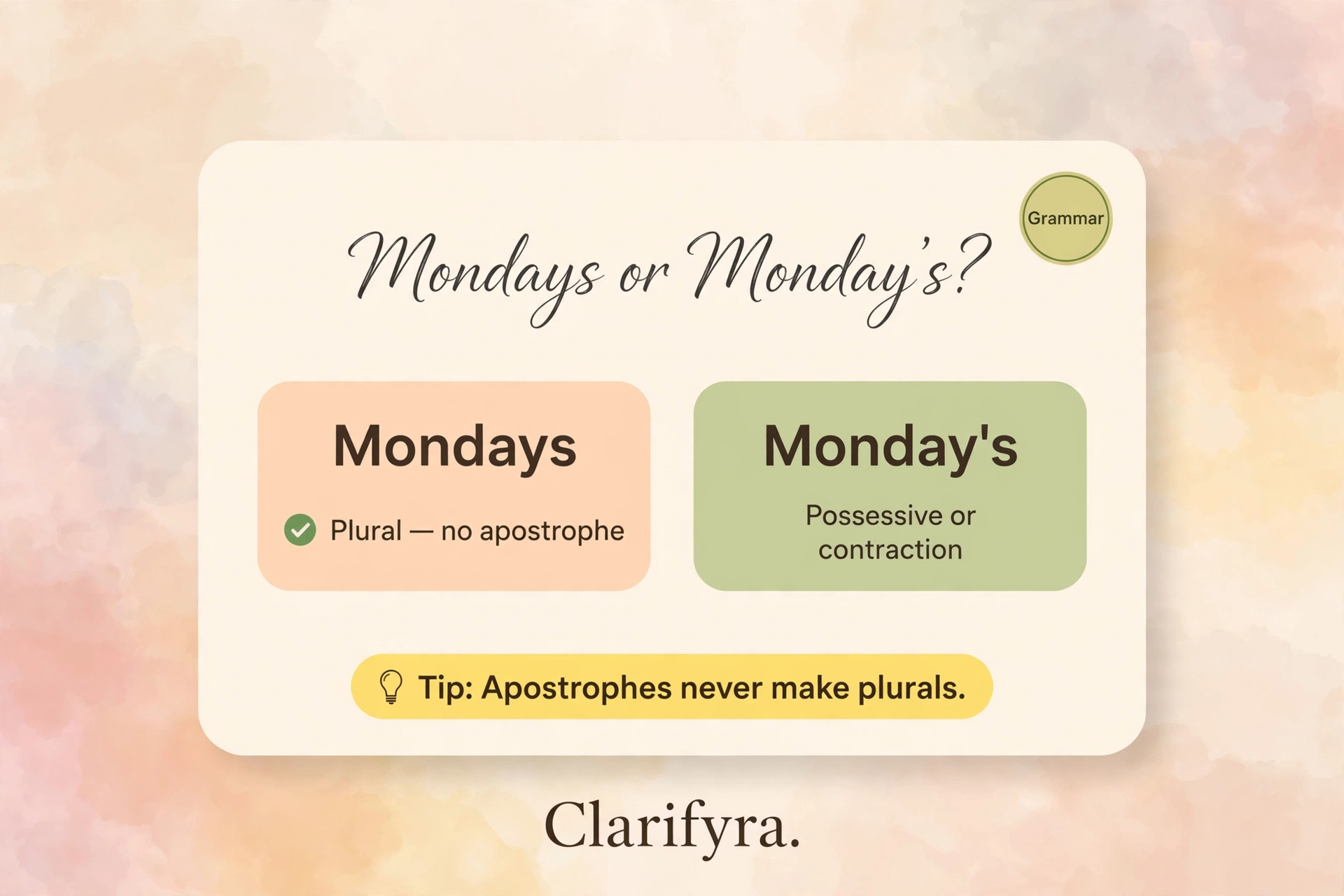
Mondays (no apostrophe) is the plural — more than one Monday: “I work Mondays.” Monday’s (with apostrophe) is either the possessive — ” Monday’s schedule” (the schedule of Monday) — or a contraction of Monday is / Monday has: “Monday’s going to be busy.” The apostrophe never makes a plural, so “open Monday’s” on a shop sign is the classic greengrocer’s apostrophe: widespread, but nonstandard in edited writing.
Quick Answer
Mondays = plural: “the gym is quiet on Mondays” (Collins lists “Word forms: plural Mondays“). Monday’s = possessive (“Monday’s meetings” — the meetings belonging to Monday) or contraction (“Monday’s a holiday” = Monday is; “Monday’s been rough” = Monday has). For the plural possessive — the meetings belonging to multiple Mondays — it’s Mondays’: “all those Mondays’ early starts.” Always capitalize: Monday is a proper noun. (Etymology for the curious: Old English mōnandæg, “moon’s day,” translating Late Latin lūnae diēs.)
Mondays: The Plural
When you mean “more than one Monday,” the spelling is Mondays — just add s, no apostrophe. Collins’s entry for Monday gives the word forms as “plural Mondays,” and the pattern is the same for every day of the week: Tuesdays, Wednesdays, Fridays.
The plural shows up in two main constructions. The habitual: “I work Mondays” (every Monday, as a rule), “the shop opens late on Mondays.” And the counted: “we’ve had three rainy Mondays in a row,” “two of the last four Mondays were holidays.” In both, no apostrophe — an apostrophe never forms a plural in standard English.
Capitalization is non-negotiable: days of the week are proper nouns, so it’s always Mondays, never “mondays.” (The one systematic exception is some technical or styled contexts, but in normal writing, capitalize.)
Monday’s: Possessive or Contraction
Monday’s with the apostrophe does two legitimate jobs — and neither of them is the plural.
Job 1: singular possessive. The schedule, weather, or mood belonging to (one) Monday: “Monday’s forecast looks grim,” “we’ll follow Monday’s agenda,” “that was Monday’s big story.” The apostrophe-s marks possession, exactly as in “the dog’s dinner.”
Job 2: contraction. Monday’s = Monday is or Monday has: “Monday’s going to be hectic” (Monday is), “Monday’s been a long day” (Monday has). This is conversational — fine in dialogue, emails, and informal writing; recast it in formal prose (“Monday is going to be hectic”).
And the form people forget: the plural possessive. The early starts belonging to many Mondays are “those Mondays’ early starts” — plural Mondays first, then the apostrophe after the s. It’s rare in practice (you’d usually rephrase: “the early starts every Monday bring”), but it’s the correct form when you need it.
| Form | Job | Example |
|---|---|---|
| Mondays | Plural | “I dread Mondays.” |
| Monday’s | Singular possessive | “Monday’s meeting ran long.” |
| Monday’s | Contraction | “Monday’s a fresh start.” (= Monday is) |
| Mondays’ | Plural possessive | “Those Mondays’ deadlines piled up.” |
The Greengrocer’s Apostrophe: An Honest Caveat
“Open Monday’s,” “closed Sunday’s,” “fresh bagel’s” — the stray apostrophe in plurals is so common on shop signs and market stalls that it has a name: the greengrocer’s apostrophe. Here’s the honest position: in edited, standard English it’s wrong — apostrophes don’t make plurals, and every style guide says so. But it’s also everywhere, it rarely causes genuine confusion (nobody thinks “Monday’s” on a door means “belonging to Monday”), and correcting strangers’ signage wins no friends.
The practical rule: in your own writing — CVs, emails, essays, published work — use Mondays for the plural. On a sign you walk past, let it go. Knowing the rule matters; enforcing it on shopkeepers doesn’t.
Monday in Idioms
Monday’s reputation as the week’s difficult child has stocked the language with idioms — and they all follow the standard spelling rules:
- Monday blues — the dread of the week’s start: “she had a bad case of the Monday blues.” Plural Mondays nowhere in sight; it’s the attributive Monday.
- Monday-morning quarterback (chiefly US) — someone who criticizes with hindsight: “the Monday-morning quarterbacks dissected every play.” Note the plural goes on quarterbacks, not Mondays.
- Manic Monday — the frantic start to the week, popularized as a song title; now shorthand for any chaotic Monday.
- Monday to Friday — the working week: “a Monday-to-Friday job.” Hyphenated as a compound adjective, no apostrophes, no plurals.
The pattern across all of them: Monday stays singular and capitalized when it’s modifying another noun, and the s-forms only appear for genuine plurals (Mondays) or possession (Monday’s). If an idiom needs neither, neither appears.
Correct vs. Incorrect
- ✓ “The office is closed on Mondays.” / ✗ “The office is closed on Monday’s.”
- ✓ “Monday’s weather looks perfect.” (possessive — the weather of Monday)
- ✓ “Monday’s the deadline.” (contraction — Monday is)
- ✗ “Mondays weather looks perfect.” → ✓ “Monday’s weather…” (possessive needs the apostrophe)
- ✓ “Three Mondays’ worth of meetings got postponed.” (plural possessive — rare but correct)
- ✗ “I hate mondays.” → ✓ “I hate Mondays.” (proper noun — capitalize)
- ✗ “See you Monday’s!” → ✓ “See you Monday!” / “See you on Monday!” (neither plural nor possessive — no s at all)
Common Mistakes
1. “Monday’s” for the plural. The keyword’s core question, and the most common error in the wild: “we’re closed Monday’s,” “I work Monday’s.” If you mean more than one Monday — or the recurring day as a habit — it’s Mondays, no apostrophe. Test it: would you write “apple’s” for more than one apple? Same rule.
2. “Mondays” for the possessive. The mirror image: “Mondays meeting is at ten” when you mean one Monday’s meeting. If the meeting belongs to Monday, the apostrophe is required: “Monday’s meeting.”
3. Dropping the capital. “mondays” in lowercase is wrong in standard writing — days of the week are proper nouns. Autocorrect usually catches this one; don’t fight it.
4. Overusing the plural possessive. Technically correct, but “Mondays’ meetings” is clunky enough that rephrasing is usually better: “meetings on Mondays,” “every Monday’s meetings.” Correctness isn’t the only virtue — clarity counts too.
5. Apostrophe-s on every weekday in lists. “Open Monday’s–Friday’s” doubles the error across the week. The range of days is a plural idea: “open Monday–Friday” or “open Mondays to Fridays.” No apostrophes anywhere in that construction.
Frequently Asked Questions
Is it “Mondays” or “Monday’s”?
It depends on the job: Mondays (no apostrophe) is the plural — “I work Mondays.” Monday’s (apostrophe) is the possessive — “Monday’s schedule” — or a contraction — “Monday’s (= Monday is) a holiday.” Apostrophes never form plurals.
What about “Mondays'” with the apostrophe at the end?
That’s the plural possessive: something belonging to multiple Mondays. “Those Mondays’ early alarms wore me down.” It’s correct but rare — most writers rephrase to avoid it (“the early alarms every Monday”).
Why do so many signs say “Open Monday’s”?
The greengrocer’s apostrophe: a hypercorrection so widespread it’s become a recognized phenomenon. Writers half-remember that apostrophes go with s-endings and insert one where a plain plural s belongs. It’s nonstandard in edited English but extremely common in informal signage.
Should “Monday” always be capitalized?
Yes — days of the week are proper nouns in English: Monday, Mondays, Monday’s. Always capitalized in standard writing, including the plural and possessive forms.
Does this rule apply to other days too?
Exactly the same pattern: Tuesdays/Tuesday’s, Fridays/Friday’s, Sundays/Sunday’s. Plural = bare s; possessive or contraction = apostrophe-s. Learn it once for Monday and you’ve learned it for the whole week.
The Takeaway
Mondays is the plural (“I work Mondays“). Monday’s is the possessive (“Monday’s agenda”) or a contraction (“Monday’s [= Monday is] a holiday”). Mondays’ is the plural possessive for the rare occasions you need it. The apostrophe never makes a plural — “open Monday’s” is the famous greengrocer’s error, forgivable on a shop sign, wrong in your writing. Capitalize always; apostrophize only for possession or contraction.