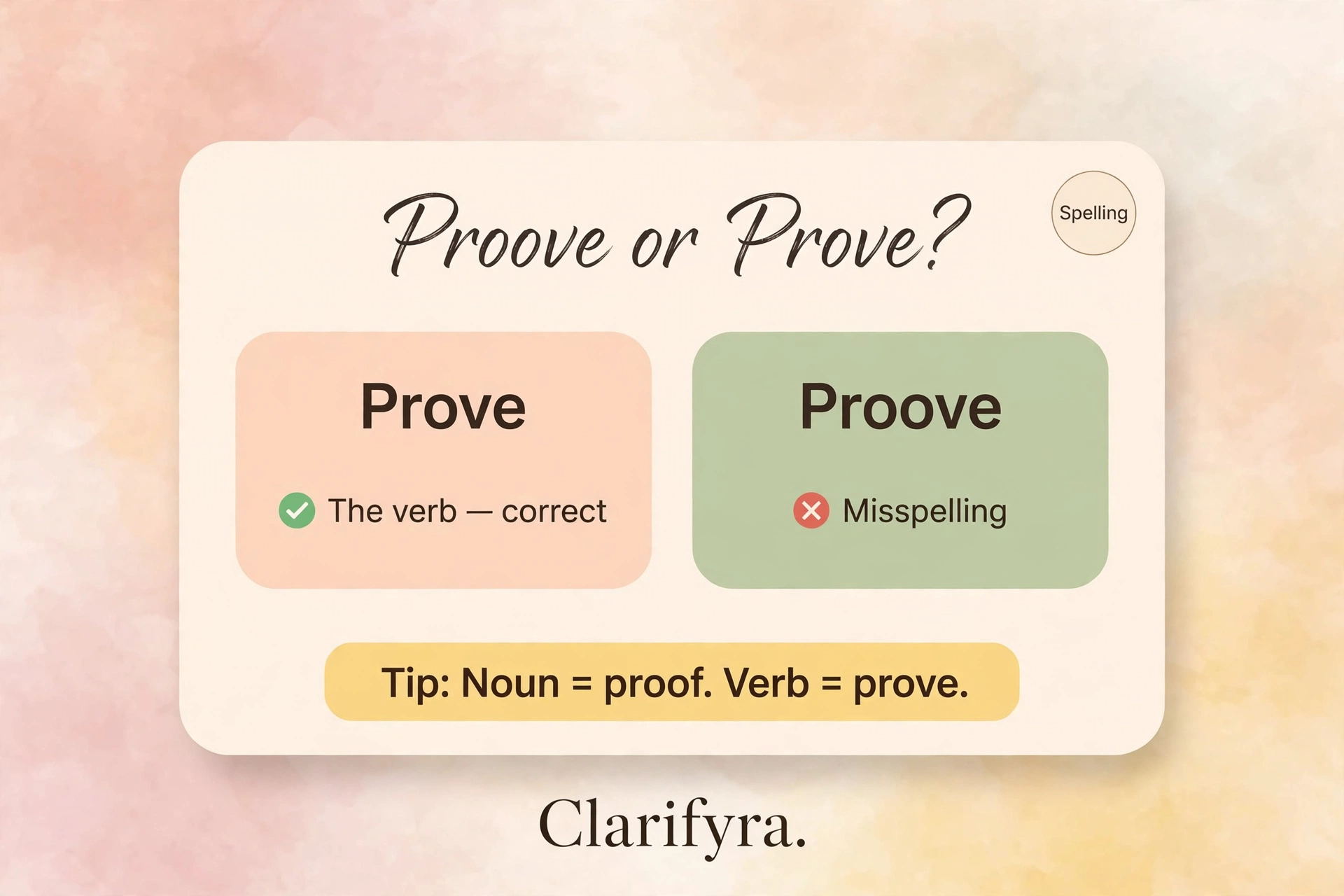
Proove or Prove: Which Is Correct?
Prove is the correct modern spelling — the verb meaning to establish the truth of something. Proove is not a current English word: Wiktionary lists it as an obsolete 16th–18th century spelling of prove and, in modern use, a misspelling. None of the major dictionaries checked (Merriam-Webster, Cambridge, Collins) give proove a headword. The double o almost certainly sneaks in from the noun proof — but the noun keeps its double o and the verb doesn’t.
Quick Answer
Prove is the verb: “to establish the existence, truth, or validity of (as by evidence or logic)” (Merriam-Webster). Its forms are proves, proving, proved (past tense), and proved or proven (past participle). Proove is an obsolete 16th–18th-century spelling per Wiktionary, and a misspelling in modern English — no major dictionary checked lists it as a current headword. Pronounced /pruːv/ (“PROOV”). Remember the split: the noun is proof (double o), the verb is prove (single o).
Why “Proove” Looks Right (But Isn’t)
The misspelling has a perfectly understandable source: the noun proof. “We need proof” and “we need to prove it” sit side by side in the same sentences, and the brain harmonizes them — if the noun has a double o, surely the verb does too. It’s the same instinct behind “embassy → embassador,” and it’s just as wrong for modern English.
Wiktionary’s entry for proove tells the fuller story: sense 1 is “obsolete spelling of prove” dated to the 16th–18th centuries; sense 2 is “misspelling of prove,” with citations showing prooved and prooven turning up in unedited modern writing. So proove isn’t a random typo — it’s a spelling English actually used four hundred years ago and then abandoned. That history is interesting, but it doesn’t make it acceptable today: no current dictionary checked headwords it.
The noun/verb split is the thing to memorize. English has several pairs where the noun and verb diverged in spelling: proof/prove is one; belief/believe and grief/grieve are cousins. In each case the noun kept the older vowel spelling and the verb moved on. Prove is the verb. Full stop.
The Forms of “Prove”: Proved vs. Proven
Getting prove right also means getting its tenses right — and this is where even confident writers hesitate. The dictionaries agree on the pattern:
| Form | Spelling | Example |
|---|---|---|
| Base / present | prove | “I will prove it.” |
| Third-person singular | proves | “The exception proves the rule.” |
| Present participle | proving | “a proving ground” |
| Past tense | proved | “She proved her point.” |
| Past participle | proved or proven | “has proved/proven“ |
Proved vs. proven deserves its own note, because it’s the live question. Merriam-Webster’s usage guidance: the past tense is always proved (“she proved it yesterday” — never “she proven it”). The past participle can be either: “has proved” or “has proven” are both standard, and Merriam-Webster notes the two are now about equally frequent overall. But as an attributive adjective — placed before a noun — proven dominates: “a proven track record,” “a proven method,” and the legal formula “innocent until proven guilty.” Collins’s word-forms line concurs: “past tense proved, past participle proved or proven.”
And the misspelled family — prooves, prooving, prooved, prooven — inherits the same verdict as proove: obsolete or misspelled. If the base form is wrong, every form built on it is wrong.
The Other Senses of “Prove”
“Establish the truth” is the head sense, but prove has earned its keep in a few more corners of the language — all spelled the same way:
- Turn out (to be): “the forecast proved wrong,” “it proved to be a long night.” The “copulative” sense — prove linking a subject to its outcome.
- Test or try: “the exception proves the rule” (tests it), “a proving ground” (a place where things are tested — originally military test sites, now any trial arena).
- Prove out (phrasal, chiefly US): “to turn out well after testing” — “the theory proved out in practice.”
- Mathematics and logic: “to prove a theorem” — establish by deduction. The noun for the completed demonstration is a proof (“a proof of the theorem”), which is why math students meet the noun/verb pair head-on.
Every one of these takes proved/proven in the past — never prooved/prooven. “The design proved out” is right; “the design prooved out” is wrong in exactly the same way as the base form.
Correct vs. Incorrect
- ✓ “The study aims to prove the hypothesis.” / ✗ “The study aims to proove the hypothesis.”
- ✓ “She proved her innocence.” / ✗ “She prooved her innocence.”
- ✓ “He has proven himself time and again.” / ✗ “He has prooven himself time and again.”
- ✓ “The lawyer presented the proof.” (noun — double o is correct here)
- ✗ “The lawyer presented the prove.” → ✓ “…presented the proof.” (noun needed, not the verb)
- ✓ “It proved to be a difficult winter.” (“turn out” sense — correct)
- ✗ “The results proove conclusive.” → ✓ “The results prove conclusive.”
Common Mistakes
1. Doubling the o by analogy with “proof.” The root cause, covered above. Tattoo this on your memory: proof is the noun (double o), prove is the verb (single o). “Burden of proof” but “prove beyond reasonable doubt.”
2. Using “proven” as the past tense. “She proven her point yesterday” is wrong — the simple past is always proved. Proven is a past participle (“has proven”) and an attributive adjective (“a proven winner”). Keep the jobs separate.
3. Writing “proove” in the “turn out” sense. Prove also means “to turn out (to be)”: “it proved impossible,” “the day proved fine.” Writers who know the “establish truth” sense sometimes treat the “turn out” sense as a different word and misspell it. It’s the same verb, same spelling.
4. Confusing “prove” with “proof” as a verb. In printing, a proof is a trial impression — and “to proof a page” (check it against the proof) is a legitimate verb with double o. That’s a separate, technical verb. In general writing, the verb you want is prove.
5. “Proove” in legal or academic writing. This error stings most where precision matters. “The defendant failed to proove…” in a brief, or “these results proove…” in a paper, undermines credibility instantly. Legal and academic readers notice.
Frequently Asked Questions
Is “proove” ever correct?
Only historically. Wiktionary records proove as the standard spelling from the 16th to 18th centuries — so you’ll meet it in Early Modern English texts. In modern English it’s a misspelling, and none of the major current dictionaries checked give it a headword.
Should I write “proved” or “proven”?
For the simple past tense, always proved: “she proved it.” For the past participle, both are standard: “has proved” and “has proven.” Before a noun, prefer proven: “a proven method,” “proven results.” Merriam-Webster notes proven is now about as frequent as proved as a participle, but far more common attributively.
Why does the noun have a double o but the verb doesn’t?
They diverged historically: the noun proof kept the older vowel spelling while the verb prove shifted. English has similar noun/verb splits (belief/believe, grief/grieve). There’s no logic to memorize beyond the pair itself: proof = noun, prove = verb.
What does “the exception proves the rule” mean?
It’s the classic idiom using prove in its older sense of “test” or “put to trial”: the exception tests the rule — a genuine exception forces you to examine (and thereby confirm the limits of) the rule. Note the third-person proves, single o.
How is “prove” pronounced?
/pruːv/ (“PROOV”) — rhymes with move and groove. The o is long despite being single, which is part of why the double-o misspelling feels natural. Don’t let the sound fool the spelling.
The Takeaway
Prove is the verb — single o, pronounced “PROOV,” with past tense proved and participle proved or proven (“a proven track record”). Proove is a 16th–18th-century spelling that modern English left behind; today it’s a misspelling, however natural the double o feels next to the noun proof. Keep the jobs straight — proof the noun, prove the verb — and the spelling takes care of itself.