65 Ways to Say “I Love You” Without Saying “I Love You”
Love doesn’t always need those exact three words. Sometimes, a thoughtful sentence, a playful text, or a small everyday gesture can communicate affection more naturally than simply saying “I love you.” The best ways to say I love you without saying I love you depend on your relationship, personality, and the feeling you want to express.
Some alternatives sound deeply romantic, while others are gentle, reassuring, cute, or playful. And in languages such as Spanish and Japanese, the right expression can carry different levels of intimacy, so context matters just as much as translation.
A Quick Guide to Choosing the Right Expression
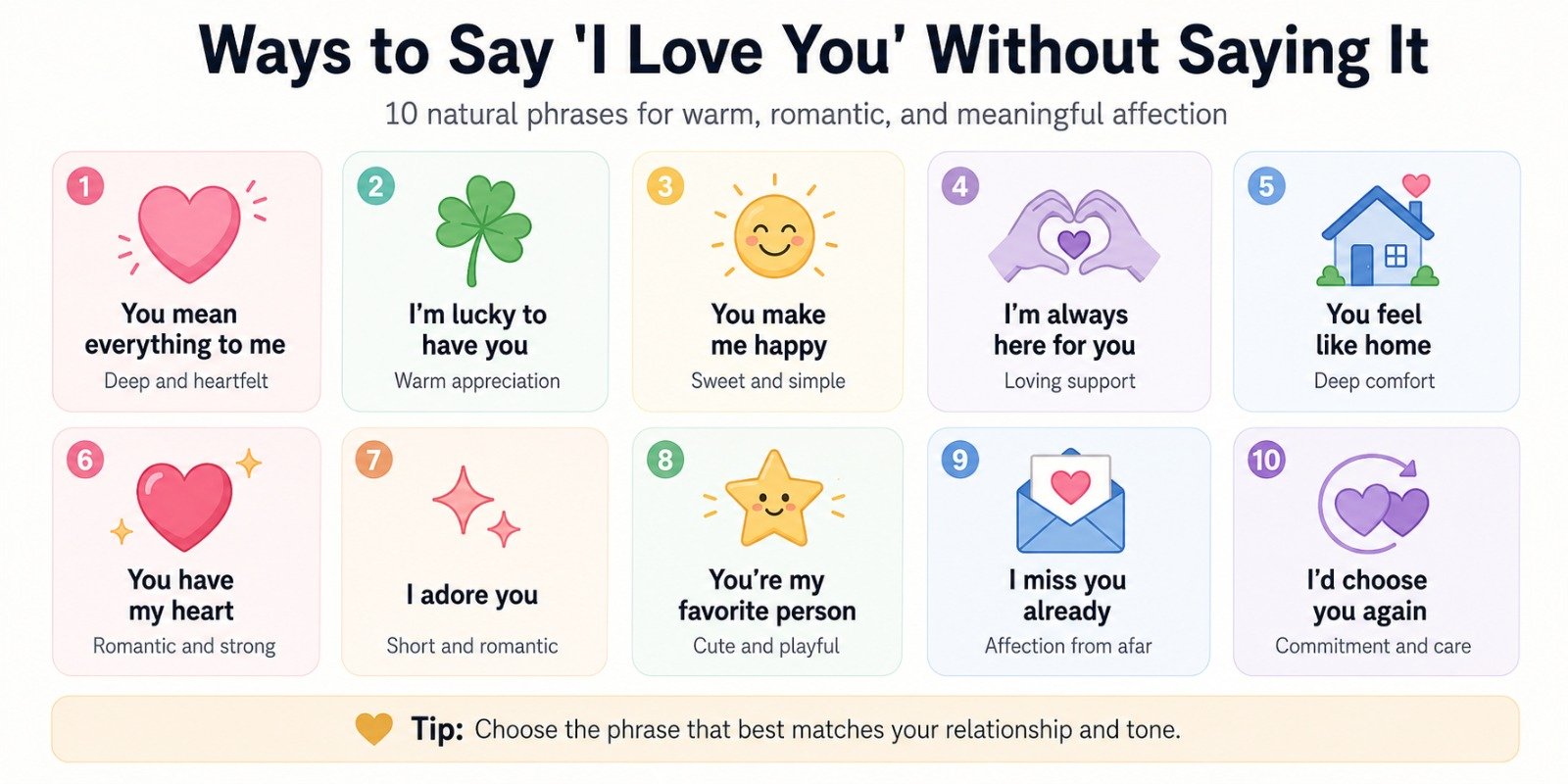
Not every affectionate phrase means exactly the same thing. “I’m proud of you,” for example, communicates support rather than romantic love, while “You have my heart” carries a much stronger romantic tone.
| Expression | Tone | Best For |
|---|---|---|
| You mean everything to me. | Deep and romantic | Serious partners |
| I’m so lucky to have you. | Warm and appreciative | Partners or spouses |
| You feel like home. | Intimate and emotional | Close relationships |
| I’m always here for you. | Reassuring | Partners, friends, family |
| You’re my favorite person. | Cute and casual | Partners or close friends |
| I adore you. | Romantic | Dating or established relationships |
| You make my life better. | Heartfelt | Partners and family |
| I believe in you. | Supportive | Anyone you care about |
| You have my heart. | Romantic and poetic | Partners |
| I’d choose you all over again. | Deep and committed | Long-term relationships |
The best phrase is the one that matches what you genuinely mean. Affection, admiration, loyalty, attraction, and emotional support can overlap, but they are not interchangeable.
Also Read | 75 Cute Ways to Say “I Love You”: Sweet, Romantic, Poetic and Funny Ideas
Romantic Ways to Say I Love You Without Saying It
When you want your feelings to be unmistakably romantic, choose language that expresses closeness, attachment, or commitment.
1. You mean everything to me.
This is strong and sincere. It works best in an established relationship rather than during the very early stages of dating.
Example:
“You mean everything to me, and I’m grateful we found each other.”
2. You have my heart.
A short, romantic option with a slightly poetic feel.
Example:
“No matter how busy life gets, you’ll always have my heart.”
3. I’m so lucky to have you.
This expresses love through gratitude rather than through a direct declaration.
Example:
“Days like this remind me how lucky I am to have you.”
4. You make my life better.
Simple and believable, especially when you want to avoid language that sounds overly dramatic.
5. I’m happiest when I’m with you.
This works well when you want to express how much someone’s presence means to you.
6. I’d choose you all over again.
A particularly meaningful expression for spouses and long-term partners.
7. You’re the person I want beside me.
This communicates commitment without sounding too flowery.
8. I can’t imagine my life without you.
A very strong statement that suits serious relationships better than casual dating.
9. Being with you feels right.
Soft and sincere, with less intensity than some traditional romantic declarations.
10. I want you in every chapter of my life.
This has a more poetic tone and suggests long-term commitment.
Deep and Meaningful Ways to Express Love
Sometimes love is less about romance and more about emotional safety, loyalty, and being truly known.
Try:
- You understand me better than anyone.
- I feel safe with you.
- I trust you completely.
- You bring out the best in me.
- I’m grateful that you’re part of my life.
- You make ordinary days feel special.
- I’m better because I know you.
- You’re one of the best things that ever happened to me.
- I want to grow with you.
- Whatever happens, you won’t face it alone.
- You matter more to me than you realize.
- I’ll always make room for you in my life.
“I feel safe with you” can be especially meaningful in a close relationship, but it is not a direct synonym for romantic love. It emphasizes trust and emotional security.
Likewise, “I trust you completely” expresses intimacy but may also be appropriate between close friends or family members.
Cute Ways to Say It Without Using the Words
Love does not always have to sound serious. A playful expression can feel more personal when humor and teasing are already part of your relationship.
- You’re my favorite person.
- You’re my happy place.
- You make my heart happy.
- You’re stuck with me.
- You’re my favorite notification.
- I like life better with you in it.
- You’re the highlight of my day.
- I still smile when your name pops up on my phone.
- You make everything more fun.
- I’d share my last slice of pizza with you.
- Save me a spot next to you.
- You’re pretty amazing, you know that?
- I could never get tired of you.
- You’re my favorite distraction.
- Life is more fun when you’re around.
Something like “You’re stuck with me” sounds affectionate only when the relationship already has a playful, comfortable tone. In a new or uncertain relationship, it could sound too possessive.
Ways to Say I Love You in a Text Without Actually Saying It
Text messages often work best when they sound natural rather than overly rehearsed.
You could write:
- Thinking about you.
- I already miss you.
- Get home safe, okay?
- Text me when you get there.
- I saw this and immediately thought of you.
- You made my day.
- I can’t wait to see you.
- Hope today is kind to you.
- Have you eaten yet?
- How did your meeting go?
- I’m here if you need me.
- Sleep well, beautiful.
- You’ve got this.
- Wish you were here.
- My day is always better when I hear from you.
Small messages such as “Text me when you get there” can communicate care very naturally. They are not literal replacements for “I love you,” but that is precisely why they often feel intimate: they show attention rather than simply naming an emotion.
Supportive Ways to Show Love Through Words
Affection is also expressed through encouragement.
Try saying:
“I believe in you.”
Useful when someone is nervous, discouraged, or taking on a challenge.
“I’m proud of you.”
Shows admiration and recognition.
“I’ve got you.”
Short, casual, and reassuring.
“You don’t have to handle this alone.”
Best during stressful or difficult moments.
“Take all the time you need.”
Shows patience rather than pressure.
“Tell me what you need.”
A practical way to communicate care.
These phrases can express love toward a partner, friend, sibling, child, or other family member. Their meaning comes from support, so they should not automatically be interpreted as romantic.
Ways to Show “I Love You” Without Words
Sometimes actions communicate affection more convincingly than another phrase ever could.
You might:
- Remember how they take their coffee.
- Bring home their favorite snack unexpectedly.
- Check that they arrived safely.
- Listen without interrupting.
- Cook their favorite meal.
- Take care of a task when they are overwhelmed.
- Remember important appointments.
- Celebrate their wins, even small ones.
- Give them your full attention.
- Hold their hand when they need reassurance.
- Leave a handwritten note somewhere they will find it.
- Make time for something they enjoy.
- Ask about something important they mentioned earlier.
- Give them space when they genuinely need it.
- Help without waiting to be asked every time.
The important distinction is that loving actions should make the other person feel cared for, not controlled. Checking that someone got home safely can feel loving; constantly demanding updates about their location may not.
Ways to Say I Love You in Spanish
There isn’t just one expression for love in Spanish, and choosing the right one depends on the relationship, intensity, and sometimes regional usage.
Te quiero
Te quiero is one of the most common affectionate expressions in Spanish. Literally translating every word can be misleading: in many contexts, it communicates genuine love and affection rather than merely “I like you.”
It can be used romantically, and in many Spanish-speaking communities it is also used with family members.
Example:
“Te quiero mucho.” — “I love you very much” or “I care about you very much.”
Te amo
Te amo is usually stronger and more intense. It is often associated with deep romantic love, though usage varies between countries and families.
Because of that intensity, it may sound more serious than te quiero in some situations.
Other Affectionate Spanish Expressions
| Spanish Expression | Natural English Meaning | Typical Tone |
| Te quiero | I love you / I care deeply about you | Warm, affectionate |
| Te amo | I love you deeply | Intense, romantic |
| Te adoro | I adore you | Romantic, affectionate |
| Eres todo para mí | You are everything to me | Deep, romantic |
| Me haces muy feliz | You make me very happy | Warm |
| Quiero estar contigo | I want to be with you | Romantic |
| Eres el amor de mi vida | You are the love of my life | Very romantic |
| Estoy enamorado de ti / Estoy enamorada de ti | I’m in love with you | Direct, romantic |
| Mi amor | My love | Affectionate term of address |
| Amor de mi vida | Love of my life | Deeply romantic |
Te Quiero vs. Te Amo: Which Should You Use?
They shouldn’t be treated as perfectly interchangeable.
Te quiero often sounds natural and affectionate in everyday relationships. Te amo typically carries greater emotional intensity, although exactly how strong each phrase feels depends on the speaker, country, family, and relationship.
If you are learning Spanish, context matters more than memorizing one expression as the “correct” translation of English “I love you.”
Ways to Say I Love You in Japanese
Japanese expressions of affection require similar care because English and Japanese do not map neatly onto each other.
好きです — Suki desu
Suki desu literally relates to liking someone or something, but in the right interpersonal context it can communicate romantic interest.
A person confessing feelings might use it in a way that is much more meaningful than the English sentence “I like you” sometimes sounds.
大好きです — Daisuki desu
Daisuki desu expresses stronger affection and can mean something closer to “I really like you” or, depending on context, “I love you.”
It can be used for people as well as things someone greatly likes, so context determines the emotional meaning.
愛してる — Aishiteru
Aishiteru is the famous direct expression associated with “I love you,” but it carries considerable emotional weight.
It is generally much stronger than suki and is not simply an everyday replacement that should be dropped into every romantic conversation.
| Japanese | Romaji | Natural Sense | Typical Use |
| 好きです | Suki desu | I like you / I have feelings for you | Romantic confession, affection |
| 大好きです | Daisuki desu | I really like/love you | Strong affection |
| 愛してる | Aishiteru | I love you deeply | Serious, intimate love |
| 愛しています | Aishiteimasu | I love you | More formal form |
| 会いたい | Aitai | I want to see you / I miss you | Longing, affection |
| ずっと一緒にいたい | Zutto issho ni itai | I want to always be with you | Romantic commitment |
Why Japanese Affection Isn’t Always Expressed Directly
Direct declarations can carry different weight in Japanese than in English. Depending on the people involved, affection may also come through attention, reliability, shared time, thoughtful actions, or less explicit wording.
That means aishiteru is not automatically the “best” phrase simply because it appears closest to “I love you” in a dictionary.
If you want to sound natural, choose an expression based on the relationship and situation rather than translating English word for word.
Funny Ways to Say It
For couples who communicate through humor, a funny phrase can sound more authentic than something highly sentimental.
Try:
- I tolerate you more than anyone else.
- You’re my favorite weirdo.
- I’d let you have the last fry.
- I’d charge my phone just to text you.
- You’re the only person I’d share my dessert with.
- I guess I’ll keep you.
- You’re worth putting my phone down for.
- I’d cancel plans to hang out with you.
- You’re my favorite reason to lose sleep.
- I still like you even when you steal the blanket.
Humor depends heavily on your relationship. “I tolerate you” can sound adorable between partners who regularly tease each other, but cold if the other person expects genuine reassurance.
How to Choose the Right Way to Express Your Feelings
Start with the emotion you actually want to communicate.
If you mean romantic devotion, phrases such as “You have my heart” or “I’d choose you all over again” are clear.
If you mean emotional security, “I feel safe with you” communicates something deeper and more specific.
If you want to show support, “I believe in you” or “I’ve got you” may be more meaningful than a romantic declaration.
And if your relationship is naturally playful, a line like “You’re my favorite person” can feel far more authentic than an elaborate poetic statement.
Your words should also fit the stage of the relationship. Saying “I want to grow old with you” after years together can feel beautiful; saying it on a second date may feel overwhelming.
Frequently Asked Questions
What can I say instead of “I love you”?
Try “You mean everything to me,” “I’m lucky to have you,” “You make my life better,” “You’re my favorite person,” or “You feel like home.” Choose according to how romantic or serious you want to sound.
How can I secretly say “I love you”?
You can express it indirectly with lines such as “Get home safe,” “I’m always here for you,” “I saw this and thought of you,” or “You make my day better.” Small thoughtful actions can communicate the same feeling without stating it directly.
What is a deeper way to say “I love you”?
More emotionally intense options include “I’d choose you all over again,” “I want you in every chapter of my life,” “You have my heart,” and “I can’t imagine my life without you.”
How do you say “I love you” in Spanish?
Two common expressions are te quiero and te amo. Te quiero is widely used for genuine affection, while te amo often feels stronger or more intense. Exact usage can vary by country, family, and relationship.
How do you say “I love you” in Japanese?
Common expressions include 好きです (suki desu) for romantic liking or affection, 大好きです (daisuki desu) for stronger affection, and 愛してる (aishiteru) for very deep love. They are not interchangeable in every situation.
Is “You mean everything to me” stronger than “I love you”?
It can sound more intense because it suggests that the person has a central place in your life. However, intensity depends on the relationship and how sincerely the phrase is used.
How can I show love without speaking?
Thoughtful actions work well: listening carefully, remembering small details, helping during stressful moments, cooking something they enjoy, making time for them, or simply being reliably present.
Choosing Words That Actually Sound Like You
There is no single perfect replacement for “I love you.” A deeply committed partner may appreciate “I’d choose you all over again,” while a new relationship might call for something lighter such as “You make me really happy.” With Spanish and Japanese expressions, cultural and relationship context matters just as much as dictionary meaning.
The most meaningful words are usually the ones that match both your feelings and the relationship you share. Clarifyra is about understanding those small differences in tone and meaning so you can say what you genuinely feel in a way that sounds natural.
Also Read | 25 Better Other Ways to Say “In Conclusion” in Essays and Professional Writing