Thats or That’s: Which Is Correct?
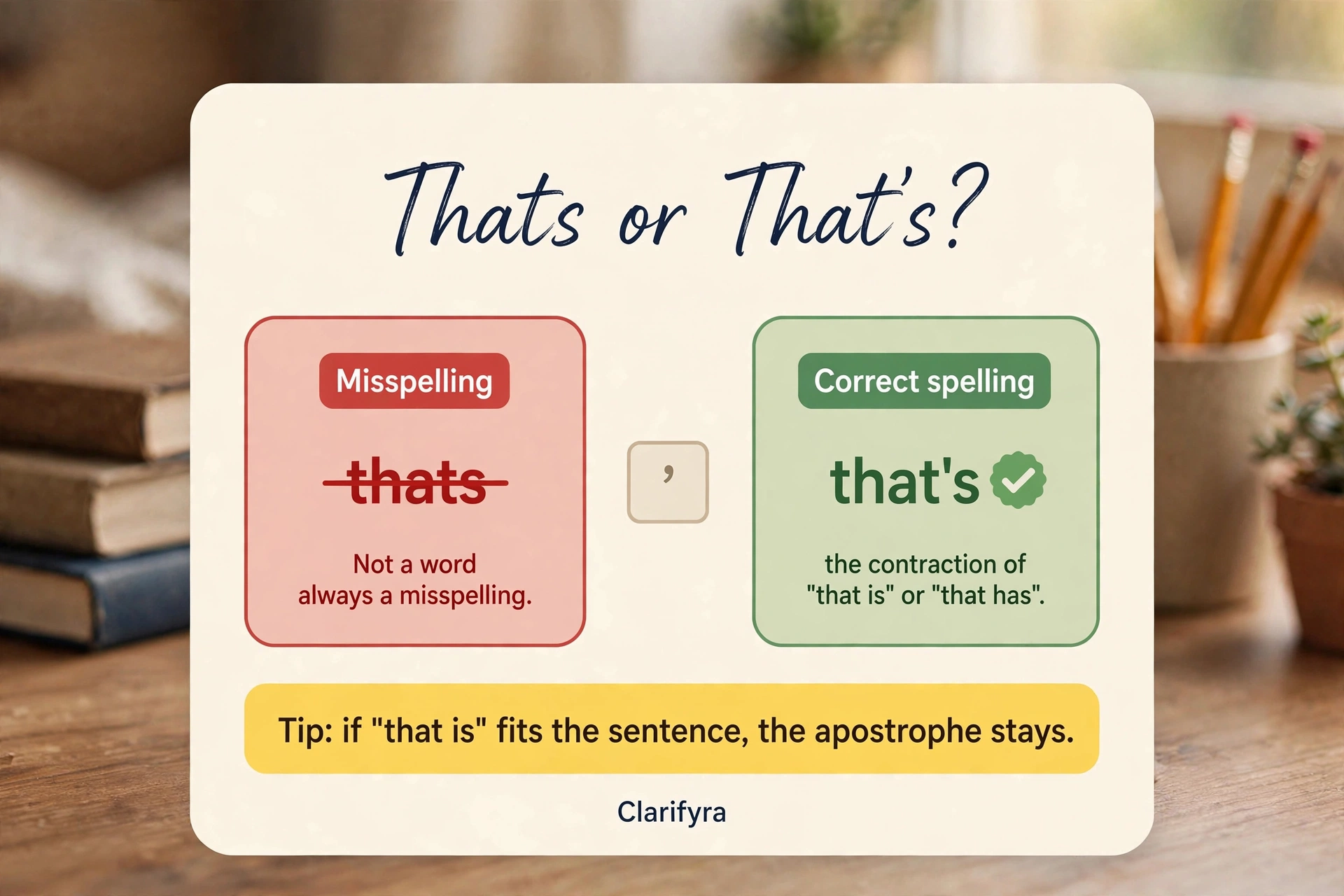
That’s is correct. Thats — without the apostrophe — is not a word in standard English. That’s is the contraction of that is or that has, and the apostrophe is not optional: it stands in for the letters that were dropped. Whenever you type thats, you almost certainly mean that’s.
Quick Answer
That’s (with the apostrophe) is the only correct form. It means that is (“That’s my bag”) or that has (“That’s been ages”). Thats has no dictionary entry and no grammatical role — not a possessive, not a plural, not a word. Always write that’s.
Why the Apostrophe Goes Missing
Nobody sits down intending to write thats. The apostrophe disappears for ordinary, human reasons. Phone keyboards make apostrophes awkward to reach, so the letter gets skipped mid-text. Fast typists outrun their fingers. And somewhere in the back of many people’s minds sits the dimly remembered rule that apostrophes can be fussy about possession — which makes them hesitate and drop the mark entirely.
There is also a genuine grammatical tripwire at work. Apostrophes in English do two very different jobs: they mark contractions (don’t, she’ll) and they mark possession (the dog’s bone). When a writer isn’t sure which job the apostrophe is doing in that’s, the safest-looking move can feel like leaving it out. That instinct backfires here, because thats without the apostrophe doesn’t fall back into some other valid word. It falls into nothing.
The final contributor is autocorrect itself. Most keyboards quietly insert the apostrophe the moment you type thats, which means many people never notice they wrote it wrong — and a few fight their phone, override the correction, and publish the error. Notice the pattern, though: the software is trying to fix it toward the apostrophe. That is because that’s is the only form that exists in the dictionary.
The Two Jobs of “That’s”
Cambridge’s Advanced Learner’s Dictionary lists that’s as the “short form of that is or that has,” and Collins gives the same two meanings: a contraction of that is or that has. Both senses live comfortably in everyday English, but they show up in slightly different places.
1. “That’s” = “that is”
This is the workhorse sense — the one you use dozens of times a day. That’s my coat. That’s interesting. That’s all for today. Any time you could replace the word with that is and the sentence still makes sense, the apostrophe belongs there. It is the sense your grammar checker expects, and it accounts for the vast majority of uses in both speech and writing.
2. “That’s” = “that has”
Less common in formal writing, but fully standard: that’s can shorten that has, usually before a past participle or got. That’s been the plan all along. That’s got to hurt. Cambridge itself illustrates this sense with the example That’s got to be the dumbest thing I’ve ever seen. The giveaway is what follows: if a verb like been, had, or got comes next, you are probably looking at that has rather than that is.
How do you tell the two apart in practice? Expand the contraction in your head. “That’s been a long day” expands naturally to “That has been a long day,” not “That is been a long day.” The wrong expansion sounds instantly wrong, which is what makes this test reliable.
Why “Thats” Is Never a Possessive or a Plural
Some writers reason that if that’s looks wrong, maybe thats is the possessive form — on the model of the cat’s or Sarah’s. It isn’t, and the reason is structural. That is a demonstrative pronoun (it points at things: that car, that’s mine), and English simply does not build a possessive of that with an apostrophe. There is no such construction as “the thats colour” the way there is “the car’s colour.”
More broadly, the possessive words that English does have — mine, yours, his, hers, ours, theirs, and its — never take apostrophes. Cambridge’s grammar guide is explicit: “We don’t use ‘s after possessive pronouns,” and it’s always means it is, never possession. The same no-apostrophe rule trips people up with possessive pronouns generally, as we show in our ours vs our’s piece. If the true possessive pronouns reject the apostrophe, there is no route by which thats could sneak in as one.
Could thats be a plural, then? No. The plural of the demonstrative that is those (that house → those houses), not thats. English never forms the plural of that by adding -s. So thats is not the plural, not the possessive, and not a contraction. It has no grammatical job at all — which is exactly why no standard dictionary carries an entry for it.
The Verdict at a Glance
| Form | Correct? | What it means | Example |
|---|---|---|---|
| that’s | Yes | Contraction of that is | That’s exactly what I meant. |
| that’s | Yes | Contraction of that has | That’s been true for years. |
| thats | No | Nothing — not a word | ✗ Thats a great idea. |
Common Mistakes
1. Dropping the apostrophe in casual writing.
✗ Thats fine, dont worry about it.
✓ That’s fine, don’t worry about it.
Speed and phone keyboards cause this one. The apostrophe still belongs there — casual writing is not exempt from contractions.
2. Using “thats” where “that is” is meant.
✗ Thats what I told you.
✓ That’s what I told you.
If you can swap in that is without breaking the sentence, the apostrophe is required.
3. Using “thats” where “that has” is meant.
✗ Thats gotta be a record.
✓ That’s gotta be a record.
Even in very informal speech-driven writing, the contraction keeps its apostrophe.
4. Treating “that’s” as a possessive.
✗ Thats colour is brighter than this ones.
✓ That colour is brighter than this one’s.
Neither word takes an apostrophe here. That’s can never show ownership; when an apostrophe appears after that, it is always a contraction. (A similar plural-versus-possessive mix-up is what we untangle in nobodies vs nobody’s.)
5. Overriding autocorrect.
✗ Typing thats, watching your phone suggest that’s, and dismissing it.
✓ Letting the correction stand — or adding that’s to your keyboard’s learned words.
Autocorrect is right on this one. If your device keeps “fixing” a word, that is usually a signal, not a nuisance.
6. Writing “thats” in formal or published work.
✗ Thats why the policy was revised. (in an email to a client)
✓ That’s why the policy was revised.
In professional writing, a missing apostrophe reads as carelessness. Proofread contractions last, when your eye is fresh.
Memory Tricks
The expansion test. Whenever you hesitate, stretch the word back out. If that is or that has fits the sentence, keep the apostrophe: that’s. If neither fits, you don’t want either spelling — rewrite the sentence. This single habit catches the error every time.
The missing-letter tombstone. Think of the apostrophe as a marker for buried letters: in that’s, it stands where the i of is was removed (or the ha of has). Thats has no tombstone and no buried letters — which is a neat way of remembering that it isn’t hiding a meaning at all.
The cousin rule. That’s behaves exactly like it’s. Nobody writes its when they mean it is, and the same instinct should apply here: apostrophe = contraction, no apostrophe = a different word (or, in the case of thats, no word).
Frequently Asked Questions
Is “thats” ever correct in English?
No — not in standard English, in any register. It has no entry in the major dictionaries, which list only that’s, the contraction of that is or that has. Any appearance of thats in print is a typo, an autocorrect override, or a deliberate stylistic choice in dialogue meant to signal careless speech. It is never the standard spelling.
How can I tell whether “that’s” means “that is” or “that has”?
Look at the word that follows. If a past participle or got comes next — that’s been, that’s got — it is that has. Everywhere else, it is overwhelmingly that is. When in doubt, expand it: whichever expansion keeps the sentence grammatical is the right one.
Can “that’s” ever show possession, like “the dog’s”?
No. Apostrophes do mark possession on nouns (the dog’s tail), but that’s is a contraction, never a possessive. English doesn’t form a possessive of that at all, and the actual possessive pronouns — mine, yours, hers, ours, theirs, its — never take apostrophes, as Cambridge’s grammar notes confirm. An apostrophe after that can only mean letters were dropped.
Is it okay to write “thats” in texting or social media?
It’s common there, but it’s still non-standard — the same way dropping all punctuation is common in texts without being correct. Readers will usually understand you, but in anything you want taken seriously (work messages, posts, applications), the apostrophe costs you nothing and avoids looking careless.
Why does my phone keep changing “thats” to “that’s”?
Because its dictionary contains that’s and not thats. Autocorrect models are built on standard spellings, so the phone treats the apostrophe-less version as the typo it is. Let it correct you — it’s one of the rare cases where the machine is unambiguously right.
Final Takeaway
There is no contest here: that’s is the word, and thats is the typo. The apostrophe is doing the essential work of a contraction — holding the place of the letters dropped from that is or that has. Remember the expansion test (if that is fits, the apostrophe stays), keep that’s away from possession duty, and let autocorrect do its job. One small mark, zero ambiguity.