Turkies or Turkeys: Which Is Correct?
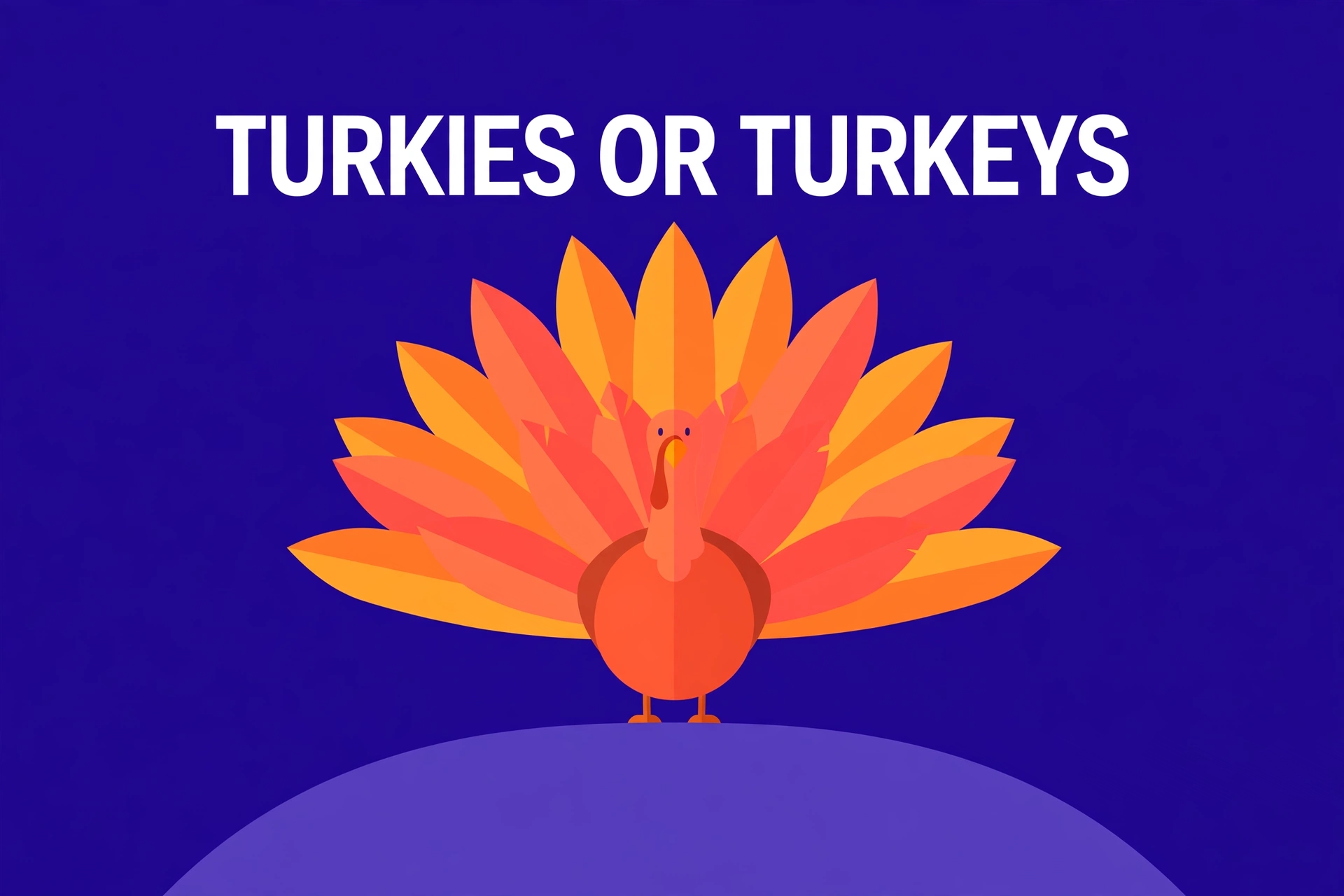
It is the spelling mistake that launches a thousand Thanksgiving menus: turkies. The word looks almost right — after all, city becomes cities and party becomes parties — but turkies is never correct. The plural of turkey is turkeys, and the reason reveals one of English spelling’s most reliable rules.
The confusion comes from over-applying the “change y to ies” pattern. That rule only fires when the y follows a consonant (city → cities). In turkey, the y follows a vowel (e), so the word pluralises like any ordinary noun: just add s. Once you see that distinction, turkies stops looking plausible.
Turkies vs Turkeys at a Glance
| Turkeys | Turkies | |
|---|---|---|
| Status | Correct plural in all dictionaries | Misspelling — not listed anywhere |
| Rule | y after a vowel → add s | The y → ies rule misapplied |
| Example | The farm raises turkeys. | The farm raises turkies. ❌ |
| Pronunciation (UK) | /ˈtɜː.kiz/ (TUR-keez) | — |
| Pronunciation (US) | /ˈtɜr.kiz/ (TUR-keez) | — |
The Rule: Vowel + Y → Just Add S
English has two different plural patterns for words ending in y, and the letter before the y decides which one applies:
- Consonant + y → change y to ies: city → cities, party → parties, baby → babies, fly → flies.
- Vowel + y → just add s: turkey → turkeys, donkey → donkeys, monkey → monkeys, valley → valleys, day → days, boy → boys.
In turkey, the y is preceded by e — a vowel — so the word takes the second pattern. Collins confirms the word forms as “plural turkeys,” and Webster’s New World College Dictionary gives the plural as -keys (noting -key as a collective alternative in some hunting contexts).
Why Turkies Looks So Convincing
Turkies survives as an error precisely because the y → ies rule is drilled into every schoolchild, and turkey ends in y. The brain applies the familiar pattern without checking the letter before the y. It is the same impulse that produces donkies and monkies — all wrong for the same reason.
There is also a visual factor: turkeys keeps the full -ey ending, which can look odd to anyone expecting the y to transform. But that unchanged ending is exactly what the rule requires. Compare valleys, alleys, and chimneys (where n is a consonant, hence the change): the pattern is completely consistent once the vowel-before-y condition is understood.
Correct vs Incorrect
- ✅ We ordered two turkeys for Christmas.
- ❌ We ordered two turkies for Christmas.
- ✅ Wild turkeys roam the woods behind the farm.
- ✅ The turkeys’ enclosure needs cleaning. (Plural possessive: apostrophe after the s.)
- ✅ The turkey’s leg was enormous. (One bird’s leg — singular possessive.)
- ✅ She has cooked turkeys every Thanksgiving for twenty years.
A Note on Turkey the Country
A related point of confusion: the country’s official name is now the Republic of Türkiye — Collins lists this as the official name under its Turkey entry — while Turkey remains the widely used English name. This does not change the plural rule: in English, more than one bird is turkeys, and the bird and the country share the same spelling in the singular. There is no circumstance in which turkies is the correct spelling of either.
The Surprising History of the Word Turkey
The word turkey carries one of English’s most entertaining etymologies. Collins traces it to Turkey cock — the name English speakers first gave to the guinea fowl, a bird imported through Turkish territory in the 1500s. When English colonists later encountered the large American bird, they mistakenly applied the same name to it. The American turkey has no connection to the country at all; the name is a five-century-old case of mistaken identity that simply stuck.
The mix-up even left traces in other languages. In Turkish, the bird is called hindi — literally “from India” — because of a parallel confusion with the East Indies. And the country-name question has its own modern chapter: the Republic of Türkiye is the official name, adopted for international use, while Turkey remains the standard English form in most publications and dictionaries. None of this affects the plural, which has been turkeys all along.
Turkey’s Other Meanings
The plural question gets slightly richer because turkey wears several hats in English. In all of them, the plural is turkeys:
- The bird: Wild turkeys are native to North America.
- The meat: usually uncountable (we ate turkey), but countable when referring to whole birds (three turkeys for the banquet).
- Slang for a foolish person (US informal): Don’t be such a turkey — read the instructions. Plural: turkeys.
- Bowling: three consecutive strikes is a turkey. Two of them? Back-to-back turkeys.
- The idiom “talk turkey”: to speak frankly about the basic facts of a matter — Let’s stop dancing around it and talk turkey.
Knowing these senses helps in context: if you read “he bowled two turkeys,” the word is correct — it is the sport’s term for consecutive strikes, not a spelling error.
Common Mistakes
Writing “turkies” on menus and invitations. Holiday menus, school newsletters, and grocery lists are where turkies appears most. The fix is a one-word substitution: turkeys.
Applying the ies rule to all y-endings. The y → ies change feels universal because it is taught early and often, but it applies only after consonants. Donkeys, monkeys, valleys, alleys, turkeys — vowel + y words all take a plain s.
Mixing up turkey’s and turkeys’. The turkey’s feathers (one bird) versus the turkeys’ feathers (several birds). The apostrophe’s position marks the number of owners, exactly as with friend’s and friends’.
Treating “turkey” as uncountable. As meat, turkey is often uncountable (we had turkey for dinner). As birds, it counts normally: three turkeys. Both uses are correct; the mistake is only in the spelling of the plural.
Frequently Asked Questions
What is the plural of turkey?
Turkeys. Collins lists the word forms as “plural turkeys,” and every other major dictionary agrees. Turkies is a misspelling.
Why isn’t it “turkies” like “cities”?
The y → ies change applies only when y follows a consonant (city → cities). In turkey, the y follows the vowel e, so you simply add s — the same as donkeys, monkeys, and valleys.
Is “turkies” ever acceptable?
No. No major dictionary lists turkies, and it is universally treated as a spelling error in edited writing. It does not even survive as an accepted variant.
What is the plural possessive of turkey?
Turkeys’. The plural already ends in s, so add only the apostrophe: the turkeys’ feed. For a single bird, it is the turkey’s feed.
Does the country’s name change the spelling?
No. Whether you write Turkey (the common English name) or Türkiye (the official name listed by Collins), the bird’s plural in English is still turkeys. The two meanings share one spelling rule.
The Takeaway
Turkeys, always. The y in turkey follows a vowel, so the consonant-rule that gives us cities and babies never applies — just add s. And while you are at it, you now know the country’s official name is the Republic of Türkiye, even though Turkey remains the everyday English name. One rule, two confusions cleared.