Convertor or Converter: Which Is Correct?
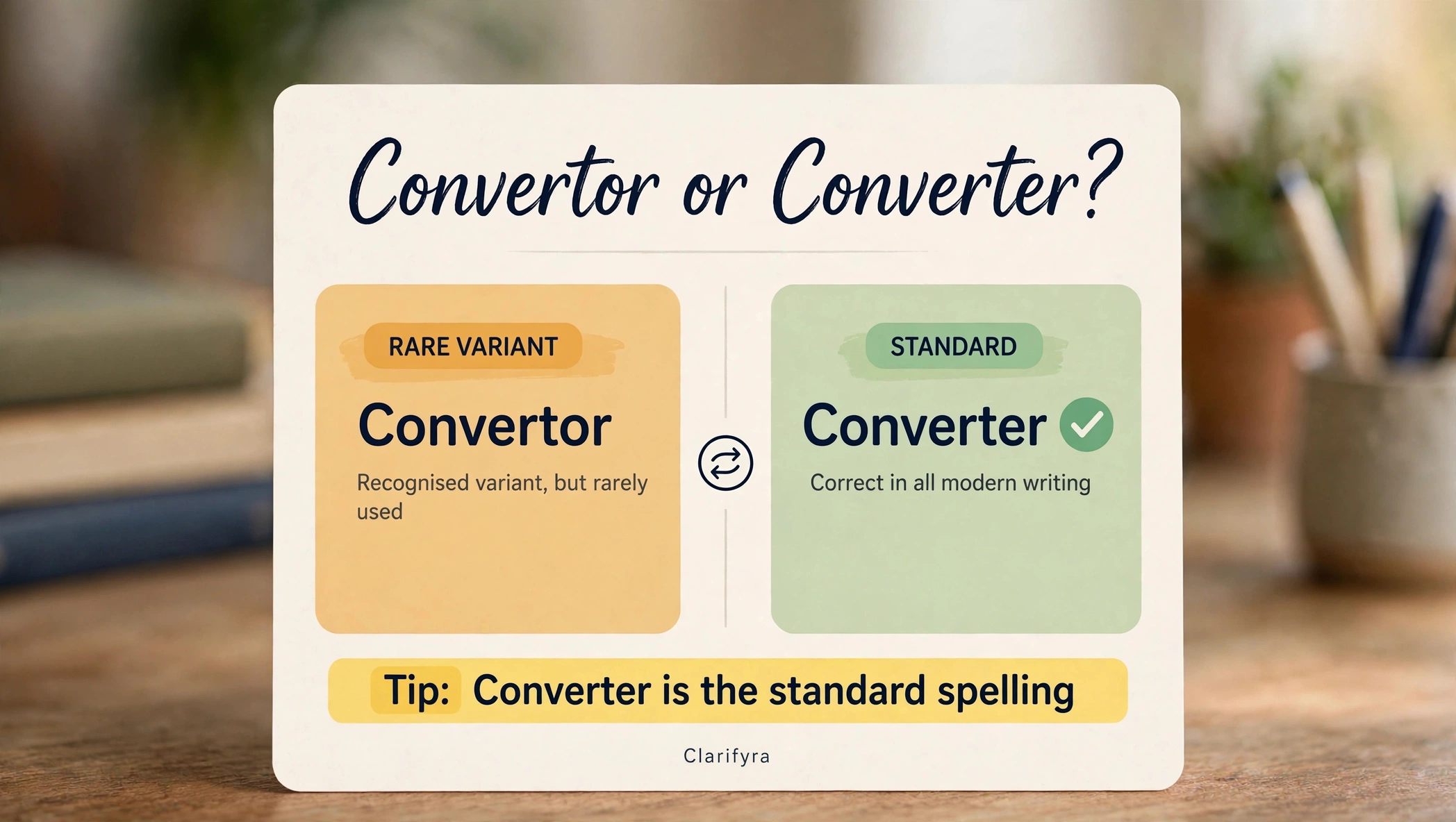
If you’re choosing between convertor and converter, the practical answer is simple: write converter. It is the standard spelling in contemporary English — for the device, the software, and the person alike. But unlike a pure misspelling, convertor has genuine dictionary backing: Oxford, Collins, Merriam-Webster, and American Heritage all record it as a variant form, and it turns up in real British print. It’s just that in today’s writing, converter is the overwhelming norm, so convertor will look like an error to most readers. The guidance is the same lesson as inclosed vs enclosed: a dictionary recording a variant is not the same as recommending it.
Quick Answer
Converter is the standard modern spelling — use it in all contemporary writing, for devices and people. Convertor is a real recorded variant (Oxford, Collins, Merriam-Webster, and American Heritage all recognize it), but it is rare, and readers will usually take it for a typo. When in doubt, converter is never wrong.
What the Dictionaries Actually Say
This is the part that trips up the confident “it’s not a word” claim — because the major references do record “convertor.” Here’s the precise picture:
- Oxford Advanced Learner’s Dictionary (both British and American editions): “converter” — (also convertor), noun: a person or thing that converts something.
- Collins English Dictionary (British): “converter or convertor“; the American Random House entry adds “Also: convertor.”
- Merriam-Webster: “convertor” resolves directly to the “converter” entry — treated as a variant headword form of the same word, with senses including “one that converts,” the Bessemer-process furnace, and devices that adapt or convert signals.
- American Heritage Dictionary: “convertor” gets its own noun entry — “a device for changing one substance or form or state into another.”
- Cambridge: “converter” only — “a machine or device that changes something into a…” — with no “convertor” variant entry among the references checked.
So the claim “no dictionary lists convertor” is wrong, just as it was wrong for inclose. The important distinction is what the listing means: the label “also” / variant spelling is the lexicographers’ way of saying the form exists but isn’t the standard. Recording a spelling is not recommending it. In every one of these references, converter is the standard form; the variant is never the recommended one.
What “Converter” Means
Converter — from convert + -er, in use since the early 1500s (Merriam-Webster’s first known use is 1533) — names a person or a thing that converts something into another form. The dictionaries group the senses into two families:
1. A device or program that converts things
This is the sense you’ll meet most often, from travel to tech:
“Pack a converter — the voltage is different there.”
“The catalytic converter reduces harmful emissions from cars.”
“She used a file converter to turn the PDF into a Word document.”
“A digital-to-analogue converter changes digital audio into an analogue signal.”
2. A person who converts people or things
“He was a converter of skeptics into believers.”
“The new packaging line made them the industry’s biggest paper converter.”
Both senses — person and device — take the -er spelling in standard modern English. There is no tradition of splitting them (“convertor” for machines, “converter” for people), despite what some usage forums suggest: the dictionaries that record “convertor” apply it to the whole word, not to one sense.
Pronunciation: UK and US
The spelling difference changes nothing about the sound — convertor and converter are pronounced identically:
- UK: /kənˈvɜːtə(r)/ — “kuhn-VUR-tuh”
- US: /kənˈvɝːtər/ — “kuhn-VUR-tur”
Stress the second syllable. One related trap: the noun convert (a person who has changed beliefs) stresses the first syllable — UK /ˈkɒn.vɜːt/, US /ˈkɑːn.vɝːt/ — but converter keeps the verb’s second-syllable stress, since it means “one who converts.”
Why the “-or” Spelling Exists at All
“Convertor” isn’t a random typo; it’s built on a real pattern. English inherited a set of Latin agent nouns ending in -or — actor, inventor, conductor, director — where the -or marks “one who does the verb.” When you bolt a suffix onto “convert,” the -or shape feels natural, especially in technical writing: a machine that converts is exactly the kind of thing an -or agent noun would name.
English also has plenty of genuine -er/-or doublets where both forms live on — ignitor vs igniter is another one still in circulation. For “converter,” though, the contest ended long ago: -er won decisively. The -or form survives only as a recognized variant, not as an equal alternative.
Where You’ll Still Meet “Convertor”
The variant isn’t purely a dictionary entry — it leaves real footprints, mostly in British technical and trade contexts. Collins’s own corpus examples come from British newspapers:
“The catalytic convertor can get rid of only some of these gases.” — Times, Sunday Times (2014)
“He had removed the catalytic convertor from the exhaust and cut vents into the bonnet.” — Times, Sunday Times (2017)
You’ll also spot “convertor” on some European product pages, technical catalogues, and trade-journal bylines — places where the Latin-flavored -or feels at home. But notice what’s absent: general prose, edited books, style guides, and every dictionary’s main entry. The variant survives in pockets; the standard rules everywhere else.
Converter vs Convertor at a Glance
| Spelling | Dictionary status | Where you’ll see it | Use it? |
|---|---|---|---|
| converter | The standard headword in every major dictionary | All modern writing, both UK and US | Yes — always |
| convertor | Recorded variant (Oxford, Collins, MW, American Heritage); no Cambridge entry found | Some British technical writing, old catalogues, quoted documents | No — readers will read it as a typo |
British vs American English: Any Difference?
Not on the standard spelling — converter is correct on both sides of the Atlantic. And the variant is recognized on both sides too: Oxford’s British and American editions both carry the “(also convertor)” note, and Collins lists it in both its British entry (“or convertor”) and its American one (“Also: convertor”). This is one of the tidy cases where there’s no transatlantic split to worry about. If you’re writing for an international audience, “converter” is safe everywhere.
Common Mistakes
1. Writing “convertor” in general modern writing. ✗ “a currency convertor” → ✓ “a currency converter.” The dictionary entry won’t save you with readers, editors, or spellcheckers, which default to the standard form.
2. Assuming “convertor” and “converter” mean different things. ✗ “A convertor is an electrical device; a converter is a person.” → ✓ They’re variant spellings of one word. No dictionary assigns them different senses.
3. Using “converter” as a verb. ✗ “This app converters files.” → ✓ “This app converts files.” The -er makes a noun; the action is “convert.”
4. Stressing the wrong syllable when speaking. ✗ /ˈkɒn.vɜː.tə/ (first-syllable stress) → ✓ /kənˈvɜːtə(r)/. That’s the stress pattern of the noun “convert,” not of “converter.”
5. Treating a recorded variant as interchangeable. Variant ≠ equal. “Less common” and “also” are usage labels, not invitations: they tell you the form exists, and they tell you not to use it.
How to Remember It
Pair it with invertEr: inverters and converters do the same job — turning one thing into another — and “inverter” has no -or variant at all, so its -er ending is uncontested. When your pen drifts toward “convertor,” ask whether you’d ever write “invertor.” You wouldn’t — and converter belongs to the same family. Back it up with the root: convert + er, the ordinary English suffix for “one who does.”
Frequently Asked Questions
Is “convertor” a real word?
It’s a real recorded variant rather than a standard word: Oxford, Collins, Merriam-Webster, and American Heritage all recognize it as a variant of “converter.” But it’s rare in contemporary writing, so in practice, treat it as an error and write “converter.”
Which is correct: “convertor” or “converter”?
Converter. It’s the headword in every major dictionary and the spelling used in all standard prose. “Convertor” is the recognized-but-unrecommended variant.
Is there any difference in meaning between convertor and converter?
No. Dictionaries that record “convertor” define it as the same word — a person or thing that converts — not as a separate sense. Any source telling you one means the device and the other the person is inventing a distinction the references don’t make.
How do you pronounce “converter”?
UK /kənˈvɜːtə(r)/, US /kənˈvɝːtər/ — stress on the second syllable. “Convertor” is pronounced exactly the same way.
What is the plural of “converter”?
Converters — “We need two voltage converters for the trip.” The variant plural “convertors” exists only alongside the variant spelling.
Is it “catalytic convertor” or “catalytic converter”?
Catalytic converter. That’s the standard collocation in dictionaries and general prose — Oxford lists it as its example sense, and Cambridge uses “catalytic converter” in its example sentences. The -or form does appear in some British newspapers, but it isn’t the standard.
Do British and American English differ on this spelling?
No. “Converter” is standard in both; the “convertor” variant is recognized (but not recommended) in both. Write “converter” everywhere.
Is “convertor” just a typo?
In anything written today, treat it as one — readers and spellcheckers will. Historically and lexicographically it’s a genuine variant (the -or ending follows the Latin agent-noun pattern of “actor” and “inventor”), but that history doesn’t make it advisable.
Final Takeaway
Converter is the spelling for the modern world — the headword in every major dictionary, standard in both British and American English, correct for the device, the software, and the person. Convertor deserves its dictionary footnote: a genuine variant with Latin-shaped logic and real (if rare) appearances in print — and that’s exactly where it should stay. When in doubt, converter is never wrong.