Ceasar or Caesar: Which Is Correct?
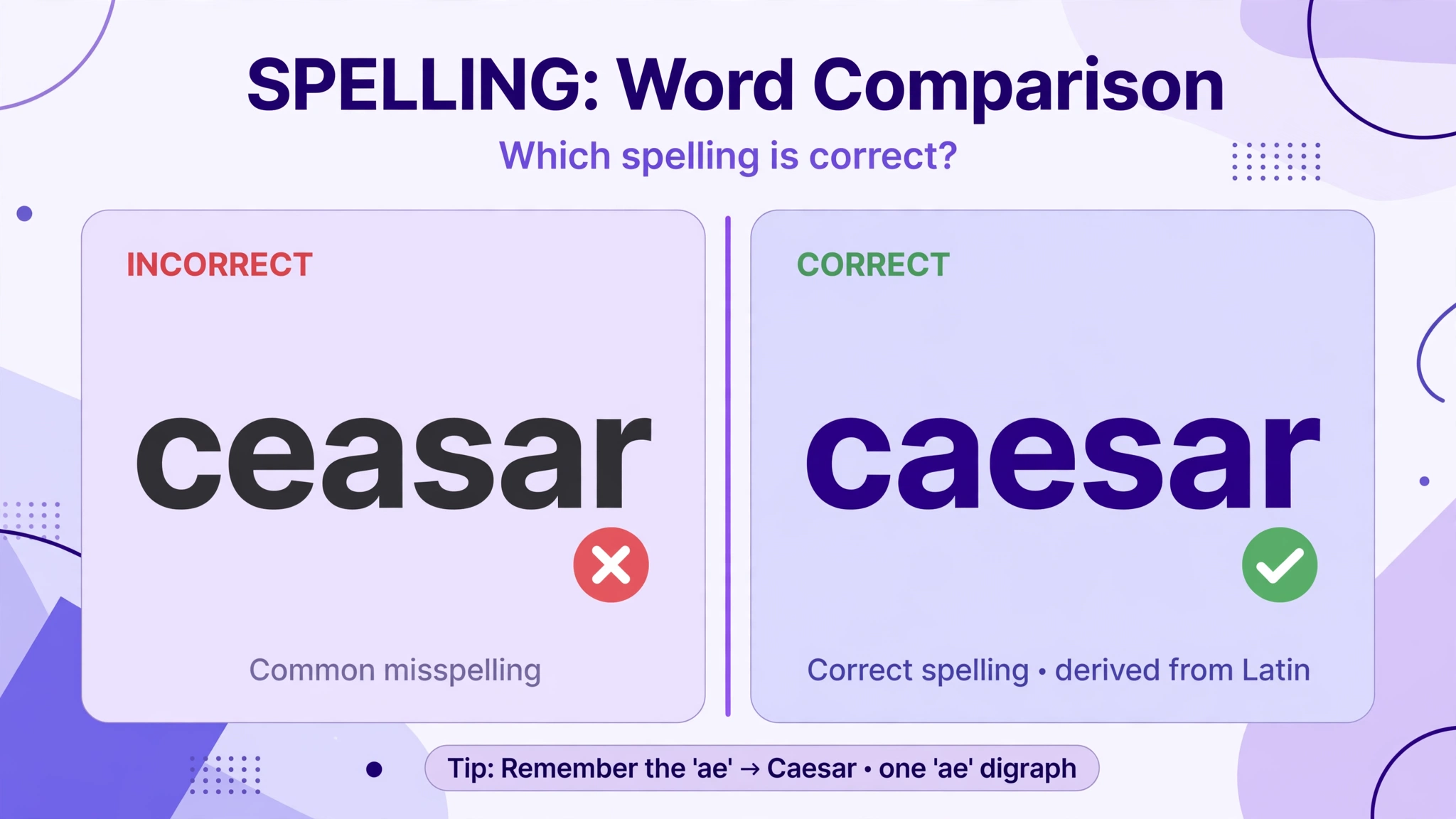
If you’re choosing between ceasar and caesar, there is exactly one correct spelling: Caesar. It’s the Roman name — Gaius Julius Caesar — and its spelling has been locked in for more than 2,000 years. Ceasar is a common transposition error: the English pronunciation (“SEE-zer”) nudges the brain toward “ea,” but the word keeps the Latin ae diphthong. Every dictionary lists “Caesar”; none records “ceasar” as a standard form. This one isn’t regional and isn’t a matter of opinion.
Quick Answer
Caesar is the only correct spelling — for the Roman dictator, the imperial title, and the salad. Ceasar is a widespread misspelling caused by swapping the vowels; it has no dictionary entry and no historical basis. The word is pronounced “SEE-zer” in English, but spelled with the Latin ae: C-AE-sar. The same “ae” survives in German Kaiser and Russian Tsar, which both descend from the name.
“Caesar” Is the Only Spelling
Let’s be precise, because this is a case where hedging would be dishonest. The references checked give Caesar as the sole standard spelling — the proper noun in every major dictionary — while “ceasar” appears nowhere as a standard form. Reference works on common misspellings describe it plainly: “ceasar” doesn’t appear in any standard dictionary and has no historical basis; it’s simply the result of transposing the “ae.” Unlike pairs such as “enrol/enroll,” there is no British/American split here, no informal variant, no older acceptable form. British, American, Canadian, and Australian English all spell it Caesar.
Spellcheckers agree, for once: “ceasar” gets flagged by every major spellchecker, while “Caesar” passes everywhere. When the dictionaries, the spellcheckers, and two millennia of usage all point the same way, the case is closed.
Why “Ceasar” Feels So Right
If it’s so clearly wrong, why do so many people write it? Because the error is phonetically motivated — it comes from how the word sounds in English:
- The pronunciation says “ea.” English pronounces Caesar as “SEE-zer” — and in English, the “see” sound is overwhelmingly spelled “ee” or “ea” (see, seem, seat, beat, read). The brain hears “see-zer” and reaches for the familiar pattern. But “Caesar” isn’t an English word at all — it’s a Latin name, and Latin doesn’t follow English sound-spelling rules.
- It’s a transposition error. All the right letters are there; they’re just in the wrong order. “Ae” → “ea” is one of the most common slip patterns in English spelling, the same slip behind “seperate” for “separate” and “recieve” for “receive.” Fast typing makes it worse.
- The “ae” digraph is rare in English. Outside of Latin borrowings, English speakers rarely write “ae” — so the hand isn’t practiced at it, and the familiar “ea” takes over under pressure.
Understanding the mechanism helps with the fix: the error isn’t ignorance, it’s interference from English phonics. The cure is to learn the word as a Latin fossil — spelled by history, not by sound.
A 2,000-Year-Old Spelling
The reason the spelling never changed is that it was never English to begin with. Caesar was the family name (cognomen) of Gaius Julius Caesar, the Roman general and dictator of the 1st century BC — and in Latin it’s spelled with the ae diphthong, pronounced roughly “KYE-sar” in classical Latin. After his death, the name became a title: every Roman emperor after Augustus styled himself “Caesar,” turning a surname into the word for supreme ruler.
The name then traveled across languages, and the trail it left confirms the original spelling. German Kaiser (emperor) and Russian Tsar (also spelled Czar) both descend directly from “Caesar” — the hard “k”/”ts” sound preserving the Latin pronunciation, the “ai”/”a” preserving the vowel. Two thousand years, three language families, one root: the “ae” (and its descendants) was there from the start. There was never a “ceasar” stage in the word’s history.
“Caesar crossed the Rubicon in 49 BC.” (the man)
“After Augustus, every emperor took the title Caesar.” (the title)
“The German Kaiser and the Russian Tsar both inherit the name.” (the descendants)
The Salad Test
The most common everyday place the spelling gets tested is the menu — and the salad confirms the rule. The Caesar salad is named not for Julius Caesar but for Caesar Cardini, the Italian-born restaurateur who created it at his restaurant in Tijuana, Mexico, in the 1920s. It was his first name, spelled the same way as the Roman’s — C-AE-sar.
So “Caesar salad,” “Caesar dressing,” and “Caesar wrap” all take the “ae” spelling. “Ceasar salad” on a menu is a misspelling, however common — and it’s worth noting that menus are one of the places the error spreads fastest, because diners copy what they read.
“Caesar” as a Common Noun
One more legitimate use to know: caesar with a lowercase c is a regular English noun meaning an autocrat or absolute ruler — “he fancied himself a latter-day caesar.” Like the title sense, it’s always spelled with “ae.” The capitalization rule is simple: the person (Julius Caesar, Caesar Cardini) and the historical title take a capital C; the generic “tyrant” sense can go lowercase. Neither ever takes “ea.”
Correct vs Incorrect
- ✗ “Ceasar was assassinated in 44 BC.” → ✓ “Caesar was assassinated in 44 BC.”
- ✗ “I’ll have the ceasar salad.” → ✓ “I’ll have the Caesar salad.”
- ✗ “The ceasar of Rome” → ✓ “The Caesar of Rome”
- ✗ “a ceaser among men” → ✓ “a caesar among men” (lowercase for the generic sense — and note “ceaser” is a different misspelling; the nearby English word is “seizer,” one who seizes)
Common Mistakes
1. Writing “ceasar.” ✗ “Ceasar salad” → ✓ “Caesar salad.” The classic transposition — right letters, wrong order.
2. Writing “ceaser.” ✗ “Ceaser” → ✓ “Caesar.” A different misspelling of the same word (and confusingly close to “seizer,” which is a real word meaning one who seizes).
3. Lowercasing the name. ✗ “julius caesar” → ✓ “Julius Caesar.” It’s a proper noun — capital C, always. (The lowercase form exists only for the generic “autocrat” sense.)
4. Capitalizing the generic noun unnecessarily. “He ruled like a Caesar” isn’t wrong exactly — the capital is often kept for emphasis — but the dictionary’s common-noun sense is lowercase: “a caesar.”
5. Writing “caesarian” for the surgery. ✗ “caesarian section” → ✓ “caesarean section” (British) / “cesarean section” (American). The medical term belongs to the same Latin family — and it keeps the “ae”/”e” question in the same place: British “caesarean,” American usually “cesarean.”
6. Trusting the menu. Restaurant menus are a prolific source of “ceasar salad.” Menus are written by busy people, not copy editors — verify against the dictionary, not the specials board.
How to Remember It
A before E — Caesar marches at the head. The emperor put himself first in everything, so the “a” marches before the “e”: C-AE-sar. Or anchor it to the descendants: German KAIser keeps the “a” first too — if the Kaiser spells it “ai,” the Caesar spells it “ae.” Either way, the “a” leads and the “e” follows, exactly as in Rome.
Frequently Asked Questions
Is “ceasar” ever correct?
No. It has no dictionary entry, no historical basis, and no regional acceptance — it’s a transposition error, pure and simple. Every variety of English spells it “Caesar.”
How do you pronounce “Caesar”?
“SEE-zer” in modern English. (In classical Latin it was roughly “KYE-sar” with a hard c — which is why German ended up with “Kaiser.”) The English pronunciation is precisely what makes the “ea” misspelling so tempting.
Why is it spelled with “ae”?
Because it’s a Latin name, and “ae” is a Latin diphthong. English sound-spelling rules (“see” = “ee”/”ea”) don’t apply to a word that was spelled 2,000 years before English existed in its modern form.
Is it “Caesar salad” or “Ceasar salad”?
Caesar salad — named for Caesar Cardini, who created it in Tijuana in the 1920s. Same spelling as the Roman name, same “ae.”
Is there a British/American difference?
No. “Caesar” is spelled identically in every variety of English. (The related medical term does split: British “caesarean,” American usually “cesarean.”)
Can “caesar” be lowercase?
Yes — as a common noun meaning an autocrat or absolute ruler: “he fancied himself a caesar.” The historical person and title take the capital; the generic sense can go lowercase. Both spell it with “ae.”
What’s the difference between “Caesar,” “Kaiser,” and “Tsar”?
They’re the same word in three languages. “Caesar” became the Roman imperial title; German borrowed it as “Kaiser” and Russian as “Tsar” (Czar), each adapting the spelling and pronunciation. All three trace back to the Latin “ae.”
Is the caesarean section named after Julius Caesar?
The popular story says so, but it’s regarded as folk etymology — the term comes from the Latin caesus (“cut”), not from the man. What matters for spelling: British English writes “caesarean,” American English usually “cesarean.”
Final Takeaway
Caesar — with the Latin “ae,” a before e — is the only spelling: the Roman, the title, the salad, and the lowercase autocrat. Ceasar is a transposition error with no dictionary standing and no history behind it, however natural it feels after hearing “SEE-zer.” Remember that Caesar marches at the head — a before e — and the 2,000-year-old spelling will take care of itself.