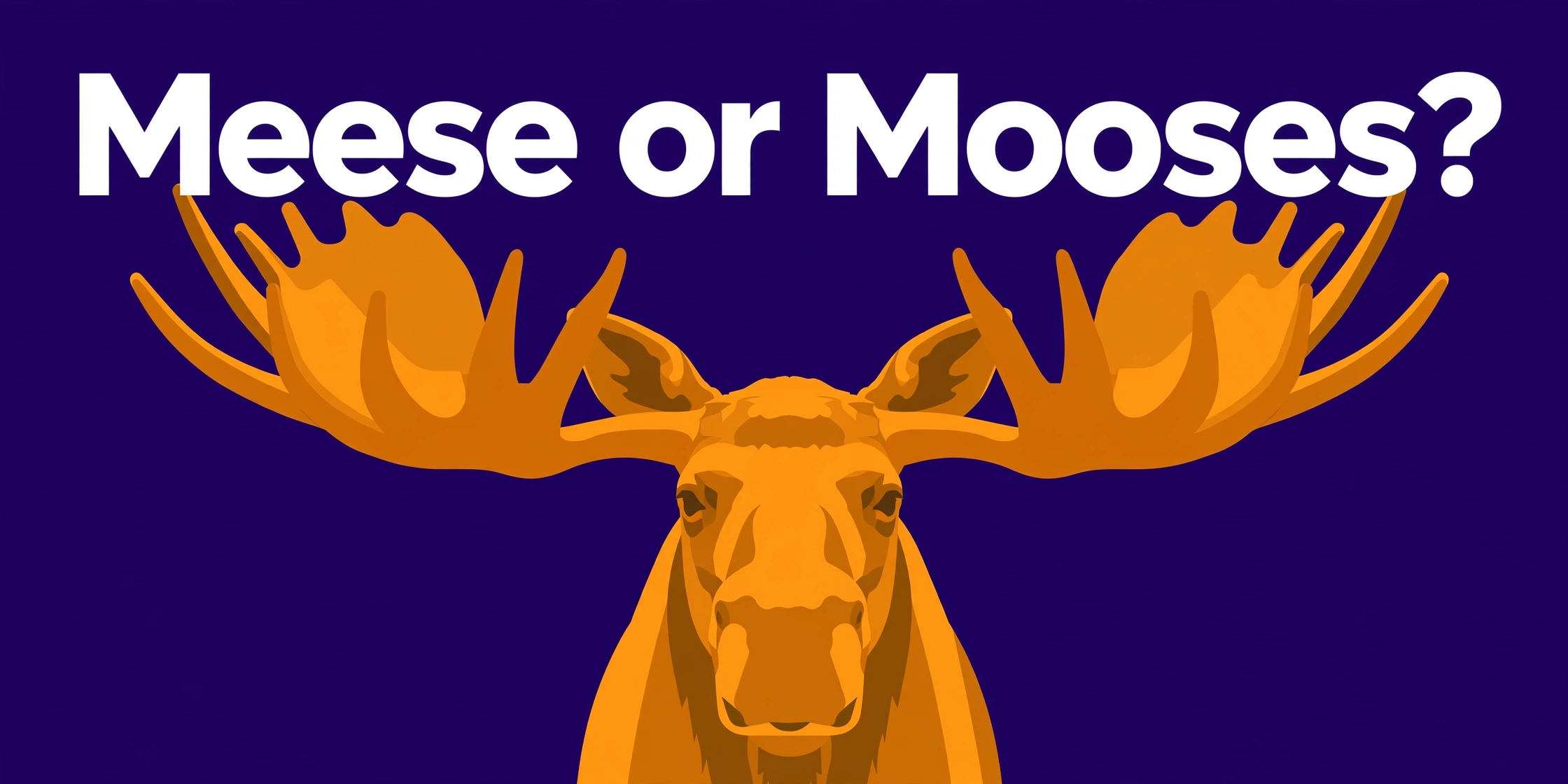
Meese or Mooses: Which Is Correct?
If you have ever stood in a Canadian forest clearing, watched three enormous animals wade out of a lake, and wondered what to call them, you have met one of English’s most persistent little puzzles. The plural of moose is simply moose: “three moose crossed the track.” Neither meese nor mooses is the standard plural in edited English. Meese is a joking or erroneous form modelled on goose/geese, and mooses is the regular -s plural that speakers sometimes produce by the normal rule — but every major dictionary checked for this article, Cambridge, Oxford Learner’s, Merriam-Webster and Collins, gives the plural as moose, unchanged. This guide explains why the word behaves this way, where the two wrong forms come from, and how to handle the possessives and related traps that follow from an unchanged plural.
Quick Answer
The plural of moose is moose: “a moose,” “two moose,” “many moose.” Cambridge lists the noun as “/muːs/, plural moose,” and Merriam-Webster gives “plural moose” with no -s form. Meese is not a standard plural — it is a humorous formation by analogy with goose/geese. Mooses occurs occasionally as a regularised plural but is treated as non-standard for the animal in dictionaries and edited prose; reserve it, if at all, for the fraternal Loyal Order of Moose or the surname Moose. When you need to show quantity clearly, use a counter phrase: “a herd of moose,” “three head of moose,” or rewrite with numerals and a verb that shows plurality: “the moose were grazing.”
What the Dictionaries Actually Say
Cambridge Dictionary’s entry is the learner’s starting point: moose /muːs/, “plural moose.” There is no alternative plural offered — no mooses in brackets, no usage note hedging the point. Merriam-Webster is equally plain: “plural moose,” followed by the etymology, “of Algonquian origin; akin to Massachusett moos,” and a first known use of 1603. That date matters. Moose entered English from an Eastern Algonquian language in the early seventeenth century, and in its source languages the noun did not mark plurality by changing its stem. English borrowed the word whole and never fitted it with the native plural machinery.
Oxford Learner’s treats moose the same way, and Collins gives the plural unchanged as well. None of the four sources lists meese as a headword or variant plural; the form lives instead in usage discussions, joke dictionaries, and articles exactly like this one, explaining why it is wrong. Mooses is a more complicated case, and honesty requires care here: you will find mooses written, occasionally, by native speakers applying the default rule, and some dictionaries’ example sentences acknowledge the temptation. But as a recorded standard plural of the animal, it does not appear in the entries checked. The accurate summary is: plural moose (standard); mooses (occasional, non-standard for the animal, sometimes seen for the organisation or the surname); meese (jocular/error).
Pronunciation offers no escape route either. Singular and plural are both /muːs/ — “mooss,” with the long oo of goose and the soft final s of mouse without the plural change. Because the spoken form never changes, writers must carry the plural meaning with determiners, numerals, and verb agreement: “this moose is,” “these moose are.” That is the same work English already does for sheep, deer, fish (in many uses), aircraft and series — the family of unchanged plurals that linguists call zero plurals.
Why Not “Meese”? The Goose Trap
Meese feels right to many speakers for a respectable reason: English preserves a small, ancient set of nouns that form their plural by changing the vowel — goose/geese, foot/feet, tooth/teeth, mouse/mice, man/men. These are survivors of an Old English pattern (technically, plurals marked by vowel mutation) that was already shrinking a thousand years ago. A word that rhymes with goose and names a large northern animal slots, in the mind’s ear, straight into that family.
The problem is ancestry. Goose is a native Germanic word that was in English centuries before the mutation pattern died out, so it carries the old plural geese. Moose arrived in the 1600s from Massachusett and its relatives — thousands of years and an ocean away from that pattern. Borrowed nouns do not inherit Old English mutations; they either take the regular -s or, as here, settle with no ending at all. Compare mongoose, borrowed from Marathi via Portuguese: its plural is mongooses, never mongeese, however strongly the rhyme with goose tugs. Moose resists the -s a little more stubbornly than mongoose does, which is why mooses sounds merely off while meese sounds like a joke — but both depart from the dictionary plural.
There is one honest footnote to the “never say meese” rule. Because the joke is so widespread, meese thrives as deliberate humour, in children’s books, cartoons, and playful writing, where the error is the point. Dictionaries of slang and crowd-sourced lexicons record it in exactly that spirit. In formal prose, examinations, journalism, and business writing, it remains an error. Knowing the difference between using meese on purpose, with a wink the reader is meant to catch, and using it by accident is most of what this article asks you to learn.
And Why Not “Mooses”?
Mooses is the plural English would predict: add -s (here spelled -es after the s sound) and move on, as with buses and foxes. Some speakers do say it, children learning the regular rule produce it predictably, and writers reaching for a countable feel (“mooses are dangerous in the rut”) sometimes type it before their internal editor objects. Yet the dictionaries checked do not record mooses as the plural of the animal, and style in edited English overwhelmingly avoids it.
Two narrow corners invite the -s: the capitalised Moose of the Loyal Order of Moose and the surname Moose (the Mooses, like the Joneses). Neither licenses “three mooses in the marsh.” For the animal, use moose — and if the result feels bare, add scaffolding: “a cow and two bull moose,” or let the verb work: “the moose have moved on.”
The Forms at a Glance
| Form | Standard spelling | Pronunciation | Example |
|---|---|---|---|
| Singular | moose | /muːs/ | “A moose blocked the trail.” |
| Plural (standard) | moose | /muːs/ | “Three moose were feeding by the lake.” |
| Jocular / erroneous plural | meese | /miːs/ | Only in deliberate humour; not standard |
| Regularised plural (non-standard for the animal) | mooses | /ˈmuːsɪz/ | Avoid for animals; names and the Order excepted |
| Singular possessive | moose’s | /ˈmuːsɪz/ | “The moose’s antlers were enormous.” |
| Plural possessive | moose’s | /ˈmuːsɪz/ | “The moose’s grazing grounds…” (several animals) |
The possessive rows deserve a second look. Because the plural does not change, the possessive cannot change either: a single animal’s tracks and a herd’s tracks are both “the moose’s tracks,” with the meaning recovered from context. That looks odd on the page but is correct, exactly as with “the deer’s habitat” for one or many deer. Writers who find it ambiguous may rephrase — “tracks of the moose” — rather than invent “mooses’.”
Correct vs. Incorrect
- ✓ “We saw a moose at dawn and two more moose at dusk.” (singular, then unchanged plural)
- ✗ “We saw several meese at dusk.” → ✓ “We saw several moose at dusk.”
- ✗ “The mooses migrate in autumn.” → ✓ “The moose migrate in autumn.”
- ✓ “These moose are used to traffic.” (plural verb shows plurality)
- ✗ “These moose is used to traffic.” → ✓ “These moose are…” or “This moose is…”
- ✓ “A herd of moose crossed the frozen river.”
- ✗ “Meeses are the largest deer.” → ✓ “Moose are the largest deer.” (Meeses compounds the joke error with a regular plural.)
- ✓ “The moose’s calf stayed close.” (one animal, possessive)
Common Mistakes
1. Pluralising by rhyme. Goose/geese and mouse/mice are inherited patterns, not rhyming rules. Moose, a seventeenth-century Algonquian borrowing, never joined that family. The rhyme is a trap; the dictionary plural is moose.
2. Adding -s “to make it clear.” Writers nervous that “moose” looks singular sometimes write mooses for clarity. Clarity is better bought with numerals, determiners, and verbs — “four moose were…” — which signal plurality without a non-standard form.
3. Singular verb with a plural subject. “The moose is grazing” is fine for one animal, wrong for five. With an unchanged plural, verb agreement carries the number, so check it in every sentence: “the moose were startled,” “one of the moose was limping.”
4. Inventing “mooses'” for the plural possessive. Since the plural is moose, the plural possessive is moose’s, identical to the singular possessive. If the sentence becomes ambiguous, restructure with of rather than respelling the noun.
5. Treating “meese” as a harmless variant. In edited English it reads as an error or a joke, never as a neutral variant. Save it for cartoons, puns, and quoted speech; everywhere else, moose.
Frequently Asked Questions
Is “meese” ever correct?
Not as the standard plural of moose. It is a jocular formation modelled on goose/geese, recorded in humour and slang contexts but absent as a plural from Cambridge, Oxford Learner’s, Merriam-Webster, and Collins. Deliberate, signalled humour is the only safe home for it.
Is “mooses” a word at all?
It is a form speakers occasionally produce by the regular -s rule, and you will meet it in unedited writing, but the dictionaries checked do not record it as the plural of the animal. It turns up legitimately only around proper names — the surname Moose (the Mooses) and jocular references to the Loyal Order of Moose. For wildlife writing, use moose.
Why is the plural unchanged?
Because moose is a loanword. First recorded in English in 1603, it came from an Eastern Algonquian language (compare Massachusett moos) whose plural formation did not alter the stem. English kept the word in its borrowed shape, joining the zero-plural group with deer, sheep, and bison (in much usage), rather than forcing a native ending onto it.
What is a group of moose called?
English has no widely standardised collective noun comparable to “a pride of lions.” wildlife writing most often uses herd (“a herd of moose”), though moose are largely solitary animals, so groups are usually small and temporary — a cow with calves, or animals gathered at a feeding site. Herd is the safe, dictionary-neutral choice when you need one.
How do I write the possessive?
Singular and plural possessive are both moose’s: “the moose’s antlers brushed the branches” (one animal), “the moose’s winter range” (the animals generally). Because the forms coincide, prefer an of-phrase when the sentence could be misread: “the tracks of the moose we saw yesterday.”
The Takeaway
One moose, two moose — the plural never changes, in spelling or sound. Meese is a joke with a respectable excuse (the goose/geese pattern) and no dictionary standing; mooses is the regular rule reaching for a word that history exempted from it. Let numerals, determiners, and verb agreement show how many animals you mean, write both possessives as moose’s, and keep meese for the moments when being funny matters more than being right.