23th or 23rd: Which Is Correct?
You have probably seen it in the wild: a party invitation reading “Saturday 23th June”, a certificate announcing a “23th anniversary”, or a hastily typed “on the 23th of May”. Something looks off straight away — and it is. There is no such ordinal as 23th in English. The correct form is 23rd, pronounced “twenty-third”. This article explains why, gives you the simple rule that covers every number (including the awkward teens), and shows you how to avoid the same mistake with 21st, 22nd, 31st, 32nd and their cousins.
Quick Answer
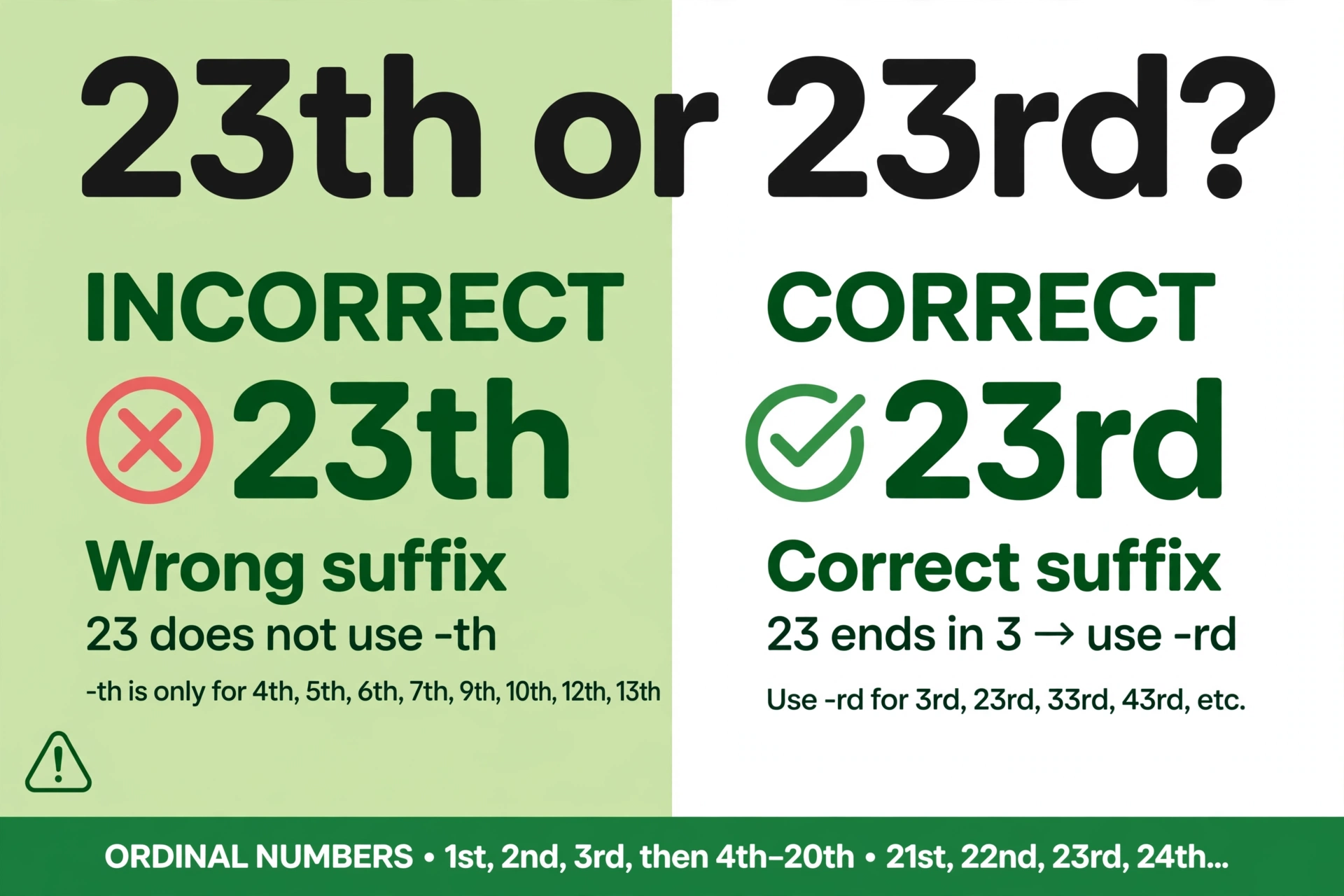
The correct form is 23rd — never 23th. Ordinal suffixes copy the end of the spoken word: because we say “twenty-third”, we write the last two letters, -rd. Use -th only when the spoken ordinal ends in “th”, as in fourth (4th), twentieth (20th) or twenty-fourth (24th). Numbers ending in 1 take -st (21st), numbers ending in 2 take -nd (22nd), numbers ending in 3 take -rd (23rd) — except for 11, 12 and 13, which all take -th (11th, 12th, 13th).
The rule behind the rule
English ordinal numbers — the numbers that show position: first, second, third, fourth and so on — are abbreviated by taking the numeral and adding the last two letters of the fully written ordinal word. That single principle explains every case:
- first ends in st → 1st
- second ends in nd → 2nd
- third ends in rd → 3rd
- fourth, fifth, sixth, seventh… end in th → 4th, 5th, 6th, 7th
For compound numbers, only the final element changes. Twenty-three becomes twenty-third, so the abbreviation is 23rd. Twenty-four becomes twenty-fourth, so the abbreviation is 24th. The suffix always belongs to the last word you say, not to the whole number. That is why the sequence runs 21st (twenty-first), 22nd (twenty-second), 23rd (twenty-third), 24th (twenty-fourth).
Reference grammars and style guides state the same system. Standard ordinal charts list 23 as “twenty-third, 23rd” without exception, and ordinal-indicator conventions are summarised as: -st for numbers ending in 1, -nd for numbers ending in 2, -rd for numbers ending in 3, and -th for everything else — with one important exception, covered below. There is no dictionary, grammar or style manual that sanctions 23th. It is simply a spelling error, produced by over-applying the common -th pattern.
The one exception: 11, 12 and 13
If the rule were only “look at the final digit”, we would write 11st, 12nd and 13rd. We do not, because the spoken forms break the pattern: eleventh, twelfth, thirteenth all end in “th”. So the written abbreviations follow the speech: 11th, 12th, 13th.
The exception extends to any number ending in those teens: 111th (one hundred and eleventh), 112th, 113th, 211th, 512th, 913th. But it does not extend to 21, 22 or 23, because twenty-first, twenty-second and twenty-third end in -st, -nd and -rd sounds. Compare:
| Number | Spoken in full | Correct abbreviation | Why |
|---|---|---|---|
| 11 | eleventh | 11th | Spoken form ends in “th” |
| 12 | twelfth | 12th | Spoken form ends in “th” |
| 13 | thirteenth | 13th | Spoken form ends in “th” |
| 21 | twenty-first | 21st | Final element is “first” |
| 22 | twenty-second | 22nd | Final element is “second” |
| 23 | twenty-third | 23rd | Final element is “third” |
| 24 | twenty-fourth | 24th | Final element is “fourth” |
| 31 | thirty-first | 31st | Final element is “first” |
| 32 | thirty-second | 32nd | Final element is “second” |
| 33 | thirty-third | 33rd | Final element is “third” |
| 43 | forty-third | 43rd | Final element is “third” |
| 103 | one hundred and third | 103rd | Final element is “third” |
| 113 | one hundred and thirteenth | 113th | Ends in thirteen — exception |
A reliable way to check any number: say it in full first. If your mouth ends with the sound of first, write -st. If it ends with second, write -nd. If it ends with third, write -rd. For everything else, write -th. Your ear will steer you right even when the digits look confusing.
How 23rd is used
The abbreviation 23rd appears most often in dates, rankings and anniversaries:
- Dates (especially American English): “The report is due on June 23rd.” / “Her birthday is on the 23rd of August.” British style often drops the suffix in formal dates — “23 June” — but when the suffix is written, it must be -rd: never “23th June”.
- Rankings and results: “He finished 23rd in the marathon.” “She placed 23rd overall.”
- Anniversaries, editions and floors: “their 23rd wedding anniversary”, “the 23rd edition of the festival”, “the 23rd floor”.
- Centuries: “the 23rd century” (the years 2201–2300).
In running text, style guides differ on whether to spell ordinals out. Hart’s Rules and similar British guides traditionally spell out ordinals up to about one hundred in formal prose (“the twenty-third chapter”), while journalism and everyday writing happily use figures with suffixes (“the 23rd chapter”). Either choice is acceptable; the suffix logic is identical. What is never acceptable, in any register, is 23th.
A note on formatting: traditional British typesetting often printed the suffix in superscript (23rd), and some word processors still do this automatically. Modern style, including The Chicago Manual of Style, prefers the suffix on the baseline — 23rd — because superscript letters can be hard to read at small sizes. Both presentations are understood; consistency within a document matters more than the choice itself. What matters is the letters: r and d.
Correct vs. incorrect examples
Correct: The meeting has been moved to the 23rd of October.
Incorrect: The meeting has been moved to the 23th of October.
Correct: She finished 23rd out of 400 runners — a personal best.
Incorrect: She finished 23th out of 400 runners.
Correct: Next week they celebrate their 23rd anniversary.
Incorrect: Next week they celebrate their 23th anniversary.
Correct: The 23rd Psalm begins “The Lord is my shepherd.”
Incorrect: The 23th Psalm begins “The Lord is my shepherd.”
Correct: Please read the twenty-third chapter (or: chapter 23) before Friday.
Incorrect: Please read the twenty-threeth chapter before Friday. (When spelling the ordinal out, it is twenty-third, never “twenty-threeth” or “twenty-three-th”.)
Common mistakes
Defaulting to “-th” for every number
Because most ordinals (fourth through twentieth, twenty-fourth, thirtieth…) do end in -th, the brain generalises. The cure is to remember that 1, 2 and 3 are special: first, second, third. Any number ending in 1, 2 or 3 inherits that special ending — 41st, 52nd, 63rd, 91st, 102nd, 203rd — unless it ends in 11, 12 or 13.
Extending the teen exception too far
Writers who learn “but 13 is 13th, not 13rd” sometimes conclude that 23 must follow suit. It does not. The exception is about the spoken ending: thirteenth ends in “th”, twenty-third ends in “third”. Only numbers whose final spoken element is eleven, twelve or a -teen take -th against their final digit.
Copying errors from invitations and social media
“23th” circulates because it is typed quickly and autocorrect does not flag ordinal suffixes. Seeing it repeatedly can make it look legitimate. It is not recorded in any dictionary as a variant; treat it the way you would treat “teh” — a typo, not an alternative form.
Adding suffixes to full dates in British formal writing
A separate, softer issue: in British English, formal dates are usually written without any suffix at all — “23 May 2026”, not “23rd May 2026”. The suffixed form is fine in informal writing and standard in American English (“May 23rd, 2026”). Whichever pattern you choose, if a suffix appears it must be the right one.
FAQs
Is it 23rd or 23th?
It is always 23rd. The spoken form is “twenty-third”, and ordinal abbreviations reproduce the last two letters of the spoken form. 23th is not a recognised variant in any dictionary or style guide.
How do you pronounce 23rd?
“Twenty-third” — in British English /ˌtwenti ˈθɜːd/, in American English /ˌtwenti ˈθɝːd/. Practise by saying the full phrase; the -rd ending you hear is the ending you write.
What about 21st, 22nd, 31st and 32nd?
They follow the same rule: 21st (twenty-first), 22nd (twenty-second), 31st (thirty-first), 32nd (thirty-second). Only 11th, 12th and 13th — and numbers ending in them, like 111th — break the final-digit pattern.
Should the “rd” be superscript?
Either style can be correct. British books traditionally used superscript (23rd); most modern publishers and style manuals now prefer baseline letters (23rd) for readability. Pick one style and use it consistently. Never mix, for example, 21st with 22nd in the same document.
Do I write “the 23rd” or just “23” in a date?
It depends on variety and formality. American English commonly writes “June 23rd”. British formal style prefers “23 June” with no suffix. Informal British writing often uses “23rd June” or “the 23rd of June”. All are acceptable — except any version containing “23th”.
Takeaway
The answer is short: 23rd, always. Ordinal abbreviations copy the end of the word as spoken — twenty-third ends in -rd, so 23 takes -rd. Remember the trio first (1st), second (2nd), third (3rd), watch out for the 11–13 exception, and say the number aloud whenever you are unsure. Do that, and “23th” will never slip into your writing again.