Other Ways to Say “Have a Good Rest of Your Day”: Meaning, Usage and Better Alternatives
“Have a good rest of your day” is a friendly way to wish someone well for the remaining hours of their day. You might say it after a meeting, at the end of a customer-service conversation, or when leaving work in the afternoon.
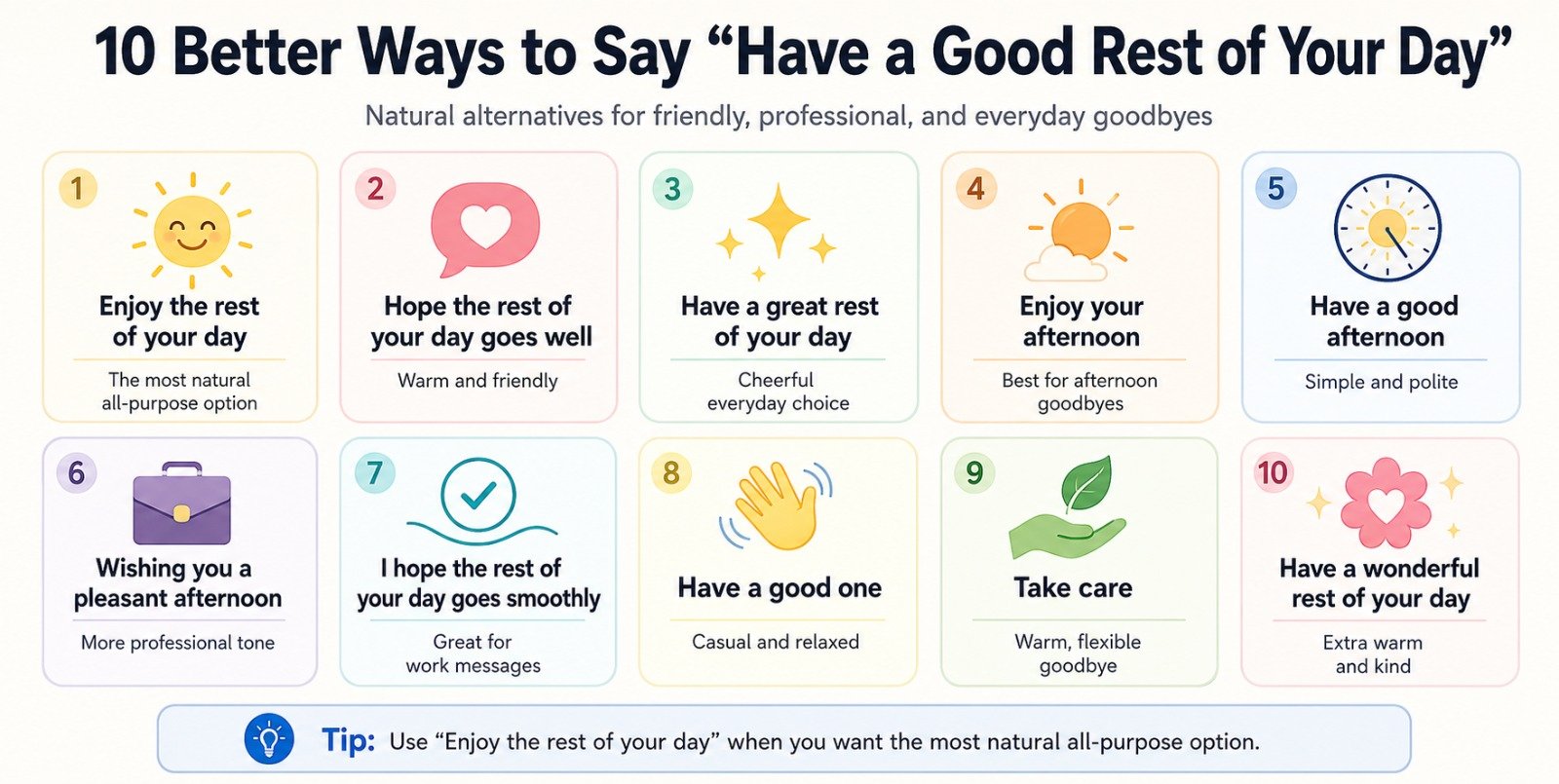
The phrase is understandable and polite, but it isn’t always the smoothest option. In many situations, “Enjoy the rest of your day” or “Hope the rest of your day goes well” sounds more natural. Below, you’ll find the meaning of the expression, when to use it, better alternatives for different situations, and related phrases such as “have a good rest of the week” and “have a good night’s rest.”
What Does “Have a Good Rest of Your Day” Mean?
The meaning of “have a good rest of your day” is simple:
I hope whatever remains of your day is pleasant.
Here, the word rest means the remaining part, not sleep or relaxation.
For example:
“Thanks for stopping by. Have a good rest of your day!”
The speaker isn’t telling the other person to take a nap. They’re wishing them well for the hours that are still left in the day.
This use of rest appears in many everyday expressions:
- the rest of the afternoon
- the rest of the week
- the rest of the year
- the rest of your vacation
- the rest of the meeting
That distinction matters because the same word can have a very different meaning in a phrase such as “get some rest,” where it refers to relaxing or sleeping.
Is “Have a Good Rest of Your Day” Correct English?
Yes. “Have a good rest of your day” is understandable and grammatically acceptable.
However, grammatical correctness doesn’t always mean a phrase is the most idiomatic choice.
Many English speakers are more likely to say:
- Enjoy the rest of your day.
- Have a great rest of your day.
- Hope the rest of your day goes well.
- Have a good afternoon.
Of these, “Enjoy the rest of your day” is probably the safest all-purpose alternative. It works in conversation, customer service, emails, and workplace settings without sounding overly formal.
Compare:
“Thanks for your help. Have a good rest of your day.”
and:
“Thanks for your help. Enjoy the rest of your day.”
Both are clear, but the second usually feels smoother.
Quick Comparison of the Best Alternatives
| Expression | Tone | Best Used For |
|---|---|---|
| Enjoy the rest of your day | Neutral and friendly | Almost any situation |
| Hope the rest of your day goes well | Warm and natural | Coworkers, friends, clients |
| Have a great rest of your day | Friendly | Casual and workplace conversation |
| Have a good afternoon | Neutral | Afternoon goodbyes |
| Wishing you a pleasant afternoon | Polite/formal | Professional messages |
| Have a good one | Very casual | Friends and familiar coworkers |
| Take care | Warm and flexible | Everyday goodbyes |
| Enjoy your afternoon | Friendly | Midday and afternoon conversations |
| Have a wonderful rest of your day | Warm | Personal or friendly messages |
| I hope the remainder of your day goes smoothly | Formal | Professional or business communication |
These expressions aren’t always interchangeable. For example, “Have a good one” is far more casual than “Wishing you a pleasant afternoon,” while “Have a good afternoon” only makes sense when it is actually afternoon.
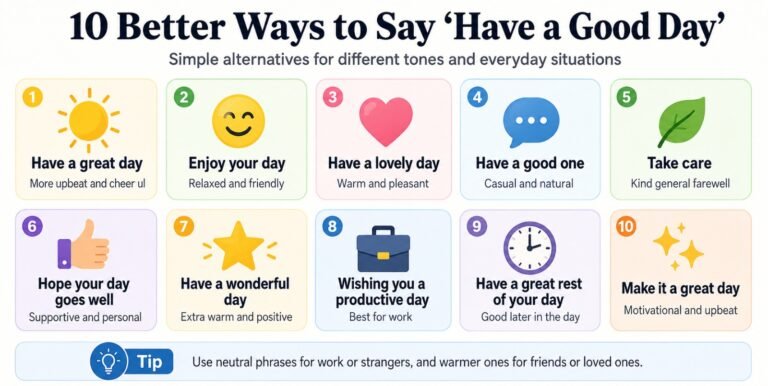
Other Ways to Say “Have a Good Rest of Your Day”
The best alternative depends on how formal, friendly, or casual you want to sound.
Natural Everyday Alternatives
These are useful when you want a normal, uncomplicated goodbye.
Enjoy the rest of your day
Probably the most natural replacement. It works with strangers, coworkers, customers, friends, and acquaintances.
“Thanks again for your time. Enjoy the rest of your day.”
Hope the rest of your day goes well
Slightly warmer and more personal.
“I’m glad we got that sorted out. Hope the rest of your day goes well.”
Have a great rest of your day
Casual but still suitable for many workplace conversations.
“I’ll send the document this afternoon. Have a great rest of your day.”
Enjoy your afternoon
A simple option when you’re speaking to someone during the afternoon.
“Thanks for calling. Enjoy your afternoon.”
Have a wonderful day
This doesn’t specifically refer to the remaining part of the day, but it works well when the distinction doesn’t matter.
“It was nice seeing you. Have a wonderful day.”
Professional Ways to Say It
In professional communication, the goal is usually to sound friendly without being too casual.
Enjoy the Rest of Your Day
This is one of the strongest choices for emails, meetings, support messages, and client communication.
“Thank you for confirming the details. Enjoy the rest of your day.”
It is polite without sounding stiff.
Wishing You a Pleasant Afternoon
This is slightly more formal.
“Thank you for your time today. Wishing you a pleasant afternoon.”
It works especially well in written communication.
I Hope the Rest of Your Day Goes Smoothly
This has a supportive tone and works well when the person has mentioned a busy schedule or ongoing task.
“I appreciate the update. I hope the rest of your day goes smoothly.”
All the Best for the Rest of Your Day
A warmer business-friendly option.
“Thank you again for your help. All the best for the rest of your day.”
This can sound a little more personal than a standard business closing, so it suits coworkers and established professional relationships particularly well.
Wishing You a Productive Afternoon
This changes the emphasis slightly. Instead of simply wishing someone a pleasant day, it specifically wishes them success with their work.
“Thanks for joining the meeting. Wishing you a productive afternoon.”
Because of that difference, it is best suited to workplace contexts rather than general social conversation.
Friendly and Casual Alternatives
You don’t always need a polished closing. With friends, family, or familiar coworkers, shorter expressions often sound better.
Have a Good One
Very casual and flexible.
“See you tomorrow. Have a good one!”
It can refer to the rest of the day without saying so directly.
Take Care
Warm but not overly personal.
“Thanks for checking in. Take care!”
This is less specifically about the rest of the day, so it works even when the time of day isn’t important.
Have an Awesome Afternoon
Energetic and casual.
“Good luck with everything later. Have an awesome afternoon!”
This may sound too enthusiastic in formal communication.
Hope Your Afternoon Treats You Well
A warmer, more conversational variation.
“Sounds like you’ve got a busy day. Hope your afternoon treats you well.”
This is better with people you already know than in highly formal messages.
Catch You Later—Enjoy Your Day
Good for informal conversations.
“I’ve got to get back to work. Catch you later—enjoy your day.”
Which Alternative Sounds Most Natural?
If you’re unsure what to use, choose:
“Enjoy the rest of your day.”
It is short, natural, and works in a wide range of situations.
If you want something warmer:
“Hope the rest of your day goes well.”
If you want something more professional:
“Wishing you a pleasant afternoon.”
And if you want something casual:
“Have a good one.”
The important point is that tone matters. A phrase that works perfectly with a friend may feel too relaxed in an email to a client.
“Have a Good Rest of the Day” vs. “Have a Good Rest of Your Day”
Both expressions are understandable, but they differ slightly in focus.
“Have a good rest of your day” speaks directly about the listener’s day.
“Thanks for coming in. Have a good rest of your day.”
“Have a good rest of the day” refers more generally to the remaining portion of the day.
“Have a good rest of the day, everyone.”
In ordinary conversation, however, “Enjoy the rest of your day” usually sounds more natural than either version.
You may also hear:
“Have a great rest of the day.”
Again, the meaning is clear, but “enjoy the rest of your day” is the smoother default for most contexts.
“Have a Good Rest of the Week”
The same pattern can be used with a longer period of time.
“Have a good rest of the week” means:
I hope the remaining days of your week go well.
For example:
“Thanks for meeting with me today. Have a good rest of the week.”
More natural alternatives include:
- Enjoy the rest of your week.
- Have a great rest of your week.
- Hope the rest of your week goes well.
- Wishing you a great week ahead.
- Have a wonderful rest of the week.
“Enjoy the rest of your week” is particularly natural when you speak to someone on Wednesday, Thursday, or Friday and don’t expect to see them again before the week ends.
“I’ll follow up next Monday. Enjoy the rest of your week.”
“Have a Good Night Rest” Means Something Different
This related phrase can be confusing because rest now has another meaning.
In:
“the rest of your day”
rest means what remains.
But in:
“a good night’s rest”
rest means sleep or relaxation.
The standard expression is:
“Have a good night’s rest.”
or:
“Get a good night’s rest.”
The apostrophe matters because night’s describes the rest associated with the night.
Natural alternatives include:
- Sleep well.
- Rest well.
- Have a restful night.
- Get some good sleep.
- Hope you sleep well tonight.
- Have a peaceful night.
For example:
“You’ve had a long day. Get a good night’s rest.”
So “have a good night’s rest” is not simply another way to say “have a good rest of your day.” The two phrases use rest in different senses.
How to Say “Have a Good Rest of Your Day” in Spanish
A natural way to express the idea in Spanish is:
Disfruta el resto de tu día.
This is suitable when speaking informally to one person and means approximately:
“Enjoy the rest of your day.”
For a more formal interaction, you can say:
Disfrute el resto del día.
When addressing multiple people:
Disfruten el resto del día.
| Spanish Expression | English Meaning | Context |
| Disfruta el resto de tu día | Enjoy the rest of your day | Informal, one person |
| Disfrute el resto del día | Enjoy the rest of your day | Formal, one person |
| Disfruten el resto del día | Enjoy the rest of your day | Multiple people |
A literal word-for-word translation isn’t always the best approach between languages. Disfruta el resto de tu día communicates the intended sentiment naturally rather than trying to reproduce every English word.
When Should You Use This Phrase?
“Have a good rest of your day” makes the most sense after part of the day has already passed.
Good situations include:
- ending an afternoon meeting
- saying goodbye to a customer
- finishing a phone call
- ending a work chat
- leaving a store or appointment
- signing off from a friendly email
- saying goodbye to a coworker you won’t see again that day
For example:
“Everything is confirmed for tomorrow. Have a good rest of your day.”
It can sound less natural very early in the morning because there is little reason to emphasize the remaining part of the day. At 8 a.m., “Have a good day” will usually sound simpler.
When Another Expression Works Better
Although the phrase is polite, there are situations where something else fits more naturally.
Early in the Morning
Use:
“Have a good day.”
rather than:
“Have a good rest of your day.”
Late in the Evening
Use:
- Have a good evening.
- Have a good night.
- Sleep well.
In a Formal Business Email
Consider:
- Wishing you a pleasant afternoon.
- I hope the rest of your day goes well.
- Enjoy the rest of your day.
With Friends
Shorter options often feel more natural:
- Have a good one!
- Take care!
- Enjoy your day!
- Catch you later!
How to Respond to “Have a Good Rest of Your Day”
You don’t need a complicated reply.
Natural responses include:
- Thanks, you too!
- Thank you—you as well.
- Same to you!
- Likewise!
- Thanks, have a good one!
- You too. Take care!
- Thanks! Enjoy yours too.
- Thank you. Hope you do as well.
For professional situations:
“Thank you. You as well.”
For casual conversations:
“Thanks, you too!”
Both are completely natural.
Common Mistakes to Avoid
Assuming “rest” means relaxation
In this phrase, it means the remaining portion.
“Enjoy the rest of your day” doesn’t mean “spend the day resting.”
Using Every Alternative in the Same Context
Not all alternatives carry the same tone.
“Have a good one” is casual.
“Wishing you a pleasant afternoon” is more formal.
“Wishing you a productive afternoon” focuses on work rather than enjoyment.
Choose based on the relationship and situation.
Saying “Good Night Rest” Instead of “Good Night’s Rest”
When you mean sleep or relaxation, the conventional expression is:
“a good night’s rest.”
For example:
“You should get a good night’s rest before the exam.”
Overcomplicating a Simple Goodbye
Sometimes the shortest phrase is best.
If “Have a good day” says everything you need, there’s no reason to make the farewell longer.
Frequently Asked Questions
Is “have a good rest of your day” grammatically correct?
Yes. The phrase is grammatically understandable and commonly used as a friendly wish for the remaining part of someone’s day. However, “Enjoy the rest of your day” often sounds more natural.
What is the best alternative to “have a good rest of your day”?
For most situations, “Enjoy the rest of your day” is the best alternative. It works well in both everyday conversation and professional communication.
Is “have a good rest of your day” professional?
It can be used professionally, especially in friendly workplace conversations. For more polished business communication, “Enjoy the rest of your day” or “I hope the rest of your day goes well” may sound smoother.
What does “rest” mean in “rest of your day”?
It means the remaining part of the day. It does not refer to sleep or taking a break.
Can I say “have a good rest of the week”?
Yes. It means you hope the remaining days of someone’s week go well. “Enjoy the rest of your week” is another natural option.
Is it “have a good night rest” or “have a good night’s rest”?
The standard phrase is “have a good night’s rest.” Here, night’s is possessive and refers to the rest or sleep you get during the night.
How do you say “have a good rest of your day” in Spanish?
A natural informal version is “Disfruta el resto de tu día.” A formal version is “Disfrute el resto del día.”
Should I say “have a good day” or “have a good rest of your day”?
Use “Have a good day” when giving a general daytime farewell, especially in the morning. Use “Have a good rest of your day” or “Enjoy the rest of your day” when a noticeable part of the day has already passed.
Choosing the Right Farewell
There’s nothing wrong with saying “Have a good rest of your day,” but the best wording depends on when you’re speaking, who you’re talking to, and how warm or formal you want to sound. “Enjoy the rest of your day” is the most versatile choice, while professional, casual, and time-specific alternatives let you adjust the tone when needed.
Small differences like these can make everyday English sound noticeably more natural. Clarifyra helps you understand those differences so you can choose a farewell that fits the person, moment, and tone you actually want to convey.
You May Also Read | Have a Good Day: Meaning, Better Alternatives, Translations and Examples