30 Other Ways to Say “According To” in Essays, Writing and Everyday Use
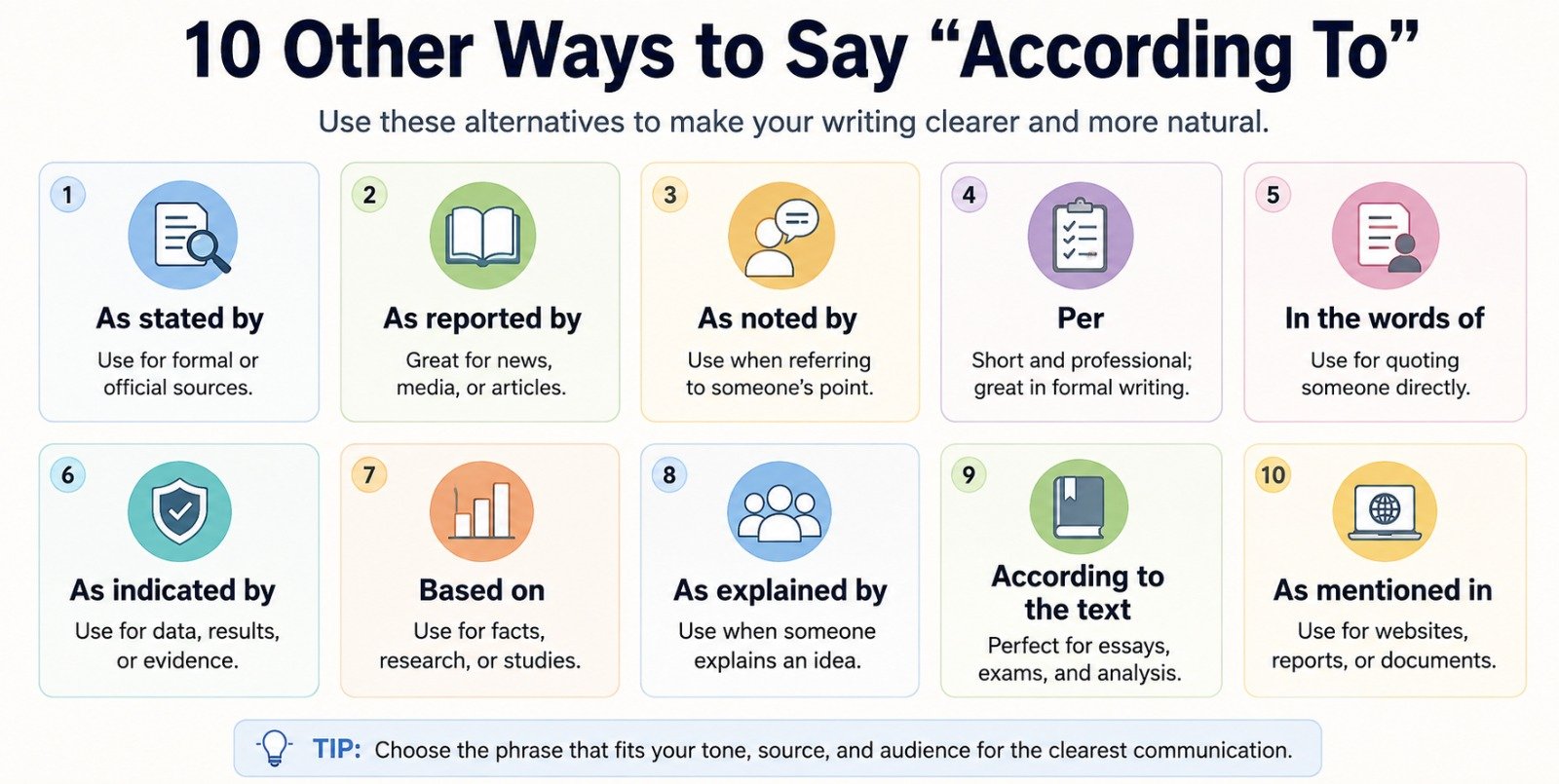
“According to” is one of the most useful phrases for referring to a source, person, report, text, or set of information. But when it appears too often in an essay, report, or article, the writing can start to sound repetitive. Fortunately, there are many other ways to say “according to”, including as stated by, based on, as reported by, as noted by, and as indicated by.
The best alternative depends on what you actually mean. Some expressions introduce a person’s opinion, others refer to evidence, and a few are better suited to rules or instructions. Choosing by context makes your writing both more varied and more precise.
What Does “According To” Mean?
“According to” commonly introduces information that comes from another source rather than directly from the speaker or writer.
For example:
According to the report, customer satisfaction improved this year.
Here, the report is the source of the information.
The expression can also have another meaning related to following a rule, plan, or standard:
The documents were organized according to date.
Because the phrase performs more than one job, there isn’t a single according to synonym that works naturally in every sentence.
30 Different Ways to Say According To
Here is a quick comparison of useful alternatives and the contexts where they tend to sound most natural.
| Alternative | Tone | Best Used For |
|---|---|---|
| As stated by | Formal | Essays, quotations, reports |
| Based on | Neutral/Formal | Evidence and conclusions |
| As reported by | Formal | News and reported information |
| As noted by | Formal | Essays and observations |
| As explained by | Neutral/Formal | Explanations and educational writing |
| As indicated by | Formal | Research, statistics, evidence |
| As suggested by | Formal | Tentative conclusions |
| As demonstrated by | Formal | Strong evidence or research |
| As shown by | Neutral | Results, charts, evidence |
| As documented in | Formal | Records and research |
| As cited in | Formal | Academic sources |
| As referenced in | Formal | Documents and reports |
| As mentioned by | Neutral | General attribution |
| As described by | Neutral/Formal | Descriptions or accounts |
| As observed by | Formal | Research and observation |
| As outlined in | Formal | Plans, policies, documents |
| In the words of | Neutral | Directly introducing someone’s words |
| As argued by | Academic | Arguments and viewpoints |
| As claimed by | Cautious/Formal | Unverified or disputed statements |
| As confirmed by | Formal | Verified information |
| As revealed by | Neutral/Formal | Newly disclosed information |
| From the perspective of | Formal | Viewpoints and analysis |
| From the viewpoint of | Formal | Opinions and perspectives |
| In the opinion of | Neutral/Formal | Clearly attributed opinions |
| On the authority of | Very formal | Authoritative information |
| Per | Formal/Concise | Business and administrative writing |
| As per | Business/Formal | Instructions and requests |
| In accordance with | Formal | Rules and requirements |
| In line with | Professional | Policies, standards, expectations |
| In keeping with | Formal | Traditions, principles, expectations |
These phrases aren’t all direct substitutes. The surrounding sentence determines which one fits.
Other Ways to Say “According To” for General Attribution
When you simply want to tell readers where information came from, these alternatives are among the most natural.
Other Ways to Say “According To”: As Stated By
As stated by works well when attributing a specific statement or piece of information to a person or source.
As stated by the project manager, the new system will launch in September.
It sounds slightly more formal than “according to,” making it particularly useful in reports and essays.
Other Ways to Say “According To”: As Reported By
Use as reported by when information has been communicated by a news outlet, organization, researcher, or report.
As reported by local officials, the bridge will reopen on Friday.
The phrase emphasizes that the information has been reported, rather than personally verified by the writer.
Other Ways to Say “According To”: As Noted By
As noted by is useful when someone has pointed out or observed something worth highlighting.
As noted by the researchers, the sample size was relatively small.
It works especially well in analytical and academic writing.
Other Ways to Say “According To”: As Explained By
Choose as explained by when the source provides reasoning or clarification rather than simply stating a fact.
As explained by the instructor, the final grade includes both assignments and exams.
This wording tells the reader that an explanation followed the source’s statement.
Other Ways to Say “According To”: As Mentioned By
As mentioned by is a flexible, relatively neutral option.
As mentioned by Daniel earlier, we still need approval from the client.
It fits everyday professional communication but may sound less precise than reporting verbs such as argued, demonstrated, or confirmed in academic work.
Other Ways to Say “According To” in an Essay
Repeatedly starting sentences with “according to” can make an essay feel mechanical. Academic writing often becomes stronger when the attribution verb describes what the source is actually doing.
Instead of:
According to Williams, the policy created unexpected economic effects.
You might write:
Williams argues that the policy created unexpected economic effects.
That version not only avoids repetition but also shows that Williams is presenting an argument, not merely supplying information.
Other Ways to Say “According To” in an Essay: As Argued By
Use as argued by when the author is presenting a position, interpretation, or case.
As argued by Patel, access to public transportation affects employment opportunities.
Don’t use argued when the source merely reports a neutral fact.
Other Ways to Say “According To” in an Essay: As Suggested By
As suggested by works when evidence points toward a conclusion without establishing it absolutely.
As suggested by the findings, regular practice may improve long-term retention.
The word suggested deliberately sounds less certain than proved or demonstrated.
Other Ways to Say “According To” in an Essay: As Demonstrated By
Use as demonstrated by when evidence gives strong support to a point.
As demonstrated by the experiment, increasing the temperature accelerated the reaction.
This is stronger than as suggested by, so the evidence should justify that confidence.
Other Ways to Say “According To” in an Essay: As Observed By
As observed by is appropriate when referring to something noticed during research, analysis, or direct observation.
As observed by the research team, participants became faster with repeated practice.
Other Ways to Say “According To” in an Essay: Based On
Based on is especially useful when a conclusion comes from evidence.
Based on the available data, the researchers rejected the original hypothesis.
Notice the difference:
According to the study, the treatment was effective.
This tells us where the information came from.
Based on the study, the committee recommended changing the guidelines.
This tells us what evidence the recommendation was founded on.
That difference matters in careful writing.
Better Reporting Verbs for Essays
Sometimes the best way to avoid “according to” is not to find another introductory phrase at all. Put the source directly into the sentence and choose an accurate reporting verb.
For example:
Lewis states that the policy took effect in 2018.
Lewis argues that the policy was ineffective.
Lewis suggests that further research is needed.
Lewis explains how the policy affected small businesses.
Lewis notes that several limitations remain.
Lewis concludes that the benefits outweigh the costs.
These alternatives often make academic prose more precise because they describe the relationship between the writer and the source.
Other Ways to Say “According To the Text”
Students are often asked to answer questions using information from a passage, article, story, or document. In that situation, repeating “according to the text” in every answer isn’t necessary.
Other Ways to Say “According To the Text”: The Text States That
This is one of the simplest alternatives.
The text states that the village was established in the nineteenth century.
Use it for information explicitly given in the passage.
Other Ways to Say “According To the Text”: The Passage Indicates That
The passage indicates that works when information points toward a conclusion.
The passage indicates that the character regrets his earlier decision.
It can be more analytical than the text states that.
Other Ways to Say “According To the Text”: The Author Explains That
Use this when the writer gives an explanation.
The author explains that rising temperatures affect migration patterns.
Other Ways to Say “According To the Text”: The Text Suggests That
This works well for an inference rather than an explicitly stated fact.
The text suggests that Maria no longer trusts her former colleague.
“Says” and “suggests” shouldn’t be treated as identical. If the idea must be inferred, suggests is usually more accurate.
Other Ways to Say “According To the Text”: Based on the Passage
Use based on the passage when you’re drawing a conclusion from information presented in the text.
Based on the passage, the narrator values independence more than financial security.
This expression is particularly useful for reading-comprehension and interpretation questions.
Formal Alternatives to “According To”
Formal documents often require more precise language than everyday conversation.
Other Ways to Say “According To”: As Indicated By
As indicated by works particularly well with data, evidence, surveys, and results.
As indicated by the latest figures, operating costs decreased during the quarter.
It implies that the evidence itself points toward the conclusion.
Other Ways to Say “According To”: As Documented In
Use as documented in when information has been formally recorded.
As documented in the annual report, the organization expanded into three new regions.
This phrase fits official records, reports, studies, and historical material.
Other Ways to Say “According To”: As Outlined In
As outlined in is useful when a document sets out a process, rule, plan, or set of points.
As outlined in the agreement, either party may terminate the contract with written notice.
Other Ways to Say “According To”: On the Authority Of
On the authority of is highly formal and emphasizes the reliability or status of a source.
On the authority of the department’s official records, the property was transferred in 1998.
Because it sounds quite formal, it would feel unnatural in casual conversation.
Alternatives for Opinions and Viewpoints
If “according to” introduces someone’s interpretation rather than a factual report, an opinion-focused expression can be clearer.
Other Ways to Say “According To”: From the Perspective Of
From the perspective of the employees, flexible scheduling improved morale.
This frames the statement as a particular point of view.
Other Ways to Say “According To”: In the Opinion Of
In the opinion of the review panel, the proposal requires further development.
Use it when you want to make clear that something is an opinion rather than an established fact.
Other Ways to Say “According To”: From the Viewpoint Of
From the viewpoint of a first-time buyer, the process can seem complicated.
Like from the perspective of, this expression places an idea within a particular person’s or group’s viewpoint.
Alternatives for Rules, Instructions, and Standards
This is where several supposed synonyms of “according to” become context-specific.
Other Ways to Say “According To”: In Accordance With
In accordance with means that something conforms to a rule, requirement, agreement, or standard.
In accordance with company policy, all expenses must be approved in advance.
Compare that with:
According to the manager, all expenses must be approved in advance.
The first refers to compliance with a policy. The second tells us that the manager is the source of the information.
They aren’t the same.
Other Ways to Say “According To”: As Per
As per appears frequently in business and administrative communication.
As per your request, I’ve attached the revised document.
It can sound formal or bureaucratic, so plain alternatives such as as requested may feel more natural in some situations.
Other Ways to Say “According To”: Per
Per is concise and common in instructions, business language, and certain professional contexts.
Per company policy, receipts are required for all reimbursements.
In conversational English, it can sound unnecessarily formal.
Other Ways to Say “According To”: In Line With
In line with expresses consistency with a policy, goal, expectation, or principle.
In line with the new guidelines, staff will receive additional training.
It doesn’t normally replace “according to” when you’re simply naming the source of a statement.
According To vs. Based On
These two expressions are related but perform different jobs.
According to attributes information:
According to the survey, 72% of respondents preferred the first option.
Based on identifies the evidence behind a decision or conclusion:
Based on the survey results, the company selected the first option.
A useful shortcut is:
- According to = Who or what says this?
- Based on = What evidence supports this?
That distinction makes choosing between them much easier.
According To vs. As Claimed By
As claimed by deserves extra care because claim can imply that the information hasn’t been independently established.
Compare:
According to the witness, the driver left immediately.
and:
As claimed by the witness, the driver left immediately.
The second can create a slightly more skeptical or cautious tone.
For neutral attribution, according to or as stated by is often safer.
According To vs. As Confirmed By
As confirmed by has almost the opposite effect of as claimed by: it suggests verification.
As confirmed by the airline, the flight has been cancelled.
Use this phrase only when confirmation has actually occurred. Don’t replace “according to” with it merely for variety.
When “According To” Is Already the Best Choice
Avoiding repetition is useful, but replacing a perfectly natural phrase just to sound different can make writing worse.
“According to” remains an excellent choice when:
- You want neutral source attribution.
- The sentence needs to be concise.
- A more specific reporting verb would imply something you don’t intend.
- The source is a person, report, study, or organization.
- The phrase hasn’t already been repeated excessively nearby.
For example:
According to the weather report, rain is expected this evening.
Changing this to from the perspective of the weather report would be unnatural, while as demonstrated by the weather report would change the meaning.
Good writing isn’t about eliminating “according to.” It’s about knowing when another expression communicates the idea more accurately.
How to Choose the Right Alternative
Ask yourself what relationship exists between your sentence and its source.
If you’re simply attributing information, try as stated by, as reported by, or as noted by.
If you’re drawing a conclusion from evidence, consider based on, as indicated by, or as demonstrated by.
If you’re presenting someone’s argument, use wording such as as argued by or place the source directly before argues.
If you’re presenting a viewpoint, from the perspective of or in the opinion of can clarify that distinction.
For rules and compliance, in accordance with, per, and in line with may be more accurate.
The most polished choice is usually the one that tells the reader more about what the source actually does.
Common Mistakes to Avoid
One frequent mistake is replacing “according to” with a phrase simply because it appears on a synonym list.
For instance:
As demonstrated by Sarah, the meeting begins at 3 p.m.
That sounds odd if Sarah merely told you the meeting time. A better sentence would be:
According to Sarah, the meeting begins at 3 p.m.
or:
As stated by Sarah, the meeting begins at 3 p.m.
Another mistake is using according to me to introduce your own opinion. Although grammatically possible in limited contexts, it often sounds unnatural in ordinary English. Usually, use:
In my opinion…
I think…
From my perspective…
Similarly, don’t use stronger verbs such as confirmed, proved, or demonstrated unless the source genuinely supports that level of certainty.
Frequently Asked Questions
What is another way to say “according to”?
Common alternatives include as stated by, as reported by, as noted by, based on, as explained by, and as indicated by. The most suitable option depends on whether you’re attributing information, describing evidence, or referring to a viewpoint.
What can I say instead of “according to” in an essay?
In essays, useful choices include as argued by, as noted by, as suggested by, as demonstrated by, and as stated by. You can also place the author’s name directly before a reporting verb, such as “Smith argues that…” or “Jones explains that…”
What are other ways to say “according to the text”?
You can write the text states that, the passage indicates that, the author explains that, the text suggests that, or based on the passage. Choose states for explicit information and suggests when you’re making an inference.
Is “based on” a synonym for “according to”?
Sometimes, but not always. “According to” normally identifies the source of information, while “based on” identifies the evidence or foundation for a conclusion or decision.
What is a formal synonym for “according to”?
Depending on the sentence, formal alternatives include as stated by, as indicated by, as documented in, as reported by, and in accordance with. “In accordance with” is mainly appropriate when talking about compliance with rules or standards.
Is “as per” the same as “according to”?
They overlap in some business contexts, but they aren’t universally interchangeable. As per is often used with requests, instructions, or arrangements, as in “As per your request.” “According to” is more natural when attributing information to a source.
What is another term for “according to” in academic writing?
Academic alternatives include as argued by, as noted by, as demonstrated by, as suggested by, as indicated by, and based on. A precise reporting verb is usually better than swapping phrases purely to avoid repetition.
Conclusion
There are plenty of different ways to say according to, but the strongest alternative isn’t simply the one that sounds different. It should accurately show whether you’re citing a statement, describing evidence, introducing an argument, expressing a viewpoint, or referring to a rule. A phrase such as as reported by may suit journalism, while as argued by works better for an academic position and in accordance with belongs with rules and requirements.
Small wording choices can make a noticeable difference in clarity. Clarifyra focuses on those distinctions so you can choose expressions that sound natural while still matching the meaning, tone, and context you intend.
You May Also Read | 100+ Other Ways to Say “Have a Good Day” for Any Situation