Lasagna or Lasagne: Which Is Correct?
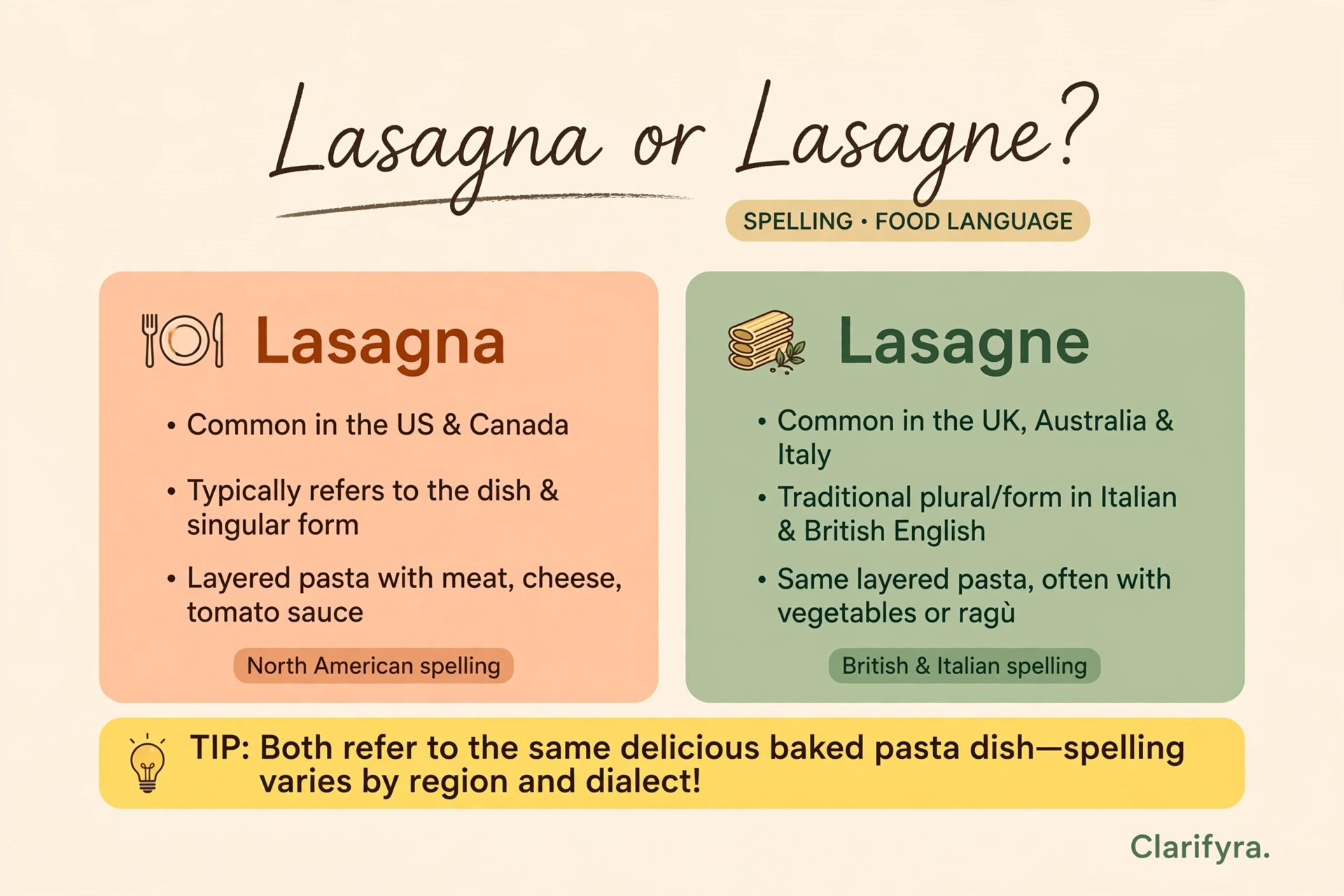
Both lasagna and lasagne are correct — you are choosing between regional habits, not between right and wrong. In the United States, lasagna is the usual spelling for both the wide pasta sheets and the baked layered dish. In Britain, lasagne is the usual spelling for the dish, and the pasta is sold as lasagne sheets. The difference comes from Italian grammar, where lasagna names a single sheet and lasagne is its plural — and because the baked dish is always made of many sheets, Italian (and British English after it) settled on the plural form for the dish itself. Pick the spelling that matches your audience, and be consistent.
Quick Answer
Lasagna and lasagne name the same food and are pronounced identically: UK /ləˈzæn.jə/, US /ləˈzɑː.njə/ (Cambridge). Use lasagna for an American audience — it is the standard US spelling for the pasta and the baked dish. Use lasagne for a British audience — Cambridge marks lasagne “mainly UK (US usually lasagna).” In Italian, lasagna is one sheet of pasta and lasagne is the plural, which is why the multi-layered dish took the plural name. Neither spelling is an error; just match your readers and don’t mix the two in one document.
What the Dictionaries Actually Say
Cambridge Dictionary makes the regional split explicit. Its entry labels lasagne “mainly UK (US usually lasagna)” — one of those compact labels that settles most arguments. Collins agrees from both directions: its British entry gives lasagne, “also lasagna,” while its American entry leads with lasagna and notes “Also: lasagne.” Oxford Learner’s splits the difference by listing the headword lasagne with “(also lasagna)” and defining both the pasta and the dish under it. Merriam-Webster, the American authority, enters the dish under lasagna — “a baked dish containing layers of boiled lasagna, and usually cheese, a seasoned sauce of tomatoes, and meat or vegetables” — with lasagna doing double duty for the noodle and the finished dish.
Longman’s learner’s dictionary states the geography in full: “lasagne British English, lasagna American English.” No major dictionary marks either form as incorrect, informal, or dated. This is a genuine spelling variant pair, like organise/organize, where correctness is a matter of audience and house style rather than of the word itself. That also means spellcheckers can mislead you: an American spellchecker will flag lasagne, and a British one may query lasagna, but both flags are about regional settings, not errors.
Pronunciation offers no help in choosing, because there is no difference to choose between. Cambridge gives UK /ləˈzæn.jə/ and US /ləˈzɑː.njə/ for lasagna, and the identical transcription for lasagne. The final -a and final -e are both swallowed into the same weak “yuh” sound (the Italianate /njə/), and the g is silent in the sense that the gn combination produces the “ny” sound of canyon. British speakers tend toward the flatter /æ/ vowel in the middle syllable, Americans toward /ɑː/, but that is an accent difference, not a spelling difference — both spellings get both pronunciations.
The Italian Logic Underneath
The spelling puzzle dissolves once you see the Italian grammar. In Italian, lasagna is a feminine singular noun: one wide, flat sheet of pasta. Its regular plural is lasagne: two or more sheets. The baked dish, by definition, stacks many sheets with ragù, béchamel, and cheese, so Italian names the dish with the plural — lasagne, or in full lasagne al forno (“lasagne baked in the oven”). Oxford Learner’s word-origin note states this plainly: “Italian, plural of lasagna.”
British English borrowed the dish name close to its Italian form and kept the -e. American English, by contrast, generalised the singular. In the US, lasagna came to name the pasta generically (much as spaghetti or macaroni function as mass nouns) and then the dish made from it. So an American recipe might say “boil the lasagna noodles” and “bake the lasagna for 45 minutes,” using one form for ingredient and dish alike. A British recipe keeps the Italian distinction a little more visibly: “layer the lasagne sheets” and “the lasagne is ready.” Neither system is illogical; they simply grammaticalised the loanword differently.
Behind the pasta lies an older word for a pot. Merriam-Webster traces lasagna to Italian lasagna, from Vulgar Latin *lasania, “cooking pot, its contents,” from Latin lasanum, “chamber pot,” from Greek lasanon. Collins gives the same Latin route. The word travelled from vessel to contents to one specific content — a classic example of a container word becoming a food word, like casserole. The first known use of lasagna in English, per Merriam-Webster, dates to 1846, when Italian food was entering the English-speaking kitchen in earnest.
Sheet, Dish, and Plural: Using Each Form Precisely
| What you mean | British English | American English | Italian |
|---|---|---|---|
| One flat sheet of pasta | a lasagne sheet | a lasagna noodle / sheet | una lasagna |
| The pasta in general | lasagne (sheets) | lasagna | lasagne |
| The baked layered dish | lasagne | lasagna | lasagne (al forno) |
| More than one baked dish | two lasagnes | two lasagnas | due lasagne (unchanged plural form) |
| Pronunciation | UK /ləˈzæn.jə/ · US /ləˈzɑː.njə/ — identical for both spellings | ||
English plurals add one wrinkle. When British writers need to pluralise the dish, Collins gives lasagnes — “two lasagnes for the freezer.” American writers pluralise lasagnas. In practice both are rare, because the dish usually behaves as an uncountable food noun: “we had lasagne for dinner,” “there’s lasagna left.” Oxford marks the word “[uncountable, countable],” capturing exactly that flexibility. If you find yourself writing lasagne’s or lasagna’s with an apostrophe for a simple plural, that’s a genuine error in both varieties — apostrophes don’t make plurals here.
Capitalisation, at least, is simple: neither form is capitalised in running text. Lasagne al forno and lasagne alla bolognese keep lower case in English menus and recipes unless house style title-cases dish names wholesale.
Correct vs. Incorrect
- ✓ “We’re having lasagna tonight.” (American audience — dish)
- ✓ “We’re having lasagne tonight.” (British audience — dish)
- ✓ “Overlap the lasagne sheets slightly.” (British recipe — pasta)
- ✓ “Boil the lasagna noodles for eight minutes.” (American recipe — pasta)
- ✓ “She baked two lasagnes for the party.” (British plural of the dish)
- ✓ “She baked two lasagnas for the party.” (American plural of the dish)
- ✗ “Add a layer of lasagne’s sheets.” → ✓ “Add a layer of lasagne sheets.” (no apostrophe)
- ✗ Mixing in one text: “Boil the lasagna, then layer the lasagne…” → ✓ Pick one spelling and use it throughout.
- ✗ “Lasanga / lasanya” → ✓ lasagna or lasagne. (The gn spelling is essential; see Common Mistakes.)
Notice what is not on the incorrect list: using lasagne in America or lasagna in Britain. Readers in both countries will understand either form instantly. At most, the non-local spelling looks faintly imported — which, for an Italian dish, is hardly a disaster. Consistency matters more than the choice itself.
Common Mistakes
1. Dropping the “g”: “lasanga,” “lasanya.” These are the commonest true misspellings, born from the pronunciation — since gn sounds like “ny,” writers guess lasanya. Every dictionary headword keeps the g: lasagna, lasagne. If you remember the Italian pasta family — gnocchi works the same way — the silent-looking g stops seeming optional.
2. Insisting one spelling is “wrong.” British writers sometimes “correct” American lasagna, and American writers return the favour to lasagne. The dictionaries checked for this article — Cambridge, Collins, Oxford, Merriam-Webster — all record both forms without any error label. The honest statement is regional: mainly UK versus usually US. Correcting a writer’s regional spelling to your own is an edit for audience, not for accuracy.
3. Using the Italian singular/plural rule as an English rule. You will occasionally read that lasagna “only means one sheet, so the dish must be lasagne.” That is true of Italian grammar; it is not a rule English adopted. Merriam-Webster defines American lasagna directly as the baked dish, and Cambridge records the US usage without qualification. English borrows words, then makes its own grammar for them — compare panini, an Italian plural that English happily uses for one sandwich.
4. Inconsistency within a document. Menus and manuscripts that drift — lasagna in the title, lasagne in the method, lasagne sheets in the ingredients — look careless even though each instance is defensible alone. Search your text before publishing and standardise. If your document quotes an Italian dish name (lasagne al forno), keeping the Italian spelling inside that name while using lasagna elsewhere is acceptable and often clearer.
5. Pronouncing the “g.” A smaller spoken mistake: saying “laz-AG-na” with a hard g. The dictionaries’ transcriptions — UK /ləˈzæn.jə/, US /ləˈzɑː.njə/ — contain no /ɡ/ sound at all. Say “luh-ZAHN-yuh” (US) or “luh-ZAN-yuh” (UK) and you will match both spellings.
Frequently Asked Questions
Which spelling should I use for an international audience?
Either will be understood everywhere. If you must pick one, consider your spelling system overall: a document using American spellings (organize, flavor, center) should use lasagna; one using British spellings (organise, flavour, centre) should use lasagne. Matching the word to your document’s variety looks more professional than any single “international” choice.
Is “lasagne” the plural of “lasagna” in English?
Not quite. In Italian, yes — lasagna (one sheet) pluralises to lasagne. In English, the two forms are regional variants of the same word, and each pluralises in the English way when needed: lasagnas (US), lasagnes (UK). An American writing “one lasagna, two lasagnes” would be mixing systems; “two lasagnas” is the consistent American plural, and Collins gives lasagnes as the British one.
Why do British recipes say “lasagne sheets” but American ones say “lasagna noodles”?
Two separate habits are stacked here. The first word follows the regional spelling (lasagne/lasagna). The second reflects a vocabulary difference: British English calls the flat pasta pieces sheets, while American English — which uses noodle broadly for pasta shapes — says lasagna noodles. Both phrases name the same product in the same box.
Does Garfield eat “lasagna” or “lasagne”?
Lasagna — the comic strip is American, and its famous cat’s favourite dish has done more than anything to fix the -a spelling in global pop culture. British editions and British readers know the dish as lasagne at home, but the character’s preference is quoted in its original American spelling worldwide. It’s a tidy illustration of the rule: the spelling follows the writer’s variety, not the food’s passport.
The Takeaway
Lasagna and lasagne are the same pasta and the same baked dish, pronounced identically (UK /ləˈzæn.jə/, US /ləˈzɑː.njə/). American English uses lasagna for both sheet and dish; British English prefers lasagne, keeping the Italian plural that the many-layered dish logically takes. No dictionary checked treats either form as wrong. Choose the spelling your audience expects, apply it consistently — lasagna noodles in the US, lasagne sheets in the UK — and save your red pen for the real errors: the missing g in “lasanya” and the stray apostrophe in “lasagne’s.”