Breech or Breach: What’s the Difference?
If you are hesitating between breech and breach, you are not alone — they sound identical, and even careful writers swap them. The short version is this: breach is about breaking — breaking a rule, a contract, a wall, or the surface of the water. Breech is about the back or bottom end of something — the back end of a gun barrel, a baby positioned bottom-first before birth, or, in the plural breeches, short trousers. Same sound, completely different jobs. Anchor each spelling — breach = break, breech = bottom/back — and the choice is usually clear.
Quick Answer
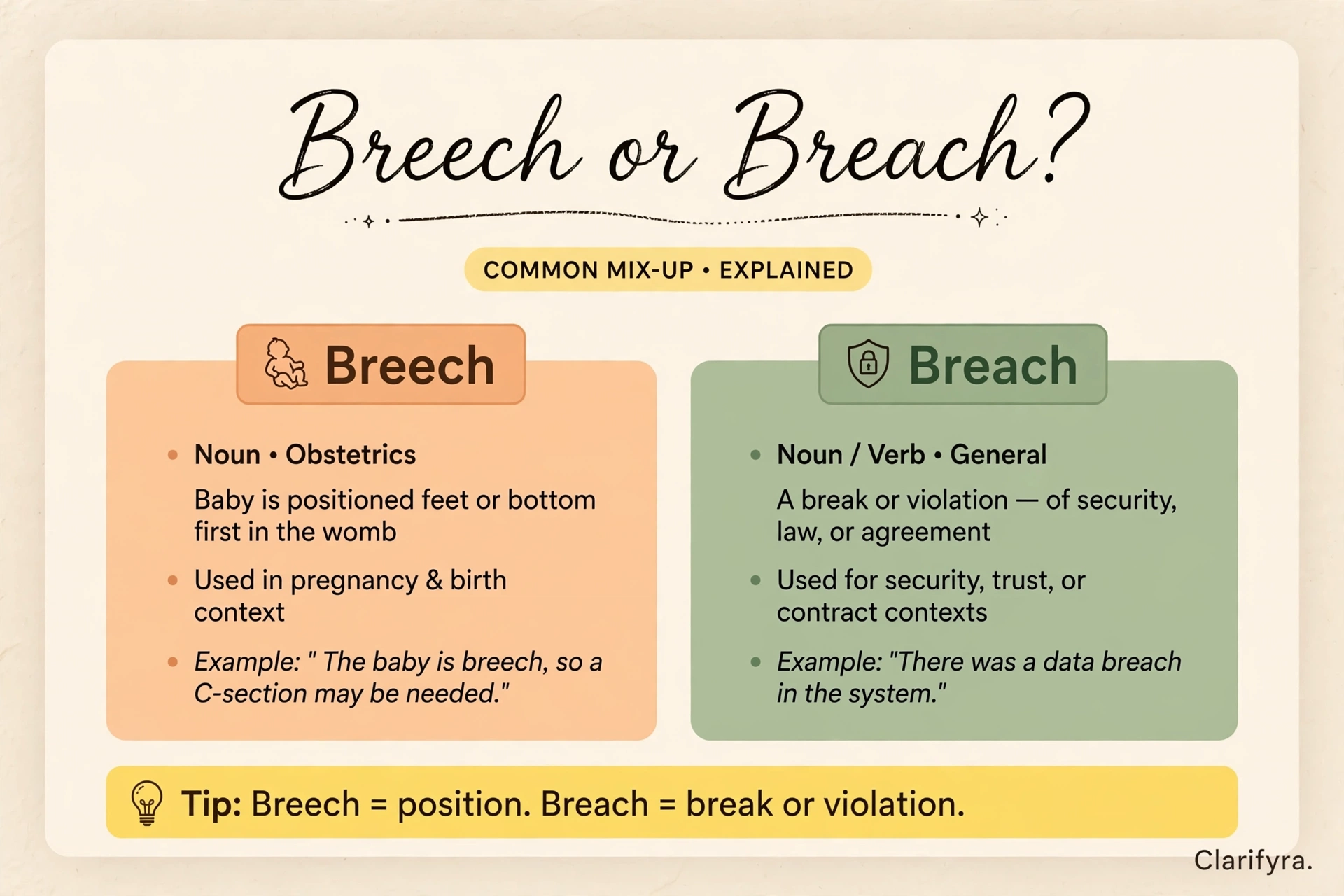
Breach (noun and verb) means a break or violation: “a breach of contract,” “a security breach,” “they breached the wall.” Breech (mainly a noun) means the back or lower end of something: “the breech of a rifle,” “a breech birth” (baby born bottom or feet first), and in the plural “riding breeches” (short trousers fastened below the knee). Both are pronounced the same — /briːtʃ/ (“BREECH”) in British and American English, according to Cambridge and Oxford — so the spelling carries the whole meaning. If your sentence involves breaking, opening, or violating, choose breach; if it involves a rear end, a gun, a birth position, or trousers, choose breech.
“Breach”: The Breaking Word
Breach is the everyday word of the pair, and its meanings all grow from one root idea: something intact has been broken open. Merriam-Webster gives the core noun senses as “infraction or violation of a law, obligation, tie, or standard” and “a broken, ruptured, or torn condition or area” — including “a gap (as in a wall) made by battering.” Oxford Learner’s organises the same territory into four related uses: a failure to keep a law or agreement (a breach of contract), an action that breaks an agreed way of behaving (a breach of confidence), a break in relations between people or countries (the breach between them), and a physical opening made by attack or force (a breach in the castle walls).
As a verb, breach means to make that opening or commit that violation: troops breach a wall, hackers breach a database, a company breaches its contract, and a whale breaches — leaping clear of the water, a sense Merriam-Webster lists separately as “a leap especially of a whale out of water.” The verb forms are regular: breaches, breaching, breached.
The word history explains the “break” core. Merriam-Webster traces breach to Middle English breche, “act of breaking, opening in a wall, violation,” connected to Old English brecan, “to break,” with influence from Old French breche, “break, gap.” Oxford gives the same Old French route. Breach and break are historical cousins — every modern sense still involves something broken.
You will also meet breach in the famous idiom step into the breach — to take over in a crisis, filling a gap left by someone else. Merriam-Webster’s usage note walks through exactly this phrase, reminding readers that the gap-in-the-wall sense is the one at work here, and Oxford Learner’s defines it as doing somebody’s job when they are suddenly unable to do it. Shakespeare’s “Once more unto the breach, dear friends” is the same image.
“Breech”: The Back-End Word
Breech lives in more specialised territory. Oxford Learner’s gives its modern core definition as “the part of a gun at the back where the bullets are loaded” — the breech of a rifle or cannon, the end opposite the muzzle. A breech-loader is a gun loaded at that rear end rather than down the barrel. Collins gives the same firearms sense first in its learner’s entry: “The breech of a gun is the part of the barrel at the back into which you load the bullets.”
From that “rear part” idea flow the word’s other uses. The oldest layer, preserved in the dictionaries’ etymologies, is clothing: Merriam-Webster dates breech to before the 12th century, from Old English brēc, the plural of brōc, “leg covering.” Oxford’s etymology tells the same story and spells out the chain: the original sense was a garment covering the loins and thighs, which gave us both breeches and the anatomical sense “buttocks,” and from there “the hind part of anything.” That is why breeches — short trousers fastening below the knee, as Merriam-Webster defines them — is always plural, like trousers.
The sense most readers meet today is medical: a breech birth or breech presentation is one in which the baby is positioned to be born with the buttocks or feet first rather than head first. Cambridge’s example sentences for breech come overwhelmingly from this obstetric literature — breech presentation, breech extraction, babies “born in breech presentation” — which reflects how dominant the term is in midwifery and medicine. Collins also records breech as a verb, though a narrow one: to fit a gun with a breech, plus an archaic sense, to clothe in breeches. As a verb, breech is rare; “they breeched the agreement” is almost always a mistake for breached, as Collins warns.
Side by Side: Breach vs. Breech
| Feature | Breach | Breech |
|---|---|---|
| Core idea | Breaking, opening, violation | Back or bottom end of something |
| Main word classes | Noun and verb | Mainly noun (verb only in narrow technical/ archaic uses) |
| Typical phrases | breach of contract, data breach, breach the wall, breach of trust | breech of a rifle, breech birth, breech presentation, riding breeches |
| Verb forms | breaches, breaching, breached | breeched, breeching (rare; mostly firearms) |
| Pronunciation | /briːtʃ/ (UK and US) | /briːtʃ/ (UK and US) |
| Word origin | From the “break” family (Old English brecan) | Old English brēc, plural of brōc, “leg covering” |
Frequency is lopsided: breach is by far the more common word in modern English, turning up in law, news, business, and computing every day. Breech survives in specific domains — firearms, obstetrics, historical clothing, plumbing and engineering (the lower end of a pulley block, in Collins’ fuller entry). If your sentence concerns rules, security, or damage, you almost certainly want breach.
Correct vs. Incorrect
- ✓ “The company was sued for breach of contract.” (violation of an agreement)
- ✗ “The company was sued for breech of contract.” → ✓ “…for breach of contract.”
- ✓ “Hackers breached the database overnight.” (verb: broke through)
- ✗ “Hackers breeched the database overnight.” → ✓ “Hackers breached the database overnight.”
- ✓ “The baby was in the breech position.” (bottom/feet first before birth)
- ✗ “The baby was in the breach position.” → ✓ “The baby was in the breech position.”
- ✓ “He loaded the rifle at the breech.” (rear end of the barrel)
- ✗ “He loaded the rifle at the breach.” → ✓ “He loaded the rifle at the breech.”
- ✓ “She stepped into the breach when the manager resigned.” (idiom: filled the gap)
- ✗ “She stepped into the breech when the manager resigned.” → ✓ “She stepped into the breach…”
- ✓ “The riders wore white breeches.” (plural trousers)
- ✓ “A humpback whale breached beside the boat.” (leapt out of the water)
Common Mistakes
1. “Breech of contract.” The legal phrase is always breach of contract — a broken agreement, squarely in the “break” family. The same applies to breach of duty, breach of warranty, breach of confidentiality, and breach of the peace. If a judge, lawyer, or HR department is involved, the spelling is breach.
2. Using “breech” as the general verb. Collins flags this directly: breach, not breech, is the verb for breaking through or violating. “The flood defences were breached,” “the agreement was breached,” “security was breached” — all take breach. The genuine verb breech exists only in the narrow senses “fit a gun with a breech” and the archaic “dress in breeches,” neither of which fits ordinary prose.
3. “Breach birth.” In maternity notes, news reports, and everyday conversation about pregnancy, the term is breech birth or breech presentation — the baby presents its breech (buttocks) first. Writing breach birth is a common slip because breach is the more familiar word, but every medical dictionary and the Cambridge corpus examples use breech.
4. Singular “a breech” for trousers. The clothing word is plural-only: a pair of breeches, riding breeches, knee breeches. Merriam-Webster notes the trouser sense “is always found used in the plural, breeches.” If the sentence is about one garment worn on the legs, it needs the -es ending.
5. Trusting pronunciation to decide. It cannot help you here. Cambridge gives breech as UK /briːtʃ/ and US /briːtʃ/; Oxford Learner’s gives breech and breach identically. They are complete homophones. The only reliable test is meaning: ask whether the sentence is about breaking (choose breach) or about a bottom/back end (choose breech).
Frequently Asked Questions
Are “breech” and “breach” pronounced differently in British and American English?
No. Both words are pronounced /briːtʃ/ — rhyming with beach and teach — in British and American English alike. Cambridge lists UK /briːtʃ/ and US /briːtʃ/ for breech, and Oxford Learner’s gives the same transcription for both words. Context and spelling do all the work.
What does “step into the breach” mean, and which spelling is right?
It means to fill a gap in an emergency — to do a job or take on a responsibility that has suddenly fallen vacant. The spelling is breach, from the image of a gap battered in a defensive wall that soldiers must fill with their own bodies. Merriam-Webster’s usage note uses this exact idiom to separate the pair.
Is “breech” ever a verb in normal writing?
Barely. Collins records verb uses meaning “to fit (a gun) with a breech” and, marked archaic, “to clothe in breeches.” Outside firearms engineering and historical writing, you will likely never need verb breech. The verb for breaking a rule, a barrier, or a surface is breach — breached, breaching.
Why is it “breech birth” and not “breach birth”?
Because the presenting part is the baby’s breech — its buttocks. Breech presentation describes a baby positioned buttocks or feet first in the womb, and breech birth (or breech delivery) describes the birth that follows. Cambridge’s medical examples use breech throughout.
What’s a quick way to remember the difference?
Use the middle letters. Breach contains ea as in break — and breaking is what breach is always about. Breech has the double e you can picture as two legs in a pair of breeches, or the rear end the word points to. Break → breach; bottom, buttocks, barrel-end, breeches → breech.
The Takeaway
Breach is the breaking word: a violation of a law or promise, a gap torn in a wall or a relationship, the act of breaking through, and even a whale breaking the surface. Breech is the back-end word: the rear of a gun barrel, a baby born bottom-first, and — always in the plural breeches — short trousers. They sound exactly alike (/briːtʃ/) in Britain and America, so let meaning decide. If something is being broken, opened, or violated, write breach; if the sentence points to a rear end, a birth position, or a pair of trousers, write breech.