Fletching Meaning: Definition, Examples and How to Use It
Fletching is the feathers on an arrow. American Heritage gives the definition in five words: “The feathers on an arrow.” It is a technical term from archery — the fin-shaped stabilisers, traditionally feathers and today often plastic vanes, fixed to the rear of the arrow shaft to keep it flying straight. It is also, grammatically, the present participle of the verb fletch (“to feather an arrow”). You will rarely meet the word outside archery, historical writing, and fantasy fiction, and that rarity is worth stating plainly: this is a specialist word doing a specialist job. This article explains the definition, how fletching works, the verb and its history, and how to use the word correctly.
Quick Answer
Fletching (noun) means the feathers — or modern plastic vanes — attached to the back of an arrow to stabilise it in flight: “He checked the fletching before nocking the arrow.” It is also the gerund of the verb fletch (“to provide an arrow with feathers”). An arrow-maker is a fletcher. Pronounced /ˈflɛtʃɪŋ/.
What “fletching” means
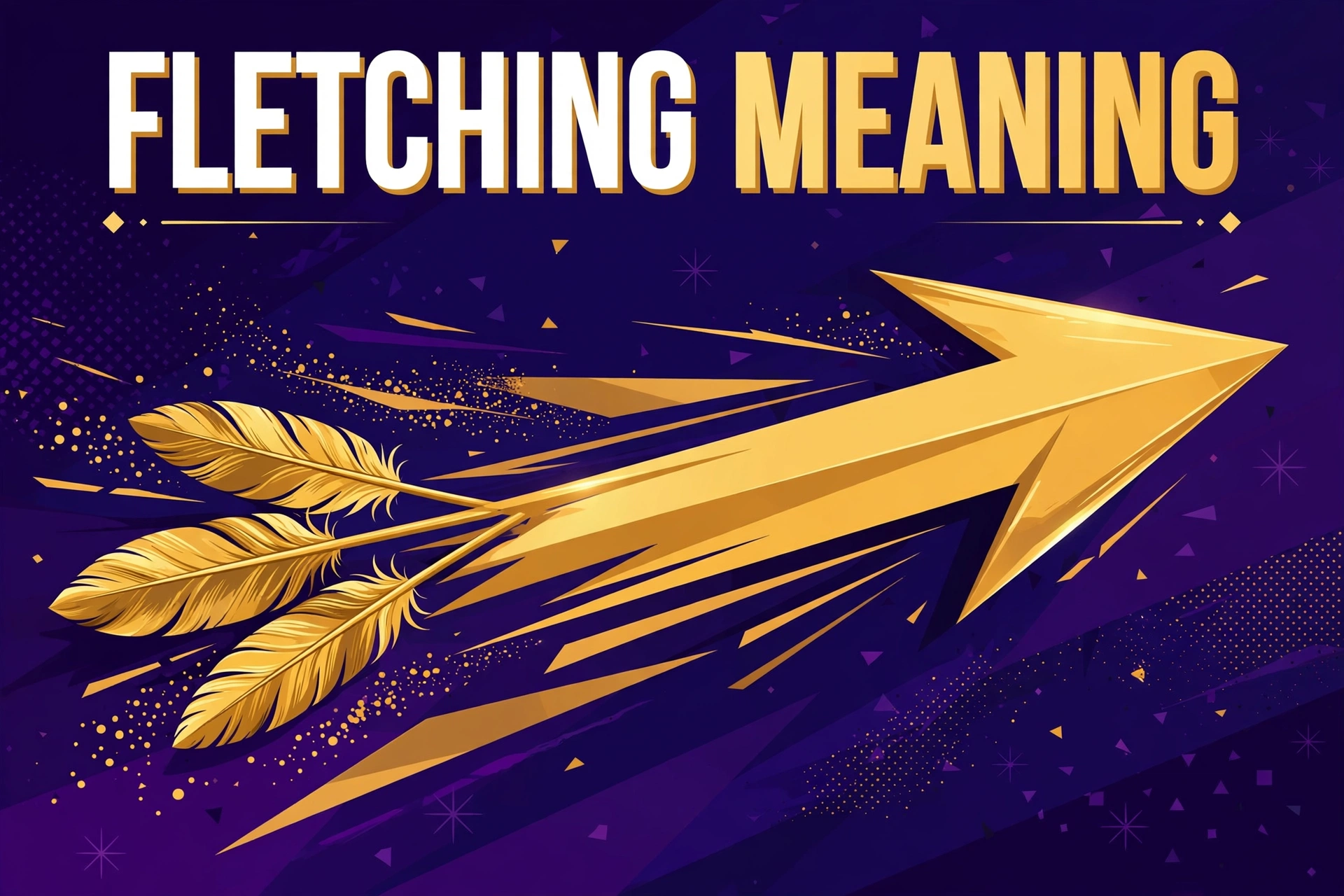
Picture an arrow. At the front is the head (the point); in the middle, the long shaft; at the back, near the nock (the notch that hooks onto the bowstring), are three small fins. Those fins are the fletching. Collins lists the plural fletchings as “(Archery) arrow feathers,” and the archery glossary definition is fuller: the fin-shaped aerodynamic stabilisation device attached to arrows, typically made from feathers or, in modern archery, from light semi-flexible materials such as plastic.
Each individual fin is a fletch — also called a flight or simply a feather. So one arrow carries three fletches, and together they are its fletching. Traditional fletching used real feathers — often goose or turkey — split and shaped; modern target and hunting arrows commonly use moulded plastic vanes, which do the same job and survive wet weather better.
What fletching does: the aerodynamics in plain English
An arrow without fletching tumbles. The fletching works like the feathers on a shuttlecock or the tail fins on a dart: it drags the rear of the arrow back into line behind the heavy head, keeping the shaft pointing where it was aimed. Two details archers care about:
- Three is the standard number. Most arrows carry three fletches, spaced evenly around the shaft. One of them — the cock feather (or cock vane) — sits at right angles to the slot in the nock and usually looks different (often a different colour), so the archer can orient the arrow correctly at a glance. The other two are the hen feathers.
- Spin helps. Fletches are often set at a slight angle so the arrow rotates in flight, like a rifled bullet. The spin irons out wobble and improves accuracy — the same principle, scaled down to feathers.
Damaged fletching is a practical problem, not a cosmetic one: a torn or missing fletch sends arrows veering off target, which is why archers inspect and replace fletching as routine maintenance. “The fletching was ragged, and his arrows kept drifting left” is a perfectly natural sentence in the sport.
The verb “fletch” and the noun “fletcher”
Fletch is the verb: “to provide (an arrow) with a feather” (Collins; American Heritage: “to feather an arrow”). Its forms are regular — fletched, fletching, fletches — and its history is tidy: it is a back-formation from fletcher, first recorded in English in the period 1625–1635 (Collins word origin; Random House). A fletcher is a person who makes or fits arrows — traditionally a member of the arrow-makers’ craft, and in London historically associated with the Worshipful Company of Fletchers, one of the City’s livery companies.
The chain runs one step further back: fletcher comes from the French word flèche, meaning “arrow” — which itself traces to the Old Frankish fliukka. So the word family is: Frankish fliukka → French flèche (arrow) → English fletcher (arrow-maker) → fletch (to fit feathers to an arrow) → fletching (the feathers themselves, or the act of fitting them).
Pronunciation and grammar
- Pronunciation: /ˈflɛtʃɪŋ/ — FLECH-ing, rhyming with fetching. The same in British and American English. The verb fletch is /flɛtʃ/.
- As a noun: fletching is usually uncountable in the “feathers on an arrow” sense (“the fletching was damaged”), though Collins records the plural fletchings (“arrow feathers”). Fletch (singular, countable) names one fin: “one fletch had come loose.”
- As a verb form: fletching is the present participle/gerund of fletch: “He spent the evening fletching arrows for the competition.”
Honesty about rarity: where you will (and won’t) meet this word
Let us be straightforward: fletching is not everyday vocabulary. Dictionaries list it, archers use it constantly, and historical novelists and fantasy writers reach for it — but in ordinary conversation and general writing, it almost never appears. If you write “the fletching on the arrow” in an archery manual, you are precise; if you use it as a metaphor in a business report, you will confuse your readers.
Related words you may meet nearby: flights (the same fins on darts — dart players say “flights,” archers say “fletching”), the nock (the notch at the arrow’s rear), the shaft (the long middle), and the quiver (the container arrows are carried in). And one caution: do not use fletching for birds’ plumage in general. A bird has plumage; an arrow has fletching. The word belongs to the arrow.
Examples in sentences
- “The fletching helps guide the arrow.” (dictionary example)
- “He checked the fletching on each arrow before the competition.”
- “Most arrows are fletched with three- to five-inch feathers.”
- “She spent the winter fletching arrows in her workshop.”
- “The cock feather of the fletching was dyed red so she could see the arrow’s orientation.”
- “A fletcher’s craft has changed little in its essentials for centuries.”
- “Rain had ruined the fletching, and his shots scattered wide.”
Common mistakes and confusions
Calling any feathers “fletching.” The word means feathers on an arrow (or the vanes doing that job). A duck’s feathers are plumage, not fletching.
Confusing “fletching” with “fledging.” Similar spelling, different words. Fledging (from fledge) is about young birds growing feathers and learning to fly; fletching (from fletch) is about arrows. Collins even lists fledge as a related term of fletch — related in the dictionary’s cross-references, but not interchangeable.
Mixing up “fletcher” and “fletch.” The fletcher is the person (the arrow-maker); to fletch is what they do; the fletching is the result on the arrow. Keep the three roles straight.
Using it outside archery. As noted above, the word’s precision is its limitation. In non-archery writing, “feathers” or “vanes” with explanation will serve readers better than the bare technical term.
FAQs
What does “fletching” mean?
The feathers (or modern plastic vanes) attached to the rear of an arrow to stabilise it in flight. American Heritage: “The feathers on an arrow.”
How do you pronounce “fletching”?
/ˈflɛtʃɪŋ/ — FLECH-ing, rhyming with fetching, the same in British and American English.
What is the verb form of “fletching”?
Fletch — “to provide an arrow with a feather.” Forms: fletched, fletching, fletches. First recorded in English in the early 1600s as a back-formation from fletcher.
What is a “fletcher”?
A person who makes arrows or fits fletching to them — from French flèche (“arrow”). It is also a well-known surname.
How many fletches does an arrow have?
Usually three. One — the cock feather — sits at right angles to the nock slot and is often a different colour; the other two are the hen feathers.
Is “fletching” a common word?
No — it is a specialist archery term. Dictionaries record it and archers use it daily, but it rarely appears in general writing. That is normal for technical vocabulary, not a flaw in the word.
What is the difference between “fletching” and “fledging”?
Fletching is arrow feathers (from fletch); fledging is a young bird growing its feathers and learning to fly (from fledge). Different words, different meanings.
The takeaway
Fletching (/ˈflɛtʃɪŋ/) is the feathers — or modern vanes — on an arrow, the three small fins that keep the shaft flying true, with one cock feather marking the orientation. The word family runs from Frankish fliukka through French flèche (arrow) to the fletcher (arrow-maker), the verb fletch (to feather an arrow, early 1600s), and finally fletching itself — both the feathers and the act of fitting them. It is honest, precise, specialist vocabulary: indispensable in archery, unnecessary everywhere else, and worth knowing exactly because English is full of such quiet technical words doing their jobs out of sight.