Visiter or Visitor: Which Spelling Is Correct?
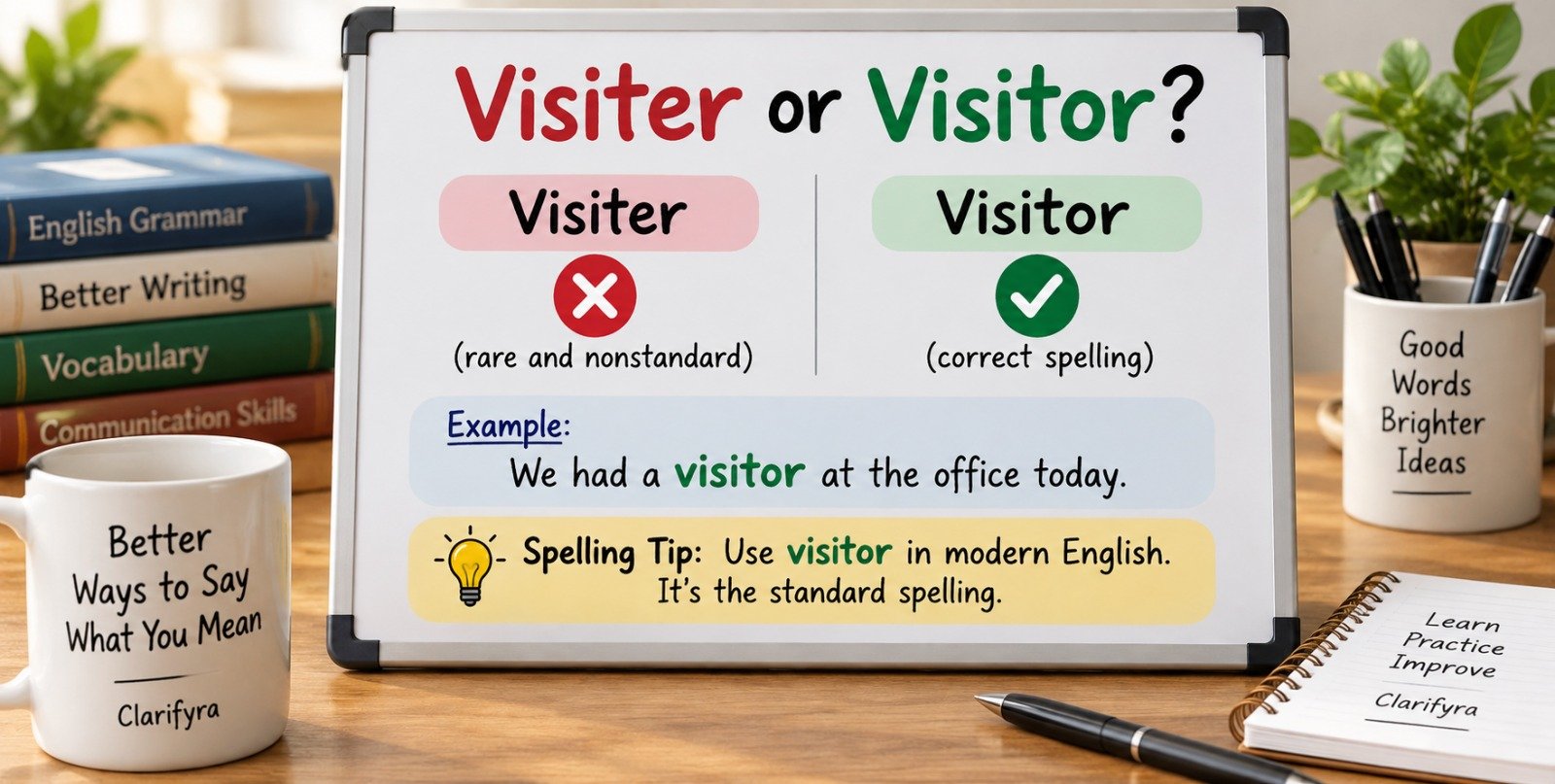
If you are deciding between visiter and visitor, the spelling you normally need is visitor. It is the standard modern English noun for someone who visits a person or place. The confusion is understandable because many nouns for people are formed with -er, as in teacher, worker, and driver. However, visit does not normally become visiter. Although visiter has been recorded as a variant spelling, it is rare and should generally be avoided in everyday, academic, and professional writing.
Visitor is the standard spelling in modern English. Visiter exists as a recorded variant spelling, but it is rare and is not the form normally used today. In regular writing, choose visitor.
Visiter or Visitor: Which Form Should You Use?
For normal modern English, write visitor.
A visitor is a person who goes to see someone or temporarily goes to a particular place. The word can also refer to someone who accesses a website. Cambridge classifies visitor as a countable noun and uses it for someone who visits a person, place, or website.
Merriam-Webster also gives visitor as the main dictionary form and defines it broadly as someone or something that visits. It separately records visiter as a variant spelling of visitor.
In practical terms:
Correct and standard: A visitor is waiting outside.
Rare variant: A visiter is waiting outside.
The second spelling has dictionary recognition, but using it in ordinary contemporary writing is likely to look like a spelling mistake to many readers.
Quick Comparison
| Feature | Visitor | Visiter |
|---|---|---|
| Standard modern spelling? | Yes | No, generally rare |
| Part of speech | Noun | Variant noun spelling |
| Meaning | Someone who visits | Variant of visitor |
| Suitable for formal writing? | Yes | Usually avoid |
| Plural | Visitors | Rarely used |
| Recommended form | Yes | No |
The simplest rule is therefore: use visitor unless you have a specific reason to reproduce the variant spelling visiter.
Many English learners mix up similar-looking words such as Supposedly or Supposably Meaning: Which Is Correct?
What Does “Visitor” Mean?
A visitor is someone who comes to see a person, goes somewhere for a limited period, or enters a place without being a permanent resident or regular member.
It is a countable noun, so it can be singular or plural:
- one visitor
- two visitors
- several visitors
Examples:
- We had an unexpected visitor this morning.
- Every visitor must report to reception.
- The museum attracts thousands of visitors each year.
- She is a regular visitor to the local library.
The word also has a digital use. Someone who opens or uses a website may be described as a website visitor. Cambridge specifically includes someone who goes to a website within the meaning of visitor.
For example:
- The website receives hundreds of visitors each day.
- New visitors can create an account for free.
What Does “Visiter” Mean?
The phrase “What does mean visiter?” is more naturally asked as “What does visiter mean?”
Visiter does not have a separate everyday meaning from visitor. Merriam-Webster lists it as a variant spelling of visitor.
So, historically or in unusual contexts, visiter may refer to the same kind of person as a visitor. However, modern writers should normally use visitor.
For example:
Recommended: We are expecting a visitor.
Not recommended in ordinary modern writing: We are expecting a visiter.
It is important not to invent a different definition for visiter. The issue is primarily one of spelling and modern usage, not two words with different meanings.
Is “Visiter” a Word?
Yes, visiter is recorded as a word variant, but that does not mean it is equally appropriate in modern writing.
Merriam-Webster explicitly identifies visiter as a variant spelling of visitor.
This makes the distinction slightly different from a simple typo such as messege for message. Visiter has documented dictionary status, but visitor is overwhelmingly the safer and standard choice for contemporary English.
Use visitor in:
- School and university assignments
- Business emails
- Articles and blog posts
- Signs and notices
- Reports
- Formal documents
- Everyday messages
You might encounter visiter in an older text, historical material, or a discussion about variant spellings. In those cases, it should not automatically be “corrected” without considering the context.
Why Is “Visitor” Spelled With -or?
The spelling can seem surprising because English frequently forms nouns for people by adding -er to a verb:
- teach → teacher
- work → worker
- drive → driver
- play → player
That pattern can make visit → visiter seem logical.
However, English does not use one universal ending for nouns describing people who perform an action. Some common nouns use -or instead:
- act → actor
- invent → inventor
- supervise → supervisor
- visit → visitor
So the spelling should be learned as:
visit → visitor
not:
visit → visiter
You do not need to apply a complicated grammar rule. Simply remember that the established standard noun ends in -or.
Visitor Pronunciation
The standard word visitor begins with the stressed syllable VIS-.
A simple pronunciation guide is:
VIS-it-er
Cambridge gives the British pronunciation as approximately /ˈvɪz.ɪ.tə(r)/ and the American pronunciation as /ˈvɪz.ɪ.t̬ɚ/.
The ending may sound similar to the -er ending in other words, especially in fast speech. That can contribute to confusion about whether the word should be written visiter or visitor.
The spelling, however, remains:
visitor
“I Have a Visitor” Meaning
The sentence “I have a visitor” means that someone has come to see you or is currently with you as a guest.
For example:
I can’t come to the phone right now. I have a visitor.
This means someone is currently visiting the speaker.
You may also hear:
You have a visitor.
That usually means someone has arrived and is waiting or asking to see you.
A visitor does not necessarily have to be a close friend. Depending on the context, the person could be:
- a friend
- a relative
- a neighbor
- a customer
- a colleague
- an official
- an unexpected guest
Compare these examples:
I have a visitor at home.
Someone has come to see me at my house.
You have a visitor at reception.
Someone has arrived at your workplace and wants to see you.
Visitor Synonyms and Related Words
Several words can be used instead of visitor, but they are not perfect synonyms in every situation.
| Word | Typical Meaning |
|---|---|
| Guest | Someone invited to a home, event, or other place |
| Caller | Someone who comes to see a person |
| Tourist | Someone visiting a place while traveling for pleasure |
| Traveler | Someone traveling from one place to another |
| Sightseer | Someone visiting attractions |
| Houseguest | A person staying temporarily in someone else’s home |
The right choice depends on the context.
For example:
Visitor: We had a visitor at the office.
Guest: Our guests stayed for dinner.
Tourist: The tourist took photos of the castle.
Sightseer: Sightseers gathered around the historic monument.
Merriam-Webster lists guest among the synonyms associated with visitor, but the two words are not always interchangeable.
A visitor may arrive without an invitation, while a guest often implies some form of welcome or invitation.
Correct and Incorrect Usage Examples
Seeing the spellings side by side makes the distinction easier.
Correct: The visitor signed in at the front desk.
Avoid: The visiter signed in at the front desk.
Correct: We are expecting several visitors this afternoon.
Avoid: We are expecting several visiters this afternoon.
Correct: Each visitor receives an identification badge.
Avoid: Each visiter receives an identification badge.
Correct: She is a frequent visitor to the museum.
Avoid: She is a frequent visiter to the museum.
In contemporary writing, visitor will be the appropriate choice in almost every ordinary situation.
Common Phrases With “Visitor”
The standard spelling appears in many everyday expressions:
- visitor center
- visitor parking
- visitor pass
- visitor badge
- visitor information
- visitor entrance
- website visitor
- regular visitor
- frequent visitor
- unexpected visitor
- foreign visitor
- first-time visitor
Examples:
- Please collect a visitor pass at the front desk.
- The visitor center opens at 9 a.m.
- This space is reserved for visitor parking.
- Every website visitor sees the welcome page.
- He is a regular visitor to the area.
Using these common combinations can also help reinforce the correct spelling.
An Easy Way to Remember the Spelling
Remember this short pattern:
visit + or = visitor
You can also connect visitor with other familiar nouns ending in -or:
actor, inventor, supervisor, visitor
Another simple memory sentence is:
A visitOR comes through the doOR.
Both visitor and door contain an o before the final r, which may help you remember not to write visiter.
Common Mistakes to Avoid
One common mistake is assuming that every verb becomes a person noun by adding -er. English has many -er nouns, but visit follows the established spelling visitor.
Another mistake is treating visiter as a completely different modern word. It is better understood as a rare variant spelling of visitor, not as a separate person with a different role.
Also remember that the plural of visitor is simply:
visitor → visitors
There is no special plural form.
Finally, do not change the spelling according to American or British English. Visitor is the standard form in both varieties. Cambridge provides both UK and US pronunciations under the same spelling, visitor.
FAQs
Is it visitor or visiter in English?
Use visitor in standard modern English. Visiter is recorded as a variant spelling, but it is uncommon and normally unnecessary in everyday or formal writing.
Is “visiter” a spelling mistake?
In ordinary modern writing, it will usually be treated as an incorrect or nonstandard choice. However, it is not an invented form: Merriam-Webster records visiter as a variant spelling of visitor.
Is “visitor” used in both American and British English?
Yes. Visitor is the standard spelling in both American and British English. The pronunciation differs slightly between the two varieties, but the spelling stays the same.
What part of speech is “visitor”?
Visitor is a countable noun. It refers to someone who visits another person, a physical place, or, in digital contexts, a website. Its plural form is visitors.
What is the meaning of “you have a visitor”?
It means that someone has arrived to see you. For example, a receptionist might say, “You have a visitor waiting in the lobby,” meaning someone is there and wants to meet you.
What is the best synonym for “visitor”?
Guest is one of the closest general synonyms, but context matters. A tourist is a visitor traveling for pleasure, a caller comes to see someone, and a houseguest stays temporarily in another person’s home.
Final Verdict: Visiter or Visitor?
For clear modern English, choose visitor. It is the standard noun for a person who visits someone or somewhere, while visiter is a recorded but uncommon variant spelling that is best avoided in ordinary writing. If you remember visit → visitor, you will have the right form for almost every situation—and that kind of straightforward distinction is exactly what Clarifyra aims to make easier.
You May Also Read | Manner or Manor: Which Is Correct in a Sentence?