Supposedly or Supposably Meaning: Which Is Correct?
If you have ever wondered whether someone should say supposedly or supposably, the answer is more interesting than it first appears. Both words exist in English, but they traditionally have different meanings and are not equally common. Supposedly is the word most people need when talking about something that is believed, reported, or claimed to be true. Supposably is much rarer and traditionally means something closer to “conceivably” or “possibly.”
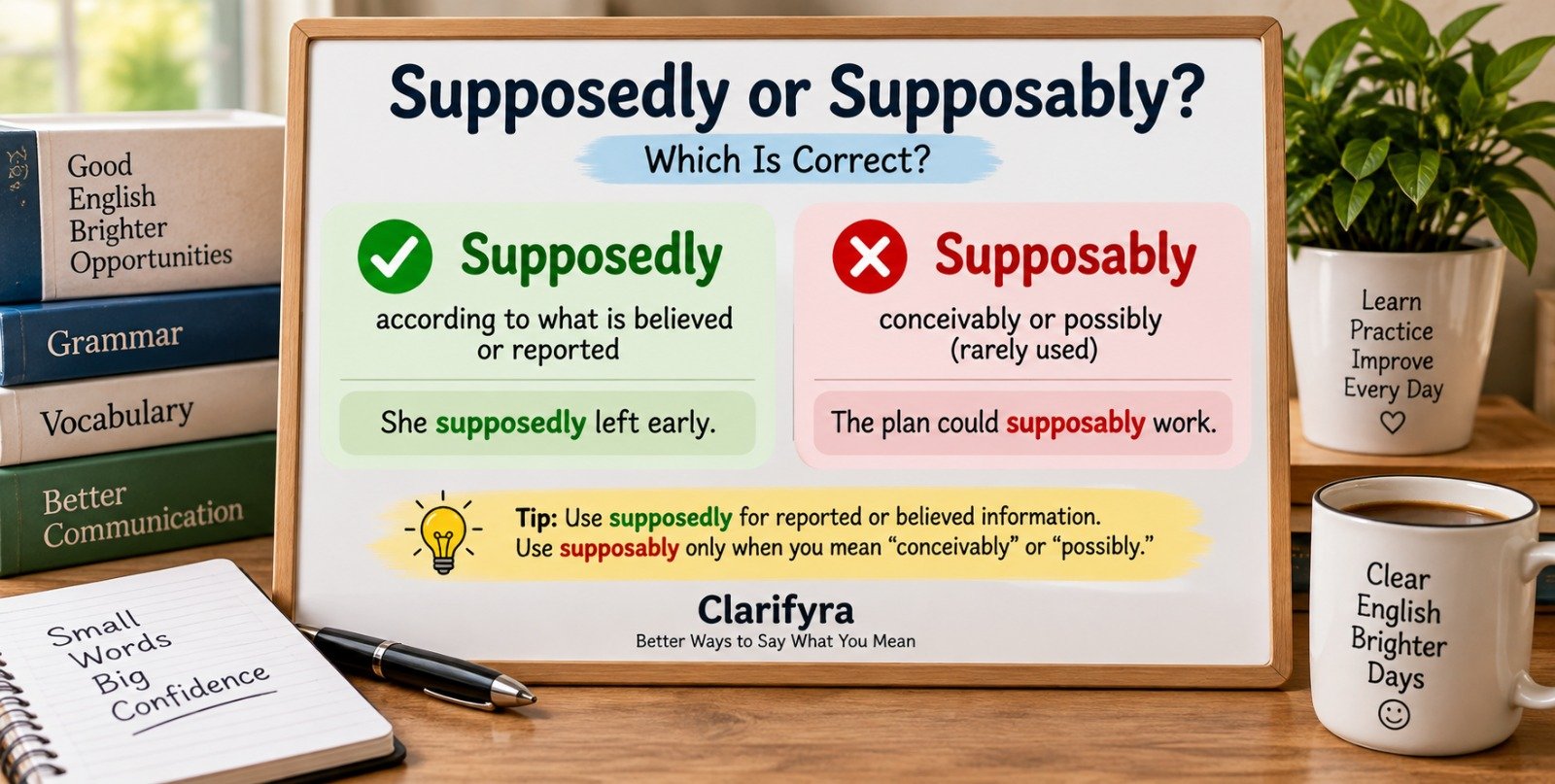
Supposedly is the correct choice when you mean “according to what is believed, reported, or claimed.” Supposably is also a real word, but it is rare and traditionally means “conceivably” or “possibly.” In most everyday sentences, supposedly is the word you want.
Supposedly or Supposably: What’s the Difference?
The simplest difference is this:
- Supposedly = according to what is believed, claimed, or reported
- Supposably = conceivably or possibly
Both are adverbs, but their normal uses are different.
| Feature | Supposedly | Supposably |
|---|---|---|
| Is it a real word? | Yes | Yes |
| Part of speech | Adverb | Adverb |
| Main meaning | According to what is believed or reported | Conceivably; possibly |
| Common in modern English? | Very common | Rare |
| Similar word | Reportedly | Conceivably |
| Example | She supposedly left early. | The plan could supposably work. |
In practice, supposedly is far more useful in everyday English.
Many English learners mix up similar-looking words such as Tardies or Tardys: Which Spelling Is Correct?
What Does “Supposedly” Mean?
Supposedly means that something is believed, reported, assumed, or claimed to be true, although the speaker may not know for certain that it is true.
It often suggests that the information comes from another person, a rumor, a report, or an assumption.
For example:
- Supposedly, the meeting starts at nine.
- He supposedly owns several restaurants.
- The package was supposedly delivered yesterday.
- She is supposedly moving abroad next year.
In each sentence, the speaker is passing along information without directly confirming it.
You can often replace supposedly with words such as reportedly, apparently, or allegedly, depending on the context.
Consider:
The building is supposedly haunted.
This means people say or believe the building is haunted, but the statement is not presented as established fact.
Is “Supposedly” Formal or Informal?
Supposedly can be used in both conversation and formal writing. However, the exact tone depends on context.
For example:
The company supposedly plans to open another office.
This sounds neutral, but it also signals that the information has not necessarily been confirmed.
In careful formal writing, reportedly may sometimes be more precise when referring to information from a published or identifiable source.
What Does “Supposably” Mean?
Supposably is a genuine English word, although it is much less common.
Traditionally, it means:
- conceivably
- possibly
- in a way that can be supposed
It comes from the adjective supposable, meaning something that can reasonably be imagined or supposed.
For example:
The journey could supposably be completed in one day.
The intended meaning is:
The journey could conceivably be completed in one day.
Another example:
The system could supposably operate without an internet connection.
Here, supposably means that such a situation is theoretically possible or conceivable.
However, these sentences may sound unusual to many modern readers. In most cases, possibly or conceivably is clearer and more natural.
Is It Supposedly or Supposably?
If your sentence means “according to what I have heard” or “according to what people claim,” use supposedly.
For example:
Correct: Supposedly, Liam is getting promoted next month.
Here, someone has said or reported that Liam will receive a promotion.
Using supposably would change the traditional meaning:
Liam could supposably get promoted next month.
This would mean that a promotion is conceivable or possible, not necessarily that anyone has reported it.
That distinction is the easiest way to choose between the two.
A Simple Replacement Test
Try replacing the word in your sentence.
If reportedly fits, use supposedly.
She supposedly won the competition.
She reportedly won the competition.
If conceivably fits, supposably may technically work.
We could supposably finish before noon.
We could conceivably finish before noon.
Even in the second example, conceivably will usually sound more natural.
How Are Supposedly and Supposably Pronounced?
The two words are not merely different spellings of the same pronunciation. They are separate words.
Pronunciation of Supposedly
Supposedly is pronounced approximately:
suh-POH-zid-lee
The ending sounds like “-zid-lee.”
Pronunciation of Supposably
Supposably is pronounced approximately:
suh-POH-zuh-blee
The ending sounds like “-zuh-blee.”
This difference matters because people sometimes pronounce supposedly as though it ended in -ably.
If your intended word is supposedly, make sure the pronunciation reflects the -edly spelling.
Why Are These Words So Often Confused?
The main reason is pronunciation.
In fast conversation, supposedly can be difficult to hear clearly. Its middle and final syllables may become less distinct, causing some speakers to hear or produce a form that sounds like supposably.
The confusion is especially understandable because supposably really is a word. This makes the situation different from a simple spelling mistake.
However, when someone says:
“Supposably, they are getting married next month.”
they will usually mean:
“Supposedly, they are getting married next month.”
The first version traditionally suggests possibility, while the second reports a claim or belief.
Examples in Sentences
Seeing the words in context makes the distinction clearer.
Examples With “Supposedly”
Supposedly, the restaurant has a six-month waiting list.
This means people say or report that the waiting list is six months long.
She supposedly met the actor at an airport.
Someone claims that she met the actor.
The new software supposedly improves battery life.
The software is said or claimed to improve battery life.
He was supposedly at work when the incident happened.
According to available information, he was believed to be at work.
Their flight is supposedly leaving on time.
The speaker has been told or has heard that the flight will leave on schedule.
Examples With “Supposably”
The problem could supposably be solved without replacing the entire system.
Meaning: it could conceivably be solved that way.
We might supposably reach the town before dark.
Meaning: reaching the town before dark is possible.
A different design could supposably reduce the cost.
Meaning: it is conceivable that another design could lower the cost.
These examples are grammatically possible, but possibly or conceivably would usually sound more natural.
Correct and Incorrect Usage
Because supposably exists, it is better to think in terms of intended meaning rather than simply labeling every use incorrect.
When the Meaning Is “Reportedly”
Correct: The store is supposedly closing next month.
Usually incorrect for this meaning: The store is supposably closing next month.
If people have reported or claimed that the store will close, supposedly is the appropriate word.
When the Meaning Is “Conceivably”
Possible: The plan could supposably succeed.
More natural: The plan could conceivably succeed.
The first sentence is defensible, but the second is clearer for most readers.
Supposedly and Supposably Synonyms
Synonyms can help you remember which word belongs in a sentence.
Synonyms for Supposedly
Depending on context, you may use:
- reportedly
- allegedly
- apparently
- presumably
- purportedly
- seemingly
- reputedly
Example:
Supposedly, the singer is recording a new album.
Possible alternative:
Reportedly, the singer is recording a new album.
Synonyms for Supposably
Possible alternatives include:
- conceivably
- possibly
- imaginably
- theoretically
Example:
The machine could supposably run for another hour.
A more natural alternative would be:
The machine could possibly run for another hour.
A Funny Thing About “Supposably”
The confusion between these words is sometimes used as a joke because many listeners assume supposably must be an incorrect version of supposedly.
That assumption is not completely accurate.
The funny part is that supposably is actually a legitimate word. The mistake happens when it is used with the meaning that belongs to supposedly.
For example:
“Supposably, Dave is secretly a millionaire.”
If the speaker means “people say Dave is a millionaire,” the correct wording is:
“Supposedly, Dave is secretly a millionaire.”
So the joke is not really that supposably does not exist. It is that speakers often use a real word in the wrong context.
Easy Way to Remember the Difference
Connect each adverb with the word it comes from.
Supposed → Supposedly
If something is supposed, believed, claimed, or reported to be true, use supposedly.
They are supposedly arriving tomorrow.
Supposable → Supposably
If something is supposable, meaning conceivable or possible, supposably may apply.
It could supposably happen.
There is also an even simpler memory rule:
Reportedly = supposedly.
If you can replace the word with reportedly, you almost certainly want supposedly.
Common Mistakes to Avoid
One common mistake is treating supposably as an alternative pronunciation of supposedly. They are separate words, not simply two ways of pronouncing the same spelling.
Another mistake is assuming that supposably is always a non-word. It does exist, although it is rare.
Writers may also use supposably when possibly would be much clearer. Even when the word is technically appropriate, choosing a familiar alternative can make a sentence easier to understand.
Finally, avoid using supposedly when you are presenting something as a confirmed fact. The word often signals uncertainty, second-hand information, or a claim that has not been independently verified.
Final Verdict: Which Word Should You Use?
Use supposedly when something is said, believed, reported, or claimed to be true. Use supposably only when you specifically mean “conceivably” or “possibly,” and keep in mind that it is rare enough to sound unusual.
For most everyday sentences, supposedly is the correct and natural choice.
Frequently Asked Questions
Is “supposably” a real word?
Yes. Supposably is a real English adverb. Traditionally, it means “conceivably” or “possibly.” However, it is uncommon, and many speakers mistakenly use it when they mean supposedly.
Which is correct, supposedly or supposably?
Both words can be correct, but they have different traditional meanings. Supposedly means “according to what is believed or reported,” while supposably means “conceivably” or “possibly.”
Can I use “supposably” instead of “supposedly”?
Usually not. If you mean that something is reported, rumored, or believed to be true, use supposedly. Replacing it with supposably changes the traditional meaning.
Is “supposedly” another word for “allegedly”?
Sometimes. Both can introduce information that has not been confirmed, but allegedly is especially common when referring to accusations or claims. Supposedly has a broader everyday use.
How do you pronounce “supposedly”?
It is pronounced approximately suh-POH-zid-lee. The final part sounds like “-zid-lee,” not “-zuh-blee.”
Should I use “supposably” in formal writing?
You can if its traditional meaning genuinely fits, but conceivably or possibly will usually be clearer. For information that is said or reported to be true, use supposedly instead.
The key is simple: choose supposedly for reported or believed information and reserve supposably for the much rarer meaning of “conceivably.” Keeping that distinction in mind will help you communicate more clearly—the kind of practical word choice Clarifyra is designed to explain.
Many English learners mix up similar-looking words such as Summery or Summary: Which Word Is Correct?