Para vs Por: What’s the Difference and When Should You Use Each?
If you are learning Spanish, por and para can be surprisingly difficult because both are often translated as “for” in English. The problem is that Spanish uses them for different relationships. Por commonly explains a reason, cause, route, method, duration, or exchange, while para usually points toward a purpose, destination, recipient, deadline, or goal. Once you stop translating “for” word by word and start looking at the meaning behind the sentence, the difference becomes much easier to understand.
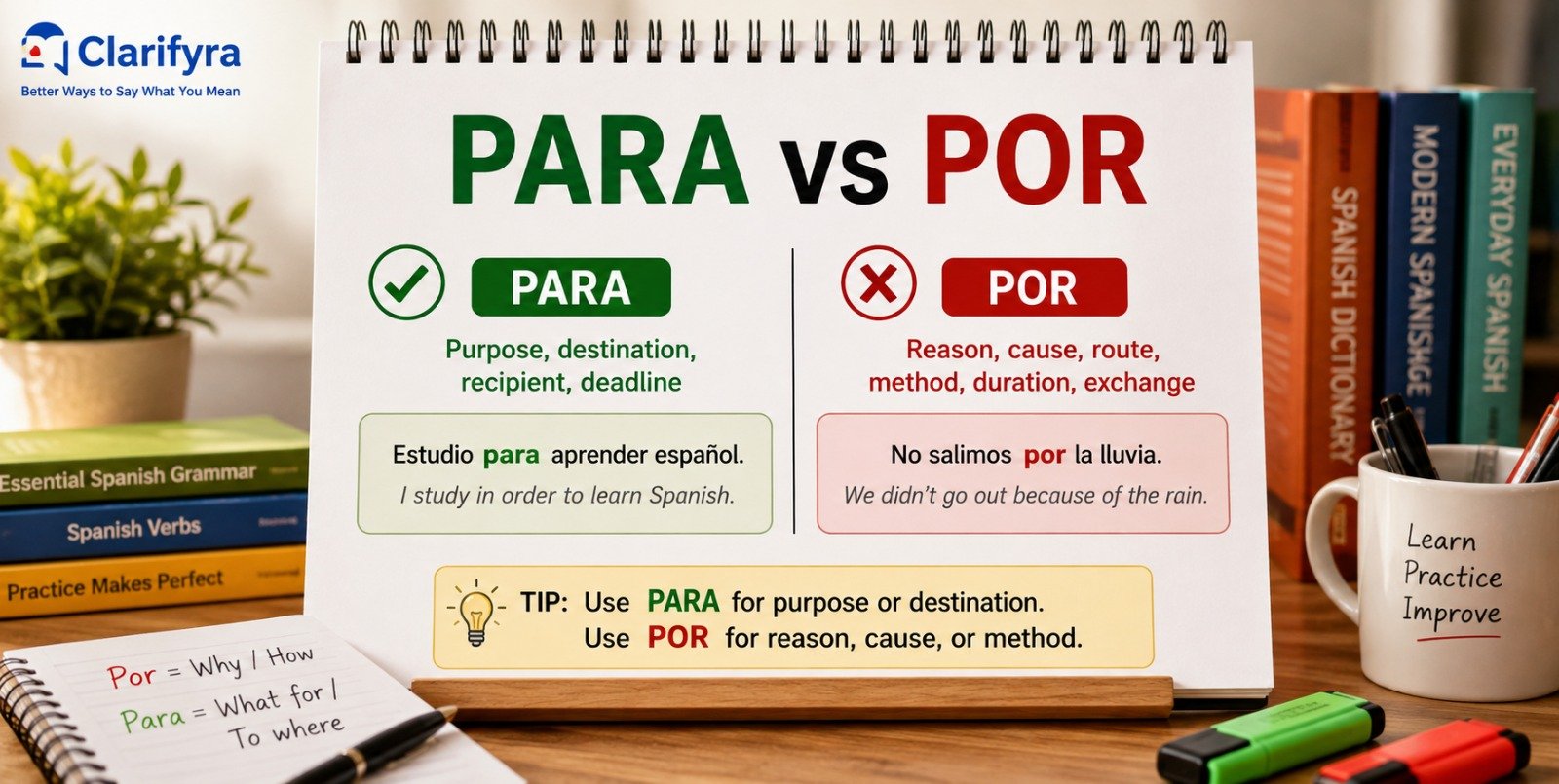
Por is generally used for reasons, causes, routes, methods, duration, and exchanges. Para is usually used for purpose, destination, recipients, deadlines, and goals. A simple shortcut is: por explains why or how, while para points toward what for or where to.
Por vs Para: What’s the Difference?
Both por and para are Spanish prepositions, and both can sometimes be translated as “for.” However, they are not interchangeable.
The central distinction is often based on direction of meaning:
- Por tends to look at the cause, reason, path, or means behind an action.
- Para tends to point toward an intended result, destination, recipient, or deadline.
Compare these two sentences:
Lo hice por ti.
I did it because of you / for your sake.
Lo hice para ti.
I did it for you.
The first explains the motivation. The second identifies the intended recipient.
Quick Comparison Table
| Feature | Por | Para |
|---|---|---|
| Basic idea | Cause, route, means | Purpose, goal, destination |
| Reason or cause | Yes | Usually no |
| Purpose | Usually no | Yes |
| Destination | Usually no | Yes |
| Route through a place | Yes | No |
| Duration | Yes | No |
| Deadline | No | Yes |
| Recipient | No | Yes |
| Price or exchange | Yes | No |
| Method or means | Yes | No |
| Opinion or viewpoint | No | Yes |
| Passive agent | Yes | No |
The table is useful as a quick guide, but context still matters because some expressions are idiomatic.
You May Also Read | Honey vs Hunny: What’s the Difference and Which Is Correct?
What Is Para?
Para is a Spanish preposition used when something is directed toward an endpoint, purpose, person, goal, or deadline.
Depending on the sentence, it may correspond to English words such as:
- for
- to
- toward
- in order to
- by
Para for Purpose
Use para when explaining the intended purpose of an action.
Estudio para aprender español.
I study in order to learn Spanish.
Trabajo para ahorrar dinero.
I work to save money.
A helpful test is to ask:
What is the action intended to achieve?
If the answer describes a goal, para is often correct.
Para for a Recipient
Use para when something is intended for a person or group.
Este regalo es para Elena.
This gift is for Elena.
Preparé la cena para mi familia.
I prepared dinner for my family.
The person after para receives or benefits from what is being described.
Para for Destination
A common question is: Is destination por or para?
For a destination or endpoint, para is normally the right choice.
Salimos para Madrid mañana.
We leave for Madrid tomorrow.
Este tren va para Sevilla.
This train is going to Seville.
Para points toward where someone or something is headed.
Para for Deadlines
Para is also commonly used for deadlines.
Necesito el informe para el viernes.
I need the report by Friday.
La tarea es para mañana.
The homework is due tomorrow.
In these examples, para points toward a future time by which something should be completed.
Para for Opinions
Para may introduce someone’s viewpoint or judgment.
Para mí, esta opción es mejor.
For me, this option is better.
Para Ana, el examen fue fácil.
In Ana’s opinion, the exam was easy.
What Is Por?
Por is a Spanish preposition that commonly expresses cause, reason, route, duration, means, exchange, price, frequency, or agency.
Depending on context, it can mean:
- for
- because of
- through
- by
- via
- per
- in exchange for
Por for Reason or Cause
Use por when something explains why an action happened.
No salimos por la lluvia.
We did not go out because of the rain.
Lo hice por amor.
I did it because of love.
The rain and love are reasons behind the actions.
Por for Movement Through a Place
Use por when describing movement through, around, along, or across an area.
Caminamos por el parque.
We walked through the park.
Pasamos por el centro.
We passed through downtown.
This is different from para, which usually points toward a destination.
Compare:
Vamos para Barcelona.
We are heading to Barcelona.
Pasamos por Barcelona.
We pass through Barcelona.
Por for Duration
Por can indicate how long an action lasts.
Trabajé por tres horas.
I worked for three hours.
Vivieron allí por un año.
They lived there for a year.
The focus is on the length of time.
Por for Price or Exchange
Por is used when one thing is exchanged for another or when stating a price.
Pagué veinte euros por el libro.
I paid twenty euros for the book.
Te doy mi café por tu té.
I will give you my coffee for your tea.
Por for Method or Means
Por is also used to explain how something is done or transmitted.
Te llamé por teléfono.
I called you by phone.
Envié el documento por correo electrónico.
I sent the document by email.
Hablamos por videollamada.
We spoke by video call.
Por With Passive Constructions
Por can introduce the person responsible for an action in a passive sentence.
La novela fue escrita por Cervantes.
The novel was written by Cervantes.
Here, por corresponds to English “by.”
When to Use Para vs Por
Instead of translating the word “for,” ask what relationship the sentence is expressing.
Use Por When You Mean:
- because of what?
- why?
- through where?
- by what method?
- for how long?
- for what price?
- in exchange for what?
- by whom?
Use Para When You Mean:
- what for?
- for what purpose?
- for whom?
- where to?
- toward what goal?
- by what deadline?
This approach is usually more reliable than direct translation.
Por vs Para: Reason vs Purpose
The distinction between reason and purpose is one of the most useful rules to learn.
Consider:
Estudio español por mi trabajo.
I study Spanish because of my job.
Your job is the reason.
Now compare:
Estudio español para trabajar en España.
I study Spanish in order to work in Spain.
Working in Spain is the goal.
A simple rule is:
Por = reason behind the action
Para = purpose of the action
Another pair makes the difference even clearer:
Compré flores por su cumpleaños.
I bought flowers because of her birthday.
Compré flores para mi madre.
I bought flowers for my mother.
The birthday explains why the flowers were purchased. The mother is the recipient.
Por and Para Examples Side by Side
Seeing both words in similar contexts can make the distinction easier.
Route vs Destination
Por: Caminamos por la ciudad.
We walked through the city.
Para: Salimos para la ciudad.
We left for the city.
Reason vs Purpose
Por: Cancelamos el viaje por la tormenta.
We canceled the trip because of the storm.
Para: Ahorramos dinero para viajar.
We save money in order to travel.
Duration vs Deadline
Por: Estudié por dos horas.
I studied for two hours.
Para: Necesito terminarlo para mañana.
I need to finish it by tomorrow.
Exchange vs Recipient
Por: Pagué $30 por la camisa.
I paid $30 for the shirt.
Para: La camisa es para mi hermano.
The shirt is for my brother.
These examples show why translating both words simply as “for” can be misleading.
Is Destination Por or Para?
A destination is generally expressed with para.
For example:
El autobús sale para Valencia.
The bus leaves for Valencia.
Voy para casa.
I am heading home.
Por usually describes the route taken rather than the final destination.
Pasamos por Valencia.
We passed through Valencia.
A useful distinction is:
Para = destination
Por = route
If a place is where you are going, think para. If it is where you pass through, think por.
Are Por and Para Prepositions?
Yes. Por and para are both prepositions in Spanish.
Prepositions connect parts of a sentence and help explain relationships such as:
- direction
- location
- time
- cause
- purpose
- method
- movement
- possession
The difficulty for English speakers comes from the fact that one English preposition can correspond to several Spanish prepositions.
English “for” does not automatically equal either por or para.
You must identify the meaning of the relationship first.
Para vs Por vs De
Learners may also confuse para, por, and de because all three are frequently used Spanish prepositions.
Their core functions are different.
Por
Usually associated with:
- reason
- cause
- route
- duration
- means
- exchange
Lo hice por dinero.
I did it for money.
Para
Usually associated with:
- purpose
- destination
- recipient
- deadline
- goal
Este dinero es para Ana.
This money is for Ana.
De
De commonly expresses origin, possession, material, description, or relationship.
Soy de México.
I am from Mexico.
El libro de Carlos.
Carlos’s book.
Una mesa de madera.
A wooden table.
A beginner-friendly shortcut is:
Por = cause or route
Para = purpose or destination
De = origin or possession
These are useful general patterns, although Spanish also contains many fixed expressions that need to be learned individually.
Common Expressions With Por and Para
Some phrases are easiest to remember as complete expressions.
Common Expressions With Por
por favor — please
por ejemplo — for example
por supuesto — of course
por fin — finally
por ciento — percent
por qué — why
Common Expressions With Para
para mí — for me / in my opinion
para ti — for you
para siempre — forever
para qué — what for
para que — so that
para variar — for a change
Learning these expressions as complete chunks helps prevent overthinking the individual preposition.
Para vs Por in Portuguese
Both por and para also appear in Portuguese.
There are some similarities with Spanish. Portuguese para often expresses destination, purpose, direction, or recipient, while por may express cause, means, route, exchange, or movement.
For example:
Este presente é para você.
This gift is for you.
However, Spanish and Portuguese do not use the two prepositions identically in every situation. A construction that requires por in Spanish does not automatically require por in Portuguese.
Learners studying both languages should therefore treat each language’s usage rules separately.
Common Mistakes to Avoid
Using Por for a Purpose
Incorrect: Estudio por aprender español.
Correct: Estudio para aprender español.
Learning Spanish is the goal, so para is appropriate.
Using Para After Gracias
Incorrect: Gracias para tu ayuda.
Correct: Gracias por tu ayuda.
Your help is the reason for the gratitude.
Confusing Route With Destination
Pasamos por Madrid.
We passed through Madrid.
Salimos para Madrid.
We left for Madrid.
Por describes the route; para points toward the endpoint.
Translating “For” Automatically
The English word “for” does not tell you whether por or para is correct.
Ask what “for” means in the sentence.
Does it mean:
- because of?
- in exchange for?
- for the purpose of?
- intended for?
The answer will usually point you toward the correct Spanish preposition.
Easy Way to Remember the Difference
A useful memory trick is to imagine por looking backward and para looking forward.
POR ←
Think about what caused the action, how it happened, or the path it followed.
No salimos por la lluvia.
Look backward: Why did we stay home?
Because of the rain.
PARA →
Think about where the action is going or what it is trying to achieve.
Estudio para ser médico.
Look forward: What is the goal?
To become a doctor.
This is not a perfect rule for every idiomatic expression, but it works well for many everyday sentences.
Para vs Por Quiz
Choose por or para in each sentence.
- Este regalo es ___ ti.
- Gracias ___ ayudarme.
- Viajamos ___ Sevilla mañana.
- Caminamos ___ el bosque.
- Estudio ___ conseguir un mejor trabajo.
- No fuimos ___ la lluvia.
- Necesito terminar el proyecto ___ el lunes.
- Pagué veinte dólares ___ esta camiseta.
- Te envié las fotos ___ correo electrónico.
- Trabajo ___ una empresa internacional.
Answers
- para — recipient
- por — reason
- para — destination
- por — movement through
- para — purpose
- por — cause
- para — deadline
- por — price or exchange
- por — method
- para — employer or organization worked for
The Bottom Line
Both por and para are correct Spanish prepositions, but they express different relationships. Use por mainly for cause, reason, route, duration, method, price, and exchange. Use para mainly for purpose, destination, recipient, deadline, and goals.
Rather than asking which word translates as “for,” look at the meaning of the sentence. That same comparison-first approach is useful whenever you are working through confusing language pairs, whether here on Clarifyra.
FAQs
When do you use para vs por?
Use para for a purpose, destination, recipient, deadline, or intended goal. Use por for a reason, cause, route, duration, method, price, or exchange. The meaning behind the sentence is more important than the English translation.
Can por and para both mean “for”?
Yes. Both may translate as “for” in English, but they are used differently in Spanish. For example, Lo hice por ti expresses a reason or motivation, while Lo hice para ti identifies the person who benefits from the action.
Is destination por or para?
Use para when referring to a destination or endpoint. For example, Salimos para Barcelona means “We leave for Barcelona.” Use por when describing movement through a place, as in Pasamos por Barcelona.
What is the difference between por and para for reason and purpose?
Use por for the reason or cause behind an action. Use para for its intended purpose or goal. Lo hice por amor means “I did it because of love,” while Lo hice para ayudarte means “I did it to help you.”
Are por and para prepositions?
Yes. Both are Spanish prepositions. They connect words and express relationships involving purpose, cause, direction, time, methods, recipients, movement, exchanges, and other ideas.
How can I remember por vs para?
Think of por as looking backward toward the cause, route, or method, and para as looking forward toward a purpose, destination, recipient, or deadline. It is a simple memory aid that works in many common situations.
You May Also Read | PPS or PSS: Which Is Correct After P.S.?