Bussed or Bused: Which Spelling Is Correct?
The words bussed and bused can look like one of them must be a spelling mistake, but both forms are correct. They are past-tense and past-participle forms of the verb bus. The main difference is usually regional preference: bused is more common in American English, while bussed is more familiar in British English. The verb can describe transporting people by bus, and in restaurant English it can also mean clearing dishes from a table.
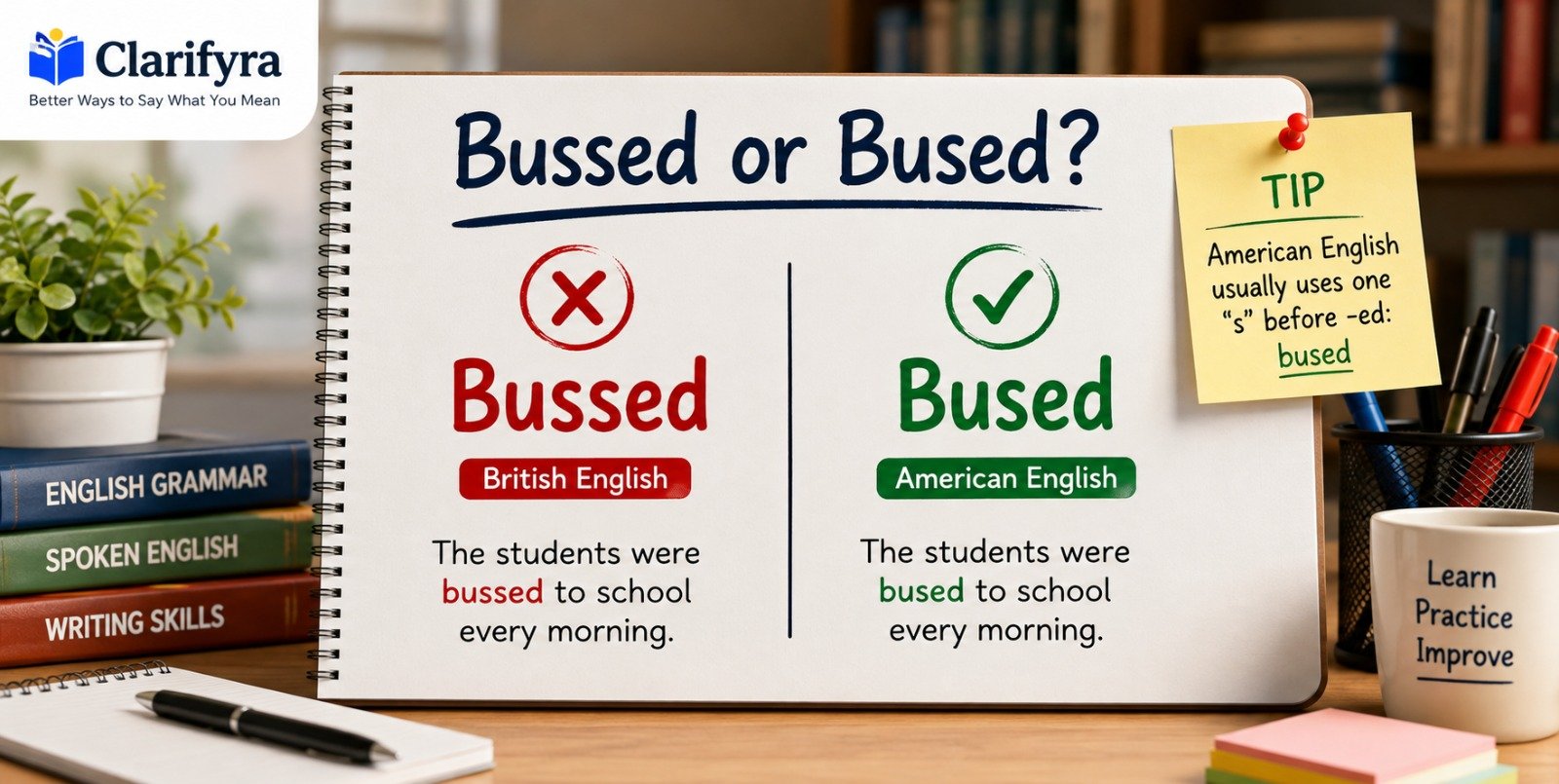
Both bussed and bused are correct. Bused is generally preferred in American English, while bussed is commonly used in British English. They usually have the same meaning when referring to transportation by bus.
Bussed or Bused: Which Is Correct?
Both spellings are accepted forms of the verb bus.
If you are writing for an American audience, bused is normally the best choice:
The students were bused to school every morning.
In British English, bussed is also standard and may look more natural:
The students were bussed to school every morning.
The difference is mainly one of spelling convention rather than meaning.
Quick Comparison
| Feature | Bused | Bussed |
|---|---|---|
| Correct? | Yes | Yes |
| Base verb | Bus | Bus |
| Common in American English | Yes | Less common |
| Common in British English | Less common | Yes |
| Can mean transported by bus | Yes | Yes |
| Can refer to clearing tables | Yes | Yes |
| Example | We were bused downtown. | We were bussed downtown. |
You May Also Read | Is It Hidding or Hiding? Correct Spelling Explained
What Is Bused?
Bused is the simple past tense and past participle of bus.
When bus is used as a verb, it most often means to transport people from one place to another by bus.
Examples:
- The athletes were bused to the stadium.
- The children were bused home after the event.
- Tourists were bused from the airport to their hotel.
- Employees were bused between the two buildings.
This spelling is especially common in American English.
You may also see bused in restaurant contexts, where the verb bus means to clear dishes and other used items from a table.
For example:
He bused tables at a local restaurant during college.
What Is Bussed?
Bussed is also a correct past-tense and past-participle form of bus.
It generally means exactly the same thing as bused when referring to transportation.
Examples include:
- The visitors were bussed to the museum.
- The children were bussed from nearby villages.
- Staff members were bussed to the conference venue.
- Spectators were bussed back to the city center.
The doubled s spelling is particularly common in British English.
So if you are asking, “Is it bussed or bused?”, the answer depends more on your preferred variety of English than on grammar.
Why Are There Two Spellings?
The confusion comes from the way English forms past-tense verbs.
Some short verbs double their final consonant before adding -ed:
- stop → stopped
- plan → planned
- drop → dropped
Because bus ends in a single consonant, bussed may look like the expected form.
However, bused also became established as a standard spelling, especially in American English.
As a result, modern English accepts both:
- bus → bused
- bus → bussed
The same variation appears in the -ing form:
- busing
- bussing
American English usually favors busing, while British English commonly uses bussing.
Is It Spelled Bussed or Bused in American English?
In American English, bused is generally the preferred spelling.
For example:
The students were bused to another campus.
Passengers were bused from the terminal to the aircraft.
The team was bused back to the hotel.
You may still encounter bussed in American writing, but bused is the more typical form when referring to transportation.
If your website, publication, or document follows American spelling conventions, using bused consistently is a sensible choice.
What About British English?
British English often uses bussed and bussing.
For example:
Children were bussed to schools outside the village.
Staff were bussed to the temporary office.
The company provided bussing between the two sites.
This does not mean that bused becomes grammatically incorrect in Britain. The difference is primarily one of conventional preference.
For formal writing, the most important rule is consistency. If you choose British spelling, avoid switching randomly between bussed and bused in the same document.
Bussed or Bused to School?
Both bussed to school and bused to school are correct.
The phrase simply means that students were transported to school by bus.
In American English:
The children were bused to school because they lived several miles away.
In British English:
The children were bussed to school from surrounding villages.
The meaning is identical.
School transportation is also one of the contexts in which readers frequently notice the two spelling forms because the verb appears in discussions of school routes, transportation policies, and student travel.
If you are writing for a U.S. audience, bused to school will usually be the more natural choice.
Bussed or Bused Tables?
The verb bus has another meaning, particularly in American restaurant English.
To bus a table means to remove used dishes, glasses, utensils, napkins, and other items after diners have finished eating.
For example:
The server bused the table before the next guests arrived.
The past tense may be written bused or bussed.
Examples:
She bused tables during her summer job.
He bussed tables at a busy restaurant.
In American restaurant writing, bused tables is a standard and natural form.
However, saying that someone cleared tables may be easier to understand for readers who are unfamiliar with restaurant terminology.
Other Ways to Say “Bused Tables”
Depending on the context, you could say:
- cleared tables
- removed the dishes
- collected used plates
- cleared away the tableware
- prepared the table for the next guests
For example:
She cleared tables during the evening shift.
This communicates the same basic idea without using restaurant-specific vocabulary.
Busing or Bussing?
The same spelling difference appears when adding -ing.
Both forms are correct:
- busing
- bussing
American English commonly uses busing:
The school district introduced a new busing schedule.
British English commonly uses bussing:
The company arranged bussing for employees.
The choice follows the same pattern as bused and bussed.
If you use bused, it usually makes sense to use busing as well.
If you use bussed, use bussing for consistency.
Buses or Busses?
The plural of the noun bus is normally written buses.
For example:
Three buses were waiting outside the station.
The spelling busses has existed as a variant, but buses is the standard modern form for the vehicles and is the clearest choice in most writing.
This gives us the common American pattern:
- one bus
- two buses
- bused
- busing
A common British pattern is:
- one bus
- two buses
- bussed
- bussing
Notice that the plural noun remains buses even when the verb is spelled bussed.
Correct Usage Examples
Because both forms are valid, there is usually no need to mark one as completely incorrect.
American English Examples
Correct: The players were bused to the stadium.
Correct: Students were bused to a temporary school.
Correct: He bused tables at a restaurant after class.
Correct: The organization is busing volunteers to the event.
British English Examples
Correct: The players were bussed to the stadium.
Correct: Students were bussed to a temporary school.
Correct: Staff were bussed from the hotel.
Correct: The organization is bussing volunteers to the event.
The most important point is to follow one spelling style consistently.
Common Mistakes to Avoid
Assuming “Bussed” Is Always Wrong
It is not a misspelling. Bussed is an accepted form, particularly in British English.
Assuming “Bused” Is Informal
Bused is fully standard English and is widely used in formal American writing.
Mixing Regional Spellings
A sentence such as this may look inconsistent:
Students were bused to school while staff were bussed to another building.
Unless there is a specific reason for the difference, choose one form and keep it consistent.
Confusing the Verb With the Plural Noun
The standard plural noun is:
buses
Not:
bused
Bused is a verb form, while buses is usually the plural noun or the third-person singular verb.
Compare:
Two buses arrived.
The company buses employees to work.
The company bused employees yesterday.
Easy Way to Remember the Difference
A simple way to remember the preferred American spelling is:
U.S. English usually uses one “s” before -ed: bused.
Think:
U.S. → bused
For British English, remember that the final s is often doubled:
British English → bussed
This is not an absolute grammar rule, but it is a useful practical guide when choosing between the two forms.
Final Verdict: Bussed or Bused?
Both forms are correct, so the best spelling depends on the variety of English you are using. Choose bused for most American English writing and bussed when following British conventions. The same regional pattern generally applies to busing and bussing. Whichever version you choose, use it consistently throughout your writing. This kind of distinction between accepted English forms is also the type of comparison readers can explore when learning through resources such as Clarifyra.
Frequently Asked Questions
Is “bussed” a real word?
Yes. Bussed is a standard past-tense and past-participle form of bus, especially in British English. It can mean transported by bus and may also refer to clearing restaurant tables.
Is “bused” grammatically correct?
Yes. Bused is grammatically correct and is the spelling generally preferred in American English. For example, “The students were bused to school.”
Can I use both “bussed” and “bused” in formal writing?
Yes, but it is usually better to choose one spelling style and remain consistent. American writing generally favors bused, while British writing commonly uses bussed.
Should I write “bused to school” or “bussed to school”?
Both are correct. Bused to school is more common in American English, while bussed to school is often used in British English. They have the same meaning.
Is it “bused tables” or “bussed tables”?
Both forms can be used. In American restaurant English, bused tables is a common spelling. The phrase means clearing used dishes and tableware after customers have finished eating.
What is the difference between “busing” and “bussing”?
Both are correct -ing forms of the verb bus. American English usually prefers busing, while British English commonly uses bussing.
You May Also Read | Vice vs Vise? Which Spelling Should You Use?