Honey vs Hunny: What’s the Difference and Which Is Correct?
If you have seen both honey and hunny in messages, captions, or romantic conversations, you may wonder whether they are two different words or simply different spellings. The distinction is mainly about standard spelling and tone. Honey is the normal English spelling and can refer either to the sweet substance made by bees or to an affectionate name for someone. Hunny is an informal alternative spelling used mainly when addressing someone affectionately. Knowing the difference helps you choose the right form for everyday writing, relationships, and casual messages.
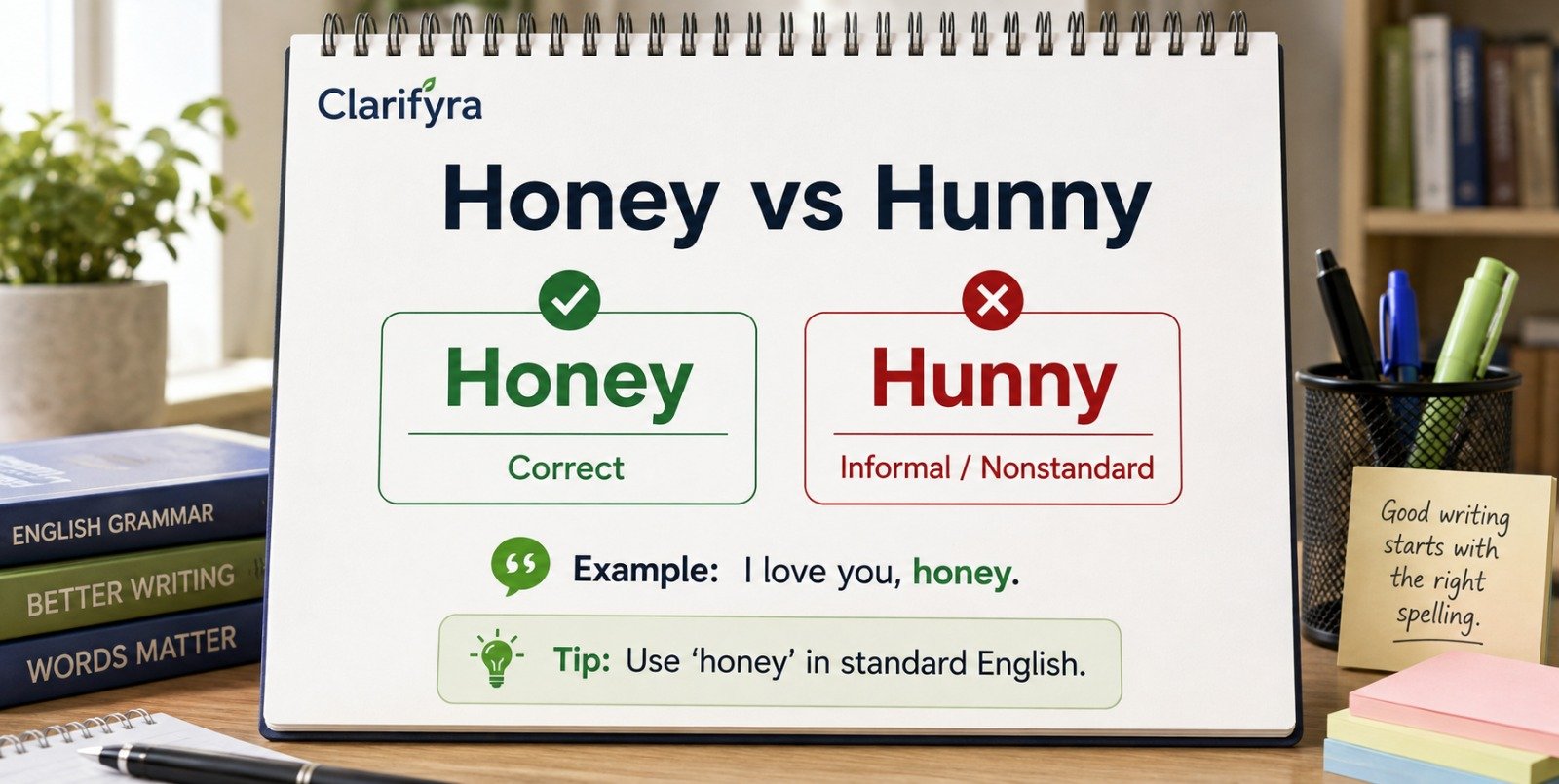
Honey is the standard English spelling. It can mean the sweet food made by bees or an affectionate name for someone you love. Hunny is an informal alternative spelling used mainly as a cute or playful term of affection, especially in personal messages.
Honey vs Hunny: What’s the Difference?
The simplest difference is that honey is standard English, while hunny is informal.
Cambridge Dictionary recognizes hunny as an informal alternative spelling of honey when it is used to address someone you like, love, or want to speak to warmly.
They are therefore not completely interchangeable.
| Feature | Honey | Hunny |
|---|---|---|
| Standard spelling? | Yes | Informal alternative |
| Bee-made food | Yes | Normally no |
| Term of affection | Yes | Yes |
| Suitable for formal writing | Yes, where context fits | Usually no |
| Common tone | Neutral, warm, affectionate | Cute, playful, casual |
| Example | “I love you, honey.” | “Miss you, hunny!” |
If you are uncertain which form to write, honey is always the safer choice.
What Is Honey?
Honey is a noun with more than one common use.
Its literal meaning is the sweet, thick substance produced by bees. For example:
- I added a spoonful of honey to my tea.
- This cake contains honey instead of sugar.
- Bees store honey in the hive.
Honey is also widely used as a term of endearment. In this sense, it refers to or addresses someone affectionately.
For example:
- Are you okay, honey?
- Good morning, honey.
- I missed you today, honey.
- Thanks for helping me, honey.
The standard spelling remains honey whether you are talking about food or calling someone by an affectionate nickname.
What Is Hunny?
Hunny is an informal alternative spelling of honey when the word is being used affectionately.
For example:
- Goodnight, hunny.
- I love you, hunny.
- Have a safe trip, hunny.
- Can’t wait to see you, hunny!
This spelling can make a message feel more playful, cute, personal, or deliberately casual.
However, hunny is not normally used for the substance made by bees.
Standard:
I put honey on my toast.
Nonstandard:
I put hunny on my toast.
Unless the unusual spelling is intentional for a joke, name, brand, or creative effect, use honey when referring to food.
Is Hunny a Real Word?
It is more accurate to call hunny an informal alternative spelling than to say it is simply nonexistent.
Major dictionaries document its affectionate use. Cambridge, for example, labels it informal and defines it as an alternative spelling of honey used when speaking to someone affectionately.
That does not make it the preferred spelling in standard writing.
Consider these examples:
Standard English:
Honey, can you call me later?
Informal and playful:
Hunny, call me when you get home! ❤️
Both can communicate affection, but the second deliberately has a more casual style.
Why Do People Write “Hunny” Instead of “Honey”?
The biggest reason is pronunciation.
Both forms represent the same familiar “HUN-ee” sound when used as a pet name. Someone writing phonetically may therefore spell the first syllable with a u.
But people also use altered spellings intentionally to make affectionate words feel more personal.
Compare:
- love → luv
- baby → babi
- honey → hunny
In these situations, the alternative spelling is a stylistic choice rather than a different standard word.
That is why hunny appears naturally in texts, private messages, nicknames, cards, and other highly informal situations.
Is It Honey or Hunny When Talking to a Female?
When addressing a woman affectionately, honey is the standard spelling.
For example:
You look beautiful today, honey.
You may also write:
You look beautiful today, hunny.
The second version is possible when you intentionally want a playful or cute tone.
Neither spelling is specifically reserved for women. Honey and informal hunny can be used for people of any gender.
Also remember that the meaning depends on the relationship. Calling someone honey may sound romantic between partners, affectionate within a family, or simply warm and friendly in some conversational settings.
Hunny or Honey for a Husband?
If you are deciding between hunny or honey for a husband, both can work in personal messages, but honey is the standard form.
For example:
Honey, what time will you be home?
This sounds natural and affectionate.
You could also text:
Miss you, hunny! ❤️
Here, hunny creates a deliberately cute and informal tone.
There is no grammatical rule saying one spelling should be used for husbands and another for wives. Your choice depends on the style of your relationship and how you normally communicate with each other.
What Does “Hunny” Mean From a Girl?
If a girl calls someone hunny, it usually communicates friendliness, warmth, or affection. However, the word alone does not prove romantic interest.
For example:
Goodnight, hunny.
If this comes from someone you are dating, it may clearly be affectionate or romantic.
But some people regularly use terms such as hun, honey, sweetie, or dear when speaking warmly to friends and other people.
So the hunny meaning from a girl depends on context, including:
- your existing relationship
- the rest of the conversation
- how she normally speaks to others
- whether other romantic signals are present
It is better to interpret the whole interaction rather than assume that one affectionate word confirms someone’s feelings.
What Does Hunny Mean in Love?
In a romantic relationship, hunny generally functions as a pet name.
It can express:
- affection
- closeness
- tenderness
- fondness
- playfulness
For example:
I love you, hunny.
Here, hunny has approximately the same affectionate meaning as honey, sweetheart, darling, or babe.
The unusual spelling does not create a separate relationship status or hidden meaning. It mainly changes the tone.
Compare:
I love you, honey.
I love you, hunny.
Both are affectionate, but the second may look more playful or personalized in a text conversation.
Honey vs Hunny in a Relationship
In relationships, both forms can be affectionate, but honey is more versatile.
You can naturally write:
Good morning, honey.
Be careful driving home, honey.
I love you, honey.
Hunny usually feels more suitable for informal digital communication:
Morning, hunny ❤️
Miss you already, hunny!
Sleep well, hunny.
Neither form automatically means a relationship is serious. Couples use different pet names at different stages, and some people use affectionate expressions much more freely than others.
“I Am Honey” Meaning in a Relationship
The sentence “I am honey” does not have one established romantic meaning.
Without additional context, it could simply be playful wording suggesting that the speaker considers themselves sweet, lovable, or attractive.
A phrase such as:
I’m your honey.
has a clearer relationship meaning. It can suggest:
I’m your sweetheart.
Likewise:
You’re my honey.
is a conventional affectionate way of referring to someone you love or care about.
Context is therefore essential when interpreting unusual relationship phrases.
What Drug Is Honey Slang For?
Honey by itself does not have one universal drug-slang meaning. Slang changes between places and communities, so it is risky to assume that every use of the word refers to a substance.
A related expression, “honey oil,” has been used as a slang name for marijuana or cannabis concentrate because some concentrates can have a honey-like appearance. The U.S. Drug Enforcement Administration lists honey oil among terms used for marijuana concentrates.
This is different from the everyday word honey.
In ordinary conversation:
Honey, are you coming?
almost certainly functions as a term of address, not as a reference to drugs.
The surrounding context should always determine the intended meaning.
Correct Usage Examples
Here are a few examples showing when each spelling works best.
Honey Referring to Food
Correct:
I poured honey over the pancakes.
Correct:
Would you like honey in your tea?
Nonstandard:
Would you like hunny in your tea?
Honey as an Affectionate Name
Correct:
I’ll see you tonight, honey.
Correct:
Thanks, honey. I really appreciate it.
Hunny as a Playful Pet Name
Informal:
Good morning, hunny!
Informal:
Love you so much, hunny.
Informal:
Drive safely, hunny ❤️
The important point is that honey works in both literal and affectionate meanings, while hunny is mainly limited to informal affectionate usage.
Common Mistakes to Avoid
Using “Hunny” for Bee-Made Honey
If you are referring to food, write:
This honey tastes delicious.
Not:
This hunny tastes delicious.
Assuming “Hunny” Is More Correct for Romance
You do not need to change the spelling just because you are talking to a partner.
I love you, honey.
is completely correct.
Thinking One Form Is for Women and the Other Is for Men
Neither word has that distinction. Both may be used affectionately regardless of gender.
Treating Every “Honey” as Romantic
Honey can be romantic, but context matters. It can also be used affectionately with family members or as a warm form of address.
Easy Way to Remember the Difference
Remember this simple rule:
Honey = the standard word.
Hunny = the playful version.
If bees are involved, always think:
Bees make HONEY.
That reminds you that honey is the standard spelling.
If you are writing a formal document, school assignment, article, recipe, or professional message, choose honey unless Hunny is deliberately being used as a name or quotation.
Final Verdict: Honey or Hunny?
Use honey as the standard spelling. It is correct for the sweet substance made by bees and for an affectionate term such as “I love you, honey.”
Use hunny only when you intentionally want an informal, cute, or playful spelling of the affectionate meaning. It can work well in personal texts and nicknames, but it should not normally replace honey in standard writing.
The easiest distinction is simple: honey is standard; hunny is stylistic. Understanding small differences like this makes everyday English clearer, which is also useful when comparing similar words and expressions on resources such as Clarifyra.
Frequently Asked Questions
Is honey or hunny the correct spelling?
Honey is the standard English spelling. Hunny is an informal alternative spelling used mainly when addressing someone affectionately. If you are unsure which one to choose, use honey.
Can I call my girlfriend hunny?
Yes. Hunny can be used as a cute or playful nickname for a girlfriend. However, honey is also completely correct and is the standard spelling.
Can you call a man honey or hunny?
Yes. Neither term is limited to women. A wife, girlfriend, partner, family member, or other person may affectionately call a man honey or, more informally, hunny.
Is hunny acceptable in formal writing?
Usually not. Because hunny is an informal alternative spelling used as a term of affection, honey is preferable in standard, academic, professional, and edited writing.
Does “hunny” mean someone loves you?
Not necessarily. It can express affection, but some people use terms such as hunny, honey, or hun casually. Look at the relationship and the rest of the conversation before interpreting it romantically.
Are honey and hunny pronounced differently?
Normally, no. When they are used as terms of affection, they are generally pronounced the same way. The main difference is spelling and level of formality rather than pronunciation.
You May Also Read | Is It Hidding or Hiding? Correct Spelling Explained