Different Ways to Say Good Morning: 75+ Creative and Natural Greetings
“Good morning” works almost anywhere, but it isn’t always the most personal, lively, or natural choice. You might want something warmer for a friend, more relaxed for a coworker, more cheerful for a text, or simply a different phrase because you’ve said the same greeting every day.
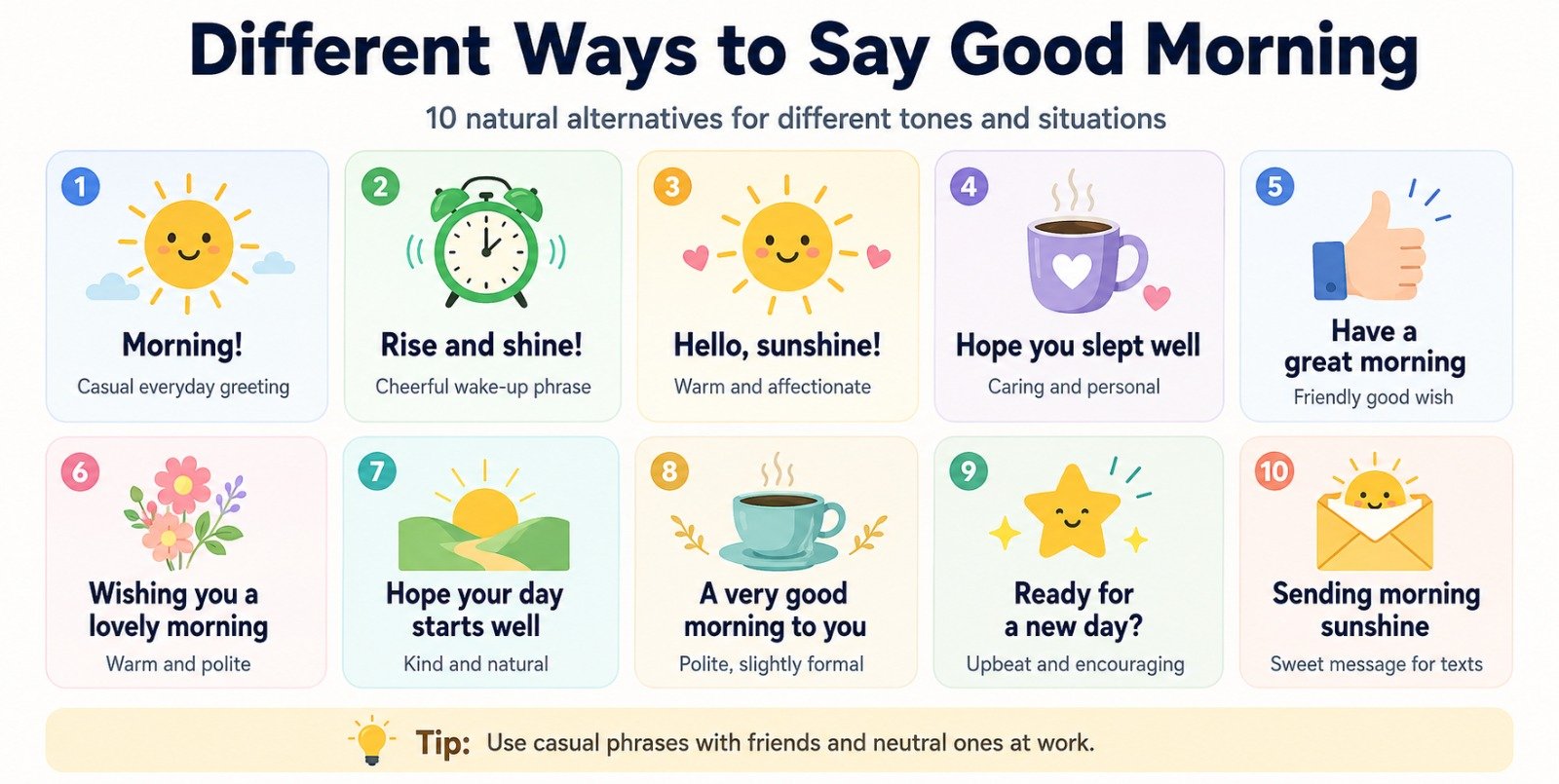
There are plenty of different ways to say good morning, but they aren’t all interchangeable. “Morning!” is a casual greeting, “Rise and shine!” is usually meant to wake or encourage someone, and “Hope you slept well” shows personal warmth rather than simply marking the time of day.
A Quick Guide to Choosing the Right Morning Greeting
Before jumping into longer lists, it helps to see how common greetings differ in tone.
| Expression | Tone | Best Used For |
|---|---|---|
| Good morning | Neutral, polite | Almost any situation |
| Morning! | Casual | Friends, coworkers, neighbors |
| Have a great morning | Friendly | Everyday conversations and messages |
| Hope you slept well | Warm, personal | Friends, family, partners |
| Rise and shine! | Energetic, playful | Waking someone up or motivating them |
| Hello, sunshine! | Affectionate, cheerful | Someone you’re close to |
| Wishing you a wonderful morning | Warm, thoughtful | Messages and greetings |
| A very good morning to you | Polite, slightly formal | Friendly or traditional speech |
| Ready for a new day? | Upbeat | Friends, family, teammates |
| Have a productive morning | Professional | Workplace communication |
The key difference is purpose. Some expressions genuinely replace “good morning,” while others add encouragement, affection, humor, or a wish for the day ahead.
Also Check | Cute Ways to Say Good Morning: Sweet, Romantic and Adorable Ideas
Everyday Ways to Say Good Morning
For normal conversations, you usually don’t need anything elaborate. These alternatives sound natural without drawing too much attention to themselves.
- Morning!
- Morning, everyone!
- Hey, good morning!
- Have a good morning.
- Have a great morning.
- Have a lovely morning.
- Hope you’re having a good morning.
- Hope your morning is going well.
- Hope your day is off to a good start.
- Have a wonderful start to your day.
- Wishing you a pleasant morning.
- Enjoy your morning.
- Have a good day ahead.
- Hope today starts well for you.
- Wishing you a bright start to the day.
Morning!
Simply saying “Morning!” is one of the most natural alternatives in everyday English. It’s shorter and more relaxed than “good morning.”
Example:
“Morning! How was your weekend?”
It works well with coworkers, classmates, neighbors, friends, and people you see regularly. It may feel too casual in a very formal setting.
Have a Great Morning
This expression is less of an opening greeting and more of a good wish. You might use it when ending a short morning conversation.
Example:
“Thanks for dropping that off. Have a great morning!”
Hope Your Morning Is Going Well
This works especially well when the morning has already started and you want to sound friendly without being overly personal.
Example:
“Hope your morning is going well. Are we still meeting at ten?”
Friendly and Warm Morning Greetings
When you’re talking to someone you know well, a little warmth can make the greeting feel more personal.
- Hope you slept well.
- Hope you woke up feeling good.
- Wishing you a beautiful morning.
- Sending some morning sunshine your way.
- Have a peaceful morning.
- I hope today starts kindly for you.
- Wishing you a happy start to the day.
- Hope your day begins on a good note.
- Here’s to a lovely morning.
- Hope you have something to smile about today.
- Wishing you a calm and easy morning.
- Have a bright and happy morning.
- Hope today treats you well.
- Wishing you a fresh start today.
- Have a beautiful day ahead.
“Hope you slept well” is much more personal than “good morning.” It makes sense with a friend, relative, or partner, but it may sound overly familiar when speaking to a client or someone you barely know.
Likewise, “Sending some morning sunshine your way” works naturally in a friendly message, but probably not in a formal business email.
Also Check | Funny Ways to Say Good Morning: 90+ Playful, Flirty and Fun Ideas
Creative Ways to Say Good Morning
Sometimes you want a morning greeting with more personality. These expressions work well in messages, social conversations, family chats, and other relaxed situations.
- Rise and shine!
- Hello, new day!
- Time to greet the day.
- Here’s to a fresh start.
- A new day is waiting for you.
- Wake up and welcome the day.
- The sun is up!
- Time to shine.
- Start the day with a smile.
- Here’s to another beautiful morning.
- Today is ready when you are.
- Welcome to a brand-new day.
- Let the morning begin.
- A fresh day has arrived.
- Another sunrise, another opportunity.
- Here’s your fresh start.
- Let today begin beautifully.
- A bright new morning to you.
- Hope your day starts with something good.
- Step into the day with a smile.
Rise and Shine!
“Rise and shine!” is a classic energetic expression, but it isn’t a direct replacement for every use of “good morning.”
It usually means something closer to “wake up and get moving.”
Example:
“Rise and shine! We need to leave for the airport in thirty minutes.”
You wouldn’t normally walk into a formal meeting and greet everyone with “Rise and shine!”
Here’s to a Fresh Start
This carries an encouraging tone and works particularly well after a difficult day or when someone is starting something new.
Example:
“Here’s to a fresh start. I hope today goes much better.”
Time to Shine
This phrase is motivational rather than purely a greeting.
Example:
“Morning! Big presentation today. Time to shine.”
That extra meaning is why context matters: creative alternatives often do more than simply say hello.
Unique Ways to Say Good Morning
If you’d like something less predictable, these greetings can add character without sounding completely unnatural.
- Happy new day!
- Greetings, early bird!
- Welcome back to the waking world.
- Another sunrise has arrived.
- Your new day has officially begun.
- Morning sunshine is calling.
- Here’s your daily dose of daylight.
- A bright beginning to you.
- The world is awake, and so are you.
- Sending fresh-start energy your way.
- May your morning start gently.
- A little morning cheer for you.
- Here’s to the first good moment of the day.
- Let today surprise you in a good way.
- May your first coffee be excellent.
- The day has begun. Make it yours.
- Another morning, another chance.
- Sending you a brighter beginning.
- May today start better than yesterday.
- Welcome to the day’s first chapter.
“Unique” doesn’t have to mean strange. The best unique ways to say good morning still sound like something a real person could use in the right situation.
For example:
“May your first coffee be excellent.”
This isn’t a literal substitute for “good morning,” but it’s a playful morning wish that works well with a friend or coworker who loves coffee.
By contrast:
“Welcome back to the waking world.”
This is deliberately playful and would feel odd in formal conversation, but it can be fun between close friends.
Professional Ways to Greet Someone in the Morning
You don’t always need a clever alternative at work. In professional settings, clear and natural language usually works best.
Useful options include:
- Good morning, everyone.
- Morning, team.
- I hope you’re having a good morning.
- I hope your day is off to a good start.
- Wishing you a productive morning.
- I hope you’re doing well this morning.
- I hope your morning is going smoothly.
- A very good morning to you.
- I hope you’ve had a good start to the day.
- Wishing everyone a productive day ahead.
For Coworkers
“Morning!” is completely natural with coworkers you know well.
Example:
“Morning, Lisa. Are you free for a quick call?”
For Clients or Formal Contacts
Stick with more neutral wording.
Example:
“Good morning, Mr. Patel. Thank you for sending the updated proposal.”
Trying too hard to avoid “good morning” can actually make professional writing sound less natural. Sometimes the standard phrase is still the best choice.
Morning Greetings for Text Messages
Text messages give you more freedom to sound cheerful, affectionate, or conversational.
You might write:
- Morning 😊
- Hope you slept well!
- Have an amazing morning.
- Morning, sleepyhead!
- Hope today is good to you.
- Sending you some morning sunshine.
- Wake up, it’s a new day!
- Hope your coffee is strong today.
- Have a beautiful start to your day.
- Just stopping by to wish you a good morning.
- Morning! You’ve got this.
- New day, fresh start.
- Hope you wake up smiling.
- Wishing you a calm morning.
- Morning! Make today a good one.
“Morning, sleepyhead!” can sound affectionate or teasing, so it works best when you already have that kind of relationship with the person.
“Morning! You’ve got this,” on the other hand, is especially suitable when someone has a busy or stressful day ahead.
Not Every Morning Phrase Means the Same Thing
A useful alternative should fit the situation, not simply contain a morning-related idea.
Consider these differences:
“Morning!”
A true casual greeting. It can replace “good morning” in many informal situations.
“Rise and shine!”
A wake-up call or motivational expression. It’s not suitable as a universal greeting.
“Hope you slept well.”
A caring personal question or wish. It assumes enough familiarity to talk about someone’s sleep.
“Have a great morning.”
Usually sounds more natural when ending an interaction than starting one.
“Time to shine.”
Motivational. It encourages someone rather than simply greeting them.
“Hello, sunshine!”
Affectionate and playful. It may sound too intimate with someone you don’t know well.
This is why choosing among other ways to say good morning requires more than finding synonyms. Tone and relationship matter just as much as dictionary meaning.
Ways to Say Good Morning in Different Languages
Morning greetings vary from language to language. Some translate closely to “good morning,” while others use a broader greeting that English speakers might translate as “hello” or “good day.”
| Language | Common Morning Greeting | Natural English Meaning |
| Spanish | Buenos días | Good morning / Good day |
| French | Bonjour | Hello / Good day |
| German | Guten Morgen | Good morning |
| Italian | Buongiorno | Good morning / Good day |
| Portuguese | Bom dia | Good morning / Good day |
| Dutch | Goedemorgen | Good morning |
| Swedish | God morgon | Good morning |
| Norwegian | God morgen | Good morning |
| Danish | Godmorgen | Good morning |
| Japanese | おはようございます (Ohayō gozaimasu) | Good morning, polite |
| Korean | 좋은 아침이에요 (Joeun achim-ieyo) | Good morning |
| Mandarin Chinese | 早上好 (Zǎoshang hǎo) | Good morning |
| Arabic | صباح الخير (Sabāh al-khayr) | Good morning |
| Hebrew | בוקר טוב (Boker tov) | Good morning |
| Greek | Καλημέρα (Kaliméra) | Good morning / Good day |
| Turkish | Günaydın | Good morning |
| Russian | Доброе утро (Dobroye utro) | Good morning |
| Polish | Dzień dobry | Good morning / Good day |
| Indonesian | Selamat pagi | Good morning |
| Vietnamese | Chào buổi sáng | Good morning |
| Filipino/Tagalog | Magandang umaga | Good morning |
Translations should always be understood in their cultural context. English divides “good morning,” “good afternoon,” and “good evening” quite clearly, but other languages may use greetings across broader parts of the day.
For instance, French bonjour literally relates to wishing someone a good day and serves as the standard daytime greeting rather than mapping perfectly onto English “good morning” in every context.
Japanese also distinguishes levels of formality. Ohayō gozaimasu is polite, while the shorter ohayō is more casual and generally used with people you’re close to or in informal settings.
Ways to Say Good Morning in Spanish
The most standard way to say good morning in Spanish is:
Buenos días
It is widely used in both formal and informal situations during the morning.
Examples:
- Buenos días. — Good morning.
- Buenos días a todos. — Good morning, everyone.
- Buenos días, señor García. — Good morning, Mr. García.
- Muy buenos días. — A very good morning.
- ¡Buen día! — Have a good day / Good day.
Buenos Días vs. Buen Día
Buenos días is the standard and safest choice when greeting someone in the morning.
Buen día is also used, particularly in some Spanish-speaking regions, but its frequency and feel can vary by location. It can function more like “good day” or “have a good day.”
If you’re learning Spanish and simply want a reliable morning greeting, buenos días is the best expression to remember.
How to Choose the Best Morning Greeting
Think about three things: relationship, setting, and purpose.
If you’re greeting a stranger, client, teacher, or senior colleague, keep things neutral:
“Good morning.”
“I hope you’re having a good morning.”
With friends and familiar coworkers, you can relax:
“Morning!”
“Hope your day is off to a good start.”
For family members, partners, or close friends, warmer expressions make more sense:
“Hope you slept well.”
“Morning, sunshine!”
And if you’re trying to encourage someone, choose language that adds motivation:
“Rise and shine!”
“New day, fresh start.”
“You’ve got this today.”
The best greeting isn’t necessarily the most creative one. It’s the one that sounds natural coming from you and feels appropriate to the person receiving it.
Frequently Asked Questions
What can I say instead of “good morning”?
Natural alternatives include “Morning!”, “Hope you slept well,” “Have a great morning,” “Rise and shine,” and “Hope your day is off to a good start.” The right choice depends on the setting and your relationship with the person.
Is “morning” a correct alternative to “good morning”?
Yes. “Morning!” is a very common informal greeting in English. It’s especially natural among coworkers, friends, classmates, and neighbors.
What is a creative way to say good morning?
Try something like “Here’s to a fresh start,” “Time to shine,” “Welcome to a new day,” or “Another sunrise, another opportunity.” Creative greetings work best in relaxed conversations or personal messages.
What is a unique way to say good morning?
You might say “Happy new day,” “Greetings, early bird,” “A bright beginning to you,” or “Welcome back to the waking world.” More unusual greetings should match the personality and relationship of the people involved.
How do you say good morning professionally?
In professional settings, “Good morning,” “Good morning, everyone,” “Morning, team,” and “I hope your day is off to a good start” are all natural. Avoid overly playful greetings unless you already have an informal workplace relationship.
How do you say good morning in Spanish?
The standard Spanish expression is “Buenos días.” It can be used in both formal and informal morning situations.
Is “rise and shine” the same as “good morning”?
Not exactly. “Rise and shine” usually encourages someone to wake up, get out of bed, or start the day energetically. It’s playful and informal rather than a neutral greeting.
Can I say “good morning” after noon?
Usually not. English speakers typically switch to “good afternoon” after midday. Exact habits vary, but “good morning” normally belongs to the part of the day before noon.
Final Thoughts
Changing a familiar greeting can make a conversation feel warmer, more relaxed, more playful, or more personal, but there’s no need to replace “good morning” simply for the sake of sounding different. Use “Morning!” when you want casual simplicity, warmer wishes with people you’re close to, and more neutral wording in professional settings.
Small differences in phrasing can change how a greeting feels even when the basic intention is similar. Clarifyra helps make those differences easier to notice, so you can choose a morning greeting that matches the person, setting, and tone you actually want.
Also Read | 75 Cute Ways to Say “I Love You”: Sweet, Romantic, Poetic and Funny Ideas