Right or Wrong: Meaning, Spelling, and Correct Usage
When someone asks whether something is right or wrong, they may be asking about correctness, accuracy, behavior, or morality. The phrase is straightforward, but its meaning changes slightly depending on the context. It can describe a correct or incorrect answer, an appropriate or inappropriate action, or a moral choice.
The good news is that “right or wrong” is itself a correct and standard English expression. The key is understanding when to use right or wrong, right and wrong, or related expressions such as correct or incorrect.
“Right or wrong” is the correct spelling and a standard English phrase. It can mean “correct or incorrect” when discussing facts or answers, or “morally acceptable or unacceptable” when discussing behavior. Right or wrong presents two alternatives, while right and wrong usually discusses the two concepts together.
Is “Right or Wrong” Correct?
Yes. Right or wrong is grammatically correct and commonly used in English.
The phrase uses the conjunction or to present two possibilities:
- right = correct, accurate, appropriate, or morally acceptable
- wrong = incorrect, inaccurate, inappropriate, or morally unacceptable
For example:
- Is my answer right or wrong?
- Was it right or wrong to cancel the meeting?
- Tell me if this sentence is right or wrong.
- I am not sure whether his decision was right or wrong.
The intended meaning depends on the subject being discussed.
If you are checking a spelling or grammar choice, right usually means correct. If you are discussing someone’s behavior, it may mean morally acceptable.
Right or Wrong: Meaning and Usage
The meaning of the expression can be divided into two main categories.
1. Correct or Incorrect
When talking about an answer, statement, calculation, fact, or piece of information, right or wrong usually means correct or incorrect.
For example:
Is this answer right or wrong?
Here, right means correct, while wrong means incorrect.
Other examples include:
- Can you tell me whether this information is right or wrong?
- I don’t know if my calculation is right or wrong.
- Which answer is right and which one is wrong?
In formal writing, you can sometimes use correct or incorrect instead:
Is this answer correct or incorrect?
That wording can sound more precise in academic or technical contexts.
2. Morally Acceptable or Unacceptable
The expression can also concern morality or ethics.
For example:
Was it right or wrong to hide the truth?
Here, right does not mean factually correct. It means morally acceptable, while wrong means morally unacceptable.
Other examples:
- People often disagree about what is right or wrong.
- She wondered whether her decision was right or wrong.
- The story raises questions about right and wrong.
So, context is important. The same two words can describe either correctness or morality.
Right or Wrong vs. Right and Wrong
Although these expressions look almost identical, or and and change the meaning.
| Expression | Typical meaning | Example |
|---|---|---|
| right or wrong | One of two alternatives | “Is this right or wrong?” |
| right and wrong | The two concepts considered together | “Children learn about right and wrong.” |
| correct or incorrect | A more direct way to discuss accuracy | “Is this answer correct or incorrect?” |
Right or wrong
Use or when you are asking someone to choose between two possibilities.
Was my answer right or wrong?
The speaker wants to know which possibility applies.
Right and wrong
Use and when referring to the concepts collectively.
The lesson teaches children the difference between right and wrong.
The sentence isn’t asking the listener to choose one. It is discussing both concepts.
This distinction is useful because replacing or with and can change the intended meaning.
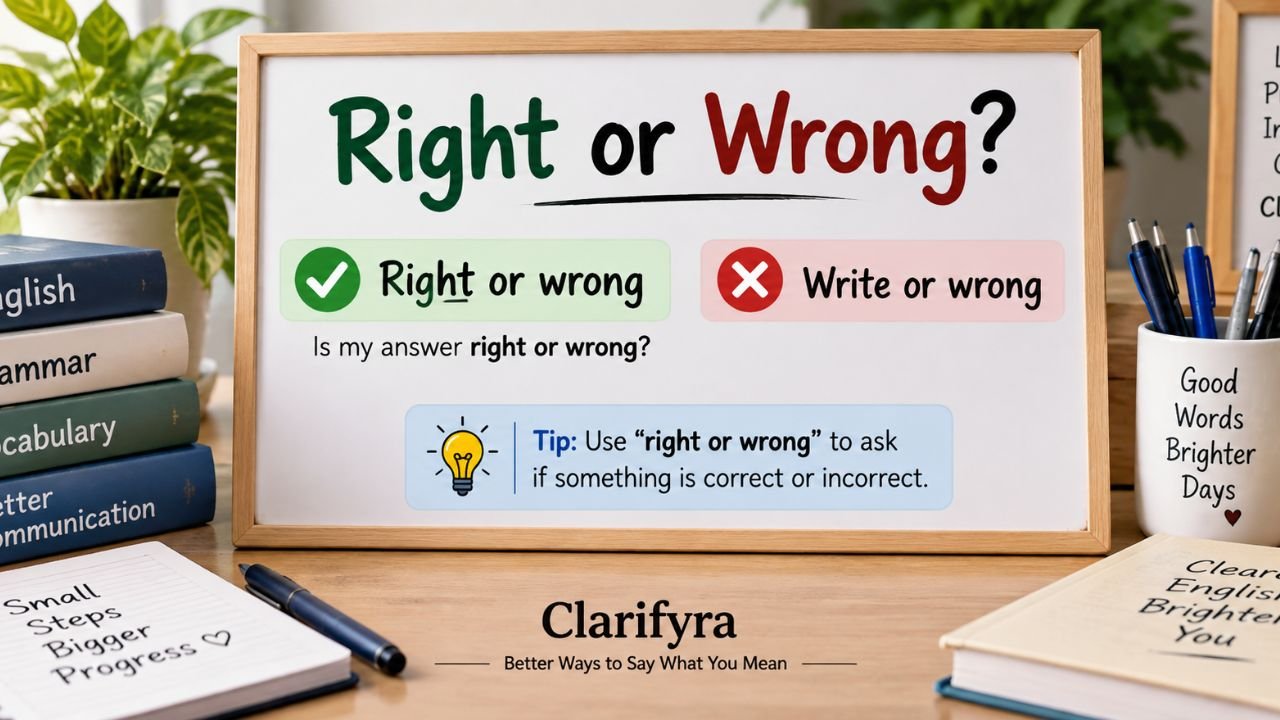
What Is the Correct Spelling?
The correct spelling is:
✅ right or wrong
Both right and wrong are correctly spelled English words.
Some common typing or spelling mistakes include:
- ❌ write or wrong
- ❌ rite or wrong
- ❌ right or rong
- ❌ right or wring
The correct expression is right or wrong.
The word right can have several meanings in English. It can mean correct, refer to a direction, describe something appropriate, or refer to a legal or moral entitlement. Wrong can describe something incorrect, inappropriate, or morally unacceptable.
Right or Wrong in Sentences
Seeing the expression in different contexts makes its meaning easier to understand.
When checking an answer
Is my answer right or wrong?
Here, right means correct.
When checking information
I need to find out whether this information is right or wrong.
Here, the phrase concerns accuracy.
When discussing a decision
She wasn’t sure whether she had made the right or wrong decision.
Here, the words describe an evaluation of the decision.
When discussing behavior
Was it right or wrong to leave without saying goodbye?
Here, the question can concern appropriateness or morality.
In a general statement
Sometimes it is difficult to know whether a decision is right or wrong.
The meaning depends on what kind of judgment is being discussed.
Can You Say “Wrong or Right”?
“Wrong or right” is grammatically possible, but “right or wrong” is the more conventional and natural ordering in ordinary English.
For example:
Right or wrong, he stood by his decision.
This sounds natural.
You could theoretically reverse the order:
Wrong or right, he stood by his decision.
The second version isn’t necessarily ungrammatical, but it is less conventional and may sound deliberately emphatic or stylistic.
For normal English writing, right or wrong is the safer and more natural choice.
What Does “Am I Right or Wrong?” Mean?
“Am I right or wrong?” is a common way to ask whether your statement, belief, interpretation, or decision is correct.
For example:
I think the meeting starts at 10 a.m. Am I right or wrong?
Here, the speaker wants confirmation about a fact.
It can also refer to an opinion or interpretation:
I think he was upset about the decision. Am I right or wrong?
In this case, the speaker is asking whether their interpretation is accurate.
The expression does not necessarily imply that every opinion has one objectively correct answer. Some questions involve facts, while others involve interpretation, values, or personal judgment.
What Symbol Means Right or Wrong?
There is no single official symbol that universally means “right or wrong.” However, several symbols are widely used to represent correctness and incorrectness.
| Meaning | Common symbol |
|---|---|
| Right / Correct | ✓ |
| Right / Correct | ✔ |
| Wrong / Incorrect | ✗ |
| Wrong / Incorrect | ❌ |
For example:
Right ✓
Wrong ✗
These symbols are particularly common in educational materials, quizzes, worksheets, proofreading, and informal digital communication.
The check mark generally indicates that something is correct or acceptable, while an X commonly indicates an error or incorrect answer. Their exact appearance can vary between fonts, applications, and cultures.
Right or Wrong: Which Is Correct?
If you are asking which phrase is correct, the answer is simple:
✅ Right or wrong
It is the standard expression.
If you are asking whether something else is correct, the phrase itself can be used as part of the question:
Is this sentence right or wrong?
For formal or academic contexts, you might instead write:
Is this sentence correct or incorrect?
Both constructions are grammatical. The second is simply more explicit when you are talking specifically about correctness.
Common Mistakes to Avoid
1. Writing “write or wrong”
Write is a real English word, but it is a verb meaning to put words or symbols on a surface or into a document.
Please write your name here.
It is not the word needed in the expression.
Correct: right or wrong
2. Confusing “right or wrong” with “right and wrong”
Use or when presenting alternatives:
Is this right or wrong?
Use and when discussing the concepts together:
We need to understand right and wrong.
3. Assuming “right” always means morally good
The word can simply mean correct.
Your answer is right.
That sentence says nothing about morality.
4. Assuming “wrong” always means immoral
Wrong can simply mean incorrect.
The answer is wrong.
It can also mean inappropriate or morally unacceptable, depending on context.
An Easy Way to Remember the Difference
Think about the conjunction:
OR = a choice between alternatives
right OR wrong
You are asking which one applies.
AND = both concepts together
right AND wrong
You are discussing the two concepts as a pair.
A simple example makes the difference clear:
Is my answer right or wrong? → Choose between two possibilities.
The teacher explained the difference between right and wrong. → Discuss both concepts.
Right or Wrong Quotes
The ideas of right and wrong are often used in quotations and reflective writing because they relate to decisions, ethics, responsibility, and personal judgment.
For original short lines, you could express the idea like this:
- Knowing what is right is only the first step; choosing it is another.
- Being wrong can be an opportunity to learn.
- The right choice is not always the easiest one.
- Admitting a mistake is better than defending a wrong answer.
- Sometimes the question is not who is right, but what is fair.
These are original reflections rather than quotations attributed to famous people. If you publish quotations from other authors, verify the wording and attribution before using them.
FAQ
Is “right or wrong” correct English?
Yes. Right or wrong is a standard English expression. It can refer to whether something is correct or incorrect, or whether an action is morally acceptable or unacceptable.
What is the difference between “right or wrong” and “right and wrong”?
Right or wrong presents two alternatives, while right and wrong discusses the two concepts together. For example, “Is my answer right or wrong?” asks for a choice, while “We learn about right and wrong” discusses both concepts.
Is “wrong or right” grammatically correct?
It can be grammatically possible, but right or wrong is the conventional expression in ordinary English. The reversed order may be used for stylistic emphasis but is much less natural in most situations.
What symbol means correct or incorrect?
A ✓ or ✔ is commonly used to indicate correct or right, while ✗ or ❌ commonly indicates incorrect or wrong. There is no single universal official symbol for the complete phrase.
Is “right or wrong” formal English?
Yes. The phrase is standard English and can be used in both everyday and formal contexts. In technical or academic writing, correct or incorrect may sometimes be more precise.
Can “right” mean morally good?
Yes. Depending on context, right can mean morally acceptable or justified. It can also simply mean correct, so the surrounding sentence determines the intended meaning.
The Bottom Line
Right or wrong is the correct and natural English expression. Use it when presenting two alternatives, such as whether an answer is correct or incorrect or whether an action was acceptable or unacceptable. Use right and wrong when discussing the two concepts together, and remember that ✓ and ✗ are commonly used visual symbols for correct and incorrect. For clear explanations of confusing English expressions, Clarifyra helps you choose words that say exactly what you mean.