Lily or Lilly: Which Is Correct?
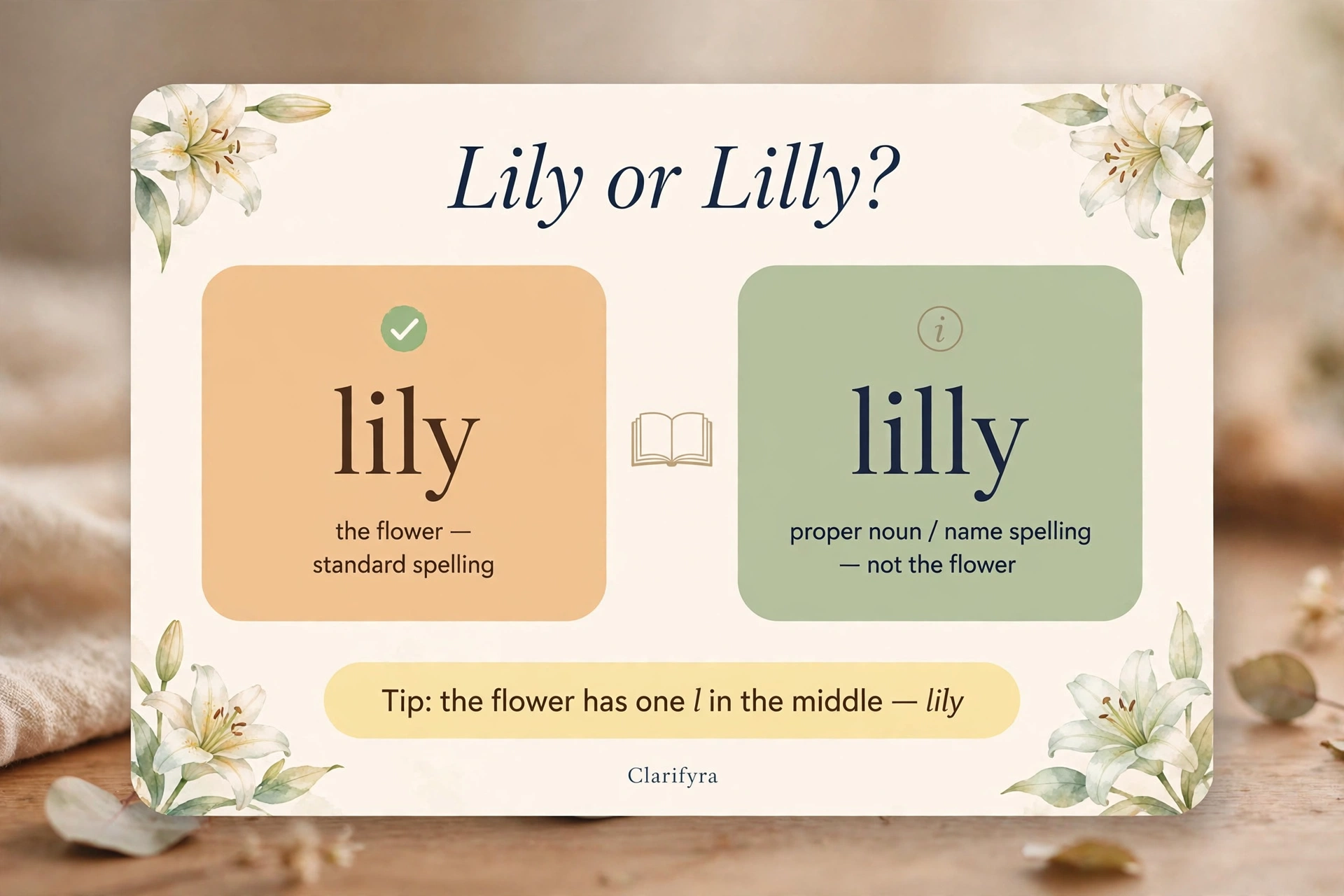
The flower is spelled lily — one l in the middle. Lilly is not a misspelling that got halfway there; it is a real spelling, but it belongs to people and companies, not to flowers. So “a bouquet of lillys” is wrong, “a bouquet of lilies” is right, and “my friend Lilly” can be perfectly right too. The rest of this article explains what each spelling is, how to pluralize the flower, and why the double-l is so easy to slip in by accident.
Quick Answer
lily = the flower (and the given name Lily). Lilly = a proper-noun spelling used as a given name or surname (e.g. Evangeline Lilly, Eli Lilly and Company) — never the flower. Plural of the flower: lilies, never lillys. Pronounced /ˈlɪli/ in both British and American English.
What “lily” means: the flower
Lily is a standard English noun, and the dictionaries agree on it completely. Collins defines it as a plant with large flowers — lily flowers are often white — giving the plural as lilies. Oxford Advanced Learner’s Dictionary describes “a large white or brightly coloured flower with petals that curl back from the centre,” again with the plural lilies. Cambridge, Merriam-Webster, and Webster’s New World all list the same headword, the same plural, and the same pronunciation: /ˈlɪli/, stressed on the first syllable, identical in British and American English.
The word reaches beyond the garden flower itself. Collins’s American entry records senses for the flower or bulb of plants in the genus Lilium, for similar plants such as the water lily, and — as an adjective — for the idea of whiteness and delicacy: “white as a lily,” as in “her lily hands.” That whiteness lives on in everyday compounds: lily-white (spotlessly clean or pale), lily of the valley (a plant with small white bell-shaped flowers — plural: lilies of the valley), and water lily. English even has the idiom gild the lily, meaning to try to improve something that is already beautiful and thereby spoil it.
The word is old: Oxford and Collins trace it to Old English lilie, from Latin līlium, from Greek leirion. It has been spelled with a single middle l in English for well over a thousand years. That is the important point for this article: no major dictionary records lilly as a variant spelling of the flower.
What “lilly” is: a name, not the flower
Lilly is a proper noun. Webster’s New World College Dictionary (via Collins) lists “Lily” as a female given name and notes “Also: Lilly” — in other words, Lilly is a recognized alternative spelling of the first name Lily. It is also a well-established surname: Eli Lilly, the founder of the pharmaceutical company Eli Lilly and Company; the actress Evangeline Lilly; the footballer Bob Lilly. In all of these uses it is capitalized, because proper nouns are capitalized.
Be precise about what the dictionaries do not say: none of Cambridge, Oxford Learner’s, Merriam-Webster, or Collins gives “lilly” as an entry for the flower, or as an accepted variant spelling of “lily.” So:
| Spelling | What it is | Example |
|---|---|---|
| lily | Common noun — the flower; also the usual given-name spelling | She planted white lilies along the fence. |
| Lilly | Proper noun — variant given name, surname, or brand name; always capitalized | Lilly won the spelling bee. |
The given name is most commonly spelled Lily, matching the flower, while Lilly is a familiar alternative that parents sometimes choose precisely to distinguish the name from the plant. When you see “Lilly,” ask yourself: is it naming a person or a company? If yes, the spelling stands as written. Is it naming the flower? Then it should be lily.
The plural: “lilies,” never “lillys”
The plural of lily follows the standard English rule for nouns ending in a consonant plus y: change the y to ies. So one lily, many lilies. This is the same pattern as:
- city → cities
- baby → babies
- story → stories
- day lily → day lilies (or daylilies, one word)
The form lillys is not listed as a word in the dictionaries checked here (Cambridge, Oxford Learner’s, Merriam-Webster, Collins), and spellcheckers flag it. Be careful of one trap: it is tempting to “fix” the plural by doubling the l because the name Lilly looks familiar. Resist it. The plural keeps the single middle l of the singular: lily → lilies.
One related wrinkle: lily of the valley pluralizes as lilies of the valley (Oxford Learner’s Dictionary), with only the first word changing. “Lily-of-the-valleys” is wrong.
Correct vs. incorrect
✗ The garden was full of lillys.
✓ The garden was full of lilies.
✗ She held a single lilly in her hand.
✓ She held a single lily in her hand.
✗ The pond was covered in water lillys.
✓ The pond was covered in water lilies.
✗ lilly of the valley is poisonous.
✓ Lily of the valley is poisonous.
✓ Lilly from accounting sent the report. (A person’s name — correct as written.)
✓ The medicine was made by Eli Lilly and Company. (A proper name — correct as written.)
✗ Her name is Lilly after the flower.
✓ Her name is Lily, like the flower. (The standard given-name spelling.)
Why this confusion is so common
Three things work against the correct spelling. First, English is full of words that do double the l before y — silly, belly, rally, tally. Writers absorb that pattern and apply it to “lily” by analogy. Second, the name Lilly and the company Eli Lilly and Company are highly visible, so the double-l form feels legitimate — and it is legitimate, just not for the flower. Third, spellcheckers often don’t help: because “Lilly” is a real name, typing “lilly” in lowercase may pass unnoticed even when you mean the flower.
The memory trick that actually works is simple: the flower’s name has a single l in the middle, just like the single stem of the plant. If you catch yourself writing “lilly,” ask whether you mean a person. Person → Lilly is fine. Plant → lily.
Frequently asked questions
Is “lilly” ever correct for the flower?
No — not according to any major dictionary. Lilly is correct as a given name, a surname, or part of a proper name such as Eli Lilly and Company. For the flower, it is always lily, plural lilies.
What is the plural of “lily” — lilies or lillies?
Lilies. Change the y to ies because the l before it is a consonant. “Lillies” with a double l is not a standard English word.
How do you spell the girl’s name — Lily or Lilly?
Both spellings are used as given names, and Webster’s New World notes “Lilly” as a variant of “Lily.” Lily is the more common spelling and matches the flower; Lilly is a familiar alternative, and it is also the standard surname spelling. Always copy the exact spelling a person uses — names are the one place where “correct” means “as the bearer writes it.”
Is it “lily-white” or “lilly-white”?
Lily-white, with one middle l, since it derives from the flower. Writing “lilly-white” doubles a letter that the flower never had.
Do “lily” and “Lilly” sound the same?
Yes. Both are stressed on the first syllable: /ˈlɪli/ in British and American English. The spelling difference is invisible in speech, which is one more reason it slips into writing.
The takeaway
Lily is the flower — singular, one l in the middle, plural lilies. Lilly is a proper noun: a given name, a surname, a company. The two are pronounced identically, which makes the spelling the only place the difference shows — and the only place you have to get it right. When in doubt, remember the memory rule: people can be Lilly; flowers are lily in the standard English covered by the dictionaries checked here.