Witch vs Which: Meaning, Difference, Pronunciation & Examples
“Witch” and “which” are easy to confuse because they are pronounced the same way in standard English, yet their meanings and grammatical roles are completely different. Witch is mainly a noun connected with magic or supernatural powers, while which is used when asking about or identifying a particular choice, person, or thing. Because they sound alike, choosing the correct spelling depends on understanding what the sentence means.
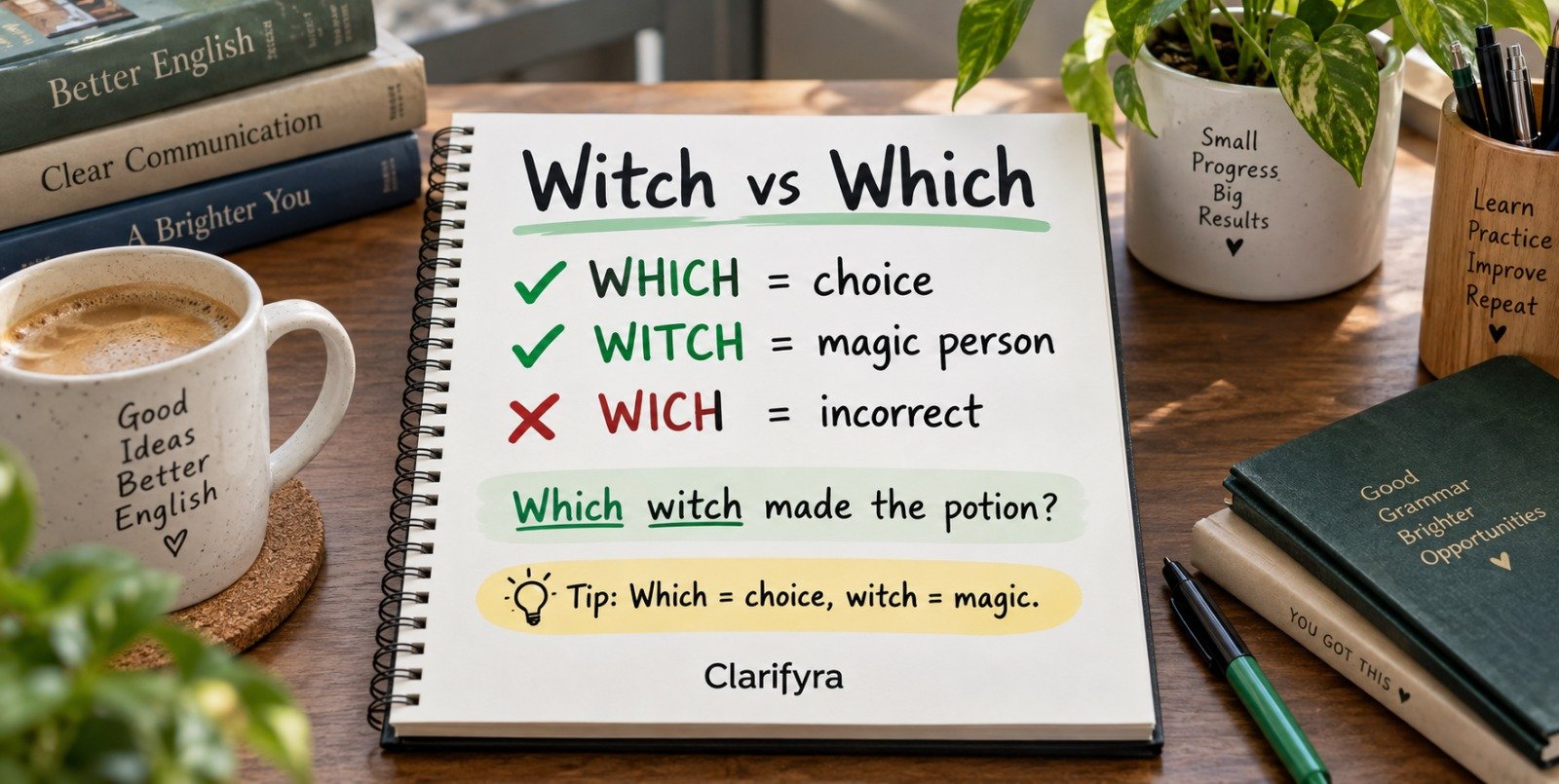
Both “witch” and “which” are correct words, but they mean different things. A witch is a person traditionally associated with magic, while which is used to ask about or identify one option from a group. “Wich” is normally a misspelling when you mean either of these words.
Witch vs Which: What’s the Difference?
The simplest difference is based on meaning.
- Witch refers to a person associated with magic, witchcraft, spells, or supernatural powers.
- Which is used to ask about, identify, or specify something from a set of possibilities.
For example:
The witch lived near the forest.
Here, “witch” names a person.
Which road should we take?
Here, “which” asks the listener to choose one road.
Both spellings are standard English, so the issue is not deciding which word is “correct” in general. The correct choice depends entirely on the meaning of your sentence.
Quick Comparison
| Feature | Witch | Which |
|---|---|---|
| Correct word? | Yes | Yes |
| Main meaning | A person associated with magic | Used to ask about or identify a choice |
| Common word type | Noun | Determiner or pronoun |
| Pronunciation | /wɪtʃ/ | /wɪtʃ/ |
| Example | The witch made a potion. | Which drink would you like? |
| Related confusion | Sometimes written instead of “which” | Sometimes written as “witch” or “wich” |
The identical pronunciation is one of the main reasons these two words are mixed up in writing.
You May Also Read | Councilor or Counselor: What’s the Difference?
What Does “Witch” Mean?
A witch is traditionally a person believed to have magical or supernatural powers.
The word is most commonly used as a noun and may appear in discussions of folklore, fantasy stories, fairy tales, historical beliefs, Halloween, or witchcraft.
Examples include:
- The witch cast a spell in the story.
- A mysterious witch lived in the old cottage.
- She dressed as a witch for Halloween.
- The novel tells the story of a young witch learning magic.
The plural form of “witch” is witches.
For example:
Several witches gathered around the fire.
The word does not normally have anything to do with choosing or asking a question. If the sentence involves selecting one thing from several possibilities, you probably need which, not witch.
What Does “Which” Mean?
Which is used when asking about, identifying, or referring to a particular person or thing from a limited group.
It can function as a determiner:
Which book do you want?
Here, “which” comes before the noun “book.”
It can also function as a pronoun:
Which is yours?
In this sentence, “which” stands on its own because the possible choices are already understood.
“Which” can also introduce a relative clause:
The laptop, which I bought last year, still works perfectly.
In that example, “which” introduces additional information about the laptop.
Other natural examples include:
- Which color do you prefer?
- I cannot decide which shoes to wear.
- Do you know which bus goes downtown?
- Which of these answers is correct?
A useful way to think about it is that which often involves selection or identification.
Witch vs Which Pronunciation
The pronunciation of witch and which is normally the same in standard modern English:
witch: /wɪtʃ/
which: /wɪtʃ/
That makes them homophones: words that sound the same but have different spellings and meanings.
When spoken aloud, the listener usually understands the intended word from context.
For example:
Which witch is your favorite character?
The first word means “what one,” while the second means a person associated with magic. Even though they sound alike, their jobs in the sentence are completely different.
Because pronunciation does not normally help you choose the spelling, pay attention to the meaning and grammatical role of the word.
Are Which and Witch Homophones?
Yes. Which and witch are homophones in standard English pronunciation.
Homophones are words that sound alike but have different meanings and often different spellings.
Other familiar examples include:
- right and write
- sea and see
- flour and flower
- pair and pear
“Which” and “witch” work in the same way.
Consider this sentence:
Which witch won the contest?
The first word is asking you to identify one person. The second word tells you what kind of person is being identified.
Witch vs Which vs Wich
Another common point of confusion is wich.
In ordinary modern English:
- which is a correct word.
- witch is a correct word.
- wich is normally incorrect when you intend either of those words.
For example:
Incorrect: Wich one should I choose?
Correct: Which one should I choose?
Incorrect: The wich made a potion.
Correct: The witch made a potion.
You may see the letters “wich” inside some place names, such as Norwich or Greenwich, but that does not make “wich” the correct standalone spelling for “which” or “witch.”
So if you are wondering how to spell wich or witch, first decide what you mean.
If you mean magic, use witch.
If you mean “what one?” or “what choice?”, use which.
Witch vs Which Grammar
The grammatical difference between these words is also straightforward.
Witch as a Noun
“Witch” is mainly a countable noun.
It names a person:
The witch entered the room.
It can take normal noun forms:
- a witch
- the witch
- two witches
- several witches
Which as a Determiner
“Which” can appear before a noun when asking about a particular choice:
Which restaurant should we visit?
Which answer is correct?
Which as a Pronoun
It can also replace the noun:
Which do you prefer?
Which is mine?
Which as a Relative Word
“Which” may introduce a clause that gives more information:
My phone, which is five years old, still works well.
Understanding these grammatical roles makes the spelling much easier to choose.
Which and Witch in a Sentence
Using both words in one sentence is a useful way to see the difference clearly.
Which witch lives in that house?
“Which” asks the listener to identify one particular person.
“Witch” tells us that the person is a witch.
Here are a few more examples:
- Which witch made this potion?
- Can you tell me which witch appears in the final chapter?
- Which costume belongs to the witch character?
- I forgot which witch won the competition.
Although the words sound identical, their sentence roles are easy to recognize when you focus on meaning.
Witch vs Which Examples
Here are additional examples showing correct usage.
Examples With “Witch”
- The witch carried an old wooden broom.
- The children listened to a story about a friendly witch.
- A powerful witch appears near the end of the film.
- The witch mixed several ingredients into the potion.
Examples With “Which”
- Which jacket should I wear?
- Tell me which train goes to the airport.
- Which option seems better to you?
- I cannot remember which key opens this door.
Incorrect and Correct Examples
Incorrect: Witch shirt do you like?
Correct: Which shirt do you like?
Incorrect: The which cast a spell.
Correct: The witch cast a spell.
Incorrect: Wich one is yours?
Correct: Which one is yours.
The key is to think about the intended meaning before choosing the spelling.
Why Are Witch and Which Confused?
The main reason is pronunciation.
Because the two words sound the same, someone who knows a word mainly from conversation may accidentally choose the wrong spelling when writing it.
The spellings are also visually similar:
witch
which
They contain almost the same letters, but the position of t and h differs.
The confusion is therefore mostly a matter of homophones and spelling rather than similar meanings. The two words are not synonyms and cannot normally replace each other.
You may also see “witch” accidentally substituted for “which” in informal online writing or discussions, including Reddit comments. In most cases, it is simply a spelling error rather than a different grammatical rule.
An Easy Way to Remember Which Word to Use
A simple memory trick is:
Which = choice
Witch = magic
Both “which” and “choice” relate to selecting something:
Which choice should I make?
For “witch,” think of familiar images such as magic, spells, potions, or a broom.
You can also remember:
Witch has a T for tricks.
A witch may perform magical “tricks,” while which helps you choose or identify something.
The meaning-based rule is more reliable than trying to remember the letters alone.
Common Mistakes to Avoid
Using “Witch” When Asking a Question
Incorrect: Witch movie should we watch?
Correct: Which movie should we watch?
The sentence asks you to choose a movie, so “which” is required.
Using “Which” for a Magical Character
Incorrect: The which flew away on a broom.
Correct: The witch flew away on a broom.
The word names a person, so “witch” is correct.
Writing “Wich”
Incorrect: Wich answer is right?
Correct: Which answer is right?
“Wich” is not the standard spelling for this use.
Assuming the Words Have Different Normal Pronunciations
In standard English, they are generally pronounced the same way. Context, not pronunciation, usually tells you which meaning is intended.
Final Verdict: Witch or Which?
Use witch when referring to a person associated with magic or supernatural powers. Use which when asking about, identifying, or referring to a particular option or thing. The words sound alike, but they serve completely different purposes, while wich is normally a spelling mistake in these contexts. Keeping the simple rule “which = choice, witch = magic” in mind makes the distinction easy to remember, and it fits Clarifyra’s goal of making confusing English clearer and easier to use.
Frequently Asked Questions
Is it “which one” or “witch one”?
The correct expression is “which one” when you are asking someone to select or identify an option. For example, “Which one do you want?” “Witch one” would only make sense in an unusual context where “witch” is being used as a noun.
Is “wich” a correct spelling?
Not when you mean which or witch in standard English. “Wich” may appear within certain names and place names, but you should write which for selection and witch for a person associated with magic.
Do witch and which sound the same?
Yes. In standard modern English, both are normally pronounced /wɪtʃ/. That makes them homophones, meaning they sound the same even though their spellings and meanings are different.
What part of speech is “witch”?
“Witch” is primarily a noun. It refers to a person traditionally believed to have magical or supernatural powers. Its regular plural form is witches.
What part of speech is “which”?
“Which” can function as a determiner or pronoun. It may also introduce a relative clause. Its exact grammatical role depends on the sentence, as in “Which car?” or “Which is yours?”
How can I remember the difference between witch and which?
Remember which = choice and witch = magic. If you are choosing or identifying something, use “which.” If you are talking about a magical character or a person associated with witchcraft, use “witch.”
You May Also Read | Is It Vender or Vendor? – Which Spelling Is Correct?