100 Different Ways to Say Hello: Creative, Casual and Stylish Greetings
“Hello” works almost anywhere, but using it every time can make conversations feel repetitive. There are plenty of different ways to say hello, from a quick “Hey!” between friends to a polished “It’s a pleasure to meet you” when meeting someone professionally.
The right greeting depends on who you’re talking to, how well you know them, and the mood you want to create. Below, you’ll find 100 ways to say hello, organized by tone and situation so you can choose something that actually sounds natural.
A Quick Guide to Choosing the Right Greeting
Not all other ways to say hello are interchangeable. “Hey” works naturally with a friend but may be too relaxed for a formal introduction. “Pleased to meet you,” on the other hand, makes sense when meeting someone for the first time but would sound strange if you said it to your best friend every morning.
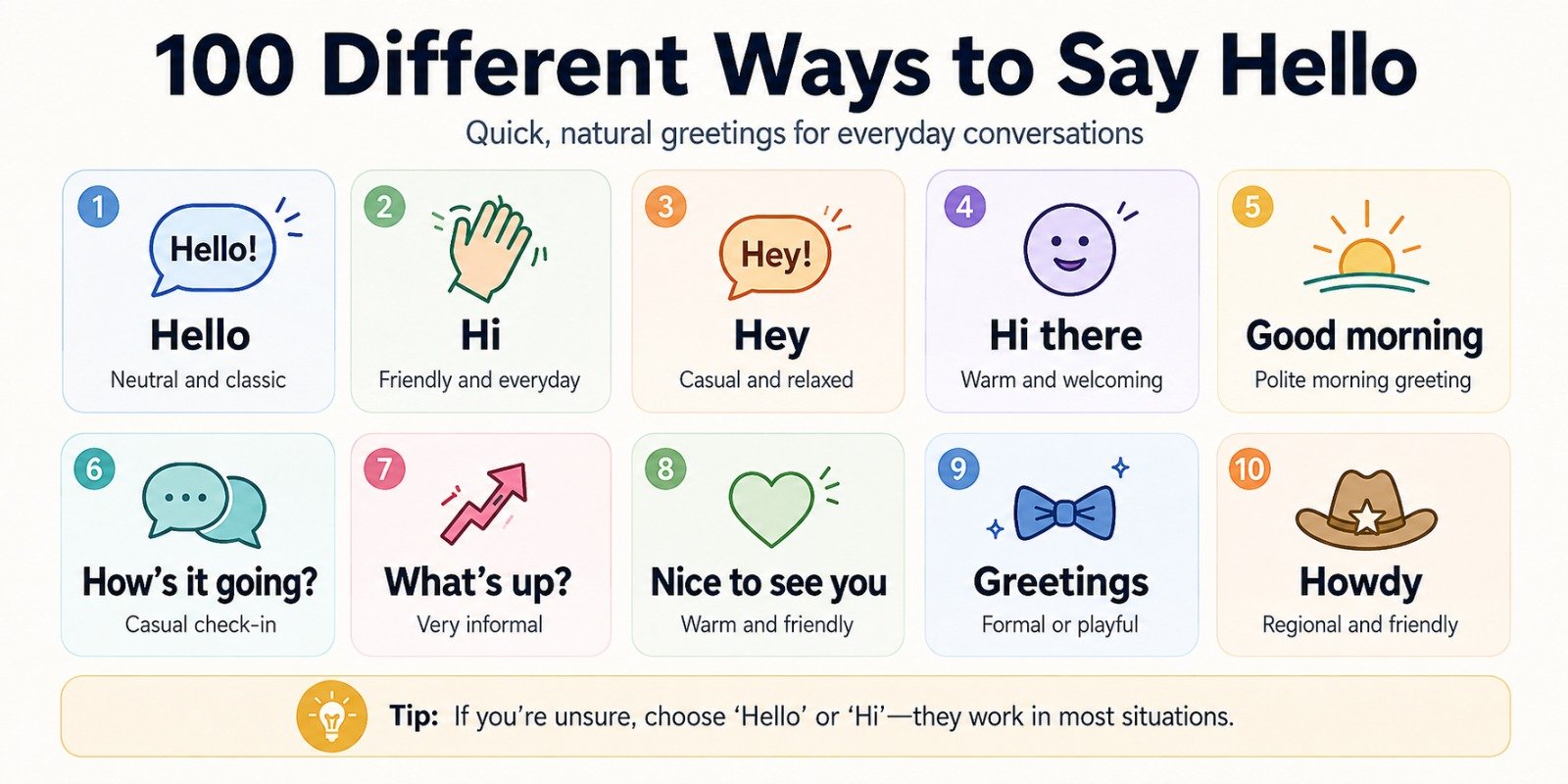
| Greeting | Tone | Best Used For |
|---|---|---|
| Hello | Neutral | Almost any situation |
| Hi | Friendly, neutral | Everyday conversations |
| Hey | Casual | Friends and familiar coworkers |
| Good morning | Polite | Work, school, everyday conversation |
| Hi there | Warm, casual | Friendly conversations |
| How’s it going? | Casual | Friends, classmates, coworkers |
| What’s up? | Very casual | Friends and peers |
| Nice to see you | Warm | Someone you already know |
| Greetings | Formal or playful | Writing or humorous speech |
| Pleased to meet you | Formal | First introductions |
| Howdy | Informal, regional | Relaxed conversation |
| Welcome | Warm | Receiving a visitor or guest |
The safest choices when you aren’t sure about the tone are Hello, Hi, Good morning, Good afternoon, and Good evening.
Also Check | 100 Funny Ways to Say Hello: Silly, Weird and Playful Greetings
Common and Everyday Ways to Say Hello
These greetings are useful when you want something natural without sounding especially formal or unusual.
1. Hello
The classic neutral greeting. It works with strangers, coworkers, neighbors, friends, and almost anyone else.
Example: “Hello, it’s nice to see you.”
2. Hi
Shorter and slightly more relaxed than “hello.” It’s one of the most natural greetings in everyday English.
Example: “Hi, how are you?”
3. Hey
Friendly and informal. Use it with people you already know or in relaxed social settings.
Example: “Hey, how’s your day going?”
4. Hi there
A warmer version of “hi” that sounds welcoming without being overly familiar.
Example: “Hi there! Can I help you?”
5. Hey there
Casual and upbeat, especially when greeting someone you know.
Example: “Hey there! Good to see you.”
6. Hello there
Friendly and slightly more expressive than plain “hello.”
Example: “Hello there! How have you been?”
7. Good morning
A polite greeting typically used earlier in the day.
Example: “Good morning, Sarah.”
8. Morning!
A shortened, casual version of “good morning.”
Example: “Morning! Coffee?”
9. Good afternoon
A polite greeting suitable for the afternoon, especially in professional or customer-facing situations.
Example: “Good afternoon, everyone.”
10. Good evening
A polite greeting used later in the day.
Example: “Good evening. Thanks for joining us.”
11. Good day
More formal or old-fashioned in some varieties of English, although its everyday use varies by region.
12. How are you?
A greeting that also politely asks about the other person.
Example: “Hi, Emma. How are you?”
13. How are you doing?
Friendly and conversational.
Example: “Hey, how are you doing?”
14. How’s it going?
A very natural casual greeting among friends, coworkers, and acquaintances.
Example: “Hi, James. How’s it going?”
15. How have you been?
Best when you haven’t spoken to someone for a while.
Example: “Hey! How have you been?”
16. How are things?
A relaxed way of asking how someone is doing generally.
17. How’s everything?
Warm and conversational, particularly when catching up.
18. What’s new?
Useful when greeting someone you already know and inviting them to share an update.
19. Nice to see you
A warm greeting for someone you’ve met before.
Example: “Hi, Daniel. Nice to see you again.”
20. Good to see you
Slightly warmer and more conversational than “nice to see you.”
Casual Ways to Say Hello
Casual greetings are ideal for friends, classmates, siblings, familiar coworkers, and relaxed social situations.
21. What’s up?
One of the most common informal greetings. It usually doesn’t require a detailed answer.
Example:
“Hey, what’s up?”
“Not much. You?”
22. What’s going on?
A casual greeting, although it can also literally ask what is happening.
23. What’s happening?
Friendly and informal, often used with people you know well.
24. How’s life?
Useful when catching up with someone.
Example: “Hey! How’s life?”
25. How goes it?
A playful variation of “How’s it going?”
26. What have you been up to?
Best when you haven’t spoken to someone recently.
27. How’s your day going?
Natural with coworkers, friends, classmates, or someone you meet during the day.
28. You alright?
An informal greeting in British English. It often functions like “How are you?” rather than suggesting that something is wrong.
29. Alright?
An even shorter informal greeting heard particularly in British English.
30. Hey, you!
Playful and familiar. Use it with someone you already know well.
31. Yo!
Very informal. It suits friends and relaxed conversation, not formal settings.
32. Hiya!
A cheerful, informal greeting used in conversational English.
33. Heyo!
Playful and deliberately casual.
34. Sup?
An extremely informal shortened form of “What’s up?”
35. Hey, man!
Casual and familiar. Whether it feels natural depends on your relationship and speaking style.
36. Hey, buddy!
Friendly, but best used when “buddy” already fits your relationship.
37. Hey, mate!
Common in casual speech in places where “mate” is a natural term of address.
38. What’s good?
Informal slang that works best among friends or peers.
39. What’s poppin’?
Playful slang. It sounds much more casual than a normal “hello.”
40. What’s up with you?
An informal opener, though the tone matters because it can also sound like you are asking what is wrong.
Friendly Ways to Greet Someone You Know
Sometimes you’re not simply saying hello; you’re showing that you’re genuinely pleased to see the person.
41. Great to see you
Warm and positive.
Example: “Hey, it’s great to see you!”
42. So good to see you
More enthusiastic than “good to see you.”
43. Lovely to see you
Warm and polite, especially natural in British English.
44. It’s been a while!
Ideal when you haven’t seen someone recently.
45. Long time no see!
A casual expression for reconnecting after a long gap.
Example: “Long time no see! How have you been?”
46. Hey, stranger!
Playful rather than literal. It works with someone you know but haven’t heard from lately.
47. Look who it is!
Friendly and teasing when someone familiar appears unexpectedly.
48. Well, look who’s here!
Another playful greeting for a familiar person.
49. There you are!
Useful when you’ve been waiting for or looking for someone.
50. Good to have you back
Perfect for someone returning after being away.
Creative Ways to Say Hello
If an ordinary “hi” feels too plain, these creative ways to say hello can add personality. Many are playful openers rather than direct replacements in every situation.
51. Well, hello there!
A slightly theatrical, playful greeting.
52. Hello, sunshine!
Warm and affectionate. Best for someone you know well.
53. Hey, superstar!
Encouraging and playful.
54. Hello, lovely!
Warm and affectionate, but relationship and regional usage matter.
55. Greetings, friend!
A deliberately playful or storybook-style greeting.
56. Fancy seeing you here!
Best when meeting someone unexpectedly.
Example: “Fancy seeing you here! I didn’t know you came to this café.”
57. What a pleasant surprise!
A natural greeting when you’re genuinely surprised and happy to see someone.
58. Well, well, well!
Playful or dramatic. Tone is essential because it can also sound suspicious or sarcastic.
59. Look what the cat dragged in!
A joking greeting for close friends. It can sound insulting if used with someone who doesn’t know you well.
60. Ah, there you are!
Friendly when you’ve been expecting someone.
61. You made it!
A welcoming greeting when someone arrives at an event, gathering, or meeting.
62. Welcome, welcome!
Enthusiastic and inviting.
63. Hello again!
Perfect when you’re speaking to someone for the second time that day or reconnecting after a short break.
64. Well, hey there!
Relaxed, warm, and slightly playful.
65. What brings you here?
This can function as an opener when you unexpectedly meet someone somewhere, but it isn’t a direct synonym for “hello.”
66. Good to see your face!
Informal and warm, especially with friends.
67. What’s cooking?
A playful informal expression. Depending on context, it can mean “What’s happening?” rather than literally asking about food.
68. How’s your world?
An unusual but understandable way to ask how someone has been. It sounds more playful than standard English greetings.
69. Hello, my friend!
Friendly and warm when “my friend” fits naturally.
70. Well, aren’t you a sight for sore eyes!
A warm idiom for someone you’re especially happy to see. It can sound theatrical, so use it with the right audience.
Fancy and Polite Ways to Say Hello
Some situations call for something more polished. These fancy ways to say hello work particularly well for introductions, professional events, formal gatherings, or deliberate stylistic effect.
71. Greetings
Formal-sounding in modern conversational English and sometimes used humorously.
Example: “Greetings, everyone. Thank you for joining us.”
72. Salutations
Much less common in everyday speech. It has a literary, humorous, or deliberately old-fashioned feel.
73. How do you do?
A traditional formal greeting used when meeting someone for the first time. It can sound old-fashioned in modern everyday conversation.
74. Pleased to meet you
A standard polite greeting for a first introduction.
Example: “I’m Daniel. Pleased to meet you.”
75. It’s nice to meet you
Natural, polite, and widely useful.
76. It’s a pleasure to meet you
Slightly more formal and polished.
77. Delighted to meet you
Warm and formal.
78. Happy to meet you
Friendly, though “nice to meet you” is more common in many settings.
79. It’s wonderful to meet you
Warm and enthusiastic.
80. A pleasure to make your acquaintance
Very formal and somewhat old-fashioned. It can be appropriate in intentionally formal settings but would sound unnatural in an ordinary casual introduction.
81. Delighted to make your acquaintance
Even more formal and traditional.
82. Good day to you
Polite but noticeably formal or old-fashioned in some contexts.
83. A very good morning to you
Cheerful and more elaborate than a regular “good morning.”
84. It’s a pleasure to see you
Polished and appropriate when greeting someone you already know.
85. Delighted to see you
Formal but warm.
Stylish and Expressive Ways to Say Hello
These options work when you want your greeting to have a little more personality.
86. Howdy!
A friendly informal greeting strongly associated with American English, particularly the southern and western United States.
87. Howdy, partner!
A playful, exaggerated version of “howdy.”
88. G’day!
A well-known informal Australian greeting.
89. G’day, mate!
Friendly and strongly associated with Australian speech. Avoid forcing it if it isn’t part of your natural dialect.
90. Welcome!
Best when receiving someone rather than simply passing them in conversation.
91. Welcome back!
Perfect when someone returns.
92. Glad you’re here
Warm and welcoming at meetings, gatherings, or events.
93. Nice of you to join us
This can be welcoming, but tone matters. Said sarcastically, it can imply that someone is late.
94. Glad to see you
A simple, warm greeting.
95. What a nice surprise!
Natural when someone arrives unexpectedly.
96. It’s great to connect with you
Useful in professional networking, especially during a first conversation online or at an event.
97. Good to finally meet you
Ideal when you’ve communicated before but are meeting in person for the first time.
Example: “We’ve emailed for months. It’s good to finally meet you.”
98. Nice to meet you in person
Useful after knowing someone online, by phone, or through work correspondence.
99. Great to have you here
Warm and suitable for guests, new team members, speakers, or visitors.
100. Pleasure seeing you again
A polished way to greet someone you’ve met previously.
Not Every Greeting Means Exactly the Same Thing
A useful list of ways to say hello has to do more than replace one word with another.
Consider these differences:
“Hey” vs. “Hello”
“Hey” is more casual. “Hello” is safer when you don’t know the person well.
“What’s up?” vs. “Hello”
“What’s up?” is both a greeting and a conversational question. It usually expects a brief response such as “Not much.”
“Pleased to meet you” vs. “Hello”
“Pleased to meet you” belongs specifically to first introductions. You generally wouldn’t say it every time you see the same person.
“Welcome” vs. “Hello”
“Welcome” acknowledges someone’s arrival. It isn’t appropriate for every ordinary encounter.
“Long time no see” vs. “Hi”
“Long time no see” tells the listener that you haven’t seen them recently. It carries information that “hi” doesn’t.
“Greetings” vs. “Hi”
Both can begin an interaction, but “greetings” sounds noticeably more formal, literary, humorous, or stylized.
That difference in context is why the most interesting greeting isn’t always the best one.
Which Greeting Should You Choose?
A few simple factors can help you decide.
When You Don’t Know the Person Well
Stick with neutral options:
- Hello
- Hi
- Good morning
- Good afternoon
- Good evening
- Nice to meet you
These rarely create the wrong impression.
With Friends
You have much more freedom:
- Hey
- What’s up?
- How’s it going?
- Hey, stranger!
- What’s good?
- Yo!
- Long time no see!
Choose expressions that already match how you and your friends communicate.
At Work
“Hi” and “good morning” work well in most modern workplaces. With clients, senior colleagues, or formal introductions, slightly more polished greetings may be preferable:
- Good morning
- Hello
- It’s nice to meet you
- Pleased to meet you
- It’s great to connect with you
A relaxed workplace may make “Hey” perfectly normal, while a formal environment may call for something more neutral.
When Meeting Someone for the First Time
Use phrases that acknowledge the introduction:
- Nice to meet you
- Pleased to meet you
- It’s a pleasure to meet you
- Delighted to meet you
- Good to finally meet you
“Good to see you,” by contrast, normally suggests that you’ve met before.
When Reconnecting
Try:
- How have you been?
- Long time no see!
- It’s been a while!
- Hey, stranger!
- So good to see you
- What have you been up to?
These naturally open the door to a longer conversation.
Greetings That Can Sound Awkward in the Wrong Situation
Creative language works best when it fits the relationship.
Avoid using extremely casual greetings such as “Sup?”, “Yo!”, or “What’s poppin’?” in formal meetings unless that style is already normal among the people involved.
Likewise, very formal greetings such as “Delighted to make your acquaintance” can feel stiff or theatrical at a casual party.
Be careful with playful lines such as “Look what the cat dragged in!” too. Among close friends, it may be funny. Said to a stranger, coworker, or someone who doesn’t understand the joke, it could sound rude.
Regional greetings also deserve context. “G’day” and “howdy” are natural expressions, but deliberately adopting regional speech that you wouldn’t normally use can sound performative.
The goal is not simply to find the most unusual wording. It’s to find a greeting that sounds believable coming from you.
Frequently Asked Questions
What are some different ways to say hello?
Common alternatives include hi, hey, hi there, good morning, how’s it going?, what’s up?, nice to see you, good to see you, greetings, and howdy. The best option depends on your relationship with the person and the level of formality.
What is another way to say hello casually?
For casual situations, you can say hey, what’s up?, how’s it going?, hiya, yo, what’s new?, or how’s life? “Hey” and “how’s it going?” are especially versatile.
What are some creative ways to say hello?
Try “Well, hello there!”, “Fancy seeing you here!”, “Look who it is!”, “Hello, sunshine!”, “You made it!”, or “What a pleasant surprise!” These work best when the playful tone fits your relationship.
What is a fancy way to say hello?
More polished greetings include “Greetings,” “Pleased to meet you,” “It’s a pleasure to meet you,” “Delighted to see you,” and “A pleasure to make your acquaintance.” The last option is quite formal and may sound old-fashioned in everyday conversation.
What can I say instead of hello in a professional setting?
Use “Good morning,” “Good afternoon,” “Hello,” “Nice to meet you,” “Pleased to meet you,” or “It’s great to connect with you.” “Hi” is also completely normal in many modern workplaces.
Is “hey” rude instead of “hello”?
Not usually. “Hey” is simply more informal. It sounds natural with friends, peers, and familiar coworkers, but “hello” or “good morning” may be better when speaking to someone in a more formal setting.
Is “what’s up?” the same as “hello”?
Not exactly. “What’s up?” can function as a greeting, but it also asks what is happening or how the other person is doing. A brief response such as “Not much” or “All good” is common.
Can I use “greetings” instead of “hello”?
Yes, but it changes the tone. “Greetings” sounds more formal, literary, or deliberately playful than ordinary “hello,” so it isn’t usually the most natural choice for casual everyday conversation.
Finding a Greeting That Sounds Like You
There’s no need to replace “hello” simply for the sake of sounding different. A simple “Hi” can be exactly right, while “Hey, stranger!” may be perfect for an old friend and “Pleased to meet you” may suit a formal introduction.
Think about the person, the situation, and the feeling you want your greeting to create. Once those are clear, choosing among these different ways to say hello becomes much easier. Clarifyra is built around those small but meaningful differences in wording, helping you choose expressions that sound natural for the moment rather than merely different.
Also Read | Cute Ways to Say Good Morning: Sweet, Romantic and Adorable Ideas