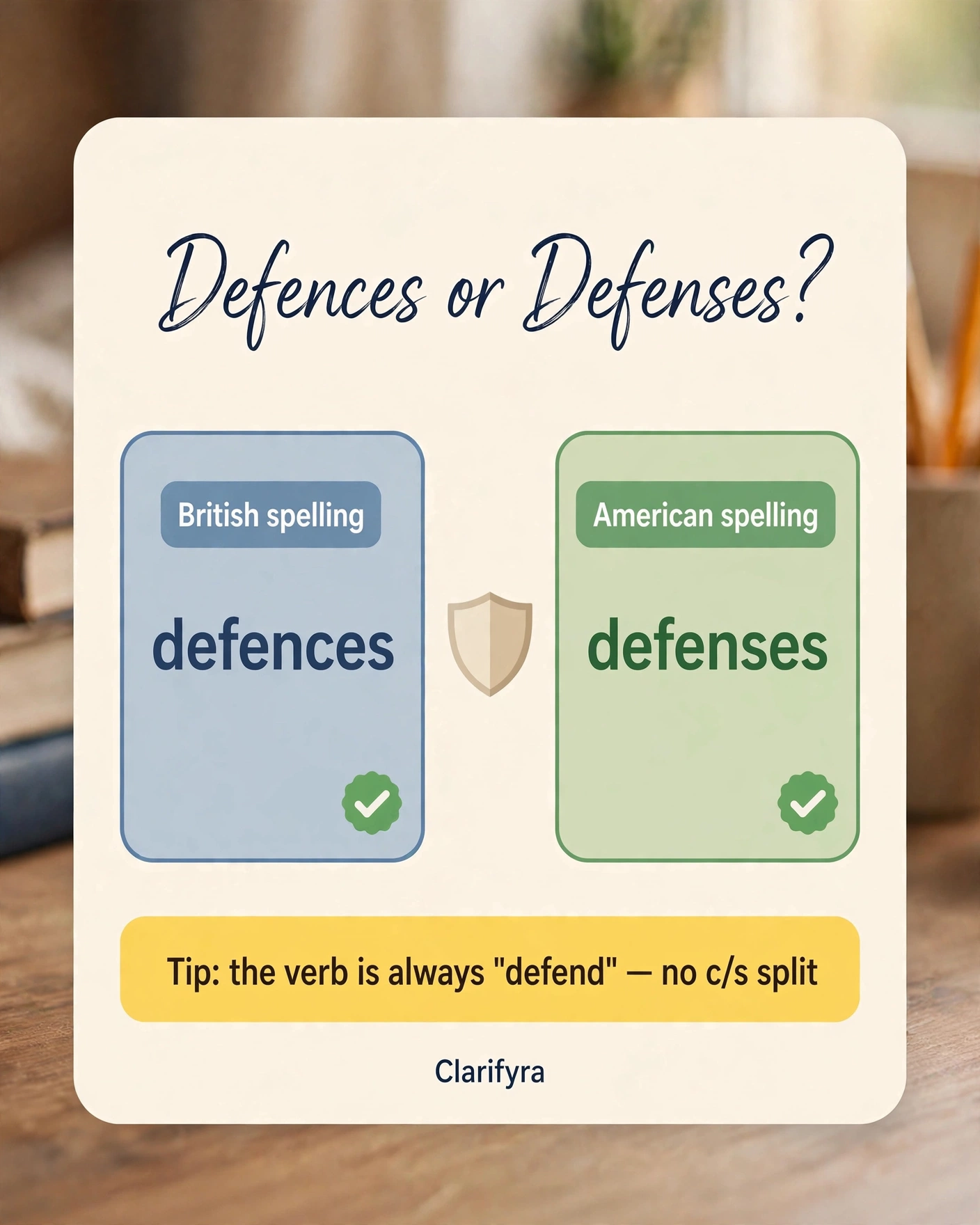
Defences or Defenses: Which Is Correct?
The correct spelling depends on your variety of English: defences is British and defenses is American. Both are fully correct — they are simply the regular plurals of defence (BrE) and defense (AmE). Every major dictionary lists both forms with regional labels: Cambridge gives “defense (UK defence),” Oxford Learner’s notes “(British English defence),” Merriam-Webster calls “defence” the “chiefly British spelling,” and Collins marks “defence” as the British variant throughout.
Quick Answer
Defences (British) and defenses (American) are both correct — the regular plurals of defence and defense respectively. The noun is pronounced /dɪˈfens/ in both varieties; the verb “defend” keeps its d in all forms. Use the spelling your audience expects and stay consistent. The same c/s split runs through the whole word family: offence/offense, licence/license (noun), practice/practise (reversed in British English).
What the Dictionaries Actually Say
- Cambridge: “defense (UK defence)” — defined as “the ability to protect against attack or harm, or something used for this purpose”; verb forms listed as “defended, defending.”
- Oxford Learner’s: “defense … (British English defence)” — with the plural given as “defenses (British English defences).”
- Merriam-Webster: “defence — chiefly British spelling of defense“; plural “defenses.” Merriam-Webster also records the verb defense (“to defend” — as in sports, “to defend against an opponent”), first used in 1900.
- Collins: headword “defence” with the note “in AM, use defense” — and lists the compounds the word anchors: “defence mechanism,” “civil defence,” “the Ministry of Defence.”
The pattern is the familiar one: the singular splits by region (defence/defense), and the plural follows mechanically — add -s to your variety’s singular. There is no separate plural rule to learn.
The -ce/-se Split: A Family Portrait
Defence/defense belongs to a family of nouns where British English uses -ce and American English uses -se. The plurals follow the singular in each variety:
| British | American | Plural (BrE) | Plural (AmE) |
|---|---|---|---|
| defence | defense | defences | defenses |
| offence | offense | offences | offenses |
| licence (noun) | license (noun) | licences | licenses |
| pretence | pretense | pretences | pretenses |
Two complications worth knowing. First, practice/practise reverses the pattern: in British English the noun is “practice” (with c) and the verb “practise” (with s), while American English uses “practice” for both. Second, advise/advice keeps the split in both varieties — “advice” is always the noun, “advise” always the verb, everywhere. The c/s distinction is doing different jobs in different words, which is why each pair deserves its own check rather than a blanket rule.
Pronunciation: Identical on Both Sides
The spelling split is purely visual. Both defences and defenses are pronounced /dɪˈfens/ (“di-FENS”) — the final -ce and -se make the same /s/ sound, and the dictionaries transcribe them identically in British and American English. Stress falls on the second syllable. (The verb defend is a different word — /dɪˈfend/, with a /d/ — and keeps its spelling in all varieties.)
What “Defence/Defense” Means: The Main Senses
1. Protection against attack. The core sense — military, sporting, and general: “missile defences,” “the team’s defenses held firm,” “the body’s defences against infection.” Both varieties use it identically; only the spelling differs.
2. In law: the defendant’s case. “The defence rested its case” (BrE); “The defense called its final witness” (AmE). Note the fixed phrases: the Ministry of Defence (UK) versus the Department of Defense (US) — proper names keep their national spelling even in foreign reporting, so an American paper writing about the UK ministry uses “Defence.”
3. Justification or vindication. “In his defence, he had only minutes to decide” (BrE); “In her defense, the data was incomplete” (AmE). The phrase “in defence/defense of” works the same way.
4. Sports. The players or strategy concerned with preventing the opposition from scoring: “a solid back four in defence” (football, BrE); “the defense forced three turnovers” (American football, AmE). Merriam-Webster’s verb “defense” (1900) belongs here too: “to defense the pick-and-roll” — sports jargon, chiefly American.
Common Mistakes
1. Mixing varieties in one document. ✗ “The Ministry of Defense announced new missile defences.” → ✓ Pick one variety per document: “Ministry of Defence … missile defences” (BrE) or “Department of Defense … missile defenses” (AmE). (Proper names are the exception — see point 4.)
2. Using the singular/plural inconsistently. ✗ “Britain’s defenses include the Trident defence system.” → ✓ “Britain’s defences include the Trident defence system.” The plural is just your singular + s.
3. “Defence” as a verb. ✗ “They defenced the title well.” → ✓ “They defended the title well.” The verb is defend in all varieties — “defence/defense” with a c or s is never a verb form (except Merriam-Webster’s rare sports verb “defense,” which most style guides would still flag).
4. “Correcting” a proper name’s spelling. ✗ Writing “Ministry of Defense” for the UK body or “Department of Defence” for the US one. Proper names keep their official spelling regardless of your document’s variety — the UK has a Ministry of Defence, the US a Department of Defense, full stop.
5. Confusing with “defensive.” The adjective defensive is spelled with an s in both varieties — there is no “defencive.” The c/s split stops at the noun; the adjective is uniform.
How to Remember the Spelling
1. Match your noun. The plural never needs independent thought: take your variety’s singular (defence or defense) and add -s. If the singular is right, the plural is right.
2. The licence parallel. Defence/defense patterns exactly like licence/license (noun): British -ce, American -se. Learn one pair and the other follows.
3. “Defensive” is always -sive. If you’re hesitating over the noun, remember the adjective never varies — defensive with an s on both sides of the Atlantic. The noun is the only form that splits.
Frequently Asked Questions
Is “defences” spelled correctly?
Yes — in British English. Defences is the standard British plural of defence, listed in Cambridge, Oxford Learner’s, and Collins. In American English the standard plural is defenses. Both are correct within their variety.
What’s the plural of “defense”?
Defenses — in American English. (The British spelling of the singular is “defence,” whose plural is “defences.”) Just add -s to your variety’s singular.
Is it “defence” or “defense” in Canada or Australia?
Canada generally follows the American defense; Australia, New Zealand, and the UK use defence. When writing for an international audience, pick one variety and stay consistent.
Why do British and American English spell it differently?
It’s part of the broader -ce/-se noun split (licence/license, offence/offense, pretence/pretense). American spelling standardized on -se for this family; British spelling kept the -ce forms that came through French. The plurals simply follow their singulars.
Can “defense” be a verb?
Merriam-Webster records a rare, chiefly sports verb defense meaning “to defend” (first used 1900) — as in “to defense the pick-and-roll.” It’s jargon, and most style guides would prefer “defend.” In ordinary writing, defend is the verb in all varieties.
Is “defencive” a word?
No. The adjective is defensive with an s in both British and American English. The c/s split applies to the noun only.
Final Takeaway
Defences is British, defenses is American — the regular plural of your variety’s singular, spelled -ce or -se to match. The pronunciation is identical, the meanings are identical, and the adjective defensive never splits. Pick your variety, add -s to the singular, and move on.