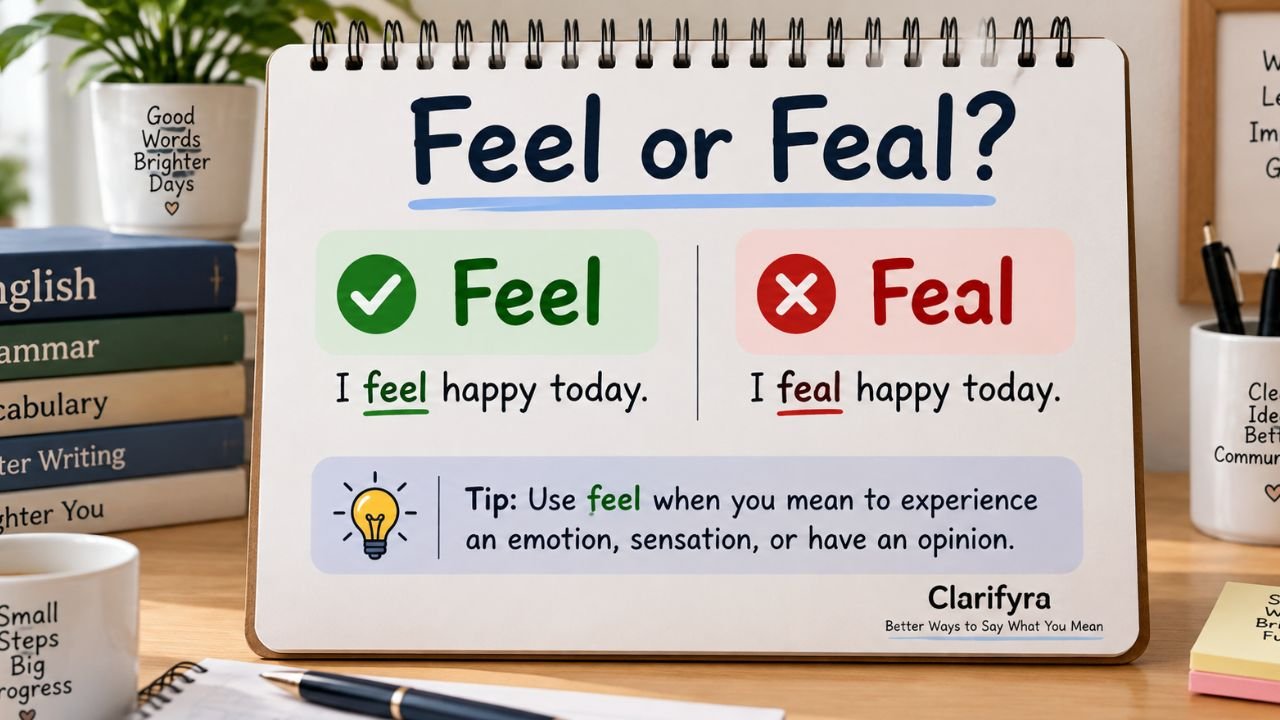
Feel or Feal: Which Spelling Is Correct?
“Feel” and “feal” look and sound similar, so it is easy to wonder whether they are two spellings of the same word. In standard modern English, however, feel is the word you normally need when talking about emotions, physical sensations, touch, opinions, or impressions. Feal is also a real dictionary word, but it is an archaic adjective meaning “faithful” or “loyal,” so it is rarely encountered in contemporary writing.
Feel is the correct spelling for the ordinary modern verb meaning to experience, sense, touch, or have an opinion. Feal is a separate, archaic English word meaning “faithful” or “loyal.” So if you mean “I feel happy” or “Can you feel it?”, always use feel.
Feel or Feal: Which Is Correct?
The answer depends on what you mean, but for almost all ordinary modern English sentences, the correct word is feel.
For example:
- I feel happy today.
- Do you feel better now?
- Can you feel the cold air?
- She feels nervous before exams.
- I feel that we made the right choice.
In each sentence, feel is the appropriate spelling.
Feal, on the other hand, is not a common alternative spelling. Dictionaries record it as an archaic adjective meaning “faithful” or “loyal.” Collins labels it archaic, while Dictionary.com gives the same basic meaning.
Quick comparison
| Feature | Feel | Feal |
|---|---|---|
| Standard modern English? | Yes | Rare/archaic |
| Main grammatical role | Verb; also noun | Adjective |
| Meaning | Experience, sense, touch, have an opinion | Faithful or loyal |
| Everyday use | Very common | Extremely uncommon |
| Example | I feel tired. | An archaic use meaning faithful |
| Use in ordinary writing | Yes | Generally no |
The important point is that feal is not simply a misspelling of feel. It is a genuine but obsolete or highly uncommon word.
What Does “Feel” Mean?
Feel is a common English verb with several related meanings. Cambridge Dictionary lists uses involving physical or emotional experience, opinions, touch, and awareness.
1. To experience an emotion
We use feel when someone experiences an emotional state.
- I feel happy today.
- She felt nervous before the interview.
- They feel excited about the trip.
- He feels disappointed by the result.
Here, the word describes an internal emotional experience.
2. To experience a physical sensation
Feel can also describe a physical condition or sensation.
- I feel cold.
- My legs feel tired.
- She felt a sharp pain in her shoulder.
- The child feels sick.
This is one of the most common uses of the verb.
3. To perceive something through touch
You can also feel something by touching it.
- Feel the fabric before you buy it.
- I could feel the heat from the fire.
- She felt the surface of the table.
- Can you feel how smooth this material is?
Cambridge specifically includes the use of feel for touching something to discover or examine what it is like.
4. To express an opinion
The verb can also mean to have an opinion or attitude about something.
- I feel that we should leave early.
- She feels that the plan needs more work.
- Do you feel strongly about the issue?
- They felt it was the right decision.
This use is particularly common in phrases such as “I feel that…”.
What Does “Feal” Mean?
Feal is a real English word, but its modern use is extremely limited.
Collins Dictionary defines feal as an archaic word for “faithful.” Dictionary.com likewise defines it as an archaic adjective meaning faithful or loyal.
So, unlike a simple spelling mistake, feal has its own dictionary history.
Its meaning is related to ideas such as:
- faithful
- loyal
- devoted
- true
However, contemporary writers would normally use faithful or loyal instead.
For example, rather than trying to use feal in ordinary modern prose, a writer would normally say:
She remained faithful to her principles.
or:
He was a loyal friend.
The word feal may appear in historical, literary, or specialized discussions, but it is not the normal choice for everyday English.
Why Are “Feel” and “Feal” Confused?
The confusion mainly comes from their extremely similar appearance and pronunciation.
Both words contain the same consonants:
F + vowel sound + L
They are also pronounced similarly. Cambridge gives feel the pronunciation /fiːl/, while Collins gives the British pronunciation of feal as /fiːl/.
That means someone who hears the word may not immediately know which spelling is intended.
There is another reason for confusion: feal really does exist in dictionaries. Therefore, simply saying “feal is not a word” would be inaccurate.
The better rule is:
Feel is the normal modern word. Feal is an archaic word with a different meaning.
Feel: Common Grammar Forms
One reason learners sometimes write fealed is that they expect the verb to follow a regular pattern.
But feel is an irregular verb.
Its main forms are:
| Form | Word |
|---|---|
| Base form | feel |
| Third-person singular | feels |
| Past tense | felt |
| Past participle | felt |
| -ing form | feeling |
Cambridge confirms that felt is both the past simple and past participle of feel.
Examples
Present:
I feel much better today.
Third person:
She feels confident about the exam.
Past:
I felt tired yesterday.
Present perfect:
We have felt this way before.
Continuous form:
He is feeling much better now.
Notice that the past form is felt, not fealed.
Feel or Feal Spelling in Everyday Sentences
If you are writing about emotions, sensations, touch, or opinions, choose feel.
Correct
I feel happy when I listen to music.
Does this jacket feel comfortable?
She felt a sudden pain in her arm.
How do you feel about the proposal?
I feel that something is missing.
Incorrect for these meanings
I feal happy when I listen to music. ❌
Does this jacket feal comfortable? ❌
She fealed a sudden pain. ❌
How do you feal about the proposal? ❌
I feal that something is missing. ❌
The correct forms are feel, feels, felt, and feeling.
Is “Feal” a Misspelling?
Not exactly.
If someone writes:
I feal happy.
they are almost certainly intending to write feel, so feal is incorrect in that particular sentence.
But the word feal itself is not meaningless. It is recorded in major dictionaries as an archaic adjective meaning “faithful” or “loyal.”
This distinction is useful:
- “I feal happy.” → Incorrect; it should be “I feel happy.”
- feal as a historical adjective → A real but archaic word.
Therefore, calling feal simply a “misspelling” without qualification can give readers the wrong impression.
Feel vs. Feal: Example Sentences
Here are some practical examples to make the distinction clear.
Use “feel”
I feel much more relaxed after the holiday.
Did you feel the ground shake?
The water feels warm.
She felt nervous before speaking.
I feel that we should reconsider the plan.
He is feeling better today.
All of these use the modern verb feel.
When “feal” may appear
Because feal is archaic, it is unlikely to appear in ordinary modern conversation. You may encounter it when reading older or historical material, where it carries the sense of faithful or loyal.
For modern writing, replacing it with faithful or loyal will normally make the meaning clearer.
An Easy Way to Remember the Correct Spelling
For everyday English, remember:
Feel = experience or sense.
If you are talking about how someone feels, what something feels like, or what someone feels about an idea, use feel.
A simple visual reminder is:
FEEL → FEELING
Both words begin with feel, which makes the relationship easy to remember.
You can also remember the irregular past tense:
feel → felt → felt
Not:
feel → fealed → fealed
Common Mistakes to Avoid
1. Writing “feal” when you mean “feel”
I feal tired. ❌
I feel tired. ✅
2. Using “fealed” as the past tense
Yesterday, I fealed sick. ❌
Yesterday, I felt sick. ✅
The past tense of feel is felt.
3. Assuming “feal” is the British version
It is not. Feel is the standard word in both British and American English. Cambridge lists the verb in both varieties, with the same basic spelling and pronunciation.
4. Assuming “feal” has no meaning at all
Although feal is not the spelling you want in ordinary sentences such as “I feel happy,” it is nevertheless a dictionary word with an archaic meaning.
FAQ
Is it feel or feal?
For normal modern English, feel is correct. Use it when you mean to experience an emotion or sensation, touch something, become aware of something, or have an opinion. Feal is a separate archaic word meaning faithful or loyal.
What is the correct spelling: feel or feal?
Feel is the correct spelling when referring to the common verb. For example, “I feel tired” and “How do you feel?” are correct. Feal should not be substituted for feel in these sentences.
Is “feal” a real English word?
Yes. Dictionaries such as Collins and Dictionary.com record feal as an archaic adjective meaning “faithful” or “loyal.” It is not, however, a normal modern alternative to feel.
What is the past tense of feel?
The past tense of feel is felt. The past participle is also felt. The complete basic pattern is feel → felt → felt.
Is “feal” the British spelling of “feel”?
No. Feel is used in both British and American English. Feal is a separate archaic word rather than a regional spelling variation.
How can I remember whether to use feel or feal?
For everyday English, remember that feel is the verb connected with feeling. If you are talking about an emotion, sensation, touch, or opinion, choose feel.
The Bottom Line
For almost every modern English sentence involving emotions, physical sensations, touch, awareness, or opinions, feel is the correct word. Its forms include feel, feels, felt, and feeling. Feal does exist, but dictionaries classify it as an archaic word meaning “faithful” or “loyal,” so it is not a replacement for feel.
Understanding that small distinction makes the feel or feal question much easier: use feel in normal modern writing, and recognize feal only when you encounter its rare historical usage. For more clear explanations of confusing English words and better ways to say what you mean, Clarifyra provides practical language guidance for everyday writing.